Tim Steinebach, Jurij Wakula, Heiko Diefenbach, Christoph Glock, Eric Grosse (2022). Ergonomic parameters considering physical workload for optimization models in manual order picking. In: Physical Ergonomics and Human Factors. AHFE Open Access, vol. 63, pp. 179–186. https://doi.org/10.54941/ahfe1002611
Order picking is a crucial contributor to corporate success within the value chain of companies. However, due to the high proportion of manual work, there is a risk of employees developing musculoskeletal disorders. In order to reduce this risk, it is vital to take ergonomics in planning concepts for order picking into account. For this purpose, ergonomic parameters are derived for picking from shelves and pallets in this paper on the basis of the EAWS screening method. The results are supported by data on postures and working conditions from practical surveys in four companies. The ergonomic parameters can subsequently be used in optimization models for order picking.
Order picking faces growing challenges. Increasing customer demands, such as enlarged product portfolios and shorter delivery times require efficient warehousing processes (Grosse et al., 2017). Order picking therefore has decisive influence on the company’s success. Due to the complex and var- ying nature of order picking, the degree of automation is still rather low and manual work predominates (Michel, 2017). The numerous manual activities performed by order pickers, such as repeatedly lifting items in awkward postures, or pushing and pulling carts, increases the risk of develo- ping musculoskeletal disorders (Marras et al., 1999). In fact, about 60%, of the disease-related absenteeism of employees in the logistics sector are due to musculoskeletal disorders (Schneider et al., 2010). This underlines the importance to plan and manage order picking systems considering both the system’s efficiency and the occurring physical workloads in a preventive manner (Grosse et al., 2015). To ensure efficient order picking, mathemati- cal optimization is widely used in the literature. Among the most important
optimization problems are planning the warehouse layout (e.g. Diefenbach & Glock, 2019; Calzavara et al., 2017), assigning items to the storage locations (e.g. Steinebach et al., 2021a, Larco et al., 2017), routing the order pickers through the warehouse, and determining order batches.
To formulate suitable mathematical optimization models, ergonomic para- meters are required to quantify the influence of certain manual handling activities on the order pickers’ physical workload. Up to now, the literature has focused primarily on the workers’ energy expenditure for that matter (e.g. Battini et al., 2016; Diefenbach and Glock, 2019). Others, as Larco et al. (2017), only considered the perceived exertion of employees. This paper develops a more sophisticated ergonomic quantification approach applying methods that are not only based on energetic but also on biomechanical and physiological studies, and that take several kinds of physical workload into account (e.g., manual material handling (MMH), static postures and upper limb loads in repetitive tasks). For this purpose, the well-established and well- suited screening method EAWS (Schaub et al., 2013) is proposed. The aim of this paper is to derive ergonomic parameters for the most relevant order picking activities (e.g., picking one-/two-handed from a pallet/a shelf) using EAWS 1.3.6 (www.eaws.it), which can subsequently be used in optimization models.
METHODS
EAWS quantifies workloads along four sections: static postures, action forces, MMH and repetitive loads of the upper limbs. In order picking, MMH is particularly relevant - however, each system must be analyzed individually regarding the other kinds of physical load. In parts-to-picker systems, for example, the upper limbs are subject to high workload due to repetitive acti- vities (Wakula et al., 2021). In the following, we focus on MMH, whose risk factor (here called the “ergonomic parameter”) is calculated as follows: Ergonomic Parameter = (LP + PP + CP) × DP
The Load Points (LP) result directly from the handled load weight accor- ding to EAWS, while the Posture Points (PP) depend on the working posture when the load is picked up or released. The PP depend, for example, on trunk flexion and twisting or the position of the load. The PP are between one and eight points according to EAWS. The Duration Points (DP; frequency of load manipulations) can range from 1 to 15 in EAWS. For our purpose, we set DP = 1 to obtain parameters for individual load manipulations. Otherwise, finding optimal solutions to the corresponding warehouse optimization pro- blems is guaranteed to be intractable, which makes them virtually impossible to be solved optimally in realistic applications due to the very large num- ber of evaluations that would be required. When pulling or pushing loads, additional Condition Points (CP) are also taken into account.
To obtain realistic data regarding the postures and working conditions, ergonomic analyzes were carried out in manually operated warehouses of four large companies in the industrial sector. Twelve different workplaces (with n = 17 subjects) in the picker-to-parts warehouse were analyzed using
Ergonomic Parameters Considering Physical Workload for Optimization Models 181
the IMU motion capture system “Captiv”. The Captiv system was proven to generate valid joint angles to derive working postures with high accuracy in industrial contexts (Steinebach et al., 2020).
The workplaces were differentiated based on whether items were picked from pallets (n = 422 picks) or from shelves (n = 509 picks), and which equi- pment (forklift, pallet truck, handcart) was available to transport the items. Moreover, the observed picking tasks were differentiated by the weight and bulkiness of the items, handling patterns (e.g., one- or two-handed material handling) as well as the height of the lifting tasks’ origins and destinations. Finally, for each combination of characteristics, the observed data was avera- ged and evaluated using EAWS, such that the results apply for the single-time execution of the respective task. The results were summarized in a set of tables that differentiate between the tasks’ characteristics and the workers’ gender. The following focuses on picking from free-standing pallets on the floor as well as picking from shelves with different heights. The ergonomic parameters relating to the pallets are to be understood as mean values for different layers of the pallet depending on the maximum filling height. It is assumed that the items are released at a height of 90 cm, e.g., on a picking cart or a conveyor system.
RESULTS
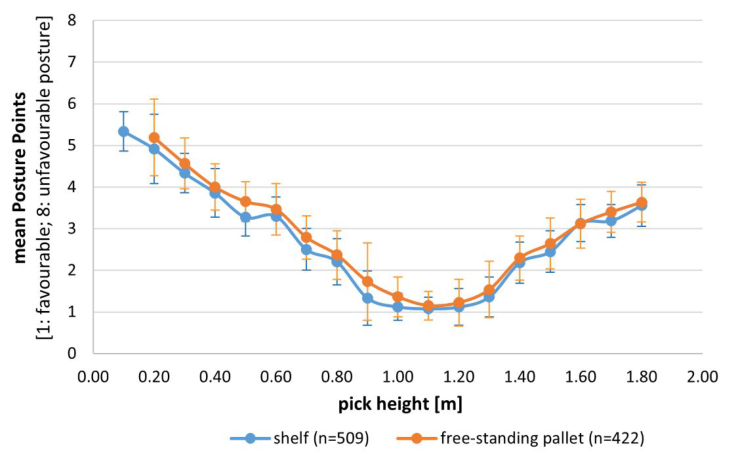
The results of the posture analysis are shown in Figure 1. It indicates the PP as a function of the pick height of the pallet or shelf, respectively. The PP for picking from free-standing pallets are usually slightly higher than those for picking from a rack. The highest values (> 5 PP) result for very low pick heights. As the pick height increases, the PPs reach a minimum in a range between 1.0 and 1.2 m. Higher pick heights lead again to higher PPs due to the overhead work and larger distances of the load from the body. Picking from high pick heights results at a lower level than picking from very low pick heights.
In addition, the final ergonomic parameters for two-handed picking from racks or pallets, respectively, are presented in Tables 1 and 2. The tables distinguish between male and female order pickers and indicate parameters for different load weights (up to 20 kg). Analogous to the PP, the ergonomic parameters are lowest at medium pick heights. As expected, the parameters increase with higher load weights.
DISCUSSION AND CONCLUSION The evaluation of the results shows that the ergonomic parameters depend primarily on the weight of the load and the postures adopted during MMH. This result is in line with the findings from the literature, e.g. Hanson & Medbo (2018), Skals et al. (2021) and Steinebach et al. (2021b).
The slightly higher PP when picking from pallets is due to the fact that the workers, on average, have to lean or bend further to reach the items. The different parameters for various pick heights demonstrate the poten- tial to incorporate ergonomic considerations into optimization models, so
Figure 1: Mean Posture Points across all picking activities from shelves or free-standing pallets for different pick heights (standard deviations given via error bars).
that, for example, storing heavy or frequently required items at locations difficult to reach (and therefore high ergonomic parameters) is avoided. Moreover, the results may help planners to better evaluate the impact of dif- ferent handling and design alternatives, such as technical equipment (lifting aids, height-adjustable carts), warehouse layouts, or routing strategies. By using appropriate optimization methods incorporating ergonomic parame- ters, the costs of appropriate measures can be compared with ergonomic and economic effects.
The ergonomic parameters presented here are an alternative to previously used approaches in optimization models, such as energy expenditure (Bat- tini et al., 2016; Diefenbach & Glock, 2019) or compression forces on the spine (Steinebach et al., 2021b; Glock et al., 2019). The advantage of the developed ergonomic parameters is that not only individual criteria but com- bined biomechanical and physiological criteria as well as different kinds of workload based on EAWS are taken into account. In addition, the parame- ters are available for specific tasks in order picking, such as picking from shelves or pallets, which can be used directly by scientists or practitioners, if item properties, pick heights of the shelf or loading heights of the pallet are known.
It should be noted that the sum of the individual ergonomic parameters is not equivalent to an EAWS risk score. The parameters are only develo- ped to solve ergonomic optimization models according to EAWS. Hence, it is recommended to carry out a risk assessment before and after optimization using the original EAWS method.
The results are subject to limitations, as the tables represent only certain handling patterns. One-handed picking can be considered according to EAWS
Ergonomic Parameters Considering Physical Workload for Optimization Models 183
Table 1. Ergonomic parameters for lifting items from free-standing pallets (pallet on ground with max. loading height of 170 cm; two-handed lifting, non-bulky items).
Table available in the original PDF paper.
by multiplying the actual weight of items by 1.7. In addition, some order picking systems may require parameters where the pallets are not stored free- standing on the floor. Similarly, bulky items or picking depths of over 40 cm when picking from shelves are not considered. The tables shown here are not applicable for such cases and would have to be adjusted. In the future,
Table 2. Ergonomic parameters for lifting items from shelves (storage depth < 40 cm; two-handed lifting, non-bulky items).
Table available in the original PDF paper.
the development of ergonomic parameters for other kinds of physical load is promising. In particular, pulling or pushing of loads occurs regularly in order picking, e.g., pushing a picking cart. Depending on the system, upper limb loads due to repetitive tasks can also be relevant. This must be analyzed before evaluating or optimizing certain workplaces.
Ergonomic Parameters Considering Physical Workload for Optimization Models 185
ACKNOWLEDGMENT
The authors would like to thank the four industrial partners of the project- accompanying committee for their willingness to carry out the studies at their workplaces. The IGF research project No.: 21292 N/2 “Integration of eco- nomic and ergonomic parameters in holistic planning concepts of manual warehousing processes” is funded by AiF Research Association and the Fede- ral Budget 2020 of the Federal Ministry of Economic Affairs and Energy due to a decision of the German Bundestag.
REFERENCES
Battini, D., Glock, C. H., Grosse, E. H., Persona, A., & Sgarbossa, F. (2016). Human energy expenditure in order picking storage assignment: A bi-objective method. Computers & Industrial Engineering, 94, 147–157. Calzavara, M., Glock, C. H., Grosse, E. H., Persona, A., & Sgarbossa, F. (2017).
Analysis of economic and ergonomic performance measures of different rack layouts in an order picking warehouse. Computers & Industrial Engineering, 111, 527–536. Diefenbach, H., & Glock, C. H. (2019). Ergonomic and economic optimization of layout and item assignment of a U-shaped order picking zone. Computers & Industrial Engineering, 138, 106094. Glock, C. H., Grosse, E. H., Abedinnia, H., & Emde, S. (2019). An integrated model
to improve ergonomic and economic performance in order picking by rotating pallets. European Journal of Operational Research, 273(2), 516–534. Grosse, E. H., Glock, C. H., Jaber, M. Y., & Neumann, W. P. (2015). Incorporating human factors in order picking planning models: framework and research opportunities. International Journal of Production Research, 53(3), 695–717. Grosse, E. H., Glock, C. H., & Neumann, W. P. (2017). Human factors in order
picking: a content analysis of the literature. International Journal of Production Research, 55(5), 1260–1276. Hanson, R., Medbo, L., Assaf, M., & Jukic, P. (2018). Time efficiency and physical workload in manual picking from large containers. International Journal of Production Research, 56(3), 1109–1117. Larco, J. A., De Koster, R., Roodbergen, K. J., & Dul, J. (2017). Managing warehouse
efficiency and worker discomfort through enhanced storage assignment decisions. International Journal of Production Research, 55(21), 6407–6422. Marras, W. S., Granata, K. P., Davis, K. G., Allread, W. G., & Jorgensen, M. J.
(1999). Effects of box features on spine loading during warehouse order selecting. Ergonomics, 42(7), 980–996. Michel, R. (2017). 2017 Warehouse/DC Operations Survey. In the thick of ecommerce adjustments. Logistics Management, 56 (11), 52–58. Schaub, K., Caragnano, G., Britzke, B., & Bruder, R. (2013). The European assembly
worksheet. Theoretical Issues in Ergonomics Science, 14(6), 616–639. Schneider, E., Irastorza, X., & Copsey, S. (2010). OSH in figures: work-related musculoskeletal disorders in the EU - facts and figures. European Agency for Safety and Health at Work, Luxembourg. Skals, S., Bláfoss, R., Andersen, L. L., Andersen, M. S., & de Zee, M. (2021). Manual
material handling in the supermarket sector. Part 2: Knee, spine and shoulder joint reaction forces. Applied Ergonomics, 92, 103345.
Steinebach, T., Grosse, E. H., Glock, C. H., Wakula, J., & Lunin, A. (2020). Accuracy evaluation of two markerless motion capture systems for measurement of upper extremities: Kinect V2 and Captiv. Human Factors and Ergonomics in Manufacturing & Service Industries, 30(4), 291–302. Steinebach, T., Wakula, J., & Mehmedovic, A. (2021a). The Influence of an Ergono-
mic Storage Location Assignment on Human Strain in Manual Order Picking. In Congress of the International Ergonomics Association, 511–521. Springer, Cham. Steinebach, T., Wakula, J., Bruder, R., & Paulke, M. (2021b). Entwicklung einer ergonomischen Lagerplatzvergabe in der manuellen Person-zur-Ware Kommissio- nierung. Zeitschrift für Arbeitswissenschaft, 75(3), 296–310. Wakula, J., Steinebach, T., Klaer, V., Rabenhaupt, W., & Maier, G. (2021). Analysis
of the Physical Workload and Ergonomic Design of Workstations for “Goods-to- Person” Order Picking. In Congress of the International Ergonomics Association, 522–529. Springer, Cham.
LISTED IN THE AHFE DIGITAL BOOKSTORE CATALOGUE
Explore the complete digital volume
Physical Ergonomics and Human Factors
Read this individual research paper free through the original publisher, or explore the full digital proceedings book.
ISBN 978-1-958651-39-1
Explore this ISBN in the AHFE Bookstore ↗Listed in the July 2026 bookstore catalogue; search by ISBN to confirm current availability · Digital book purchase optional