Cesar Corrales, Jonatan Rojas, Wilmer Atoche (2022). Anxiety level among industrial engineering students in virtual learning. In: Physical Ergonomics and Human Factors. AHFE Open Access, vol. 63, pp. 79–86. https://doi.org/10.54941/ahfe1002599
Stress is one of the most important psychosocial risks and it can produce, among other things, different degrees of anxiety, in work life, in studies or in any field of activities carried out by human beings. Anxiety is a state of mind and a physiological response of the person when facing a situation that causes anguish, fear and mental and emotional blockage. Among young university students, this occurs to a greater or lesser degree and is often not diagnosed or evaluated in its true magnitude. The Covid 19 pandemic has generated a radical change in the teaching modality that has gone to a virtual learning, which has aggravated the usual anxiety levels in students. The aim of this study was to examine the anxiety level of industrial engineering students of different academic levels, in this pandemic environment, to help them cope with this problem. To do this, a study sample was taken and an evaluation instrument was applied that allowed these levels to be established. Relationships were established with the number of credits taken on average and the study cycle of the students in the sample. The results show significant information that can help academic leaders and students themselves to take measures that help improve their anxiety levels.
Coronaviruses are a large family of viruses that are known to cause a wide range of illnesses, from the common cold to more serious illnesses such as Middle East Respiratory Syndrome (MERS) and severe acute respiratory syndrome (SARS). The COVID-19 pandemic is a public emergency of inter- national concern that affects several nations and has brought not only the risk of death from infection, but also great psychological pressure (Aylie, Meko- nen, & Mekuria, 2020; Cao et al., 2020). The effective management of the global pandemic caused by the Severe Acute Respiratory Syndrome Corona- virus 2 (also known as COVID-19), resulted in the implementation of severe restrictions on movement and the application of social distancing measures, but a high commitment to measures of precaution could act as a potenti- ator for depression, which could lead to an increase in anxiety symptoms (Solomou & Constantinidou, 2020). Due to the spread of COVID-19 on a global scale, most efforts at the national and international levels were directed at mitigating the spread of the disease and its physical damage, paying less attention to the psychological impacts and its impact on life. global mental health, especially in the early stages of the pandemic (Al-Tammemi, Akour,
& Alfalah, 2020). The WHO and public health authorities around the world are acting to contain the outbreak of COVID-19, however, this moment of crisis is generating stress throughout the population (WHO). In particular, young adults have experienced a number of consequences related to the pan- demic, such as university closures, transition to remote work, and loss of income, which can contribute to poor mental health. During the pandemic, anxiety, depression, sleep disturbances, and suicidal thoughts have increa- sed for many young adults, with a higher-than-average proportion of young adults (ages 18-24) reporting symptoms of anxiety and/or depressive disor- der (56%) (Panchal et al., 2020). Although much of the attention is focused on the health sector, other sectors such as education have also experienced profound transformations and impacts (Prado-Gascó, Gómez-Domínguez, Soto-Rubio, Díaz-Rodríguez, & Navarro-Mateu, 2020). In this sense, the COVID-19 pandemic has had an unprecedented impact on the psychological health of university students, a population vulnerable to distress and mental health disorders (Sun, Goldberg, Lin, Qiao, & Operario, 2021). In Bangla- desh, about 97% of college students are deeply anxious due to the current epidemic (Dhar, Ayittey, & Sarkar, 2020).
Anxiety is characterized by feelings of tension, apprehension or fear, it ari- ses from concern about the performance of students at the university, with an emphasis on exact science subjects being a predominant factor in the per- formance of students at all levels and this problem has increased during the COVID-19 pandemic (Mendoza, Cejas, Rivas, & Varguillas, 2021). Having a family member or acquaintance infected with COVID-19, economic factors, effects on daily life, and academic delays were associated with Chinese college students’ level of anxiety symptoms during the epidemic, while social support was negatively correlated with their anxiety, in this way the mental health of university students is significantly affected by public health emergencies, and they require attention, help and support from society, families and educati- onal institutions (Cao et al., 2020). Likewise, social isolation, concern for personal health and the health of family and friends, and uncertainty about academic progress generated by the COVID-19 pandemic have a great psych- ological impact on students (Romeo, Benfante, Castelli, & Di Tella, 2021). Isolation in social networks, lack of interaction and emotional support, and physical isolation were associated with negative mental health trajectories for students, and in this sense Female students appeared to have worse mental health trajectories (Elmer, Mepham, & Stadtfeld, 2020).
The prevalence of symptoms of depression, anxiety and stress in univer- sity students surveyed in a Brazilian study was considered high and worrying, mainly because the pandemic crisis. The data suggest that higher levels of sati- sfaction with life and dimensions of psychological well-being, as well as the use of adequate coping strategies, including educational actions, may con- stitute favorable factors in university students in relation to symptoms of depression, anxiety and stress (Lopes & Nihei, 2021). It is important to consi- der that some students better manage the dramatic changes they experienced, such as health professions students, younger students and students with more resources, so educational and public health institutions must take these parti- cularities into account, even more so, taking into account that the pandemic
Anxiety Level Among Industrial Engineering Students in Virtual Learning 81
may impact higher education much longer after the outbreak has finally been brought under control (Dratva et al., 2020). In that sense, policymakers and mental health care providers are recommended to provide continuous moni- toring of the psychological consequences of the pandemic by providing the required health support (Alyami, Naser, Dahmash, Alyami, & Alyami, 2021).
Based on the above, the objective of this work is to identify the anxiety levels of engineering students at a Peruvian university in order to formulate measures to counteract this situation.
METHODOLOGY
Beck Anxiety Inventory (BAI) The Beck Anxiety Inventory is a useful tool to assess somatic symptoms of anxiety, both in anxiety disorders and depressive symptoms. The question- naire consists of 21 questions, providing a score range between 0 and 63. The suggested cut-off points to interpret the obtained result are the following:
00–21 - Very low anxiety
22–35 - Moderate anxiety
over 36 - severe anxiety Each item is scored from 0 to 3, with 0 corresponding to “not at all”, 1 to “slightly, it does not bother me much”, 2 to “moderately, it was very unpleasant but I could bear it” and 3 to “severely, I almost couldn’t take it.” The total score is the sum of all the items. The symptoms refer to the last week and the current moment.
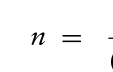
Population Data and Determination of the Number of Samples This research is developed in a Peruvian university, specifically in industrial engineering students belonging to the Faculty of Science and Engineering between the fifth and tenth academic semester. In addition, the study was conducted during the period from March to December 2021. The current population of students in the case study is about 1500. From this total, a sample was developed that yielded a sample size of 91 students (n = 90,314). However, for security reasons in the dispersion of the data, an additional sample of 10% was taken, obtaining a total of 100 students to take the survey (n = 99.41). To calculate the sample, the statistical formula described in equation (1) was applied.
Z1−α
2 2Nσ 2
Equation reproduced from the original PDF.
2 2σ 2 (1)
Where: n = Number of students needed. σ = Standard deviation (5 students). N = Total of Industrial Engineering students (1500 students). Z = Confidence level 95% = 1.959963 (95% + α
2). E = Permissible error (1 student).
Once the sample was defined, the survey was applied virtually through the following link: https://forms.gle/b5HLcAKKSP4cDsMj7.
Table 1. Beck anxiety inventory (BAI). [Beck, A. T., & Steer, R. A.].
Table available in the original PDF paper.
Description None (0) Low (1) Moderate (2) Severe (3)
1. Clumsy or numb 2. Overheated 3. With trembling in the legs 4. Unable to relax 5. Fearful that the worst will happen 6. Dizzy, or going out of your mind 7. With a strong and rapid heartbeat 8. Unstable 9. Frightened or frightened 10. Nervous 11. Feeling blocked 12. With trembling hands 13. Restless, insecure 14. Afraid of losing control 15. With a feeling of suffocation 16. With fear of dying 17. With fear 18. With digestive problems 19. With fainting 20. With facial flushing 21. With sweating, hot or cold
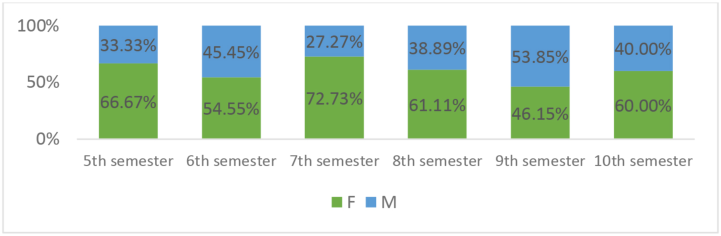
Figure 1: Gender by academic semester.
RESULTS
To determine the level of anxiety, the survey the Beck Anxiety Inventory (Beck, A. T., & Steer, R. A.) was conducted to industrial engineering stu- dents during the 2021 semester. He presents that 61% of the respondents are women and 39% are men. Figure 1 shows the characterization by gender and by academic semester.
Table 2 details the behavioral characterization of each measurement vari- able, which is evaluated with scores from 0 to 3, with 0 corresponding to “None”, 1 to “slightly, it does not bother me much”, 2 to “moderately, it
Anxiety Level Among Industrial Engineering Students in Virtual Learning 83
Table 2. Characterization of anxiety variables in the beck anxiety inventory (BAI).
Table available in the original PDF paper.
Description None (0) Low (1) Moderate (2) Severe (3)
1. Clumsy or numb 20.00% 39.00% 29.00% 12.00% 2. Overheated 17.00% 38.00% 34.00% 11.00% 3. With trembling in the legs 45.00% 33.00% 15.00% 7.00% 4. Unable to relax 9.00% 23.00% 44.00% 24.00% 5. Fearful that the worst will happen 15.00% 22.00% 31.00% 32.00% 6. Dizzy, or going out of your mind 21.00% 39.00% 30.00% 10.00% 7. With a strong and rapid heartbeat 42.00% 22.00% 25.00% 11.00% 8. Unstable 23.00% 28.00% 28.00% 21.00% 9. Frightened or frightened 21.00% 41.00% 22.00% 16.00% 10. Nervous 6.00% 31.00% 37.00% 26.00% 11. Feeling blocked 12.00% 41.00% 22.00% 25.00% 12. With trembling hands 51.00% 28.00% 11.00% 10.00% 13. Restless, insecure 11.00% 33.00% 32.00% 24.00% 14. Afraid of losing control 30.00% 32.00% 20.00% 18.00% 15. With a feeling of suffocation 56.00% 23.00% 12.00% 9.00% 16. With fear of dying 75.00% 15.00% 5.00% 5.00% 17. With fear 21.00% 38.00% 28.00% 13.00% 18. With digestive problems 38.00% 23.00% 21.00% 18.00% 19. With fainting 80.00% 11.00% 6.00% 3.00% 20. With facial flushing 45.00% 36.00% 11.00% 8.00% 21. With sweating, hot or cold 36.00% 35.00% 20.00% 9.00%
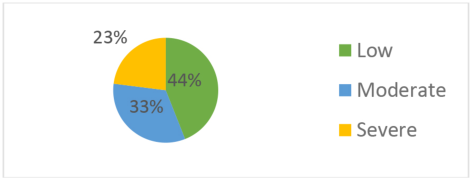
Figure 2: Anxiety level.
was very unpleasant, but I could stand it” and score 3 to “severely, it is unbe- arable”. Table 2 expresses the pro-portion of the sample with respect to each attribute.
In the analysis it was determined that 44% of the students in the analysis presented a low level of anxiety, 33% presented a moderate level, and 23% presented a severe level (see Figure 2). These data are disturbing, given that about 56% of the sample presented a considerable level of anxiety.
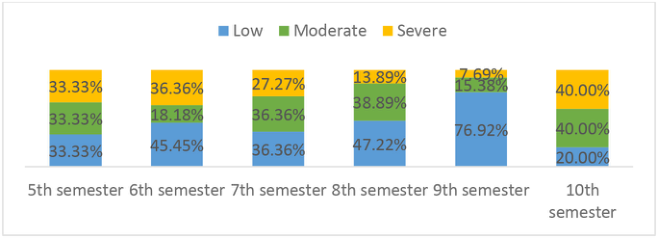
Figure 3 shows the distribution of anxiety levels in students by academic semester, where it can be observed that in the fifth and tenth semesters the highest levels of anxiety are found, with 80% of students having medium and high levels of anxiety. The causes may be that the fifth-semester students have a transition period, beginning their specialty studies, with a very heavy academic load, and the tenth-semester students mostly work and study.
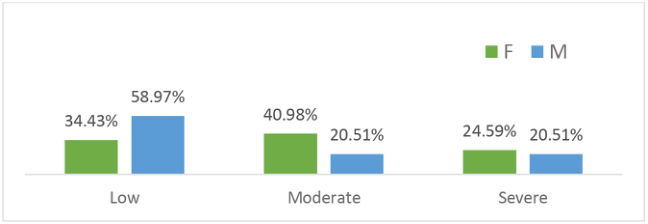
Figure 3: Anxiety per semester.Figure 4: Anxiety level by gender.
Figure 4 shows the level of anxiety classified by gender. It can be seen that in the low anxiety level, the proportion of male students is close to double that of female students. Likewise, at the moderate level, we observe an opposite trend, where the proportion of women is twice as high as that of men.
Finally, in Table 3 a multivariate score was calculated for each of the cha- racteristics, which allowed us to determine the most significant variables in the level of anxiety, which are: Unable to relax, Nervous, Fearful that the worst will happen, Restless, insecure, Feeling blocked.
CONCLUSION
The levels of anxiety obtained from the study: 44% are low, 33% are moderate and 23% are severe. The most severe levels of anxiety occur in students of the fifth semester and tenth semester, this is basically due to the change in academic level in the fifth semester and the proximity to graduating in the tenth semester.
There is no significant difference between male or female students in severe anxiety levels and there are more incidences of moderate anxiety levels in female students than male students.
It is necessary to generate among students security in the future by provi- ding reliable information about the current situation, providing support to listen and help in difficulties with this different teaching modality and acti- vities must be developed among students, until returning to face-to-face teaching.
Anxiety Level Among Industrial Engineering Students in Virtual Learning 85
Table 3. Impact of indicators.
Table available in the original PDF paper.
Description None (0) Low (1) Moderate (2) Severe (3) Score Unable to relax 0.09 0.23 0.44 0.24 1.83 Nervous 0.06 0.31 0.37 0.26 1.83 Fearful that the worst will happen 0.15 0.22 0.31 0.32 1.80 Restless, insecure 0.11 0.33 0.32 0.24 1.69 Feeling blocked 0.12 0.41 0.22 0.25 1.60 Unstable 0.23 0.28 0.28 0.21 1.47 Overheated 0.17 0.38 0.34 0.11 1.39 Clumsy or numb 0.2 0.39 0.29 0.12 1.33 Frightened or frightened 0.21 0.41 0.22 0.16 1.33 With fear 0.21 0.38 0.28 0.13 1.33 Dizzy, or going out of your mind 0.21 0.39 0.3 0.1 1.29 Afraid of losing control 0.3 0.32 0.2 0.18 1.26 With digestive problems 0.38 0.23 0.21 0.18 1.19 With a strong and rapid heartbeat 0.42 0.22 0.25 0.11 1.05 With sweating, hot or cold 0.36 0.35 0.2 0.09 1.02 With trembling in the legs 0.45 0.33 0.15 0.07 0.84 With facial flushing 0.45 0.36 0.11 0.08 0.82 With trembling hands 0.51 0.28 0.11 0.1 0.80 With a feeling of suffocation 0.56 0.23 0.12 0.09 0.74 With fear of dying 0.75 0.15 0.05 0.05 0.40 With fainting 0.8 0.11 0.06 0.03 0.32
REFERENCES
Al-Tammemi, A. B., Akour, A., & Alfalah, L. (2020). Is It Just About Physical Health?
An Online Cross-Sectional Study Exploring the Psychological Distress Among University Students in Jordan in the Midst of COVID-19 Pandemic. Frontiers in Psychology, 11. https://doi.org/10.3389/fpsyg.2020.562213 Alyami, H. S., Naser, A. Y., Dahmash, E. Z., Alyami, M. H., & Alyami, M. S. (n.d.).
Depression and anxiety during the COVID-19 pandemic in Saudi Arabia: a cross- sectional study. https://doi.org/10.1101/2020.05.09.20096677v1 Aylie, N. S., Mekonen, M. A., & Mekuria, R. M. (2020). The psychological impacts of COVID-19 pandemic among university students in bench-sheko zone, South- West Ethiopia: A community-based cross-sectional study. Psychology Research and Behavior Management, 13, 813–821. Beck, A. T., & Steer, R. A. Manual for the Beck Anxiety Inventory. San Antonio, TX:
Psychological Corporation. (1990). Cao, W., Fang, Z., Hou, G., Han, M., Xu, X., Dong, J., & Zheng, J. (2020). The psychological impact of the COVID-19 epidemic on college students in China. Psychiatry Research, 287. https://doi.org/10.1016/j.psychres.2020.112934 Dhar, B. K., Ayittey, F. K., & Sarkar, S. M. (2020). Impact of COVID-19 on
Psychology among the University Students. Global Challenges, 4(11), 2000038. https://doi.org/10.1002/gch2.202000038 Dratva, J., Zysset, A., Schlatter, N., von Wyl, A., Huber, M., & Volken, T. (2020).
Swiss university students’ risk perception and general anxiety during the covid-19 pandemic. International Journal of Environmental Research and Public Health, 17(20), 1–11. https://doi.org/10.3390/ijerph17207433
Elmer, T., Mepham, K., & Stadtfeld, C. (2020). Students under lockdown: Comparisons of students’ social networks and mental health before and during the COVID-19 crisis in Switzerland. PLoS ONE, 15(7 July), 1–22. https://doi.org/10.1371/journal.pone.0236337 Lopes, A. R., & Nihei, O. K. (2021). Depression, anxiety and stress symptoms in
Brazilian university students during the COVID-19 pandemic: Predictors and asso- ciation with life satisfaction, psychological well-being and coping strategies. PLoS ONE, 16(10 October). https://doi.org/10.1371/journal.pone.0258493 Mendoza, D., Cejas, M., Rivas, G., & Varguillas, C. (2021). Anxiety as a prevailing factor of performance of university mathematics students during the covid-19 pandemic. Obrazovanie i Nauka, 23(2), 94–113. https://doi.org/10.17853/1994- 5639-2021-2-94-113 Panchal, N., Kamal, R., Cox, C. & Garfield, R. (2020). The implications of COVID-
19 for mental health and substance use. Kaiser Family Foundation, 1–16.7 Prado-Gascó, V., Gómez-Domínguez, M. T., Soto-Rubio, A., Díaz-Rodríguez, L., & Navarro-Mateu, D. (2020). Stay at Home and Teach: A Comparative Study of Psychosocial Risks Between Spain and Mexico During the Pandemic. Frontiers in Psychology, 11. https://doi.org/10.3389/fpsyg.2020.566900 Romeo, A., Benfante, A., Castelli, L., & Di Tella, M. (2021). Psychological distress
among italian university students compared to general workers during the covid- 19 pandemic. International Journal of Environmental Research and Public Health, 18(5), 1–9. https://doi.org/10.3390/ijerph18052503 Solomou, I., & Constantinidou, F. (2020). Prevalence and predictors of anxiety and depression symptoms during the COVID-19 pandemic and compliance with precautionary measures: Age and sex matter. Internatio- nal Journal of Environmental Research and Public Health, 17(14), 1–19. https://doi.org/10.3390/ijerph17144924 Sun, S., Goldberg, S. B., Lin, D., Qiao, S., & Operario, D. (2021). Psychiatric symptoms, risk, and protective factors among university students in quarantine during the COVID-19 pandemic in China. Globalization and Health, 17(1).
LISTED IN THE AHFE DIGITAL BOOKSTORE CATALOGUE
Explore the complete digital volume
Physical Ergonomics and Human Factors
Read this individual research paper free through the original publisher, or explore the full digital proceedings book.
ISBN 978-1-958651-39-1
Explore this ISBN in the AHFE Bookstore ↗Listed in the July 2026 bookstore catalogue; search by ISBN to confirm current availability · Digital book purchase optional