Akio Murakami, Percy Mesias, Wilmer Atoche, Jorge Wam (2022). Impact of remote work on ergonomic risk in Peruvian companies during COVID-19. In: Physical Ergonomics and Human Factors. AHFE Open Access, vol. 63, pp. 160–169. https://doi.org/10.54941/ahfe1002609
The COVID-19 pandemic has forced to most organizations to implement remote work as a viable option to continue working. Worldwide this is the normal current situation, and Peru has not been the exception to this issue. However, the lack of adequate readiness to manage this working modality has resulted in the appearance of musculoskeletal discomfort. The prevalence and severity of this health condition increase as more time has passed since the onset of this situation. This readiness includes both, having adequate space and furniture at home, as well as having healthy posture and habits.In this study we will analyze the impact that remote work has had on people's ergonomics and how different factors influence it. We will also present some proposed actions to adapt the remote workplace to reduce the incidence on this health condition, under de understanding that this situation will continue as part of the new normal for most organizations.
All around the world, as a result of the COVID-19 pandemic that we are experiencing, a high percentage of workers in most companies have begun to carry out Telework, Home Office or Remote Work. Therefore, Remote Work has become a viable option to continue working. However, this abrupt change without prior readiness, has made us suddenly accommodate “as we can and where we can at home”, without being able to comply with the precise recommendations that are required to maintain Occupational Safety, Health and Ergonomics.
Therefore, the workspace must be adapted to carry this process as heal- thy as possible and initiate the necessary adaptation that will be requi- red in the future to continue developing Remote Work, which is envisi- oned as the future of Labor Activity as manifested by 70% of compa- nies that have decided that they will keep remote work in some format (Marsh Peru, 2020).
Impact of Remote Work on Ergonomic Risk in Peruvian Companies During COVID-19 161
STATE OF THE ART There has been some research on the impact of remote work as a result of lockdown resulting from the COVID-19 pandemic. When conducting the search in Scopus, it was possible to identify research on the comprehensive impact of quarantines on various aspects of daily and work life.
According to a study carried out (Tiago, Kawasaki, Bolis, and Morioka, 2021), the impact of the Covid 19 pandemic in the workplace has been analy- zed, identifying that most of these works address the impact on the first line of professionals in medical care. Therefore, we find evidence of the lack of diagnostics in other industrial sectors that adopted the modality of remote work and the impact on musculoskeletal and mental health.
A study carried out in Ecuador (Larrea-Araujo, Ayala-Granja, Vinueza-Cabezas and Acosta-Vargas, 2021) analyzes the new normal and work from confinement, the remote working conditions that had to be impro- vised in the face of the health emergency and how these affect ergonomic risk, mainly in disorders musculoskeletal and visual impairment, when working long hours in front of a computer monitor. Psychosocial risk is also menti- oned, which due to the extension of its analysis is recommended to treat in another study, however the interrelation with ergonomic risk is specified in a comprehensive manner.
Taking into account the material collected, it can be seen that the research carried out are mostly focused on analyzing the conditions of remote work in a specific environment and for front-line workers handling the Covid 19 pandemic.
METHODOLOGY
If during Remote Work we don’t consider a minimum of basic conditions, in a short term we could present musculoskeletal or sensory annoyances.
The project was the implementation of the Occupational Ergonomic Dia- gnosis in order to check if the workers have musculoskeletal discomfort and know the design of the workplace and furniture they have, as a support to the Occupational Health and Safety Management System and compliance with the Occupational Health and Safety regulations in Peru (RM 375-2008 TR, 2008)
Hypothesis a. Workers who perform Remote Work without Ergonomics recommenda- tions, will have musculoskeletal discomfort. b. Workers who spend more time sitting, for 02 hours or more in a row, have more musculoskeletal discomfort. c. Workers who do not adapt the screen to eye level, have musculoskeletal discomfort in the neck. d. Workers who do not use the back of the chair or do not have incorporated some element to give rest to this area of the back, have musculoskeletal discomfort in the lower back (lumbar area).
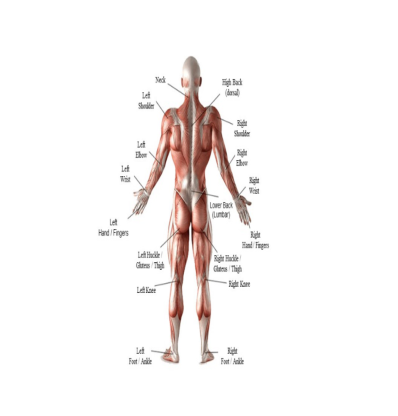
Figure 1: Model to indicate musculoskeletal complaints for the Nordic kuorinka questionnaire.
Ergonomic Diagnostics for Remote Work The Ergonomic Diagnosis for Remote Work is a survey to workers for the evaluation of musculoskeletal discomfort based on the Nordic Kuorinka Questionnaire and the design of the job according to Ergonomics technical standards (Peru and Spain) through a virtual questionnaire.
The Occupational Ergonomic Diagnosis consists of 51 questions:
11 General Population questions
06 questions of the Nordic Questionnaire - Musculoskeletal Discomfort
28 questions on the Job Design
06 questions of Digital Disconnection
Kuorinka Nordic Questionnaire The Nordic Kuorinka Questionnaire is a standardized assessment for the detection and analysis of musculoskeletal symptoms, applicable in the con- text of ergonomic or occupational health studies. This tool focuses in the detection of initial symptoms, that have not yet constituted disease or that have not yet led to a doctor’s consultation (Kuorinka, Jonsson, Kilbom, Vinterberg, Biering-Sørensen and, Andersson, 1987).
Its value lies in the fact that it gives us information to, proactively estimate the level of risks and act early.
This questionnaire is used to collect information on pain, fatigue or discomfort in different areas of the body.
The reliability of the questionnaires has been shown to be acceptable, with more than 80% acceptance in various studies using the questionnaire.
Impact of Remote Work on Ergonomic Risk in Peruvian Companies During COVID-19 163
Check List of the Basic Norm of Peru The Peruvian regulations apply the recommendations of:
Work that can be done in a sitting position (Art. 16)
The seats used in the jobs (Art. 17)
The equipment used in computer work (Art. 21)
On the organization of work (Art. 36 y 37) Ergonomics: Ergonomic Analysis of Office Workspaces
Apply the recommendations of the Spanish Prevention Technical Notes in:
Height of the work plane.
Space reserved for the legs.
Forced postures: Work chair, work desks, footrest.
Rest During Work Time: Pauses Apply the recommendations of the Spanish Prevention Technical Notes in:
Work time and rest breaks. The regulatory framework.
Frequency of breaks and duration.
Percentage of rest of the working time according to the position of the body according to Cornman.
Percentage of rest according to visual and mental demand according to Cornman.
Ergonomic Criteria to Correctly Regulate the Office Chair and Other Alternative Chairs Apply the recommendations of the Spanish Prevention Technical Notes in:
Selecting a Chair.
Another type of seat, called “Ergonomic”.
Ergonomic Risks in the Use of New Technologies With Display Screens Apply the recommendations of the Spanish Prevention Technical Notes in:
The Occupational Ergonomic Diagnosis has been carried out on 3,531 wor- kers out of a population of 4905 workers, a sample of 72%, from 23 companies, under the modality of remote work.
Through the Occupational Ergonomic Diagnosis, was observed that 92% of people in remote work who were evaluated manifested some type of
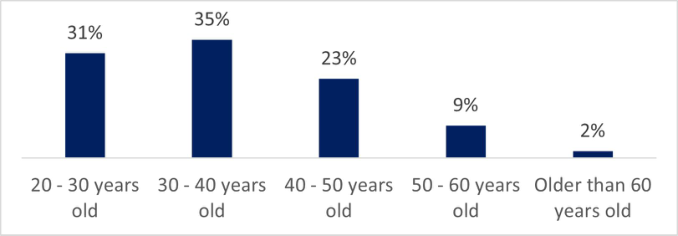
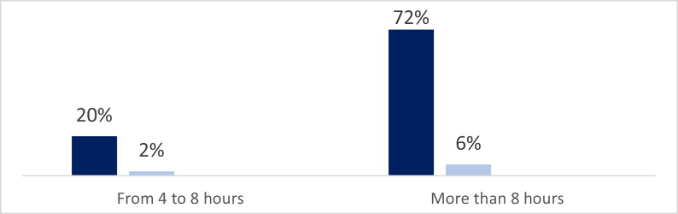
Figure 2: Distribution of participants by age.Figure 3: Distribution of participants by musculoskeletal discomfort in the last 04 months.Figure 4: Distribution of participants by continuity of working hours.
musculoskeletal discomfort, mainly due to forced postures, to the furniture and to electronic devices they use (Marsh Peru, 2021).
The profile of participating population is as follows: 66% of the workers are between 20 and 40 years old, while 31% are between 40 and 60 years old; only 2% are older than 60 years.
78% of the workers reported that they work more than 8 hours. Likewise, 72% responded having presented musculoskeletal discomfort in the last 4 months.
Prolonged sitting can be defined as sitting for two hours or more in a row.
Impact of Remote Work on Ergonomic Risk in Peruvian Companies During COVID-19 165
Figure 5: Most affected body segments.Figure 6: Duration of neck discomfort.
That is why 97% of workers report that they spend more than 2 hours in a sitting position (43%), have presented musculoskeletal discomfort in the last 4 months.
In general, two hours is considered the maximum time to sit continuously, as health risks can occur. When this two-hour limit is regularly exceeded, low back pain, neck and shoulder discomfort appear more frequently.
While 12% of all workers stand up, on average, more than once for every hour of work, of this group only 83% of workers have presented musculoskeletal complaints in the last 4 months.
The body segments affected in the highest proportion when consulting about the presence of musculoskeletal discomfort in the last 4 months were:
Neck: 73% of the workers interviewed reported having musculoskeletal discomfort
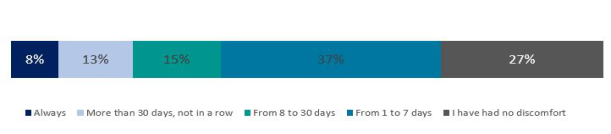
Lower back: 71% of the workers interviewed reported having musculo- skeletal discomfort 73% of workers have neck discomfort. Of the 100% of the workers, 8% state that they always have it, and 13% that they have it for more than 30 days not in a row.
71% of workers have lumbar discomfort. Of the 100% of the workers, 8% state that they always have it, and 14% that they have it for more than 30 days not in a row. When consulting about the adjustments in the design of the work station, there was a higher proportion of alterations in the following aspects that are related to neck discomfort:
Figure 7: Duration of discomfort in lumbar area (lower back).Table 1. Cross analysis: screen edge + use of cell phones.
Table available in the original PDF paper.
Screen edge Use of cell phones Less than 02
hours
Between 02 and 04 hours
Between 04 and 06 hours
More than 06 de hours Yes 64% 33% 20% 12% 35% No 36% 39% 19% 11% 31%
Table 2. Cross analysis: Lumbar support + adequate seat.
Table available in the original PDF paper.
Lumbar support Adequate seat Yes No Yes 58% 85% 15% No 42% 47% 53%
36% of workers do not have the edge of the screen at eye level, which is why they must tilt their neck causing musculoskeletal discomfort.
Likewise, 43% use the cell phone as a display screen and data entry for more than 4 hours during the working day and 21% of all workers use the cell phone for more than 4 hours at the end of the working day.
44% of workers who use the cell phone as a display screen and data entry for more than 04 hours, do not have the edge of the screen at eye level, that is equivalent to almost half of the workers surveyed.
When consulting about the adjustments in the design of the workstation, there was a higher proportion of alterations in the following aspects that are related to lumbar discomfort:
42% of workers do not have lumbar support from the chair or have not implemented some element to ensure that the lumbar area rests on the back of the chair (cushions, pillows).
31% of workers do not have an adequate seat, either it is at least 20 mm thick or the worker has implemented some element to achieve it (cushion, blanket, etc.).
26% do not have an adjustable chair and have not implemented something to achieve an adequate height (cushions, raising the desk).
Impact of Remote Work on Ergonomic Risk in Peruvian Companies During COVID-19 167
Table 3. Cross analysis: Lumbar support + adjustable chair.
Table available in the original PDF paper.
Lumbar Support Adjustable Chair Yes No Yes 58% 87% 13% No 42% 55% 45%
Lumbar Support Adjustable Chair Adequate Seat Yes No Yes No Yes 58% 87% 13% 89% 11% No 42% 55% 45% 31% 69%
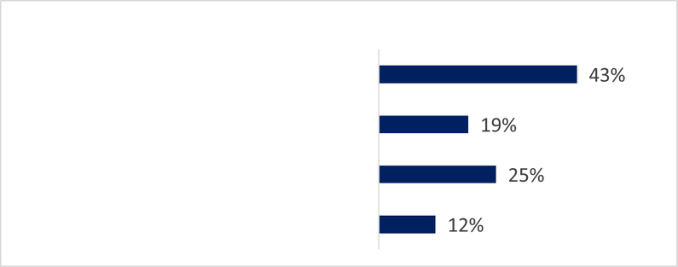
Figure 8: On ergonomic habits at home - percentage of workers who adopt forced postures.Figure 9: On ergonomic habits at home - percentage of workers who take active breaks.
53% of workers who do not have an Adequate Seat, do not have or use the Lumbar Support of the chair.
45% of the workers who do not have an Adjustable Chair, do not have or use the Lumbar Support of the chair.
69% of the workers who do not have an Adjustable Chair and an Adequate Seat, do not have or use the Lumbar Support of the chair, that is more than half of the workers surveyed.
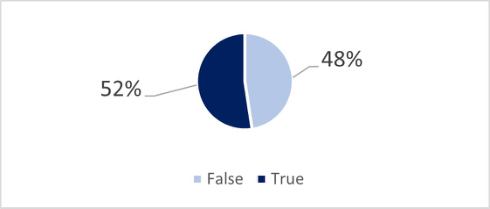
In addition, incidence in musculoskeletal discomfort in the neck and lumbar area: 48% adopt Forced Postures such as: cross legs, sit on one leg, incline/bend the back and neck, lean on elbows among other.
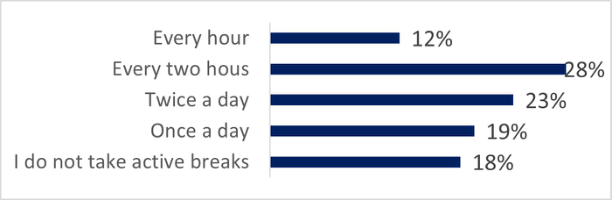
It can also be determined that 18% do not take active breaks, 42% do them incorrectly and only 40% do them correctly (from 01 to 02 hours).
CONCLUSION
92% of workers who perform Remote Work have musculoskeletal com- plaints.
97% of the workers that report they spend more than 2 hours in a sitting position (43%), have presented musculoskeletal discomfort in the last 4 months.
The results obtained verify a correlation between neck discomfort (79%) and workers who do not have the data display screen at eye level (36%) or who use the cell phone as display screens and entry of data for more than 04 hours (43%).
The results obtained also verify a correlation between lower back discom- fort (71%) and workers who do not use the back of the chair or have not incorporated any element to give rest to this area of the back (42%), those who do not have a suitable seat (31%) or an adjustable chair (26%). This totals 69% of workers who do not have an Adjustable Chair and Adequate Seat, do not have or use the Lumbar Support of the chair.
Furthermore, 60% of workers do not take active breaks (18%) or take them incorrectly (42%).
REFERENCES
Instituto Nacional de Seguridad y Salud en el Trabajo (INSST) Elaborado por: Ricardo Chavarría Cosar – Ingeniero Técnico Eléctrico. NTP 242: Ergonomía: análisis ergonómico de los espacios de trabajo en oficinas. Link: https://www.cn ae.com/ficheros/files/prl/ntp_242.pdf Instituto Nacional de Seguridad y Salud en el Trabajo (INSST) Elaborado por:Silvia
Nogareda Cuixart Lcda. en Medicina del Trabajo. Ergónoma Manuel Bestratén Belloví Ingeniero Industrial y Arquitecto CENTRO NACIONAL DE CONDICI- ONES DE TRABAJO – NTP 916 El descanso en el trabajo (I): pausas. Instituto Nacional de Seguridad y Salud en el Trabajo (INSST) Elaborado por: Teresa Álvarez Bayona CENTRO NACIONAL DE NUEVAS TECNOLOGÍAS. INSST – NTP 1130 Criterios ergonómicos para regular correctamente la silla de oficina y otras sillas alternativas. Instituto Nacional de Seguridad y Salud en el Trabajo (INSST) Elaborado por: Teresa
Álvarez Bayona CENTRO NACIONAL DE NUEVAS TECNOLOGÍAS. INSST Silvia González Menéndez UNIVERSIDAD INTERNACIONAL DE LA RIOJA (UNIR) NTP 1150 Riesgos ergonómicos en el uso de las nuevas tecnologías con pantallas de visualización. Kees Peereboom y Nicolien de Langen (vhp human performance, Países Bajos) en colaboración con Alicja Bortkiewicz (Nofer Institute of Occupational Medi- cine, Łod´z, Polonia) – (mayo 2021) – Permanecer sentado en el trabajo con una postura estática y durante periodos prolongados — Resumen ejecutivo Efectos en la salud y recomendaciones de buenas prácticas - Agencia Europea para la Segu- ridad y la Salud en el Trabajo. Link: file:///C:/Users/U1172514/Desktop/sitting_at _work_721a_es_rev.pdf Link: https://www.gob.pe/institucion/mtpe/normas-legal es/394457-375-2008-tr
Impact of Remote Work on Ergonomic Risk in Peruvian Companies During COVID-19 169
Kuorinka I, Jonsson B, Kilbom A, Vinterberg H, Biering-Sørensen F, Andersson G (1987), Standardised Nordic questionnaires for the analysis of musculoskeletal symptoms. Applied Ergonomics; 18 (3):233-237. Larrea-Araujo, C.; Ayala-Granja, J.; Vinueza-Cabezas,A.; Acosta-Vargas, P. (2021)
“Ergonomic-risk-factors-of-teleworking-in-ecuador-during-the-covid19-pand emic-A-crosssectional-studyInternational-Journal-of-Environmental-Research-a nd-Public-Health”. Marsh Peru (March 2021) “Evaluaciones Ergonómicas durante el Trabajo Remoto”. Marsh Peru (August 2020) “Estudio de Retorno Laboral y la Nueva Normalidad”. RM 375-2008 TR (2008) – Norma Básica de Ergonomía y de Procedimiento de Evaluación de Riesgo Disergonómico – Perú. Tiago, F.A.C. Sigahi; Kawasaki, B.C.; Bolis, I.; Morioka, S.N. ( 2021). “A systematic
review on the impacts of Covid-19 on work_ Contributions and a path forward from the perspectives of ergonomics and psychodynamics of work”.
LISTED IN THE AHFE DIGITAL BOOKSTORE CATALOGUE
Explore the complete digital volume
Physical Ergonomics and Human Factors
Read this individual research paper free through the original publisher, or explore the full digital proceedings book.
ISBN 978-1-958651-39-1
Explore this ISBN in the AHFE Bookstore ↗Listed in the July 2026 bookstore catalogue; search by ISBN to confirm current availability · Digital book purchase optional