Lucia Botti, Adriano Paolo Bacchetta, Maniva Oliva, Riccardo Melloni (2023). Exoskeletons at work: opportunities, suggestions for implementation and future research needs. In: Human Aspects of Advanced Manufacturing. AHFE Open Access, vol. 80, pp. 77–87. https://doi.org/10.54941/ahfe1003510
Exoskeletons are wearable devices that use mechanical interaction with the body to augment, assist, and enhance physical activity, motion, and body posture. In the last decades, these devices have been extensively studied and applied in motor rehabilitation. More recently, both industrial and academic researchers have been working to explore the effectiveness of exoskeletons in supporting human upper and lower extremities during manual material handling to eliminate or reduce the risk of Work-related Musculoskeletal Disorders (WMSDs). If on the one hand, the effects for the prevention of WMSDs seem evident, on the other hand, some studies are carefully evaluating the overall impact of exoskeletons on the health and safety of workers. Still, there is limited evidence on the long-term effects of these devices. Hence, more researches are necessary to understand the benefits and the potential opportunities arising from the introduction of exoskeletons in the workplace, as well as the potential limitations and risks that may arise for workers. This paper aims to address these challenges, providing the results of a structured analysis of the scientific literature on occupational exoskeletons. A conceptual framework describes the benefits and the potential limitations of occupational exoskeletons, supporting the safe and effective selection and adoption of these devices in workplaces. The findings in this paper support academic, industrial practitioners, and researchers to understand the opportunities behind the use of exoskeletons, the future research needs, and to predict the benefits and the potential limitations of their implementation in workplaces.
Exoskeletons are defined as wearable devices that augment, enable, assist, or enhance motion, posture, or physical activity, through mechanical interaction with the body (Lowe et al., 2019). These devices are conventionally classified into two categories, i.e. exoskeletons and exosuits. Exoskeletons consist of rigid elements, such as metal components and mechanical drives. Exosuits,
also known as soft exoskeletons, consist of soft parts, such as textile compo- nents and flexible supports. These devices have been widely adopted in the last decades for medical purposes. For example, the benefits of exoskeleton robot-assisted physical therapy are well-known in the field of human uppe- r/lower extremity rehabilitation, i.e. exoskeleton robots can provide different forms of physical exercise at different stages of the physical recovery of para- plegic patients. In the last years, both industrial and academic researchers have been working to explore the effectiveness of exoskeletons in suppor- ting human upper and lower extremities during various tasks (Maurice et al., 2020). The increasing number of research papers in the recent scientific litera- ture proposing new wearable devices and previously unexplored applications confirm a widespread interest of researchers and industrial practitioners in the use of these devices. A recent discussion paper of the European Agency for Safety and Health at Work (EU-OSHA) states that occupational exoskeletons can reduce the burden of physical work, such as heavy lifting, decreasing the risk of Work-Related Musculoskeletal Disorders (WMSDs) (Monica et al., 2020). However, some studies are questioning the overall impact of exoske- letons on the health and safety of people at work (Baldassarre et al., 2022). The use of occupational exoskeletons providing arm or back support may increase the physical demands at other body regions. Some users experience excessive interface pressure at the points of contact between the exoskele- ton and the body, which may lead to an overall perception of discomfort during use (Kozinc, Baltrusch, et al., 2021; Madinei et al., 2020a). Other studies have pointed out some safety concerns, such as the difficulty to main- tain balance and the decreased ability to react to a postural perturbation, e.g. when recovering the position from out-of-balance situations, such as slips, falls or trips (Kozinc, Baltrusch, et al., 2021; Park et al., 2021). Also, there is limited evidence about the long-term effects of these devices on the health and safety of workers, i.e. the deconditioning of the muscles after a prolon- ged period of use may result in further potential risks. More researches are necessary to understand the benefits and the potential opportunities arising from the introduction of different types of exoskeletons in workplaces, as well as the potential limitations and risks that may arise for workers. No practical guidelines provide directions and suggestions for industrial practi- tioners describing how these devices should be introduced in workplaces and managed by an Occupational Health and Safety (OHS) management system (e.g. as engineering controls to reduce or prevent hazards from coming into contact with workers, or personal protective equipment on a par with other wearable devices, such as safety shoes, safety glasses, hearing protection and gloves). This paper addresses these challenges, providing the results of a stru- ctured analysis of the scientific literature on occupational exoskeletons. The aim is to provide an overview of occupational exoskeletons, describing what they are, how they work, and how they should be considered in OHS manage- ment systems. A conceptual framework is proposed to describe the benefits and the potential limitations of occupational exoskeletons, supporting the safe and effective selection and adoption of these devices in workplaces. The findings in this paper support academic, industrial practitioners, and resea- rchers to understand the opportunities arising from the use of exoskeletons,
Exoskeletons at Work 79
the future research needs, and to predict the benefits and the limitations of their implementation in workplaces.
MATERIALS AND METHOD A literature review was conducted across different online bibliographic data- bases of scientific and medical publications, including Science Direct and Pubmed, as well as other online databases of several institutions, e.g. Occu- pational Safety and Health Administration (OSHA) of the United States Department of Labor and the European Agency for Safety and Health at Work (EU-OSHA), collecting discussion papers, reports, data sheets, regu- lations, guidelines and other documentation on the subject of OHS. The keyword exoskeleton was combined with the terms industrial, work, and occupational. Searches were limited to published documents, including rese- arch studies, conference proceedings, reviews, guidelines, discussion papers, and reports, written in English and published between 2011 and 2022. The search was initially conducted in January 2022 and revised in January 2023. The publications included in the present review meet the following inclusion criteria: (i) the focus of the document is on one or more exoske- letons meeting the definition of the ASTM. F48.91 “A wearable device that augments, enables, assists, and/or enhances motion, posture, or physical acti- vity, through mechanical interaction with the body” (Lowe et al., 2019); (ii) the device(s) is(are) intended to support the users during work activities or in industrial applications; (iii) the study investigates multiple aspects of the human-device interaction, including biomechanical aspects, user perspe- ctives, physical demands, and safety concerns. A total of 83 documents met the research criteria and therefore are included in the present review.
RESULTS AND DISCUSSION
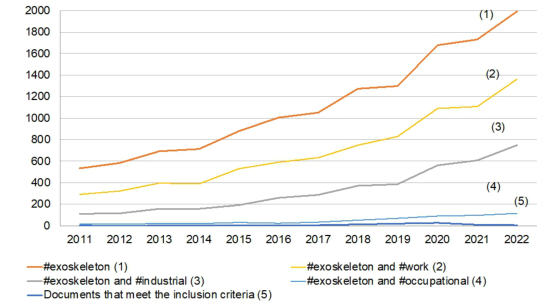
Research Trends The search term exoskeleton returned more than 13,000 documents, two- thirds of which included the keyword work (see (1) in Figure 1). About 95% of these documents were excluded following the screening of the titles or based on the review of the abstracts to meet the inclusion criteria. Of the 198 documents selected for the full review, 83 met the inclusion criteria (see (5) in Figure 1).
About 70% of the documents in this review are research articles, 22% are reviews and the remaining 8% are conference proceedings, guidelines, discussion papers, and reports. The exponential increase in publications on exoskeletons confirms the growing interest of the scientific community in these devices in the last few years. Such a trend is also visible in documents addressing the use of exoskeletons for work and in industrial applications (see Figure 1). The overall number of exoskeletons included in the present review is 224, of which 78% are prototypes and 12% are commercial products. Active exoskeletons, i.e. powered devices that make use of batteries or any other source of energy to run sensors and actuators, are 44% of the exoske- letons included in this study. Passive exoskeletons, which are not motorized
Figure 1: Publications retrieved using the term exoskeleton (1) in combination with work (2), industrial (3), and occupational (5). Publications meeting the inclusion criteria (5).
and do not have any electrical power source, are 53%. The remaining 3% are hybrid devices that combine electrically controlled actuation with functi- onal electrical stimulation (Stewart et al., 2017). Most evidence on the use of the exoskeletons included in this review is from laboratory applications, i.e. 90% of the exoskeletons were tested in a laboratory. The 8% were tested in the workplace and the remaining 2% were tested both in the laboratory and in the workplace. Almost all exoskeletons in the documents in this review are designed to provide support for manual handling. Exoskeletons for the upper part of the body support manual workers during overhead work. Back and leg support exoskeletons provide support during manual tasks such as lifting and carrying. These devices account for more than half of all the exoskeletons tested in the documents in this review (see Table 1).
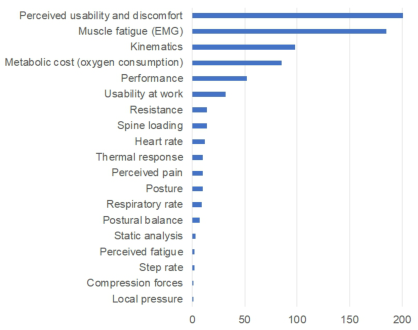
The research on full-body exoskeletons for work is limited, i.e. these exo- skeletons are often considered bulky and uncomfortable whilst carrying out different tasks. The parameters investigated in the studies in this review are in Figure 2. User perceptions of usability and discomfort, and muscle fatigue are the most frequently investigated parameters, followed by the kinematics of the movements and the metabolic consumption of the users. Interviews
Table 1. Supported part of the human body and number of devices in the present review.
Table available in the original PDF paper.
Part of the human body Number of exoskeletons Arm support 83 Leg support 52 Back support 93 Full body 8 Shoulder 19 Hip 1 Total 256
Exoskeletons at Work 81
Figure 2: Parameters investigated during the testing of the exoskeletons in the reference studies, and the number of tested exoskeletons for each specific parameter.
and questionnaires with both open-ended and closed-ended questions are frequently used to assess the perceptions of the users during and after the use of the exoskeletons. Other methodologies adopted to obtain users’ subje- ctive ratings include: the Borg’s scale to assess the rate of perceived exertion; the local perceived pressure to evaluate the musculoskeletal pressure of the parts of the body that are in contact with the exoskeleton; the visual ana- log scale and the numeric rating scale to measure the pain intensity and the pain severity; the system usability scale to assess the perceived usability; and the Likert scale to collect the level of agreement and disagreement of users on a symmetric agree-disagree scale for a series of statements. The following subsections in this paper describe the findings from the studies in this review, using a SWOT Analysis methodology for collecting and analyzing strengths, weaknesses, opportunities, and threats of exoskeletons. Specifically, strengths and weaknesses examine the success points and the internal issues of exoske- letons. Opportunities and threats explore the impact of external factors on the success of these devices in workplaces.
Strengths and Weaknesses Evidence from laboratory applications shows how some back-support exo- skeletons allow for reduced low-based muscle activity, muscle fatigue, and energy expenditure during material manual handling (Madinei et al., 2020a, 2020b). However, the overall impact and effectiveness depend on the task demands and the worker’s characteristics. Active exoskeletons seem to have a greater potential in reducing physical load than passive devices, in the face of higher weight and greater pressure at the body–machine interface. Furth- ermore, exoskeletons provide the greatest support during static postures that require keeping the arms and the hands above the shoulder level for a long time, e.g. during overhead assembly (Baldassarre et al., 2022). Several studies report that occupational exoskeletons can reduce localized muscle activity by distributing the load to other locations of the musculoskeletal system. Other
studies point out excessive interface pressure and discomfort (Kozinc, Babiˇc, et al., 2021). Depending on the device, the task, the user, and the work envi- ronment, this mechanism may expose other areas of the body to potentially harmful forces and unfamiliar conditions. The adoption of forced prolonged postures and unnatural movements may cause the compression of nerves or damage to the tendons, ultimately resulting in long-term injuries. Some rese- archers argue that the regular use of exoskeletons at work may lead to the deconditioning of the muscles, muscle disuse atrophy (shrinking), and stru- ctural weakness (McGowan and Beltzman, 2020). This condition may occur when muscles become accustomed to reducing their level of activity during dynamic tasks with the exoskeleton. Once removed the exoskeleton, e.g. after work, such muscles may have difficulties in performing ordinary tasks with no support. Most existing evidence is from laboratory-based studies, which confirm the short-term efficacy of these devices. Field studies are complex and the transfer of lab-based results to real workplaces is not always possi- ble. Still, results in real case studies show lower user satisfaction compared with laboratory studies. This may be due to the higher complexity of work tasks and workplaces, compared to experimental designs. Evidence shows that the use of exoskeletons during dynamic tasks involving different postu- res, e.g. lifting and carrying or lifting and driving, may obstacle mobility, resulting in reduced job performance and higher perceived discomfort (Zhu et al., 2021). However, researchers and industrial practitioners agree that comfort and wearability are key factors for the usability and acceptance of exoskeletons in real workplaces (Salvadore et al., 2020). Recent studies have investigated the ability of users to maintain balance while performing work tasks with exoskeletons (Park et al., 2021, 2022; Steinhilber et al., 2020). The findings reveal that the use of back-support exoskeletons affects the ability of the users to recover the balance with a single step. While no alteration was found in the maximum lean angle from which individuals can succes- sfully recover, wearing the exoskeleton increases reaction times. Also, the exoskeleton may hinder hip flexion, resulting in decreased step length, redu- ced knee range of motion, and potential fall risks. More research is necessary to explore further safety concerns among the research community about the impact of exoskeletons on workers’ safety in case of unexpected events, e.g. slips, snags and trips. Finally, the introduction of new technologies in the workplace, such as occupational exoskeletons, requires new regulations and procedures that consider the redistribution of the forces due to the use of exoskeletons to different body areas and the evaluation of user perceptions. Nowadays, no directions or guidelines are available for safety professionals and practitioners who need to assess the impact of occupational exoskeletons on the risk assessment methodologies proposed in the International Standards on MMH (International Standard Organization, 2007a, 2007b, 2021).
Opportunities and Threats The research on exoskeletons is currently receiving considerable attention from both academia and industry. Researchers and industrial practitioners are investigating the opportunity to decrease the physical demands of manual
Exoskeletons at Work 83
work and enhance performance thanks to the use of industrial exoskele- tons. Some manufacturers promote the adoption of their products to protect workers from injuries or to reduce the risk of developing WMSDs. Recent studies suggest that exoskeletons can support workers in performing specific tasks in some working environments, and therefore can help prevent WMSDs (Monica et al., 2021). Other studies specify that exoskeletons in stationary workplaces cannot be recommended to improve the ergonomic design, but they may offer a promising approach to reduce WMSDs in non-stationary or mobile workplaces in which ergonomic measures are not possible (Peters, M.; Wischniewski, 2019). Even though different studies investigate multiple aspects of the usability and functionality of exoskeletons, long-term effects on the health of workers are not clear. Data on the potential for preventing work-related diseases and disorders are limited. The long-term effects of exo- skeletons on biomechanical, physiological, and psychosocial parameters are not known. Future studies should address practice-oriented long-term effects of exoskeletons in the workplace. Despite the apparent promising potential of occupational exoskeletons, the adoption of such devices in a wide range of workplaces and for multiple tasks should be questioned. For example, Peters and Wischniewski (2019) do not recommend using exoskeletons to improve the ergonomic design in stationary workplaces. However, exoskele- tons may offer a promising approach to reducing WMSDs among workers in non-stationary or mobile workplaces in which ergonomic measures are not possible. Furthermore, the technology behind these devices continues to change and improve. Soon, exoskeletons may become conventional equi- pment for standard manual work processes and remain niche products for very specific tasks. The current commercial attention to occupational exoske- letons may pose a risk to the technological progress and future developments of these devices. Indeed, the prioritization of performance-oriented or eco- nomic approaches to the development of exoskeletons may leave a gap in the attention spent on OHS issues. Finally, no practical guidelines are availa- ble for practitioners who are interested in adopting these devices to support workers during manual work.
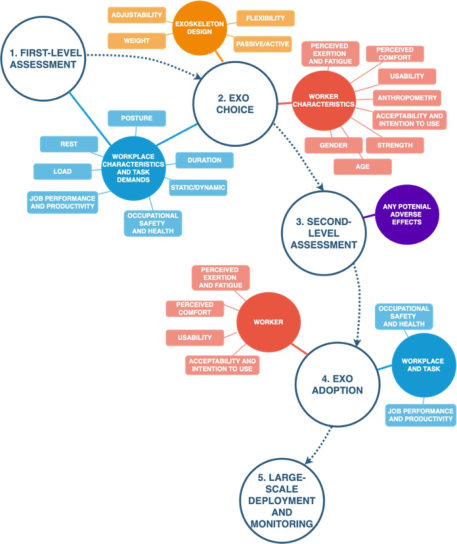
A Conceptual Framework The framework in Figure 3 proposes a structured approach for the intro- duction of occupational exoskeletons, based on five steps. The proposed approach supports employers and industrial practitioners who are conside- ring the possibility of introducing one or more exoskeletons in the workplace. The first step of the proposed approach suggests performing a first-level assessment, i.e. an ergonomics analysis of the workplace including the chara- cteristics of the workstation and task demands, aiming to identify potential structural adjustments and/or organizational optimizations. This step inclu- des a comparison between the investment required to adopt one or more exoskeletons with the costs for workplace adjustments or organizational optimizations (if possible). In case the comparison is in favor of the adoption of one or more exoskeletons, the employer is required to select a device among those on the market (Step 2). The selection of the exoskeleton shall
Figure 3: Conceptual framework supporting the introduction of exoskeletons in work- places.
include the analysis of the whole work system to find the match between the worker anthropometric characteristics, the workplace characteristics and task demands, the exoskeleton features, and, in the case of active exoskele- tons, the characteristic of the power feed line and other constraints. Still, the analysis must consider that the effectiveness of occupational exoskeletons is closely related to the anthropometric characteristics of the users. Hence, the promiscuous use of exoskeletons between workers in different work shifts should be avoided.
The second-level assessment (Step 3) investigates any potential adverse effect that could result from the adoption of the selected exoskeleton during the work activity. The implementation of the device should be gradual and limited to a selected sample of workers and tasks, aiming to identify any potential problems that may arise during use, before large-scale deployment (Step 4). During large-scale deployment, the use of the exoskeleton shall be monitored aiming to optimize the design of the workplace and the task, and understand the benefits and limitations that may arise.
CONCLUSION
Over the past decade, the interest in research on occupational exoskeletons has increased significantly. Today, a large number of manufacturers play in the market, offering different solutions for various applications. The web- site Exoskeleton Report collects news and resources for practitioners on the
Exoskeletons at Work 85
emerging technological field of exoskeletons, exosuits, and wearable robotics, aiming “to separate science fiction from reality” (Exoskeleton Report LLC, 2020). In late 2022, the website database, i.e. the exoskeleton catalogue, col- lects more than one hundred devices. Most of these devices are passive (71%). It is interesting to note that a category named “injury prevention” collects 83% of the occupational exoskeletons in the catalogue. Despite the current attention to commercial devices and the growing interest of both academia and industry, the actual effects of occupational exoskeletons on the safety and health of workers are complex and difficult to understand. This paper intro- duced a conceptual framework supporting the safe and effective selection, adoption, and use of exoskeletons in the workplace. The aim was to provide a practical tool for employers and industrial practitioners who are conside- ring the possibility to adopt an occupational exoskeleton in their workplace. To contribute to the ongoing debate and research on occupational exoskele- tons, the authors of this contribution have organized an exoskeleton analysis laboratory to evaluate the impact of the use of these devices on normal work activity and the psychological aspects induced on the workers. The laboratory activities provide for the development and application of ergonomic evalu- ation methodologies with particular attention to the safety and usability of the exoskeletons according to their design features, the body district to which they are intended to assist (lower limbs, upper limbs, whole body) and the work to be performed. The results of the experimental investigations, con- ducted both through laboratory and field simulations, will allow to define specific and practical indications for the safe and effective selection and use of exoskeletons to support the performance of work activities.
ACKNOWLEDGMENT
Partial support for this research was provided by the Department of Indu- strial Engineering “Enzo Ferrari” (DIEF) of the University of Modena and Reggio Emilia, through the fund “FAR2022DIP_DIEF - Fondo di Ateneo per la Ricerca 2022 per il finanziamento di piani di sviluppo dipartimentale nell’ambito della ricerca” Prot. n. 2985 del 27/07/2022, and from the Uni- versity of Modena and Reggio Emilia, through the fund “FAR2022ATTR - Fondo di Ateneo per la Ricerca 2022 per il finanziamento di attrezzature”, Decreto rettorale n. 835/2022 Prot. 193214 del 25/07/2022. The authors are grateful for this support.
REFERENCES
Baldassarre, A., Lulli, L. G., Cavallo, F., Fiorini, L., Mariniello, A., Mucci, N. and Arcangeli, G. (2022), “Industrial exoskeletons from bench to field: Human-machine interface and user experience in occupational settings and tasks”, Frontiers in Public Health, Vol. 10, doi: 10.3389/fpubh.2022.1039680. Exoskeleton Report LLC. (2020), “Exoskeleton Report”, Webpage, available at:
ExoskeletonReport.com (accessed 23 December 2022).
Manual handling — Part 2: Pushing and pulling”. International Standard Organization. (2007b), ISO 11228-3:2007. Ergonomics.
Manual Handling. Part 3: Handling of Low Loads at High Frequency. Kozinc, Ž., Babiˇc, J. and Šarabon, N. (2021), “Comparison of subjective responses of low back pain patients and asymptomatic controls to use of spinal exoskeleton during simple load lifting tasks: A pilot study”, International Jour- nal of Environmental Research and Public Health, Vol. 18 No. 1, pp. 1–9, doi: 10.3390/ijerph18010161. Kozinc, Ž., Baltrusch, S., Houdijk, H. and Šarabon, N. (2021), “Short-Term Effe-
cts of a Passive Spinal Exoskeleton on Functional Performance, Discomfort and User Satisfaction in Patients with Low Back Pain”, Journal of Occupational Rehabilitation, Vol. 31 No. 1, doi: 10.1007/s10926-020-09899-7. Lowe, B. D., Billotte, W. G. and Peterson, D. R. (2019), “ASTM F48 Formation and Standards for Industrial Exoskeletons and Exosuits”, IISE Transactions on Occupational Ergonomics and Human Factors, Vol. 7, doi: 10.1080/24725838.2019.1579769. Madinei, S., Alemi, M. M., Kim, S., Srinivasan, D. and Nussbaum, M. A.
(2020a), “Biomechanical Evaluation of Passive Back-Support Exoskeletons in a Precision Manual Assembly Task: ‘Expected’ Effects on Trunk Muscle Activity, Perceived Exertion, and Task Performance”, Human Factors, Vol. 62 No. 3, doi: 10.1177/0018720819890966. Madinei, S., Alemi, M. M., Kim, S., Srinivasan, D. and Nussbaum, M. A. (2020b), “Biomechanical assessment of two back-support exoskele- tons in symmetric and asymmetric repetitive lifting with moderate postural demands”, Applied Ergonomics, Elsevier Ltd, Vol. 88 No. June, p. 103156, doi: 10.1016/j.apergo.2020.103156. Maurice, P., Ivaldi, S., Babic, J., Camernik, J., Gorjan, D., Schirrmeister, B., Bornmann, J., et al. (2020), “Objective and Subjective Effects of a Passive Exoskeleton on Overhead Work”, IEEE Transactions on Neural Systems and Rehabilitation Engineering, Vol. 28 No. 1, doi: 10.1109/TNSRE.2019.2945368. McGowan, B. and Beltzman, B. (2020), “Exoskeletons: The Good, the Bad and the
Ugly”, Safety Technology, 7 August, available at: https://www.ehstoday.com/s afety-technology/article/21138659/exoskeletons-the-good-the-bad-and-the-ugly (accessed 22 December 2022). Monica, L., Anastasi, S. and Draicchio, F. (2020), “Occupational exoskeletons: wearable robotic devices and preventing work-related musculoskeletal disorders in the workplace of the future”, pp. 1–12. Monica, L., Draicchio, F., Ortiz, J., Chini, G., Toxiri, S. and Anastasi, S. (2021),
“Occupational Exoskeletons: A New Challenge for Human Factors, Ergonomics and Safety Disciplines in the Workplace of the Future”, Lecture Notes in Networks and Systems, Vol. 222 LNNS, doi: 10.1007/978-3-030-74611-7_17. Park, J. H., Kim, S., Nussbaum, M. A. and Srinivasan, D. (2021), “Effects of two passive back-support exoskeletons on postural balance during quiet stance and functional limits of stability”, Journal of Electromyography and Kinesiology, Vol. 57, doi: 10.1016/j.jelekin.2021.102516. Park, J.-H., Lee, Y., Madigan, M. L., Kim, S., Nussbaum, M. A. and Srinivasan, D.
(2022), “Wearing a back-support exoskeleton impairs single-step balance recovery
Exoskeletons at Work 87
performance following a forward loss of balance – An exploratory study”, Journal of Biomechanics, Vol. 144, p. 111352, doi: 10.1016/j.jbiomech.2022.111352. Peters, M.; Wischniewski, S.; (2019), “The impact of using exoskeletons on occupational safety and health - Safety and health at work - EU-OSHA”, EU-OSHA, pp. 1–10. Salvadore, G., Rota, E., Corsi, E. and Colombina, G. (2020), “Industrial Wearable
Robots: A HUMANufacturing Approach”, pp. 1729–1733, doi: 10.1007/978-3- 030-31635-8_210. Steinhilber, B., Seibt, R., Rieger, M. A. and Luger, T. (2020), “Postural Control When Using an Industrial Lower Limb Exoskeleton: Impact of Rea- ching for a Working Tool and External Perturbation”, Human Factors, doi: 10.1177/0018720820957466. Stewart, A. M., Pretty, C. G., Adams, M. and Chen, X. Q. (2017), “Review of Upper
Limb Hybrid Exoskeletons”, Vol. 50, doi: 10.1016/j.ifacol.2017.08.2266. Zhu, Z., Dutta, A. and Dai, F. (2021), “Exoskeletons for manual material handling – A review and implication for construction applications”, Automation in Construction, doi: 10.1016/j.autcon.2020.103493.
LISTED IN THE AHFE DIGITAL BOOKSTORE CATALOGUE
Explore the complete digital volume
Human Aspects of Advanced Manufacturing
Read this individual research paper free through the original publisher, or explore the full digital proceedings book.
ISBN 978-1-958651-56-8
Explore this ISBN in the AHFE Bookstore ↗Listed in the July 2026 bookstore catalogue; search by ISBN to confirm current availability · Digital book purchase optional