Lucia Botti, Riccardo Melloni, Maniva Oliva (2022). Understanding human factors to improve occupational safety in manufacturing: a case study. In: Human Aspects of Advanced Manufacturing. AHFE Open Access, vol. 66, pp. 30–39. https://doi.org/10.54941/ahfe1002685
This paper investigates how the deviation of an industrial process from its optimal productivity, maintenance, and quality levels can lead to safety issues. An integrated approach was developed in 2021 to analyze the correlation between safety deficiencies and process inefficiencies. In this study, the proposed approach was adopted, aiming to identify potential connections between the safety issues that emerged from the previous investigations and the process inefficiencies. A case study describes the application of the proposed approach in an Italian company leader in the production of boilers for domestic and industrial heating and cooling systems. The findings show that the joint analysis of the results from the investigations in the proposed approach allows understanding the human factors in the investigated manufacturing process, i.e. the environmental, organizational, and job factors, and the human and individual characteristics which influence behavior at work in a way which can affect occupational safety.
The dynamic characteristics of the modern industry and the market conditi- ons require the industrial organizations to adopt a system-oriented approach, based on the assumption that a system is more complex than the sum of its elements. The elements determining the complexity of a production system include the technological equipment for the transformation proces- ses (e.g. machinery and tools), the production materials (e.g. raw materials and energy), the financial resources affecting the cash flow, and the human resources governing the whole system. Productivity and working capacity are critical drivers for the development of industrial systems. Productivity measures the work system output, e.g. the number of produced units, over a specific time. At corporate level, productivity refers to the efficiency cha- racteristics of a production process, and it may be calculated by relating the number of units produced to the hours of work (Collewet and Sauermann,
Understanding Human Factors to Improve Occupational Safety 31
2017). Working capacity is related to the worker’s attitude and capability to perform a specific task (Oecd, 2001). Different factors affect the working capacity, such as structural and organizational interventions, improvement projects, health surveillance, training programs, production quality control, reports, and remedial measures. An increase in productivity should corre- spond to increasing working capacity and sustainable working conditions. Industrial systems must ensure the balance between productivity and working capacity. Otherwise, the imbalance in productivity will produce hard working conditions, fatigue, and potential negative consequences on workers’ safety and health. Sustainable working conditions do not imply lower productivity, but higher quality and, most likely, higher performance (Botti et al., 2022). Various production methodologies and approaches emerged in the last deca- des, aiming to improve the availability of work processes and the quality of the process outputs in a multidimensional perspective (Adjoul et al., 2021; Ghouat et al., 2021; Peruzzini et al., 2020). Hence, the success of an orga- nization and the efficiency of a work process depend on the ability to seek excellence in three strictly related aspects, i.e. productivity, maintenance, and quality, which find their best condition under the umbrella of occupational health and safety (Djurovi´c et al., 2015; Narayan, 2012). However, the devia- tion of such aspects from their optimal levels may result in safety deficiencies and ultimately occupational accidents (Botti et al., 2022).
The European Statistics on Accidents at Work (ESAW) of the statistical office of the European Union (EU) collects the EU statistics related to Occu- pational Health and Safety (OHS). ESAW data reveal that 3.1 million serious accidents and 3,332 fatal accidents occurred in the EU-27 in 2018 (Eurostat, 2020a). Specifically, construction (21%), transportation and storage (17%), manufacturing (15%), and agriculture, forestry, and fishing (13%) registered the highest percentages of fatal accidents. The highest percentage of serious accidents at work was registered in manufacturing (19%), followed by who- lesale and retail trade (12%), construction (12%), and human health and social work activities (11%). A recent study has investigated the design of modern manufacturing systems, aiming to analyze and understand workers’ reasonably foreseeable behaviors leading to serious accidents, in the Ita- lian metal production and manufacturing industries (Botti et al., 2021). The results reveal that the most frequent risk factor for occupational accidents that occurred in such industries was the use of fixed machinery, followed by the use of fixed material transport equipment and industrial trucks. The fin- dings also show that the leading apparent cause of accidents involving the use of fixed machinery was the adoption of an improper procedure. Wor- ker misplacement was the leading apparent cause of occupational accidents that occurred in manufacturing, during operations that involved the use of fixed material transport equipment. The improper use of equipment was the leading apparent cause of occupational accidents that occurred in manufa- cturing, during operations that involved the use of industrial trucks. EU data confirm these statistics. ESAW reveals that about 29.3 % of fatal accidents that occurred at work in the EU-27 in 2018 resulted from losing control of a machine, tool, or transport and handling equipment. Also, the impact with
a stationary object caused 21.5% of the serious accidents that occurred at work, in the EU-27 in 2018 (Eurostat, 2020b, 2020c).
This paper investigates how the deviation of an industrial process from its optimal productivity, maintenance, and quality levels can lead to safety issues. An integrated approach was developed in 2021 to analyze the cor- relation between safety deficiencies and process inefficiencies (Botti et al., 2022). The proposed approach is based on three investigation levels. Speci- fically, the first-level investigation focuses on the identification of the root causes of major accidents that occurred in the same industry (Botti et al., 2020). The second-level investigation explores the human factors that lead to the investigated accidents. This step requires the active participation of the workers in the analysis of consequences and causes of unsafe behaviors that may result in safety issues (Mosconi et al., 2019). The third-level investiga- tion explores the company processes aiming to identify potential connections between the safety issues that emerged from the previous investigations and the process inefficiencies. In this paper, a case study describes the application of the proposed approach in an Italian company leader in the production of boilers for domestic and industrial heating and cooling systems. The findings show that the joint analysis of the results from the first-level investigation and the focus groups with the workers in the second-level investigation, together with the results from the cross-impact analysis in the third-level investigation, allows understanding the human factors in the investigated manufacturing process, i.e. the environmental, organizational and job factors, and the indi- vidual characteristics which influence behavior at work, in a way which can affect occupational safety. The results also suggest critical interventions for improving occupational safety in the investigated process, which support the achievement of higher production performances.
MATERIALS AND METHOD This study shows the application of the methodology proposed in (Botti et al., 2022), which consists of three investigation levels. The first-level investiga- tion supports the identification of the causes of accidents that occurred in the company or that occurred in the same industry. The second-level investi- gation aims to understand the consequences and causes of unsafe behaviors. In this step, the workers are invited to interact and share their knowledge about critical issues for health and safety in the workplace. The participatory technique adopted in this step is the Focus Group with Workers (FGW). The moderator of the FGW is a safety professional who coordinates the discus- sion between the workers, following a Fault-Three Analysis (FTA) approach (Mosconi et al., 2019). The resulting FGW-FTA methodology adopted in this research realizes a bottom-up approach to address the gap between the centralized management and the workers. Hence, during the FGW, the parti- cipants have the opportunity to express their concerns and perceptions about the risks of their work.
The main idea is that someone who has been performing a complex task for a significant amount of time has the most conscious knowledge about the potential issues related to his job activity. Finally, the third-level investigation
Understanding Human Factors to Improve Occupational Safety 33
analyses the company processes, aiming to recognize potential connections between the process inefficiencies and the safety gaps identified in the previ- ous investigations. The proposed approach was applied with the workers operating on the assembly lines of an Italian company leader in the pro- duction of boilers for domestic and industrial heating and cooling systems. Specifically, the manual operations required for the boiler assembly involve repetitive movements of the upper limbs and the use of vibrating tools, e.g. screwdrivers. The OCRA methodology was adopted for the risk assessment of repetitive movements, as described in the ISO 11228-3 (International Standard Organization, 2007, 2015; Occhipinti and Colombini, 2016). The results of the OCRA risk assessment allow the classification of the risks related to the investigated operations by a three-zone approach, i.e. green, yellow and red. Such classification allows defining the consequent actions that should be taken to improve the workers’ health and safety conditions. The risk is acceptable in the case of the green zone and no corrections are required. The yellow zone identifies situations in which the risk is very low. In this case, structural risk factors as posture, force, and frequency of technical actions should be improved by employing technical measures.
Organizational measures are necessary in case of other risk factors, such as insufficient time for recovery or improper distribution of breaks. The red zone confirms the presence of a risk condition. Employers are required to redesign tasks and workplaces according to priorities. Hand-arm vibration (HAV) risk assessment was performed aiming to quantify the workers’ expo- sure to vibration from the vibrating tools used for assembly operations during the work shift, as described in the ISO 5349-1 (ISO, 2001).
CASE STUDY The methodology introduced in the previous section of this paper was applied to investigate the health and safety conditions in the assembly lines of an Italian company leader in the production of boilers for domestic and indu- strial heating and cooling systems. Two assembly lines (named Line3/A and Line10/L) were analyzed, aiming to understand the risk factors due to the manual operations performed. The company safety manager performed the risk assessment for the activities at the reference assembly lines. The results from the risk assessment with the OCRA methodology in the ISO 11228-3 (International Standard Organization, 2007) confirmed the exposure of the workers to the risk factors related to the repetitive movements performed in both the assembly lines. In this study, four risk zones were identified, i.e. green, yellow, orange, and red, aiming to facilitate the identification of priorities for workplace corrections. The results are in Table 1 and Table 2.
The risk factors observed in the workstations characterized by yellow, orange and red risk zones are the presence of awkward postures, high freque- ncy of technical actions (30-50 technical actions per minute), force exertions, and insufficient breaks. The company safety manager assessed the workers’ exposure to vibrations, following the requirements in the ISO 5349-1 (ISO, 2001). The assembly workers in this study were required to use vibrating tools, such as the screwdriver, to accomplish the assembly operations. Table 3
Table 1. Results of the risk assessment performed with the OCRA methodology for the assembly operations performed in Line3/A (20 workstations).
Table available in the original PDF paper.
Risk level Operations Number of workstations
Assembly 6 (30%)
Acceptable (green zone) Assembly and test 10 (50%) Conditionally acceptable (yellow zone) Moderate (orange zone) Assembly 3 (15%) Not acceptable (red zone) Assembly and packing 1 (5%)
Table 2. Results of the risk assessment performed with the OCRA methodology for the assembly operations performed in Line10/L (18 workstations).
Table available in the original PDF paper.
Risk level Operations Number of workstations
Assembly 3 (17%)
Acceptable (green zone) Assembly and test 11 (61%) Conditionally acceptable (yellow zone) Moderate (orange zone) Assembly 1 (5%) Not acceptable (red zone) Assembly and packing 3 (17%)
Table 3. Exposure of the workers to HAV: results from a trial adopted for the risk assessment, as described in the ISO 5349-1 (ISO, 2001).
Table available in the original PDF paper.
Body part Time X-axis Y-axis Z-axis Total Dominant [s] [m/s2] [m/s2] [m/s2] [m/s2] axis Right hand-arm 8 1.13 0.87 0.78 1.63 X
shows the results of the analysis performed for the assessment of the workers’ exposure to HAV from the vibrating tools used during the assembly opera- tions. All the workers involved in the study were right-handed. The handle of the screwdriver included the tool activation button. The screwdriver (0.9 kg weight) was required to lock 7 screws on each boiler. Each worker was required to assembly 150 boilers during the 8-hour work shift. 8 seconds were necessary to lock each screw on the boiler (see Table 3), which equals approximately 1,050 seconds of use of the screwdriver per day. The resulting Exposure Action Value (EAV), i.e. the level of daily vibration exposure to HAV for each assembly worker, above which steps should be taken to mini- mize exposure, was 2.5 m/s2. The Exposure Limit Value (ELV), i.e. the level of daily vibration exposure to HAV for each assembly worker which should not be exceeded, was 5 m/s2. Finally, the daily vibration exposure, A(8), i.e. the quantity of HAV the assembly worker is exposed to during a working day, normalized to the work-shift duration, was 0.31 m/s2. A(8) is derived from the magnitude of the vibration, i.e. the vibration total value, and the daily exposure duration.
The first-level investigation was performed, aiming to identify the main causes of the accidents that occurred in Italian manufacturing. The second- level investigation involved two hundred workers. Nine FGW were organized in 2019. Each FGW was attended by 20-25 workers. The moderator of the
Understanding Human Factors to Improve Occupational Safety 35
FGW was a full Professor in industrial engineering with multiple years of experience in occupational health and safety. The moderator coordinated the discussion between the workers, following the FGW-FTA methodology in Mosconi et al. (2019). Each FGW lasted 4 hours. During the first hour of FGW, the moderator introduced the aims of the FGW to the workers. The discussion focused on the role of the worker in the prevention of accidents and injuries at work, and the importance to report any near-miss, hazardous conditions, and system anomalies. Specific risks were discussed during the second and third hours of FGW. The moderator encouraged the workers to share their experiences and thoughts about the causes of unsafe behaviors and risk conditions that occurred during work. Finally, the workers proposed a set of preventive actions that could be implemented in the workplace.
RESULTS AND DISCUSSION
The results of the first-level investigation revealed that the leading apparent causes of the accidents that occurred in Italian manufacturing were related to workers’ behaviors, e.g. worker misplacement or the voluntary adoption of an improper procedure. For more details about such findings, please see (Botti et al., 2021). The second-level investigation supported the analysis of the causes of accidents in the reference company, aiming to understand wor- kers’ unsafe behaviors and the causes of the risk factors that emerged from the risk assessments. During the FGW, the workers revealed that the adoption of awkward postures was due to improper vertical or horizontal position of product and equipment, e.g. workbenches, screwdrivers, work-in-process, and conveyors. Force exertions were required to assemble the components characterized by poor tolerances and unexpected deformations. Poor design features caused difficult access to some areas of the product, i.e. the boiler, where workers were required to perform assembly operations. Poor accessibi- lity caused the assumption of awkward postures during assembly operations and higher exertions with the upper part of the body. Also, the actual dura- tion of breaks was lower than prescribed by the company management. This was due to the workers’ attitude to increase the work pace, aiming to carve out additional breaks. Furthermore, such attitude caused the adoption of improper procedures leading to awkward postures and high exertions, i.e. the workers did not vary the position of the boiler on the adjustable bench aiming to save time, although at the expense of greater efforts and awkward postures. These behaviors were also observed in case of limited production rate requirements and no time pressure. The cross-impact matrix in Figure 1 shows the correlations between the process variables and the safety issues that emerged during the first and second-level investigations. In this study, the process variables for the cross-impact matrix in the third-level investiga- tions were the assembly operations performed in the reference assembly lines and the quality control.
During the FGW, the participants revealed that frequent blockages due to the lack of components and production quality deficiencies occurred during the testing operations. The quality control often revealed the imperfect ali- gnment of the holes of the boiler frame with the control dashboard. The
Figure 1: Cross-impact matrix of safety issues and process deficiencies for the assem- bly lines in the reference case study.
Figure available in the original PDF paper.
workers stated that great effort and extra time were necessary to force the alignment of the components. Interventions after quality control inspecti- ons caused frequent blockages of the assembly lines. The workers revealed that the acceleration of manual operations and an increased work pace were necessary to make up for the lost time. Consequently, non-value-added acti- ons, e.g. the movements required to adjust the boiler close to the body, were avoided. Such behaviors became common practice regardless of the necessity to make up for the lost time. Also, the products stayed on an adjustable bench during the assembly operations. However, the workers revealed that they lear- ned to save time by avoiding the operations required to adjust the boilers and adapting their postures to the boiler position during assembly operations. All personnel involved in the FGW revealed little knowledge about the principles of ergonomics and ergonomic design of workplaces and work tasks for the prevention of musculoskeletal disorders (MSDs).
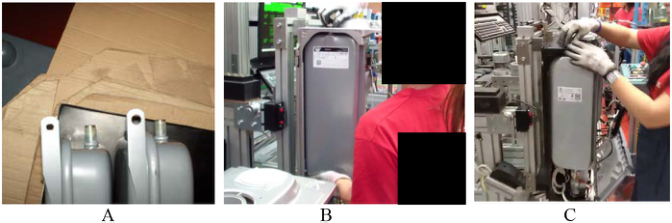
The company management defined a set of interventions aimed at addres- sing the issues that emerged from the third-level investigation, including training programs, design modifications, and organizational interventions. Training programs provide proper training on the ergonomics approach for the prevention of work-related MSDs to the company personnel, including designers, technicians, department managers, and line operators. Design inte- rventions aim at reducing the exertions required during assembly operations. For example, hard exertions were necessary to hold the boiler during the assembly operations (Figure 2B). Such activity also required the assumption of awkward postures of shoulders and hands. A larger hole was designed on the boiler case (Figure 2A) from which the worker can fix the boiler on the frame before performing the assembly operations (Figure 2C).
The workers revealed that high exertions with the hand in palmar grip were necessary during the application of the insulating material on the boi- ler frame. The thickness of the insulation material was reduced, allowing lower exertions during such operation. The intervention also allowed a sli- ght improvement of the hand posture. Other design interventions include
Understanding Human Factors to Improve Occupational Safety 37
Figure 2: Design interventions on the boiler to improve assembly operations: 2A. Details on the boiler frame; 2B. Assembly operations before the intervention; 2C. Assembly operations after the intervention.
the adoption of gravity roller conveyors on the assembly lines to facilitate the retrieval of the components during assembly operations. The height of the conveyors allowed the workers to retrieve the components in the vertical range between the hips and the shoulders. Organizational interventions were defined to reduce the time of exposure to vibrations due to the use of the scre- wdriver. Job rotation was implemented for the assembly operations that did not require highly skilled personnel, e.g. the workers on the assembly lines rotate every four hours during the 8-hour shift. Other organizational inte- rventions include the reduction of the number of screws to be assembled on the boiler and the use of screws that facilitate assembly operations. Finally, the distribution and duration of the breaks were modified aiming to ensure the proper recovery for the upper part of the body. Specifically, workers were usually entitled to one 1-hour meal break and two 10-minute rest breaks during the 8-hour shift. The break schedule was modified allowing a 1-hour meal break, a 10-minute break, and two 8-minute breaks during the 8-hour shift.
CONCLUSION
This paper proposed the application of an integrated approach for the analy- sis of the correlation between safety deficiencies and process inefficiencies in an industrial case study. The aim was to understand the impact of the devi- ations of the investigated industrial process from its optimal productivity, maintenance, and quality levels on safety performances. The results of the focus groups with the workers revealed the causes of the unsafe behaviors observed on the assembly lines. The workers confirmed the presence of mul- tiple safety issues that emerged from the risk assessments for the assembly operations. Furthermore, the workers revealed that some unsafe behaviors, e.g. the acceleration of manual operations to save time for additional rest breaks, resulted from a memory effect such that they chose to adopt the same improper behavior regardless of the actual need to save time. The cross-impact analysis in this study described the connections between such behaviors and the characteristics of the reference assembly processes. The results suggested critical interventions for improving occupational safety in the investigated processes, which also support the achievement of higher production performances.
REFERENCES
Adjoul, O., Benfriha, K., Zant, C. El and Aoussat, A. (2021), “Algorithmic Strategy for Simultaneous Optimization of Design and Maintenance of Multi-Component Industrial Systems”, Reliability Engineering and System Safety, Vol. 208, available at:https://doi.org/10.1016/j.ress.2020.107364. Botti, L., Melloni, R., Mosconi, S. and Oliva, M. (2020), “A Detailed Investiga-
tion on Apparent and Root Causes of Accidents in Manufacturing”, Proceedings of the 11th International Conference on Applied Human Factors and Ergono- mics (AHFE 2020) and the Affiliated Conferences, Springer Nature Switzerland, pp. 1–8. Botti, L., Melloni, R., and Oliva, M. (2021), “Analyzing the Dynamics of Work Accidents in Manufacturing to Understand “Reasonably Foreseeable Behaviors””, in Trzcielinski, S., Mrugalska, B., Karwowski, W., Rossi, E. and Di Nicolantonio, M. (Eds.), Advances in Manufacturing, Production Management and Process Control, Springer International Publishing, Cham, pp. 367–375. Botti, L., Melloni, R. and Oliva, M. (2022), “Learn from the past and act for the
future: A holistic and participative approach for improving occupational health and safety in industry”, Safety Science, Vol. 145, available at:https://doi.org/10. 1016/j.ssci.2021.105475. Collewet, M. and Sauermann, J. (2017), “Working Hours and Productivity”, IZA Discussion Papers, Institute of Labor Economics (IZA), Bonn, April. Djurovi´c, D., Bulatovi´c, M., Sokovi´c, M. and Stoi´c, A. (2015), “Measure-
ment of maintenance excellence”, Tehnicki Vjesnik, Vol. 22 No. 5, available at:https://doi.org/10.17559/TV-20140922094945. Eurostat. (2020a), Statistics Explained: Accidents at Work Statistics, available at:https://doi.org/ISSN 2443–8219. Eurostat. (2020b), “Accidents and injuries statistics”, Report, August. Eurostat. (2020c), “Accidents at work - statistics on causes and circumstances”,
November. Ghouat, M., Haddout, A. and Benhadou, M. (2021), “Impact of Industry 4.0 Concept on the Levers of Lean Manufacturing Approach in Manufacturing Indu- stries”, International Journal of Automotive and Mechanical Engineering, Vol. 18 No. 1, available at:https://doi.org/10.15282/ijame.18.1.2021.11.0646. International Standard Organization. (2007), ISO 11228-3:2007. Ergonomics.
Manual Handling. Part 3: Handling of Low Loads at High Frequency. International Standard Organization. (2015), “ISO/TR 12295, Ergonomics — Application document for International Standards on manual handling (ISO 11228-1, ISO 11228-2 and ISO 11228-3) and evaluation of static working postures (ISO 11226). ISO 12100, Safety of machinery—General principles for design”. ISO. (2001), “ISO 5349–1. Mechanical vibration. Measurement and evaluation of
human exposure to hand-transmitted vibration. Part 1: General requirements”. Mosconi, S., Melloni, R., Oliva, M. and Botti, L. (2019), “Participative ergonomics for the improvement of occupational health and safety in industry: a focus group- based approach”, in Perona, M. and Zanoni, S. (Eds.), Proceedings of the XXIV Summer School “Francesco Turco” - AUGMENTED KNOWLEDGE: A New Era of Industrial Systems Engineering, Brescia, IT, pp. 437–443. Narayan, V. (2012), “Business performance and maintenance: How are safety, qua-
lity, reliability, productivity and maintenance related?”, Journal of Quality in Maintenance Engineering, Vol. 18 No. 2, available at:https://doi.org/10.1108/ 13552511211244210.
Understanding Human Factors to Improve Occupational Safety 39
Occhipinti, E. and Colombini, D. (2016), “A toolkit for the analysis of biomechanical overload and prevention of WMSDs: Criteria, procedures and tool selection in a step-by-step approach”, International Journal of Industrial Ergonomics, Vol. 52, pp. 18–28. Oecd. (2001), “Overview of productivity measures”, Measuring Productivity -
OECD Manual, Vol. 2. Peruzzini, M., Grandi, F. and Pellicciari, M. (2020), “Exploring the potential of Operator 4.0 interface and monitoring”, Computers and Industrial Engineering, Vol. 139, available at:https://doi.org/10.1016/j.cie.2018.12.047.
LISTED IN THE AHFE DIGITAL BOOKSTORE CATALOGUE
Explore the complete digital volume
Human Aspects of Advanced Manufacturing
Read this individual research paper free through the original publisher, or explore the full digital proceedings book.
ISBN 978-1-958651-42-1
Explore this ISBN in the AHFE Bookstore ↗Listed in the July 2026 bookstore catalogue; search by ISBN to confirm current availability · Digital book purchase optional