Xinyang Zhu, Yang Zhou (2022). Ergonomics Evaluation Methods for Civil Aircraft Cockpit Layout. In: Physical Ergonomics and Human Factors. AHFE Open Access, vol. 63, pp. 1–7. https://doi.org/10.54941/ahfe1002589
The design of aircraft cockpits tends to gradually become more and more human-centered, and the role of pilot in the cockpit has also been given more important responsibilities other than just flying the airplane. Therefore, the ergonomic design of the cockpit will largely affect the work efficiency and workload of the pilot, which can in turn affect the safety of the flight. In this paper, the objectives, objects and criteria of ergonomic evaluation of cockpit layout are defined, and the general evaluation process is put forward. In addition, this paper introduces several different ergonomics evaluation methods for civil aircraft cockpit layout, and recommends suitable evaluation methods according to the characteristics of the evaluation objects in different development phases of the cockpit.
The development of civil aircraft cockpit is a complex system integration process. The four major phases to go through during the process include: requirements and concept validation phase, preliminary design phase, detai- led design phase, trial production and verification phase [1]. During the entire development process, design proposal of the cockpit layout will undergo multiple rounds of iterative optimizations or changes, while the results of ergonomics evaluations providing important basis and inputs for the improvements.
At the early phases of design, concept proposal for the design of the cock- pit layout is conceptual and digital. As development progresses, the design proposal is gradually detailed and manufacturable, and eventually forming a cockpit which can be used for test and verification. At different development phases of the cockpit, the objects of ergonomics evaluations may have diffe- rent characteristics. Therefore, engineers should employ different ergonomics evaluation methods to evaluate cockpit layout proposals, depending on the development phase they are in, in order to achieve the different objectives of cockpit layout design of these development phases.
This paper puts forward a general process for the ergonomics evaluation of civil aircraft cockpit layout design proposals and several applicable ergo- nomics evaluation methods, considering characteristics of the cockpit layout proposals at different development phases.
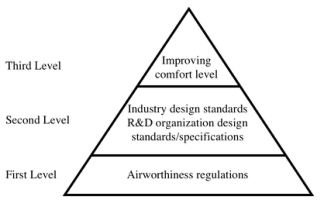
Figure 1: Three levels of ergonomic evaluation objectives of cockpit layout proposal.
EVALUATION OBJECTIVES The objectives of ergonomics evaluation of civil aircraft cockpit layout pro- posal are to ensure that the objects of evaluation comply with relevant airworthiness regulations [2], meet industry standards and specifications, such as SAE ARP4101, MIL-STD-1472, etc., and improve comfort level, if possible, following an order of levels as shown in Figure 1.
(a) The first level: requirements relevant to ergonomics, as required in airworthiness regulations, are objectives that must be met; (b) The second level: ergonomics design standards and/or specifications, published as industry standards or by research and development organizati- ons, are objectives that should be met;
(c) The third level: in addition to the above-mentioned two levels, further improving the comfort level of the cockpit, are objectives that can be met.
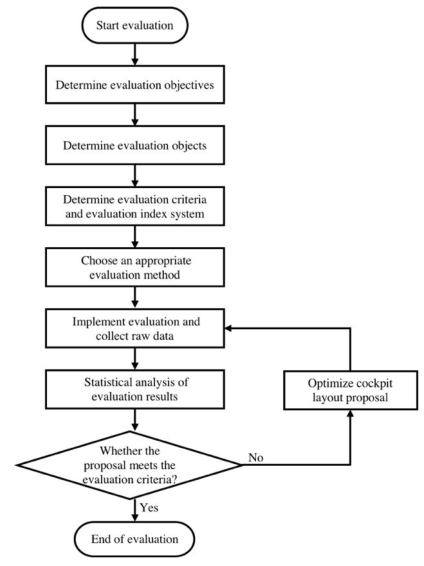
EVALUATION PROCESS A general process of cockpit ergonomics evaluation is shown in Figure 2. This process is applicable to the cockpit layout ergonomics evaluations of diffe- rent development phases. Prior to the evaluation, one should first determine the evaluation objectives, evaluation objects, evaluation criteria, evaluation index system, and appropriate evaluation method. Then the evaluation can be carried out and the raw data will be collected. Finally, based on analysis of the evaluation results, optimizations to the design of cockpit layout can be proposed.
EVALUATION OBJECTS AND EVALUATION CRITERIA Evaluation Objects
The objects of cockpit layout ergonomics evaluation include the overall layout of the cockpit (such as the layout of the main instrument panel, glareshield, pedestal, overhead panel, and lateral consoles), equipment arran- gement (such as the arrangement of displays, crew seats, emergency equi- pment, etc.), control devices arrangement (such as that of control levers, control switches, etc.), marking and placard position (as for indication or warning information), integrated cockpit environment (such as the vibration and noise, lighting, ventilation environment in the cockpit).
Ergonomics Evaluation Methods for Civil Aircraft Cockpit Layout 3
Figure 2: Evaluation process of civil aircraft cockpit ergonomics.
Evaluation Criteria The following present some evaluation criteria for the five aspects of evalua- tion objects as mentioned in Evaluation Objects.
Evaluation criteria for the overall layout of the cockpit include: The overall layout of the cockpit should allow the minimum flight crew to perform their duties without unreasonable concentration or fatigue; The overall layout of the cockpit should provide the pilots with a sufficiently extensive, clear, and undistorted view.
Evaluation criteria for equipment arrangement include: The emergency equipment in the cockpit should be arranged at a location where it is conve- nient for the pilots to access; The display equipment in the cockpit should be arranged within the best or maximum field of view of the pilots; The auxi- liary equipment in the cockpit should be arranged at a location where it is comfortable for the pilots to operate.
Evaluation criteria for control devices arrangement include: By the princi- ple of frequency of use: control devices that will be used frequently should be placed at a location where it is most likely for the pilots to see or touch. For emergency controls, although their use frequency may be low, they must still be arranged at a location where it can be quickly and conveniently operated by the pilots when needed. By the principle of sequence of use: control devi- ces that will be used during flight in a certain fixed order of use, should be arranged considering the order of use, such as from left to right or from top
4 Zhu and Zhou
to bottom; By the principle of importance, the location of the control devices can be ar-ranged according to their degree of importance, with respect to the realization of system goals. Control devices with higher importance should be arranged at the most convenient areas for pilots to operate or recognize; By the principle of functionality: arrange control devices according to their func-tional relationships, for example, arranging control devices with similar or related functions together.
Evaluation criteria for marking and placard position include: Marking and placard should be positioned at obvious and unobstructed places, to indicate or warn pilots; If marking or placard is used to indicate function and ope- ration of control devices, it should be positioned close to the corresponding control device.
Evaluation criteria for the integrated cockpit environment include: Vibra- tion and noise characteristics of cockpit equipment should not interfere with the safe operation of the aircraft; The air outlets in the cockpit should be able to provide a sufficient amount of uncontaminated air to enable the crew members to perform their duties without undue discomfort or fatigue, and they should be positioned and directed such that the crew members will not feel too cold or too hot; The lighting equipment in the cockpit should be able to provide sufficient illumination to make each instrument, switch and other devices necessary for safe operation easily readable, and they should be positioned and directed such that direct light can be shielded from the pilots’ eyes, and interfering reflections visible to the pilots can be avoided.
EVALUATION METHODS Evaluation Method Based on Digital Model
The evaluation method based on digital model (such as DELMIA, RAMSIS, etc.) is an ergonomics evaluation method developed with technologies such as computer graphics and computer-aided design. Utilizing digital cockpit pro- totype, anthropometric data and test manikins, analysis and evaluation of the ergonomics of the layout can be realized. When performing simulation- based evaluations of the cockpit layout, the first step is to create test manikins and select a suitable anthropometric database representative of the target pilot group. Next, test manikin can be made to simulate the actual opera- ting posture of the pilot in the cockpit with typical flight scenarios. Finally, analysis of field of view, accessibility, and comfort evaluation of the test mani- kin can be performed [3]. The advantage of this kind of evaluation method is that evaluation can be carried out in the early design phases when only digital models are available. Limitations of the method include lacking of feedback from real pilots, as well as the difficulty to assess all evaluation cri- teria, such as those on integrated cockpit environment, due to the limitations of computer technology.
Evaluation Method Based on Virtual Reality Technology The virtual-reality-technology-based ergonomics evaluation method can pro- vide pilots with an immersive cockpit environment without having to
Ergonomics Evaluation Methods for Civil Aircraft Cockpit Layout 5
construct a physical cockpit, and it can provide visual perception and inte- raction feedback for the evaluator (engineers or pilots) with the help of body motion sensing equipment. For virtual-reality-based cockpit evaluati- ons, questionnaires are usually designed for evaluators to provide evaluation comments or to give scores using ergonomics evaluation indexes, so as to obtain evaluators feedback on the cockpit layout proposal. This evaluation method incorporates the evaluator’s feedback into the design iteration pro- cess, which can improve the iterative efficiency of the overall cockpit design proposal prior to detailed design phase, and reduce the likelihood of major design changes in later development phases.
Evaluation Method Based on Engineering Mockup The engineering mockup is one of the indispensable physical prototypes in the cockpit development process. The purpose of the engineering mockup is to verify the design status against the requirements of airworthiness regu- lations during the development process. It is a platform for the review of cockpit design before exiting the detailed design phase, and also for the Civil Aviation Administration (certification authority) to conduct verification acti- vities. As development progresses, the engineering mockup platform will also be gradually upgraded, and the overall layout, equipment/control devices arrangement, and human-machine interaction interfaces in the cockpit will be getting close to that of the final design. Pilots can be invited to evalu- ate the ergonomics of the cockpit layout proposal on this platform based on simulated flight tasks. This kind of evaluation method can provide the pilot with real touch feel, force, sound and interactive feedback, which allows the pilots to give more accurate evaluation comments, improving the reliability of evaluation data.
Evaluation Method Based on On-Aircraft Ground Test The on-aircraft ground test is an ergonomics evaluation test based on pro- totype aircraft. The evaluation object of this test is the cockpit layout proposal of the trial production and verification phase, and the layout pro- posal has been fully realized on the prototype aircraft. The purpose of the evaluation is to confirm whether human body characteristics are fully con- sidered in the design process, such as human body measurements, operating habits, vision, hearing, and fatigue, so that it meets the actual needs of pilots of different height. The evaluation can also provide references for cockpit design optimizations, and support for subsequent certification activities. As the on-aircraft ground test can be carried out with just the aircraft being powered on, it does not have very strict requirements on test personnel qualifications (i.e. can be pilots or engineers) and test conditions.
Evaluation Method Based on Flight Test Flight test on prototype aircraft can also be used as a way to perform cockpit ergonomics evaluation. Flight test is mainly used to verify evaluation objects that may be affected by aircraft status and flight conditions. For example,
6 Zhu and Zhou
Table 1. Corresponding relations between evaluation objects, methods and development phases.
Table available in the original PDF paper.
Evaluation object Phase 1 Phase 2 Phase 3 Phase 4 Overall Layout 1,2 1,2,3 1,2,3 4,5 Equipment Arrangement 1,2 1,2 1,2,3 4,5 Control Devices Arrangement 1,2 1,2 1,2,3 4,5 Marking and Placard Position 2 2 2,3 4,5 Integrated Cockpit Environment 2 2 2,3 4,5 1: Evaluation method based on digital model; 2: Evaluation method based on virtual reality technology; 3: Evaluation method based on engineering mockup; 4: Evaluation method based on on-aircraft ground test; 5: Evaluation method based on flight test.
Remark 1. Phase 1 refers to requirements and concept validation phase; Phase 2 refers to preliminary design phase; Phase 3 refers to detailed design phase; Phase 4 refers to trial production and verification phase.
when confirming whether the vibration and noise characteristics of the cock- pit equipment affect the safe operation of the aircraft, the aircraft needs to go through a complete typical flight profile, including take-off, climb, cruise, descent, and landing. Other examples include when confirming whether the overall cockpit layout can provide a sufficiently wide, clear and undistorted field of view for the pilot, or evaluating the arrangement of lighting equi- pment, it would require the aircraft to go through a complete flight profile, in both day and night conditions. The cost of flight test is high and it has more strict requirements on test personnel (i.e. tests pilots required) and test conditions.
Recommendations for Evaluation Method Selection In the early phases of cockpit design, such as the requirements and concept validation phase and the preliminary design phase, much uncertainty exists in the design of cockpit layout and there is large room for adjustments. The purpose of cockpit layout evaluations at this time is to improve ergonomics. The variability of layout proposal at this time makes it uneconomic to invest too much in the materialization of the cockpit layout proposal. Therefore, in the early phases of the cockpit development process, software simulation or virtual reality-based methods are often used to evaluate the ergonomics design of the cockpit layout.
In the later phases of cockpit design, such as in the detailed design phase, trial production and verification phase, the design of cockpit layout is nearly finalized, and room for adjustments is small. The purpose of cockpit layout evaluations at this time is to confirm the cockpit’s ergonomics design, making sure that there are no ergonomics issues with the cockpit layout that may affect safety of the flight or have a major impact on pilot’s work efficie- ncy. Evaluations at this phase need to be based on a physical cockpit in order to provide a more realistic experience, allowing interactive operations of the objects being evaluated. Therefore, in the later phases of the cockpit
Ergonomics Evaluation Methods for Civil Aircraft Cockpit Layout 7
development process, ergonomics evaluations of the cockpit layout are car- ried out more in ways of simulation tests based on engineering mockups, or ground or flight tests with prototype aircraft.
For different objects of evaluation, recommended cockpit layout evalu- ation methods at different development phases are shown in the following Table 1.
CONCLUSION
The ergonomics design of a cockpit plays an important role in the design of civil aircraft, it is an important index to evaluate how well the overall design of the cockpit is. During the cockpit layout design process, different ergono- mics evaluation methods should be introduced, and the differences in pilot group’s body measurements and operating habits should be fully considered. Evaluation method should be selected taking account of different cockpit development phases and the characteristics of the objects being evaluated, in order to improve evaluation efficiency and achieve evaluation goals.
REFERENCES
He D, Zhao Y, Qian Z.: COMAC Systems Engineering Manual. Shanghai Jiao Tong University Press (2017), (in Chinese). Pei H, Ding Y, Jiang Y, GAO Z, SHI H.: Research on Conformity Certification and
Evaluation Methods of the Cockpit Ergonomics for Civil Aircraft. J. Civil Aircraft Design & Research. 127, 52—57 (2017), (in Chinese). Zhu X, Zhu H, Jin Z, Zhang Y.: Physical Ergonomics Design and Evaluation of Civil Aircraft Cockpit Control Devices. In: AHFE 2021, LNNS 273, pp. 338–345, 2021. https://doi.org/10.1007/978-3-030-80713-9_43
LISTED IN THE AHFE DIGITAL BOOKSTORE CATALOGUE
Explore the complete digital volume
Physical Ergonomics and Human Factors
Read this individual research paper free through the original publisher, or explore the full digital proceedings book.
ISBN 978-1-958651-39-1
Explore this ISBN in the AHFE Bookstore ↗Listed in the July 2026 bookstore catalogue; search by ISBN to confirm current availability · Digital book purchase optional