With the rapid development of smart cockpit due to technological progress, the use scenario and user behavior of the in-cockpit users have changed dramatically. Automation and interconnection have greatly enriched the HMI (human-machine interaction) experience in the SCS (smart cockpit systems), the designs and researches conducted by researchers and designers from the perspective of traditional automobile interior layout will be greatly limited by these changes. We summarize the changes in cockpit layout caused by the development of human-machine experience in the smart cockpit systems, and present a design framework for smart cockpit design that includes design space. The framework consists of four parts: intelligent display area, seat space, smart peripherals and driving components. This research and framework provide new ideas and inspirations for the division of cockpit interior layout in design research, and provide guidance for the design of smart cockpit as a tool.
The integration of advanced digital technologies such as computer algori- thms and automation has resulted in a significant transformation in the utilization patterns and habits of vehicle users. The driving responsibilities of drivers have been largely assumed by the vehicle-machine system, affor- ding users more leisure time and space (Reimer et al. 2016) and significantly enhancing the potential for interaction and experience within the vehicle inte- rior. Consequently, this shift has fueled the advancement of the operational mode, interactive media, and user experience of the smart cockpit system, significantly expanding its scope beyond the traditional boundaries of a car interior space (Sun et al. 2018). The requirements of users for human-vehicle interaction have also evolved from being focused on safety and comfort to encompassing the entire cockpit experience within the system (JIN, 2016).
The field of automotive interior design is influenced by a multitude of factors, with a trend towards declining representation of designs that solely fulfill basic functions in the design development process (Lidwell et al.
Smart Cockpit Layout Design Framework Based on Human-Machine Experience 217
2010). The functional needs of the smart cockpit, along with shifts in human-machine interaction (HMI) and user behavior, will directly result in alterations to the interior arrangement and design of components.
The aim of this study is to assess the impact of HMI on the organiza- tion and arrangement of the cockpit, with the assumption that the smart cockpit experience will be significantly enhanced. A comprehensive design framework will be proposed and integrated into the design space to serve as a foundation for the reorganization and division of the layout and structure of the smart cockpit. This framework will provide a basis for future design efforts by offering guidance and tools.
THE TRANSFORMATION OF THE SMART COCKPIT SYSTEM The concept of a “smart cockpit” refers to a cockpit that has been equipped with advanced technologies and internet-connected products, allowing for interaction with individuals (Sun, 2018). The evolution of the smart cockpit has been driven by the ongoing development and integration of cutting-edge technologies, advancements in infrastructure, and research in automation. As a result, the smart cockpit has transformed into a highly intelligent mobile environment, constituting a third living space beyond the traditional driving context and singular task-based environment (Dattatreya, 2016).
Previous research on human-vehicle interaction has primarily centered on the relationship between automotive technology and human factors, such as driving tasks, driver environment, advanced driver assistance systems, and external communication access (Akamatsu et al., 2013). With the advancement of technology, automobile companies have integrated display application technologies, such as heads-up displays (HUD), virtual reality HUD, and holographic projections, as well as interactive technologies, such as gesture interaction and voice recognition, into smart cockpit systems (HARMAN, 2017). This has resulted in a shift towards an intelligent, interactive experience, as evidenced by the following changes.
Human-Vehicle Dual Subject Mode In human-vehicle interaction, there will be a growing emotional connection between users and intelligent systems. The advancement of autonomous dri- ving and the integration of intelligent assistants will allow users to experience a personalized emotional connection with the car-machine system in the cockpit. For instance, NIO’s mass-produced ES8 model, showcased at the 2017 Shanghai International Auto Show, features the intelligent voice assi- stant NOMI. In the future, drivers and passengers will also have greater trust in the advanced safety features of the vehicle, which will demonstrate a level of care for the driver. Additionally, the trend of HMI towards Human-Robot Interaction (HRI) will leverage advancements in artificial intelligence and robotics to provide users with a personalized, humanized experience through autonomous learning (Sun et al., 2018). In human-vehicle interaction, both the human and the vehicle will be the primary entities simultaneously.
218 Zhang and Zhao
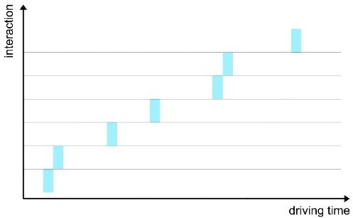
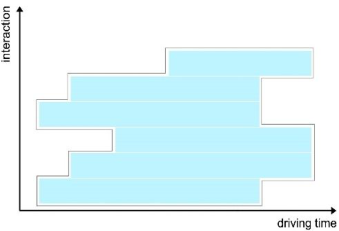
The Holistic HMI Determines the Scenarization of Interaction Behavior As vehicles become increasingly automated and interconnected, drivers are gradually relieved from driving responsibilities. The development of the mul- timodal user interface (MUI) has greatly improved the user experience in the cockpit (Song et al. in 2022). The distinction between driving and other tasks is becoming increasingly blurred. The architecture of the cockpit is moving beyond its traditional focus on driving as the main task, necessitating the integration of rich infotainment systems and multi-task dynamic frameworks into HMI design. The interaction within the cockpit has evolved from single, isolated behaviors (see Figure 1) to a more integrated, scenario-based expe- rience of the overall HMI multi-modality (see Figure 2). The latter exhibits a seamless integration of time and space, eliminating boundaries and creating a cohesive experience.
Increase in the Intelligent Display Area The proliferation of electronic display screens in the cockpit is an inevita- ble outcome of the automotive industry’s shift towards digital interaction, and appears to be an irreversible trend. The advancement of display tech- nologies, such as the widespread adoption of OLED displays and electronic rearview mirrors, as well as the emergence of head-up displays and the trend towards displaying content on side windows (Dattatreya, 2016), has resul- ted in an increase in the number and display area of displays in automotive
Figure 1: Single interaction behavior within the cockpit.Figure 2: The holistic HMI presents scenarized interaction.
Smart Cockpit Layout Design Framework Based on Human-Machine Experience 219
interior design. The concept car displayed by Bosch at CES 2016 showcases a large-area digital display and seamless digital interaction, while Porsche, with its mechanized heritage, introduced the Mission E concept car with a large display screen at IAA 2015 Frankfurt, followed by the mass-production of the Taycan in 2020. The ongoing development and refinement of the car-machine system has greatly improved the efficiency and convenience of on-screen inte- raction compared to traditional physical inputs, while also strengthening the operation logic and integrity. The transplantation of smart mobile terminal UI further erodes the boundaries of the smart cockpit, and the trend towards electronic displays is being accelerated by companies such as Tesla.
Chang in the Human-Vehicle Interaction Mode Within the Cockpit Compared to the traditional car’s singular method of physical input inte- raction, increasingly intelligent and efficient multi-sensory interaction has emerged and developed. The design and approach to cockpit interior infor- mation and content has shifted from focusing on the physical input of a single central control and instrument panel to seamless interaction across displays, and from static predefined content to a fluid exchange of information betw- een devices, voice, and various forms of interaction such as gestures. This diversification and complexity of interaction methods has replaced the singu- lar interaction method of the past. Hongqi showcased a full-voice interactive concept cockpit at the 2018 Beijing International Auto Show, completely eli- minating physical input interaction. To reduce the cognitive and operational burden of voice interaction on the driver, digital assistants are widely ado- pted in new energy vehicles. The technical capabilities for gesture input have also advanced, and the diversification of input command methods enhances the feasibility of in-vehicle operation, making it more similar to the opera- tion mode of smart devices (Sun and Li, 2014). Additionally, the autonomous learning of intelligent systems can provide users with an increasingly intelli- gent and humanized experience. The changes in interaction methods not only improve the safety and comfort of human-vehicle interaction, but also make the entire cockpit an intelligent interaction interface (Sun et al. 2018).
Increase of Intelligent Peripherals Within the Cockpit The integration of advanced hardware and technology into the smart cockpit has become increasingly prevalent. The incorporation of VR/AR and car assi- stants enhances the range of interaction options available to users within the cockpit. The use of graphics processing units and multi-sensory sensors, such as those capable of detecting facial expressions and movements, has enabled the creation of user behavior models. The widespread adoption of 5G and the Internet of Vehicles has greatly improved the user experience in the driving field. For instance, the car-machine system of WM Motor supports intercon- nectivity with smart homes. The use of cameras and eye-tracking equipment to collect data on the driver’s face, emotions, and state has become incre- asingly common in the intelligent system of the smart cockpit (HARMAN, 2017). The addition of augmented and virtual reality devices, as well as smart assistants, has become essential for the development of the intelligent cockpit.
220 Zhang and Zhao
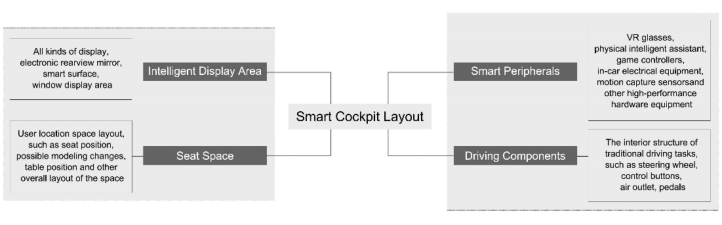
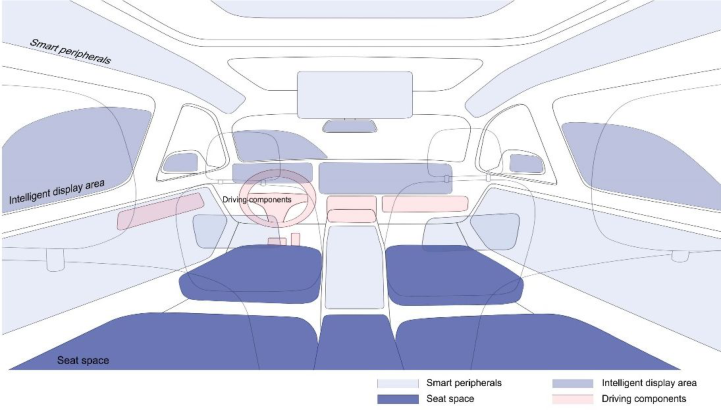
SMART COCKPIT LAYOUT DESIGN FRAMEWORK A framework for cockpit layout design is proposed based on the analysis of human-machine interaction in the smart cockpit (see Figure 3). The framew- ork is designed to provide a new smart cockpit space, which is guided by the latest developments in the Smart Cockpit System, to meet the needs of cockpit design. Additionally, the framework was incorporated into the architecture of the newly designed smart cockpit space (see Figure 4).
Smart display area: Different types of displays found within the cockpit, such as electronic rearview mirrors, smart surfaces, window display areas, and head-up displays.
Seat space: The arrangement of the user’s seating position within the cockpit, designed to accommodate the desired experience and interactive functions. This includes elements such as the position of the seat, its potential shape modifications, and the placement of any accompanying tables.
Smart Cockpit Layout Design Framework Based on Human-Machine Experience 221
Smart peripherals: Hardware Devices established to facilitate interactive functions, including high-performance devices like VR glasses, physical smart assistants, game controllers, in-car electrical equipment, and motion sensors.
Driving parts: The components within the car that are involved in traditi- onal driving tasks, such as the steering wheel, control buttons, air vents, and pedals, prior to full automation.
DISCUSSION
Prior research has explored and established design principles for multi-modal multi-tasking in cockpit environments (Wang et al. 2018). This study, how- ever, concentrates on the framework of cockpit layout in the context of evolving human-computer interaction experiences, with the aim of offering a guide for intelligent cockpit design and analysis. The framework will serve as a basis for future design practices. Nonetheless, further validation of the framework is required, and the design space configuration should be continu- ously improved and adapted with the integration of new cockpit components through practical implementation.
CONCLUSION
This study endeavors to provide a comprehensive framework for the design of cockpit layout and interior styling in the context of the evolving human-machine interaction experience in the smart cockpit. The proposed framework encompasses four components that incorporate current cockpit designs and integrate new design concepts for the interiors of vehicles. The framework offers innovative approaches and resources for researchers and designers to advance the field of smart cockpit interior design and further investigate intelligent cockpit layout design.
ACKNOWLEDGMENT
The authors would like to acknowledge. This research is supported by Para- digm Construction and Theoretical Boundary of Design Research, National Social Science Foundation (20BG103).
REFERENCES
Akamatsu, M., Green, P., & Bengler, K. (2013). Automotive Technology and Human Factors Research: Past, Present, and Future. International Journal of Vehicular Technology 2013, 1–27. Dattatreya, P. H. (2016). 22-1: Invited Paper: Future Automotive Interiors - The 3rd
Living Space. SID Symposium Digest of Technical Papers 47, 263–266. Fangli Song, Wei Wang, Hongnan Lin, Yuanqing Tian. (2022). A framework for designing the seamless automotive multimodal experience in future connected and autonomous vehicles. Presented at the DRS2022: Bilbao. JIN Sheng-hui. (2016). The Interior Design and Research of Aisn’s Electric Car[D].
Changsha: Hunan University.
222 Zhang and Zhao
Lidwell W, Holden K, Butler J. (2010). Universal principles of design, revised and updated: 125 ways to enhance usability, influence perception, increase appeal, make better design decisions, and teach through design[M]. Rockport Pub. Motoyuki Akamatsu, Paul Green, Klaus Bengler. (2013). Automotive Technology and Human Factors Research: Past, Present, and Future. https://news.harman.com/releases/harman-demonstrates-advanced-connecte d-car-platform-for-industry-leading-intelligent-cockpit. Reimer, B., Pettinato, A., Fridman, L., Lee, J., Mehler, B., Seppelt, B., Park, J., &
Iagnemma, K. (2016). Behavioral Impact of Drivers’ Roles in Automated Driving, in: Proceedings of the 8th International Conference on Automotive User Interfaces and Interactive Vehicular Applications. Presented at the AutomotiveUI’16: 8th International Conference on Automotive User Interfaces and Interactive Vehicular Applications, ACM, Ann Arbor MI USA, pp. 217–224. Sun, X., Chen, H., Shi, J., Guo, W., & Li, J. (2018). From HMI to HRI: Human- Vehicle Interaction Design for Smart Cockpit, in: Kurosu, M. (Ed.), Human- Computer Interaction. Interaction in Context, Lecture Notes in Computer Science. Springer International Publishing, Cham, pp. 440–454. Sun, X., Wu, S., Zhang, S., Wang, H. (2019). Mixed Reality-Based Platform for Smart
Cockpit Design and User Study for Self-driving Vehicles, in: Karwowski, W., Ahram, T. (Eds.), Intelligent Human Systems Integration 2019, Advances in Intelligent Systems and Computing. Springer International Publishing, Cham, pp. 448–459. Wang, W., Zhou, F., Li, W., & Budd, J. (2018). Designing the product-service system for autonomous vehicles. IT Professional, 20(6), 62–69. Xiaohua Sun, Tong Li. (2014). Survey of studies supporting the use of in-air gesture
in car HMI. UXPA, China.
LISTED IN THE AHFE DIGITAL BOOKSTORE CATALOGUE
Explore the complete digital volume
Ergonomics In Design
Read this individual research paper free through the original publisher, or explore the full digital proceedings book.
ISBN 978-1-958651-53-7
Explore this ISBN in the AHFE Bookstore ↗Listed in the July 2026 bookstore catalogue; search by ISBN to confirm current availability · Digital book purchase optional