Yuhao Jiang, Danhua Zhao (2023). Shaping Multiple Values: Research Characterization of DRS Conferences. In: Ergonomics In Design. AHFE Open Access, vol. 77, pp. 186–192. https://doi.org/10.54941/ahfe1003375
The time-space distribution of conference papers, significant authors, and research themes were studied from three perspectives using the bibliometric method to analyze the research characteristics of DRS conferences. Regarding the papers' time-space distribution, it exhibits a general rising trend in the time sequence and mostly concentrates on the design of inclusion, happiness, and health. In terms of significant authors, two academic communities, one centered on Lancaster University and the other on the Delft University of Technology, were established. Design education, service design, participatory design, inclusive design, design methodology, and social design are the six main research themes that have emerged from DRS research. The main traits of DRS conferences are shaping multiple values, as this study demonstrates.
The Design Research Society is an academic organization that was establi- shed in the 1960s during the British design method movement to further design research. It was the first organization in the world to do comprehen- sive research on all facets of the design process (Hu & Shi, 2022). Because of its professional and cutting-edge focus, the Design Research Society’s bien- nial DRS conference is acknowledged by the international design research academic community for its academic contributions and value. Beck (Beck & Chiapello, 2018) used the DRS conference as the focus of their investi- gation into the dissemination of Schön’s scholarly ideas in the field of design studies. Meanwhile, design studies are increasingly using bibliometric metho- dologies, which offer the benefit of big data analysis. Bibliometric techniques were utilized by Chai and Xiao (Chai & Xiao, 2012) to analyze the Design Studies research landscape. Xu Jiang (Xu, 2019) builds a knowledge map of design meta-research using a bibliometric technique. DRS conferences are intended to offer a public forum for design research scholars from all around the world to discuss recent advancements in the field. This study examines the research characteristics of the last three DRS conferences using a bibliometric approach (2022, 2020, 2018).
Shaping Multiple Values: Research Characterization of DRS Conferences 187
REVIEW OF PREVIOUS DRS CONFERENCES AND RESEARCH METHODS Since 1971, DRS Conferences, which reflect the broad field of design research, have been held; a summary of the last 10 conferences is provided in Table 1. Value, thinking, and future are phrases that frequently appear in the conference topics, which reflects a strong sense of exploration and speculativeness.
The papers published in the most recent three DRS conferences (DRS- 2022, DRS-2020, and DRS-2018), totaling 679 papers, were chosen as the data set for this study. The research data in this paper were gathered from the official digital library of DRS conferences. With the use of the bibliometric information visualization tool VOSviewer, the research characteristics of DRS conferences were examined from three aspects using a bibliometric appro- ach: the time-space distribution of conference papers, significant authors, and research themes (van Eck & Waltman, 2010).
THE TIME-SPACE DISTRIBUTION OF CONFERENCE PAPERS Timing Distribution
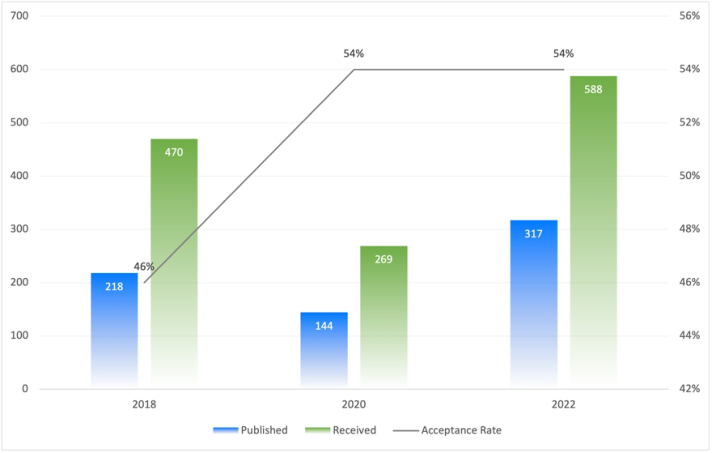
Figure 1 depicts the basic organization of the papers from the previous three DRS conferences following analysis. DRS-2018 received 470 submissions, of which 218 were accepted and published, as can be seen in the figure. Of the 269 submissions to DRS-2020, 144 were accepted and published. 317 of the 588 submissions to DRS-2022 were accepted and published. After the temporary decline of DRS-2020, there is a general rising tendency in the quantity of publications. From 46% in DRS-2018 to 54% in DRS-2022, the acceptance rate increased and remained stable.
Space Distribution The DRS conference provides contributors with a thorough research track that has strong directional guidance each year. After analysis, there are 25 Tracks in DRS2018, and the Tracks with high publication volume are Tools of Design(15), Health and Wellbeing by Design(15), Design Education(14),
Table 1. Summary of the most recent DRS 10 conference.
Table available in the original PDF paper.
Conference Title Theme DRS-2022 Bilbao DRS-2020 Synergy DRS-2018 Catalyst DRS-2016 Future-Focused Thinking DRS-2014 Design’s Big Debates DRS-2012 Uncertainty Contradiction Value DRS-2010 Design and Complexity DRS-2008 Undisciplined! DRS-2006 Wonderground DRS-2004 Futureground
188 Yuhao and Danhua
Figure 1: Timing distribution of the papers from the most recent three DRS conferences.
Inclusive Design(11), Design, Research and Feminism(11). DRS2020 con- tains a total of 40 Tracks. Inclusive Design, Sustainability, Design Innovation Management, Wellbeing, Happiness and Health, Global Health, Design Pedagogy, Tangible, Embedded, and Networked Technologies are the high volume Tracks in DRS2020, each with 6 articles. 52 Tracks are in DRS-2022, and the high-volume tracks are Rethinking design for a complex world(16), Futures of design education(14), Design methods and transdisciplinary pra- ctices(12), Design for policy and governance(11), Wellbeing, happiness, and health(11), Inclusive design practice and healthy aging (11), Valuing the qualitative in design and data(11).
Overall, the DRS conference revolves around design for happiness, health, and inclusion, with a high volume of Track postings around design for health and well-being, design education, inclusive design, sustainable design, design management, game design, policy and governance design, and healthy aging. It is worth mentioning that in the 2022 session, there are Tracks related to technology, materials, artificial intelligence, and other new materials and tools, such as Biodesign, AI and the conditions of design, Legal Design, Designing with bodily materials, food+ design, etc.
SIGNIFICANT AUTHORS The significant scholars who have made excellent contributions and garne- red the most attention in the area are shown through an examination of the authors of the papers from the previous three DRS conferences. Table 2 shows the outcomes of data cleaning and publication analysis of the authors. With 11 articles published, Paul Coulton of Lancaster University in the UK
Shaping Multiple Values: Research Characterization of DRS Conferences 189
Table 2. Significant authors.
Table available in the original PDF paper.
Author Institute Research Direction Number of Articles Paul Coulton Lancaster university Design fiction 11 Farnaz Nickpour Liverpool university Inclusive design 7 Emmanuel Tsekleves Lancaster university healthcare design 7 Geke Ludden University of Twente Emotion and experience 6 Rebecca Price Delft University of Technology Design thinking 5 Rachel Cooper Lancaster university Design management 5 Peter Lloyd Delft University of Technology Design process 5 Joseph Lindley Lancaster university HCI 5
has the most. Both Lancaster University’s Emmanuel Tsekleves and Liverpool University’s Farnaz Nickpour had seven papers. Six essays were written by Geke Ludden of the University of Twente. Peter Lloyd (Delft University of Technology), Rebecca Price (Delft University of Technology), Rachel Cooper (Lancaster University), and Joseph Lindley (Lancaster University) have all published five publications. Two institutions, Lancaster University and the Delft University of Technology, respectively, are at the center of the academic community.
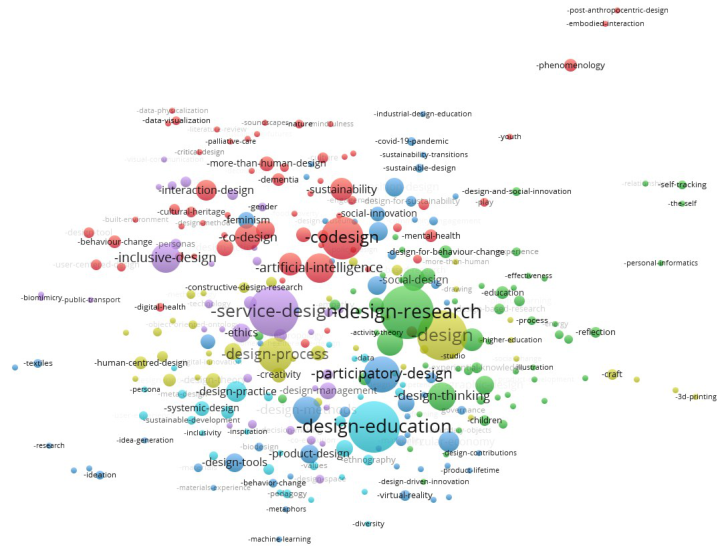
RESEARCH THEME In order to examine the research themes of the previous three DRS confere- nces, the keywords of the papers in the database were extracted, as shown in Figure 2, and the keyword co-occurrence analysis feature of VOSviewer was employed. The six core research themes of the DRS conferences—design edu- cation, service design, participatory design, inclusive design, design methods, and social design—were identified by clustering the keyword co-occurrence network.
The first theme, Design Education, is focused on the study of design edu- cation methods. From the Bauhaus era to the present, studio pedagogy has been one of the concerns in the field of design education due to design’s strong practical features and the wealth of tacit knowledge it includes. Because of the COVID-19 epidemic, the studio’s prominence in design education has been called into question. Instead of using physical studios for studying and teaching, educators are instead using distance learning and online teaching techniques (Marshalsey & Sclater, 2020). Additionally, one of the focuses of this theme is the study of reflective and critical pedagogy in design education.
The second theme, Service Design, focuses on how service design is used in various fields to provide value. The practice of service design is centered on brand design, innovation in public organizations, design for happiness and well-being, social governance, public health, etc. The application of design thinking in organizational innovation and public affairs is the most concerning of them.
Participatory Design is the third theme. Participatory design’s two main themes are “Participation”and “Empowerment.”More emphasis is placed on participatory design’s mechanisms as a co-creative strategy in several fields of
190 Yuhao and Danhua
Figure 2: Keywords co-occurrence map of the most recent three DRS conferences.
practice (Khan et al., 2020). While empowerment, on the other hand, emph- asizes the value innovation of participatory design throughout the design process (Coupe et al., 2020).
Fourth theme: Inclusive Design. The elderly, those with chronic diseases, and children are among the unique populations that the inclusive design focu- ses on. Perspectives, Guidance, and Reflections are the three areas of inclusive design that the DRS conference focuses on. Considering inclusive design from many angles is referred to as the perspective level. The reflection level refers to suggesting improvements based on an analysis of current practices, whe- reas the guidance level relates to offering concrete advice for inclusive design practice.
5th theme: Design Methods. More and more, interdisciplinary collabora- tion between designers, scientists, governments, and individuals is necessary to address complex societal issues. Design is viewed as a “bridge” discipline in this interdisciplinary context, working as a “glue” (van der Bijl-Brouwer, 2022). Tensions and Opportunities are the two key views in this new rela- tionship, where techniques and tools have emerged as the center of design research. Tensions represents the study of design epistemology and methodo- logy from a reflective and critical perspective (Saito, 2022). Opportunities, from a constructivist perspective, represent the creation of new techniques, instruments, and roles (Peukert, 2022).
Sixth theme: Social Design. Today, design has been argued to be more widely opposed to, or at the very least a substitute for, reified, abstract,
Shaping Multiple Values: Research Characterization of DRS Conferences 191
and “uncaring” ways of knowing (Buchanan, 2001). This designerly cogni- tive paradigm emphasizes the study of social design practices as a means of comprehension and knowledge acquisition, turning society into the object of design.
In 1973, Horst Rittel and Melvin Webber first introduced the wicked pro- blem as a new problem type. The components of complexity, diversity, and uncertainty all interact and overlap in this kind of problem (Head & Alford, 2015). According to Donald Schon, the design process engages in reflective practice and a continuous conversation with the context when attempting to solve such ill-structured problems. In 2011, Dorst made the argument that design is a framing frame (Dorst, 2011) and that design, as a “frame,” may frame not only a product to solve the micro-cycle design challenge but also frame an enterprise to solve the full-cycle design process. Design is the itera- tive process of framing and reframing between HOW and VALUE, and the DRS conference is focusing on design issues in the fields of design educa- tion, service design, participatory design, inclusive design, design methods, social design, etc., and shaping multiple values through the way of value construction.
CONCLUSION
This study, which is based on the bibliometric approach, analyzes the research characteristics of the last three DRS conferences from three perspectives: the time-space distribution of conference papers, significant authors, and rese- arch themes, revealing its key characteristic: shaping multiple values. The spatio-temporal distribution of papers, which mostly focuses on the design of happiness, health, and inclusion in terms of space, exhibits an overall rising tendency in terms of chronology. A scholarly community focused on two universities, Lancaster University and the Delft University of Technology, respectively, has emerged in terms of significant authors. Design education, service design, participatory design, inclusive design, design methodology, and social design are the six main research themes that have emerged from DRS research. The main traits of DRS conferences are shaping multiple values, as this study demonstrates.
ACKNOWLEDGEMENT
This research is supported by Paradigm Construction and Theoretical Boun- dary of Design Research, National Social Science Foundation (20BG103), and the Chongqing Natural Science Foundation: Human Factors Program Design of Intelligent Internet Products (CSTB2022NSCQ-MSX1463).
REFERENCES
Beck, J., & Chiapello, L. (2018). Schön’s intellectual legacy: A citation analysis of DRS publications (2010–2016). Design Studies, 56, 205–224. Buchanan, R. (2001). Design Research and the New Learning. Design Issues, 17(4),
3–23.
192 Yuhao and Danhua
Chai, K.-H., & Xiao, X. (2012). Understanding design research: A bibliometric analysis of Design Studies (1996–2010). Design Studies, 33(1), 24–43. Coupe, G., Whitham, R., Cruickshank, L., Perez, D., & Pearson, B. (2020, September
10). Co-designing tools to empower further, independent co-design: Collaborating with diverse individuals with lived experience of food poverty. Design Research Society Conference 2020. Dorst, K. (2011). The core of ‘design thinking’ and its application. Design Studies, 32(6), 521–532. Head, B. W., & Alford, J. (2015). Wicked Problems: Implications for Public Policy
and Management. Administration & Society, 47(6), 711–739. Hu Fei & Shi Jixing. (2022). A 60-year Approach to the Study of British Design Methods. Art& Design Research (04), 50-57. Khan, A. H., Snow, S., Heiner, S., Hardgrove, R., Matthews, S., & Matthews, B.
(2020, September 10). The Politics of Materiality: Exploring Participatory Design Methods, Tools and Practices. Design Research Society Conference 2020. Marshalsey, L., & Sclater, M. (2020). Together but Apart: Creating and Supporting Online Learning Communities in an Era of Distributed Studio Education. International Journal of Art & Design Education, 39(4), 826–840. Peukert, D. (2022, June 16). Material metaphors: An approach to collabora-
tive knowledge production in transdisciplinary sustainability research. DRS2022: Bilbao. Saito, C. (2022, June 16). Coming to terms with design wickedness: Reflections from a forum theatre on design thinking. DRS2022: Bilbao. Van der Bijl-Brouwer, M. (2022, June 16). Design, one piece of the puzzle: A conce-
ptual and practical perspective on transdisciplinary design. DRS2022: Bilbao. Van Eck, N. J., & Waltman, L. (2010). Software survey: VOSviewer, a computer program for bibliometric mapping. Scientometrics, 84(2), 523–538. Xu Jiang. (2019). Restricted View on Design Meta-Research from the Perspective of
Knowledge Graph. Zhuangshi (10), 46-51.
LISTED IN THE AHFE DIGITAL BOOKSTORE CATALOGUE
Explore the complete digital volume
Ergonomics In Design
Read this individual research paper free through the original publisher, or explore the full digital proceedings book.
ISBN 978-1-958651-53-7
Explore this ISBN in the AHFE Bookstore ↗Listed in the July 2026 bookstore catalogue; search by ISBN to confirm current availability · Digital book purchase optional