Intelligent cabin is a space that provides users with interaction information during vehicle movement, but in current research, the description model of intelligent cabin interaction design is framed by input-output and focuses only on actions and feedback, but in a multi-touchpoint cabin, the relationship between the interaction medium and the user's spatial location is equally important. Therefore, this paper attempts to refine the spatial description model of interaction touchpoints and interaction behaviors in the cabin based on the existing spatial model-related literature and the cabin interaction design practice to help interaction designers in related fields identify and solve the human-computer relationship issues in the intelligent cabin more comprehensively. The addition of the spatial dimension will expand the concept of interaction touchpoints in the cabin, which will be beneficial to the design of intelligent cabin interaction in both the concept development and design expression stages.
As the vehicle evolves toward intelligent automation, its role is quietly chan- ging. The vehicle is no longer just a mobility tool, and more and more people tend to spend more time in the cabin, as the addition of social, entertainment, and work functions make the cabin a multifunctional third space (Kern and Schmidt, 2009). When thinking about the intelligent intelligent cabin sce- nario from a spatial perspective, the focus of our research will shift from a single driver to all passengers in the front and rear rows, and the role of the driver will blur into a passenger when fully automated driving is realized in the future. The focus on digital touchpoints will also shift from the front screen to a physical or virtual medium displayed in the whole cabin. Multi- touchpoint and multi-user are the important features of the future intelligent cabin space, digital touchpoints are distributed in the cabin space, different people interact with different or the same touchpoints to generate action, and information flow between touchpoints.
With this new spatial perspective, the traditional interaction design descri- ption model based on the input-output framework is no longer applicable, which only focuses on actions and feedback, ignoring the layout of diffe- rent interaction media and their spatial location in relation to the user. The integration of automotive styling and interaction design also raises the impor- tance of spatial perspective. If spatial relationships are not described, it will be difficult for interaction designers to advance the project in the stages of concept definition, detail design, and communication with stylists for intel- ligent cabins. On the basis of this background, this paper introduces the current literature on spatial descriptions and summarizes three types of spa- tial expression patterns applicable to intelligent cabin interaction design from design practice, each of which has its own characteristics and can be used in different design stages to help designers comprehensively identify and solve human-machine relationship problems.
PERSPECTIVE IN SPATIAL DESCRIPTIONS Knowledge about space was one of the first forms of knowledge used by humans, but descriptions of space may vary from person to person. Spa- tial language theorists classify three frames of reference commonly used for description: viewer-centered, object-centered, and environment-centered. The observer-centered frame of reference emphasizes the action and expe- rience of the observer in a larger space, while the object-centered frame of reference is a holistic observation of the state and layout of the space. Alth- ough the other-centered frame of reference may be counterintuitive, it is more like transposition, and may help to predict understanding of someone’s acti- ons in the space, while also making it easier to notice all things and people in the space. This perspective is more suitable for designers to understand the space in the context of intelligent cabin interaction design.
In terms of design research, the first relevant studies categorized the input and output devices and their locations in the cabin in the form of a tabular linkage but were still limited to a driver-centric front view. Recent researchers have reviewed the location of new sensors and new modalities in the cabin for different levels of autonomous driving, using multiple side views with perspective to represent the cabin space. Outside of cabin interaction design, which also involves the study of multi-user interaction behavior in public and semi-public spaces, Eva Eriksson proposes a Four Space Model that inclu- des interaction space, social space, physical space, and digital space. This classification model shows designers the components of a space that needs to be designed. How these elements are integrated into the cabin space and described is the focus of this paper.
SPATIAL DESCRIPTION OF THE INTELLIGENT CABIN DESIGN PROCESS From the above study, researchers and designers currently do not have spe- cific tools to analyze and depict the cabin space. The introduction of spatial description mode can help designers explore the digital contact points and
Spatial Views in Intelligent Cabin Interaction Behavior and Touchpoints Design 587
multi-user interaction behavior in the cabin at various stages of the project, while the spatial expression can also convey the design ideas of the cabin layout from the styling side to a certain extent. Adding such ideas to the inte- raction design program in advance can enable interaction designers to better understand the intelligent cabin design.
In this paper, we show the activities employed to characterize cabin space touchpoints and interaction behavior in a recent hands-on intelligent cabin design project:
Choose a spatial perspective to help us better examine the arrangement of each digital contact point in the cabin.
Sifted through the spatial elements and thought about how they are connected and how they can help us in the design process.
Model the space, merge the above perspectives and elements in text or graphics, and express the design points.
Spatial Perspective Based on Ullmer-Ehrich’s study of different spatial perspectives (Ullmer- Ehrich, 1982), an other-centered object perspective was chosen, considering the application to cabin design.
The viewer’s self-centered perspective is intuitive to the user (Golledge, 1992) and more immersive in the current environment, but in the first-person view, the mind and eyes are assumed to be facing a specific direction at all times, and the size of the field of view is a relatively fixed range. Therefore, if you want to show the full space in this view, you need to place the viewpoint in the center of the cabin very close to the front or back, when the digital touchpoints on both sides of the viewpoint and the user’s actions may be ignored, and the picture will be more deformed. However, the other-centered object view allows us to be outside the cabin space, which provides us with a map-like reading mode and facilitates us to quickly obtain comprehensive and holistic information about the cabin space and the surrounding envi- ronment. At the same time, given the development of HMIs such as eHMI (Bengler et al. 2020), future cabin digital touchpoints will expand from the interior to the surface of the space and even to the exterior, and the gaze per- spective can also help us to identify new possibilities for user interaction with digital touchpoints in a trend.
Spatial Elements With the help of the Four Space Model (Eriksson, 2011), we identified four categories of elements for the intelligent cabin experience scenario: intera- ction behaviors, user-information dynamics, physical touchpoints, and digital touchpoints.
Interaction behavior is the core of intelligent cabin interaction design, including all kinds of modalities, such as gestures, voice, etc., as well as all kinds of user actions and states, which may be the design content of this project, or may be the habitual behavior of users in scenarios related to the design goals. Marking out this information in the space can help designers identify existing and undiscovered design opportunities.
588 Meng and Zhao
The kinetic line is the product of our design after focusing on space issues, divided into two parts: the physical user kinetic line and the virtual informa- tion kinetic line. In the future automated intelligent cabin, the user’s position may change in different scenarios such as social, office and entertainment, and the user will use different contact points in different processes, and infor- mation will flow behind each other to support this change. These lines of motion reveal how people and space are related, and help us sort out complex usage and linkage scenarios.
The physical touchpoints include everything visible in the cabin space and are an important part of the cabin’s support for driving behavior. The layout of the physical touchpoints is consistent with the layout design in interior design, and it largely determines how the cabin space and each smaller space looks, providing the basis for other elements to occur.
Digital touchpoints are the display medium for all kinds of information in the cabin space. The new digital touchpoints outside the center console screen, HUD, etc. are important design elements of the intelligent cabin, the specific form depends on the current interaction scenario. It needs to be arran- ged in the cabin space together with the physical touchpoints, and the new digital touchpoints will guide the user to produce different actions in the space.
Spatial Modelling The other-centered perspective and the four types of spatial elements descri- bed above need to be strung together in some form to form the cabin space that is planned and expressed within the designer. This process borrows the concept of 3D modelling to complete the construction of the space on a two- dimensional plane. Three different forms of modelling were chosen in the course of our project:
1. Text-based modelling
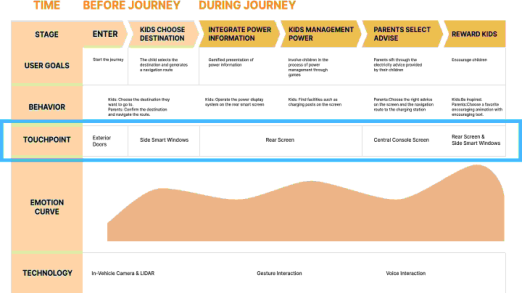
Similar to Kern and Schmidt’s study (2009), we use text directly to describe different numerical and physical contact points (see Figure 1). Text enables the description of cabin space interactions at a lower cost, and in practice
Figure 1: Text-based modelling.
Spatial Views in Intelligent Cabin Interaction Behavior and Touchpoints Design 589
we can achieve a quick listing, modification and deletion of touchpoints at different locations. However, we also found that the textual form is perhaps only applicable to those spatial locations where there is a general consensus among project participants, such as the right-hand window, floor, etc. Sli- ghtly more complex and innovative locations would be significantly more costly to describe. Also, text-based spatial representations often need to be used in conjunction with other design tools, such as user journey maps, to complement missing interactions and user movement.
2. Stereoscopic image-based modelling
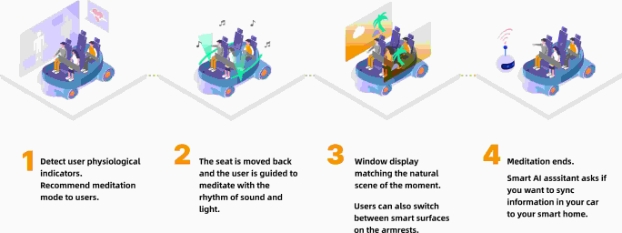
The most direct way of expressing three-dimensional space is to use ste- reoscopic images with height information, which can directly convey spatial information. It is worth noting that a three-dimensional diagram ultimately needs to be represented on a two-dimensional plane, and the representation of height information becomes the focus of this representation, and the choice of perspective will affect it, but either a one-point or multi-point perspective will cause the viewer to substitute a certain scene. To eliminate this biased and complex effect, we drew on previous research to program depth infor- mation using diagonals as the direction of perspective and simplifying details (Bryant and Tversky, 1999). In this way, we obtained a more objective stereo image representation of the other’s perspective (see Figure 2). We mapped the cabin, the seat, the user, each digital touchpoint, and the interaction content in a uniform diagonal perspective direction, combining them according to different scene sequences. This representation carries its own connection to real people and the world, and is highly storytelling, while clearly showing relationships such as front-to-back and top-to-bottom.
3. Planar image-based modelling
Architecture is concerned with the organization of activities and social relationships through spatial layout, which is a highly relevant source of inspiration for interaction designers (Dalsgård and Eva, 2007). In fact, in the field of architecture, designers often use the form of floor plans to refine the details of the building’s interior and exterior. This inspired us to also adopt the form of a floor plan to represent the cabin space, especially the top view, which can fully show the layout, the location of users and contact points,
Figure 2: Stereoscopic image-based modelling.
590 Meng and Zhao
Figure 3: Planar image-based modelling.
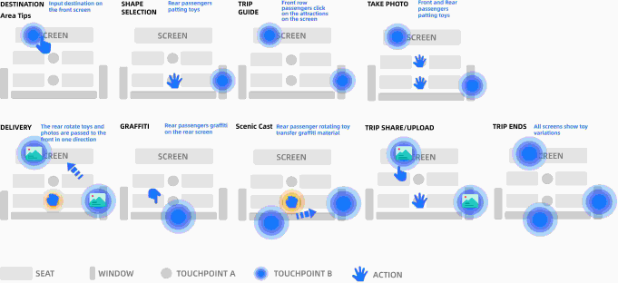
the interaction behavior, and the virtual and real movement lines in a tiled form (see Figure 3). We use circles of different colors and sizes to refer to the user and each touchpoint, icons of specific actions to represent user acti- ons and behaviors, and lines of different colors with arrows to represent the motion lines. This approach greatly reduces the cost of drawing and allows for a comprehensive display of all spatial elements as well as quick editing of images. The material used for the top view is not limited to a specific form, abstract lines and figurative shapes can be used, attention needs to be paid to the use of color, the need to avoid color overlap and superposition and other situations that cause difficulties in understanding, as well as the need to add comments.
THE USE OF SPATIAL DESCRIPTION IN THE DESIGN PROCESS By modelling the organization of spatial perspectives and spatial elements, we can obtain different forms of spatial expressions. In the course of pro- ject practice, these expressions are not chosen or fixed, and we use them in different stages of design definition, concept and system construction, and detailed design (Zeng et al. 2020) to match their strengths and weaknesses.
Text-based modelling is a quick and easy way to describe a space. Language and words themselves are a direct bridge between people. It is suitable for research and the design stage when the design concept is not yet fully defined. In this stage of cabin design, much of the work is still in communication and discussion, and text-based expression can help designers generate ideas and confirm consensus quickly among themselves and between designers and users. Although text is not enough to describe the dynamic changes in the space and carries less information, it defines the most important aspect of cabin interaction design in the early stage of design: what are the digital and physical touchpoints.
Stereoscopic image-based modelling shows advantages in the element of interactive behavior, where the actions of one or more users in the cabin space can be captured, and with its connection to the real spatial representation, it is suitable for use in the concept and system building phase as a storyboard
Spatial Views in Intelligent Cabin Interaction Behavior and Touchpoints Design 591
and other tools to explain and express the design concept. At this stage, inte- raction designers also begin to collaborate with stylists, at which point they will have the same spatial perspective as the stylists, and the stereoscopic image will become the basis for communication between them. However, we do not recommend abusing the stereoscopic image, although it provides the most visual representation. Because the change of shape will affect the con- tent of the image, and the content with diagonal perspective will also produce obscuration, a more abstract and comprehensive spatial expression is needed in the process of repeated deduction.
Planar image-based modelling enables this to be done very well. We have used this form extensively in the detailed design phase of designing interfaces with multiple modalities. The top view not only shows the various touch- points and users, but also allows for connecting lines to represent the actual or virtual motion, in addition to labelling the specific interface content and multimodal interaction actions. The detailed stage of cabin interaction invo- lves sorting out and explaining the detailed flow and interaction logic, and the package of the cabin shape is usually fixed at this stage, so designers can get a bulk patterned top view of the space, which will be easy for other designers to read quickly to get detailed information.
An important component of the human systems integration plan should be a verification and validation process that provides a clear way to evaluate the success of human systems integration. The human systems integration team should develop a test plan that can easily be incorporated into the systems engineering test plan. The effectiveness and performance of the human in the system needs to be validated as part of the overall system. It may seem more attractive to have stand-alone testing for human systems integration to show how the user interacts with controls or displays, how the user performs on a specific task. This methodology can address the performance of the human operator or maintainer with respect to the overall system. The most important thing is to develop a close relationship between human systems integration and systems engineering.
CONCLUSION
In this paper, based on the choice of spatial perspective and spatial elements, three spatial modelling expressions are proposed. These expressions have dif- ferent matches with different stages of the intelligent cabin design process due to their own characteristics, and designers can choose different descri- ptions at different stages according to their needs, in order to define the design problems in the cabin spatial perspective and clarify the touchpoints and interaction behaviors in the space.
The practice has proven that these new diagrams describing spatial perspe- ctives have facilitated communication between designers in different fields such as interaction and styling, deepened interaction designers’ understan- ding of actions and touchpoints, and improved design efficiency under each phase. Our work has increased the focus on the spatial perspective in intelli- gent cabin design, and in the future we will continue to explore patterns of user, interaction and touchpoint representation in cabin space, and iterate on
592 Meng and Zhao
existing patterns in practice to help designers create better intelligent cabin experiences.
ACKNOWLEDGMENT
This research is supported by Paradigm Construction and Theoretical Boun- dary of Design Research, National Social Science Foundation (20BG103), and Intelligent Network Product Human Factors Solution Design, Chong- qing Natural Science Foundation (CSTB2022NSCQ-MSX1463).
REFERENCES
Bengler, K., Rettenmaier, M., Fritz and Feierle, A. (2020). From HMI to HMIs: Towards an HMI Framework for Automated Driving, Information, 11, p. 61. Bryant, D. J. and Tversky, B. (1999). Mental representations of perspective and spa-
tial relations from diagrams and models, Journal of Experimental Psychology: Learning, Memory, and Cognition, 25, pp. 137–156. Available at: Dalsgård, Peter, and Eva Eriksson (2007). Ubiquitous Computing in Physico- Spatial Environments-Activity Theoretical Considerations. In Position paper in: Proceedings of the 2007 Workshop on Multiple and Ubiquitous Interaction. Eriksson, E. (2011). Spatial Explorations in Interaction Design, p. 9. Garnham, A. (1989). A unified theory of the meaning of some spatial relational
terms, Cognition, 31(1), pp. 45–60. Golledge, R. G. (1992). Place recognition and wayfinding: Making sense of space, Geoforum, 23(2), pp. 199–214. Jansen, P., Colley, M. and Rukzio, E. (2022). A Design Space for Human Sensor
and Actuator Focused In-Vehicle Interaction Based on a Systematic Literature Review, Proceedings of the ACM on Interactive, Mobile, Wearable and Ubiquitous Technologies, 6(2), p. 56:1-56:51. Kern, D. and Schmidt, A. (2009). Design space for driver-based automotive user interfaces’, in Proceedings of the 1st International Conference on Automotive User Interfaces and Interactive Vehicular Applications. New York, NY, USA: Association for Computing Machinery (AutomotiveUI ‘09), pp. 3–10. Taylor, H. A. and Tversky, B. (1996). Perspective in Spatial Descriptions, Journal of
Memory and Language, 35(3), pp. 371–391. Tversky, B. and Hard, B. M. (2009). Embodied and disembodied cognition: Spatial perspective-taking, Cognition, 110(1), pp. 124–129. Ullmer-Ehrich, Veronika. (1982). The Structure of Living Space Descriptions, Speech,
Place, and Action, pp. 219–249. Zeng, Q., Duan, Q., Shi, M., He, X. and Hassan, M. M. (2020). Design Framework and Intelligent In-Vehicle Information System for Sensor-Cloud Platform and Applications, IEEE Access, 8, pp. 201675–201685.
LISTED IN THE AHFE DIGITAL BOOKSTORE CATALOGUE
Explore the complete digital volume
Ergonomics In Design
Read this individual research paper free through the original publisher, or explore the full digital proceedings book.
ISBN 978-1-958651-53-7
Explore this ISBN in the AHFE Bookstore ↗Listed in the July 2026 bookstore catalogue; search by ISBN to confirm current availability · Digital book purchase optional