Wang Siwei, Danhua Zhao (2023). Global Design Practice: Mask Design in COVID-19 era. In: Ergonomics In Design. AHFE Open Access, vol. 77, pp. 193–200. https://doi.org/10.54941/ahfe1003376
Prior to the covid-19 pandemic, there were differences in the use of masks due to different cultural backgrounds. Since 2019, the coronavirus COVID-19 pandemic has caused a global health crisis. One of the effective protection methods is wearing a face mask in public areas according to the World Health Organization (WHO). The use of face masks in public settings has been widely recommended by public health officials during the current COVID-19 pandemic in various countries. This has made wearing a mask a daily practice for people around the world. It also makes the design of masks attract the attention of designers around the world. In this case, masks become a suitable object to study design practices in a global perspective. This paper reviews the process of normalizing the use of masks worldwide during the covid-19 era, different mask-wearing behaviours and mask design features, and the evolution of modern mask design during the COVID-19 era. Sorting out the design language of masks and their globalization process to provide reference for other design products to globalize.
For at least a decade, design historians have been arguing that a global perspe- ctive on the discipline is essential. However, despite some initial efforts, the project of a global design history remains in its infancy. In particular, rela- tively few studies have been conducted for the mapping design practice in the global era. The research on contemporary aspects of design practice and globalization are no doubt valuable. However, this kind of research might proceed across various fronts, making it a difficult task (Huppatz, 2015). Global corporations founded on particular design ideals such as Apple or IKEA, are often the subject of such studies (Kristoffersson, 2014). These studies analyse the global production and consumerism of some specific desi- gned objects. Beyond such smaller scale studies, larger themes await the attention of design historians. In the recent three years, the lives of people around the world have been forced to change dramatically due to the COVID- 19 epidemic. Designs and products have also witnessed and permeated this particular era, for example, masks.
In the past, wearing a mask in daily life was only a custom in some areas. In response to the epidemic, this behaviour became widespread around the world. This has led to masks being manufactured and consumed globally.
However, the globalization of this product is forced (in many regions the population will be forced to wear masks) and is contrary to the laws of the market. The resistance of some people to wear masks, as seen in the news, shows that the masks are not designed to meet the needs of the multicultural world.
However, unlike cars or cell phones, masks are simple, standardized, every- day items with few parts, low cost, and short production processes. Such products are easy to improve to suit the needs of consumers in different regi- ons. In the last three years, we can see more and more types of masks on the market and more related entries in design awards. This paper reviews the process of normalizing the use of masks worldwide during the covid-19 era, different mask-wearing behaviours and mask design features, and the evolution of modern mask design.
TO MASK OR NOT TO MASK: DURING THE COVID-19 ERA In the wake of the covid-19 outbreak, people around the world have different attitudes about whether or not masks should be worn. Depending on the stage of development of the epidemic, medical experts and epidemic prevention authorities in various countries differed in their guidance, government poli- cies on epidemic prevention and management, and public actions on whether healthy people should wear masks in public.
The first case of COVID-19 was reported in China on December 8, 2019, followed by a small number of cases, and on January 11, 2020, an outbreak notification from the Wuhan Municipal Health and Wellness Commission suggested that the public may wear masks when necessary. On January 20, 2020, the Chinese government issued a policy requiring the public to wear masks in public places. However, on January 28, 2020, the World Health Organization (WHO) issued “Advice on the use of masks the community, during home care and in health care setting in the context of the novel coronavirus(2019-nCoV) outbreak” stating that individuals without respi- ratory symptoms do not need to wear medical masks because there is no evidence that they can be used to protect non-ill individuals. On February 25, 2020, the Ministry of Health, Labor and Welfare (Japan) recommended that the public wear masks when going out. From March 2020, the dome- stic outbreak in China was effectively controlled, with new cases exceeding 100 per day in South Korea, Italy, Iran, Germany and France. At this time, China maintained its policy of requiring the public to wear masks in public. In contrast, on February 28, 2020, the CDC issued a letter stating that masks are not recommended for the general public. A two-way discrimination emer- ged during this time: in Western countries such as the United States, people who wear masks are shunned and even attacked. In Asia, people who did not wear masks were blamed and required to wear them, and were restricted from entering certain public places.
The attitude towards mask-wearing in the West changed as the epidemic escalated in Western countries and as the control of the epidemic in Asian countries began to show results. On 3 April 2020, the CDC finally advised the public to wear masks (Crawford & Robinson, 2020), claiming new evidence
Global Design Practice: Mask Design in COVID-19 Era 195
regarding COVID-19 transmission (Lyu & Wehby, 2020). The WHO fol- lowed suit on 5 June 2020 (Mandavilli, 2020). The WHO has stated that governments should encourage the public to wear masks in closed and cro- wded environments such as public transportation and stores. This update emphasizes that wearing masks in public places is one of the effective pro- tection methods against the spread of COVID-19. An increasing number of national guidelines for epidemic prevention are beginning to recommend that the public wear masks. Austria, Germany, Greece, France, and several U.S. states have implemented mandatory mask wearing policies in public places. However, in countries such as China, Japan and South Korea, the public con- tinued to actively wear masks after the outbreak stabilized. In Europe and the United States, as the outbreak spread, the proportion of the public wearing masks increased, but a significant proportion of the public still did not wear masks, and there were occasional protests against the mask mandates.
To this day, the epidemic has not gone away and the act of wearing masks has become a part of people’s lives around the world. The mask has become a cross-cultural product on a global scale, although it seems to be a passive choice of consumers from different cultures.
DIFFERENT MASK-WEARING BEHAVIORS AND MASK DESIGN FEATURES Different cultural backgrounds have an impact on mask-wearing behaviour. These behaviors have influenced the development of mask design in different regions.
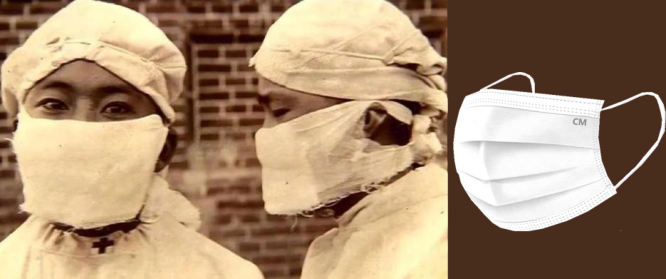
The mask is a product designed to be worn over the mouth and nose to provide respiratory protection by filtering air. ‘In European and American countries, it is generally believed that only infected patients need to wear a mask and that wearing a mask implies an admission of disease’ (Yi-Fong Su et al., 2020). Mask in the modern sense were invented as medical supplies in the beginning. In 1897, Carl Flügge, a German microbiologist, demonstrated that the act of talking to a wound during surgery could cause an inflamma- tory wound infection. Later, medical personnel would wear sterile gauze to cover the mouth and nose when performing surgery, and such a mask was called “Mikulicz’s mask”, which is the first recorded medical mask in the modern sense. But the mask here is simply a layer or layers of gauze wrapped around the face in a compact manner, which is far from the current produ- cts with convenience and comfort. In 1899, a British surgeon improved the design of the mask - he cut the gauze into rectangles and set up a frame of thin wire brackets between the gauze, leaving a gap between the gauze and the mouth and nose, solving the problem of poor breathing caused by the mask. French surgeon Paul Berger had also improved the design - a looped band attached to the gauze hanging from the ear or the back of the head. In 1910, there was an outbreak of “bubonic plague” in China. After deter- mining that the disease was airborne, Woolender (1879–1960) upgraded the surgical masks he had seen in Western countries by inventing a mask made of gauze. He used gauze and cotton to make a stronger mask that could be wrapped securely around a person’s face, while adding several layers of cloth
196 Siwei and Danhua
as interlayers to filter inhalants. At that time, there were other areas of the doctor developed similar to the submarine mask, but eventually because of the Woolender design mask material is cheap and readily available, and sim- ple to make and popularized. By this time, the design of the medical surgical mask was basically formed (Figure 1). The landmark event that really brou- ght the mask from a surgical device to the general public was the Spanish Flu during WWI. During this time, governments began to mandate the wearing of masks and public places began to refuse service to people who were not wearing them. Companies around the world increased production of masks like the “Woolender Mask” to reduce the spread of the flu.
After the industrial revolution, masks began to appear as a product to combat air pollution. In the 1950s, a large number of workers worked long hours in a polluted environment and masks could protect workers from pollu- tion. However, due to the harsh working environment, the lack of ventilation and stuffiness caused by wearing masks could affect workers’ willingness to wear masks. The design of masks for the industrial production field also has more improvements based on the medical mask form. Most of the well- known mask companies today are mainly manufacturing masks for industrial use, such as 3M, Honeywell, Uvex. In 1956, 3M produced the world’s first disposable respirator for dust control, and in the 1980s, 3M improved the fit of the mask to the human face through large-scale quantitative facial fit testing. In 2000, 3M developed a foldable mask. However, in the 21st cen- tury, after the environmental remediation in Europe and the United States, masks have gradually faded out of the civilian consumer market, and the design and development of masks are mainly aimed at the special occupa- tional groups of some industrial production. In oriental countries, masks have always had a place in consumer goods for civilian use. The practice of mask-wearing by the public persisted in Japan since the 1918 flu pande- mic (Burgess & Horii, 2012). They started as self-protection, but are now commonly worn to block pollen and other allergens, as well as to cover one’s face when not wearing makeup. One Japanese anthropologist has depicted mask wearing by the Japanese as a way of restoring a sense of control in the face of uncertainties and establishing a boundary between a clean and pure
Figure 1: “Woolender Mask” and medical surgical mask.
Global Design Practice: Mask Design in COVID-19 Era 197
inner self and a potentially polluted outside (Horii M, 2014). Since masks are a very common civilian consumer product in Japan, there are a large number of local brands that produce masks, such as Kowa three-dimensional masks, unicharm ultra-dimensional masks, and ISDG masks. As a civilian consu- mer product, these masks are designed with more emphasis on portability, aesthetics and comfort. In China, it has been shown that the main reason for Chinese residents to wear masks outside is to protect themselves from the cold (Jing Nie et al., 2015). Some Western scholars (Hansstein FV, Echegaray F., 2018; Baehr P. 2008) also attribute the Chinese habit of wearing masks to having experienced epidemics (sars) and to the more polluted environment in which they live. However, there are no companies with established mask design and development capabilities in China, only mask manufacturers.
Before the covid-19 pandemic, there were significant differences in the acceptance of mask use in the daily lives of people in the East and West. While masks were basically designed and developed as industrial and medi- cal products in the West, they existed as consumer products in Japan, so there was a clear difference in the design and development tendencies of masks in the East and West.
EVOLUTION OF MODERN MASK DESIGN DURING THE COVID-19 ERA After the mask became a standardized product, the mask focused on the improvement of filtration materials and processes, and the design langu- age iteration was slower, such as 3M’s N95 mask since its introduction in 1972, the product would be adjusted according to the ergonomic continu- ous adjustment of the mask’s facial fit for adjustment, but until now, the N95 mask did not change much in terms of design appearance. However, the 3-year-long and unending epidemic has accelerated the iteration of the mask design language. Based on 300 mask designs from Amazon.com in the US, Amazon.com in Japan, and Taobao.com in China, we can summarize three types of design languages:functional design language, comfort design language,aesthetic design language (Table 1).
It can be found that the design of global masks has improved to varying degrees toward enhancing the effectiveness of masks, enhancing the comfort of masks, and enhancing the aesthetics of masks based on the prototype of medical surgical masks. There is a hierarchical relationship between these three. More than half of the masks on the market have been structurally
Table 1. Design languages of modern mask.
Table available in the original PDF paper.
comfort design language aesthetic design language
functional design language Structure to increase facial fit
Thicker or adjustable ear cords; Increase the space for smooth breathing; Pressure-reducing nose clips; Skin-care fabrics
Multiple colours of coverings; Multiple patterns for coverings; Multiple colours of ear cords; Structure to modify face shape
198 Siwei and Danhua
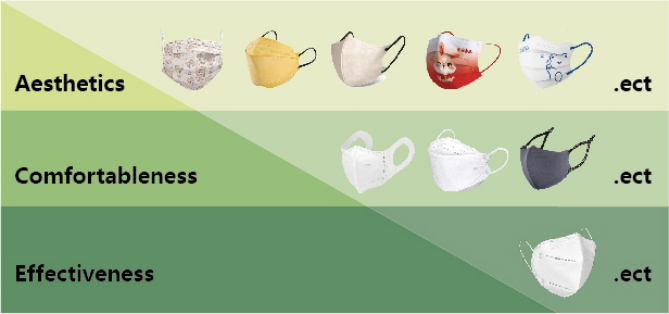
improved to better fit the face. Among the structural designs that fit the face, there is one that increases the space for smoother breathing. Masks with a three-dimensional structure are also considered more for their ear cord com- fort. Aesthetic design language is also more often found in masks that already have an effective design language and a comfort design language. The higher the design language level, the more varieties of masks are available, which means that the product becomes more diversified to meet market demand (Figure 2).
Analysis of the design of masks sold on e-commerce in the US, Japan and China reveals that the design language of common mask products in each country shows different degrees of development (Table 2). On the US Amazon website, medical surgical masks without any design improvements still account for a significant proportion of the market, and there are also a large number of designs that add patterns directly to the prototype of medi- cal surgical masks, which may be related to their low prices. Because U.S. consumers are not in the habit of using masks for long periods of time, but rather for short periods of time in public places as recommended by health experts, they are more likely to choose cheaper masks rather than more comfortable but more expensive masks. The masks on the Japanese Amazon website are basically based on prototypes with improved design lan- guage and various combinations, and the tiers are not particularly obvious, which may be related to the fact that Japan already has a relatively mature and diversified mask market. The design language of masks on Chinese e- commerce platforms shows the most obvious hierarchical distribution. The Chinese population did not have the habit of wearing masks on a daily basis before the epidemic, but the high level of obedience to health experts and the government led Chinese consumers to consume masks in large quanti- ties. The current hierarchical distribution of mask design language precisely reflects the changing needs of Chinese consumers for masks as a product. The first priority is to ensure that the mask provides effective protection against viruses, then to pursue comfort for extended wear, and then to pursue aesthetics.
Figure 2: Mask design language levels.
Global Design Practice: Mask Design in COVID-19 Era 199
Table 2. Number of products with different design language in USA, Japan and China.
Table available in the original PDF paper.
Country Number of products
Number of products with comfort design
Number of products with aesthetic design
with functional design language
language
language USA 53 32 47 Japan 65 79 50 China 72 62 30
CONCLUSION
Different cultural backgrounds have an impact on mask-wearing behaviour. However, due to the global spread of the COVID-19 epidemic, we are forced to live with the virus for a long time. The wearing of masks as one of the effective ways to prevent COVID-19 is becoming normalized worldwide. And masks have become a cross-cultural product worldwide. The design language of common mask products is currently evolving to different degrees in each country due to the different acceptance of wearing masks. This is related to the consumer characteristics of each country. In the United States, the total number of existing improved design languages for mask products is low, and there are fewer combinations between multiple design languages. In Japan, the total amount of existing improved design language for mask products is high, and there are various combinations of multiple design languages. In China, the total amount of improved design language of existing mask products is high, and the combination of multiple design languages shows an obvious hierarchical relationship.
As far as the existing products are concerned, the improved design lan- guage itself is homogeneous and does not reflect obvious characteristics of different cultural backgrounds. This may imply that the degree of diversity of the mask as a product is far from sufficient to meet the needs of consumers from different backgrounds and cultures, and needs urgent improvement. At present, the COVID-19 epidemic is not over, and the follow-up continues to pay attention to the development and evolution of the design language of masks, which can be used as a model for the development of global design practice as a reference for the cross-cultural design of other products.
This research is based on the existing mask products in the market, but the mature products in the market have a certain lag for user needs. In the subse- quent research, we will include the research trends of mask design before and after the epidemic in the East and West, and the analysis of award-winning mask designs in design competitions, in order to draw a more comprehensive trend of mask design language evolution.
ACKNOWLEDGMENT
This research is supported by Paradigm Construction and Theoretical Boun- dary of Design Research, National Social Science Foundation (20BG103), and Intelligent Network Product Human Factors Solution Design, Chong- qing Social Science Fund of China (CSTB2022NSCQ-MSX1463).
200 Siwei and Danhua
REFERENCES
Emi, K., Sasha, A. (2022). Masks across borders: etiquette, threat and prevention.
JOURNAL OF Applied Communication Research Volume 50 No. S1. Hansstein, F. V., Echegaray, F. (2018). Exploring motivations behind pollution-mask use in a sample of young adults in urban China. Global Health Volume 14 No. 122. Horii, M. (2014). Why do the Japanese wear masks? Electronic Journal of Contem-
porary Japanese Studies Volume 14. Huppatz, D. J. (2015). Globalizing design history and global design history. Journal of Design History Volume 28 No. 2. Markus, K., Waleed, A. J. (2021). Mask wearing as cultural behavior: an investiga-
tion across 45 U. S. states during the COVID-19 pandemic. Frontiers in Psychology Volume 12. Nie, J., Duan, X. L., Wang, B. B., et al. (2015). Survey of environmental exposure-related wearing masks behavior patterns in Chinese adults. Journal of Enviromental and Health Volume 32 No. 3. Scheid, J. L., Lupien, S. P., Ford, G. S., et al. (2020). Commentary: physiological
and psychological impact of face mask usage during theCOVID-19 pandemic. International Journal of Enviromental Research and Public Health Volume 17 No. 6655. Thomas, C., Trisha, G., Dirk, B., et al. (2021). Masks and face coverings for the lay public: a narrative update. Annals of Internal Medicine Volume 174 No. 4. Tian, J. (2020). Face mask design and evolution of respiratory protection. Art&desigh Volume 322.
LISTED IN THE AHFE DIGITAL BOOKSTORE CATALOGUE
Explore the complete digital volume
Ergonomics In Design
Read this individual research paper free through the original publisher, or explore the full digital proceedings book.
ISBN 978-1-958651-53-7
Explore this ISBN in the AHFE Bookstore ↗Listed in the July 2026 bookstore catalogue; search by ISBN to confirm current availability · Digital book purchase optional