Haowen Guo, Danhua Zhao, Liyang Zhang, Yihong Lin, Hao Xin (2023). The Effectiveness of the Attention Guidance mechanisms in VR Museum. In: Ergonomics In Design. AHFE Open Access, vol. 77, pp. 208–215. https://doi.org/10.54941/ahfe1003378
The COVID-19 pandemic has led to a shift towards digital exhibitions on virtual platforms and the increasing use of VR devices. In most exhibitions, audiences are free to explore and understand the content. However, in themed museums, this freedom may result in missing important exhibits.In this study, we examine the effectiveness of various attention guidance mechanisms and user satisfaction in virtual museums. We designed an immersive VR experiment in a simulated virtual museum environment with four mechanisms: no guide, arrows, characters, and characters that acknowledge the user and environment. There were two guiding directions (left and right) and three museum spacial compositions (60-degree angle, 90-degree angle, and 180-degree angle).Through mixed-method analysis, we found that all three attention guidance mechanisms were effective in guiding users in the three museum spacial compositions. Among them, the virtual arrow had the longest visibility time, and the acknowledging character had the highest user satisfaction.In conclusion, attention guidance mechanisms in VR museums significantly improve user attention to the target. The acknowledging character and arrow have the best guidance efficacy, and spacial composition also has a significant impact on attention effectiveness.
The rise of new internet technology and the COVID-19 pandemic has led museums worldwide to adopt digital technologies for virtual experiences such as online visiting and viewing. Virtual museums can overcome the limitations of traditional exhibitions by reorganizing space in real-time, creating dynamic exhibitions, and transforming fixed exhibition halls into knowledge netw- orks for free exploration (Davidedi, 2022). Representative virtual museum technologies include 3D scanning/printing, VR/AR, and mobile app develo- pment (Hou, 2022). VR museums offer users a more immersive and realistic experience by displaying cultural relics in virtual scenes.
Despite the widespread use of online platforms, the lack of effective navigation design continues to affect the quality of virtual museum user expe- rience (Li, 2022). Attention guidance mechanisms have been widely studied (Fearghail, 2018 and Lange, 2020). Previous research shows that diege- tic mechanisms, where the guide is part of the narrative background and provides information through action, offer a stronger sense of immersion (Cao, 2020). Non-narrative mechanisms like arrows, whose sole function
The Effectiveness of the Attention Guidance Mechanisms in VR Museum 209
is to guide attention, may have stronger recognition (Wallgrün, 2020). Vir- tual animals are also conducive to interaction and guidance for the audience (Norouzi, 2021).
While there has been analysis of the effectiveness of attention guida- nce mechanisms in VR environments (Norouzi, 2021), the comparison of the effectiveness of different attention guidance mechanisms in combination with museum’s special spatial composition and guiding path requires further exploration. When arranging exhibitions, museums must consider the visiting order for users to understand the relevance between exhibits. Existing diege- tic logic modes for virtual museums include spacial composition designs of causal clues, multi-dimensional integration of time and space, and temporal clues associated with multiple clues (Ge, 2022). These spacial compositions may impact guidance effectiveness.
The purpose of this study is to explore the effectiveness and user satisfa- ction of different attention guidance mechanisms in VR museums. An expe- riment was conducted in a VR museum virtual environment and simulated visit process.
The paper is organized as follows: Section 2 details our experiment, Section 3 and 4 describe and discuss our findings, and Section 5 summarizes our work.
MATERIALS AND METHODS
This section provides details about the experiment aimed at comparing the effectiveness and impact of different attention guidance mechanisms in various spatial structures of a virtual museum.
Participants Thirty participants were recruited from the university (15 females and 15 males aged 21-25). They had normal hearing and vision, and no movement impairments. All participants were VR museum novice and the experimental scheme was approved by the university institutional review board. The user evaluation was conducted from October 9th to 11th, 2022.
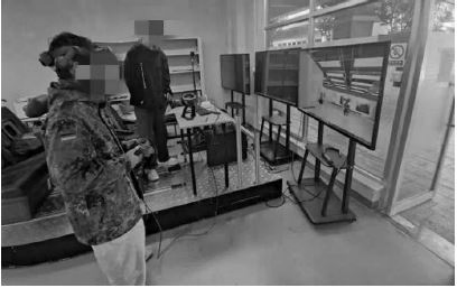
Hardware Participants experienced the VR museum environment using an HTC VIVE headset (90 Hz, 1440 × 1600 pixels) and a 16-inch Legion computer (R9 5900HX, RTX3080) served as the VR program execution device (see Figure 1). The VR perspective and interactive behavior were recorded by a screen capture application and a camera, respectively, and projected on a large-screen display.
Software A virtual scene was created in Unreal Engine 4.27, with assets obtained from the UE4 assets store (see Figure 2). The scene was designed to simulate a realistic museum with decorative paintings, cultural relics, ornaments, and pendants, and a bright lighting environment was set up. The experiment also included virtual guide and arrow as attention guidance mechanisms. The
Figure 1: The hardware layout of the experiment (HTC VIVE, Legion and screens).Figure 2: A virtual museum scene was created using unreal Engine 4.27, featuring a spatial composition of 180◦, 90◦, and 60◦display environments arranged from left to right.
character model was obtained from MIXAMO and the arrow model was produced using Blender 3.1.
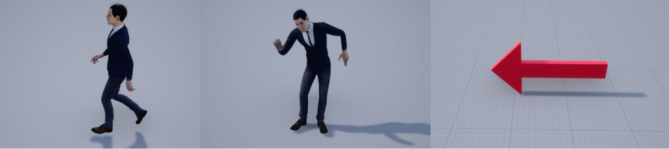
Attention Guidance Mechanisms The attention guidance mechanism was based on existing solutions (Norouzi, 2021). In addition, a virtual character was added as an attention guidance mechanism, to enhance user immersion. Three different attention guida- nce mechanisms were set up: Arrows, Characters, and Act-Characters that acknowledge the user and the environment (see Figure 3). The guiding time for each mechanism was 6.5 seconds, with Act-Character having a 1.5-second confirmation time before guidance, during which it stays in place and waves its hands. This time is not included in the guiding time.
Figure 3: Three attention guidance mechanisms: the Arrow (right), the characters (left), and the act-characters that acknowledge the user and the environment (middle).
The Effectiveness of the Attention Guidance Mechanisms in VR Museum 211
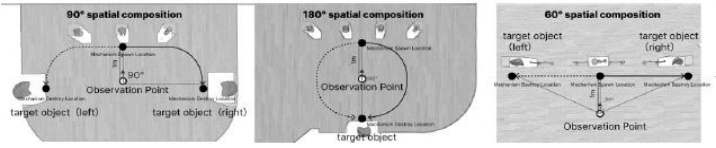
Figure 4: Three spatial compositions with navigation paths: the 60◦display environ- ment (right), the 90◦display environment (left) and the 180◦display environment (middle).
Spacial Compositions and Navigation Paths Three different spacial compositions of the VR museum were set up to simu- late different exhibit placements, with the same target, based on 60
, 90
, and 180
display environments. The final guidance target was located at the designated angle degrees from the initial observation point. Three navigation paths and two guiding directions were set according to the relationship betw- een the three exhibits (see Figure 4). The attention guidance mechanisms were all located 1m directly in front of the participants’ vision at the beginning, to ensure visibility. When the attention guidance mechanisms reached the final target, they disappeared immediately, ending the guidance.
Procedure The experiment consists of two phases: a VR simulation experiment (approx. 10 minutes) and an oral interview (approx. 5 minutes). After obtaining informed consent from each participant, they will stand on a flat floor and be assisted in wearing the VR headset. Participants will have three minutes to familiarize themselves with the experiment before star- ting. The task is to experience the attention guidance mechanisms in the VR museum and respond to the guidance. Their VR perspective and movements will be recorded by a screen recording program and camera. Participants will be divided into three groups (60
, 90
, and 180
display environments) based on different spacial compositions. Each participant will experience eight rounds of guidance experiments with all eight types of mechanisms (three different attention guidance mechanisms under two guidance directi- ons and two no-guide groups). The order of mechanisms will be randomized to avoid order effects. Each round will be played automatically according to the program and will begin with a scene prompt tone. After each round, the screen will dim and participants will return to their initial position.
At the end of the experiment, participants will evaluate their satisfaction for each attention guidance mechanism on a 5-point Likert scale (1=very dissatisfied, 5=very satisfied).
Measurement To evaluate the effectiveness of different attention guidance mechanisms, we conducted an evaluation through both objective and subjective measurement.
The objective measurement indicators are comprised of the following three categories: Mechanism visibility time (MVT), which refers to the amount of time the attention guidance mechanism remained in the participants’ visual field.
Reaction time, measured from the start of each scene to the moment the participant’s reaction began to follow the guidance.
Guidance result, assessed based on whether the participant observed the target in the end.
Subjective measurement involves the use of a questionnaire to gauge the impact of the attention guidance mechanism on the participants’ subjective experience.
RESULTS
The results of objective measurement are depicted in Figure 5 and Figure 6. To analyze the data, we employed ANOVA and descriptive statistics. Our fin- dings indicate that the attention guidance mechanism has a significant impact on all objective measures.
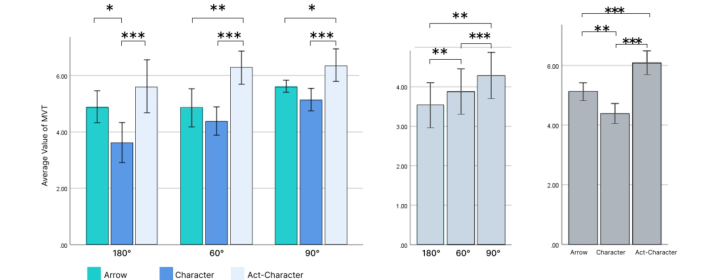
In the comparison of mechanism visibility time (see Figure 5), we discove- red that the three spatial compositions have a significant impact and that the mechanism visibility time was longest in the 90-degree angle spatial compo- sition. A highly significant difference was observed between the act-character and character (p < 0.001), with the act-character mechanism having the longest visible time. In the 60-degree and 90-degree spatial compositions, there was a statistical difference between the arrow and act-character (p < 0.05), while under the 180-degree spatial composition, there was a statistical difference between the arrow and character (p < 0.05).
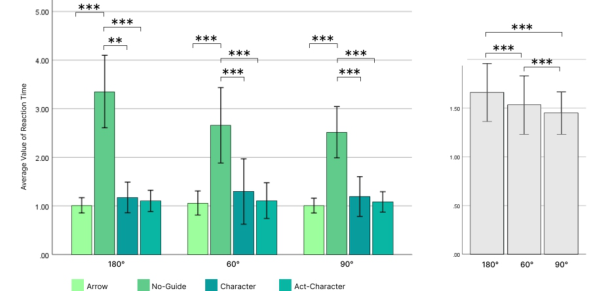
Regarding reaction time (see Figure 6), we found that the three spatial compositions had a highly significant difference in the average reaction time (p < 0.001), with the shortest reaction time in the 90-degree spatial composi- tion. There were significant differences between the no-guide group and the other attention guiding mechanisms (p < 0.01), indicating that the reaction
Figure 5: MVT: combinations of spacial compositions and attention guidance mechani- sms (left), MVT: three spacial compositions (middle) and MVT: three attention guidance mechanisms (right).
The Effectiveness of the Attention Guidance Mechanisms in VR Museum 213
Figure 6: Reaction time: combinations of spacial compositions and attention guidance mechanisms (left) and reaction time: three spacial compositions (right).Figure 7: Guidance results: four mechanisms (left), and guidance results: three spacial compositions (right).
time of the no-guide group was significantly longer. There were no significant differences in the guiding duration among the arrow, pedestrian, and wave mechanisms.
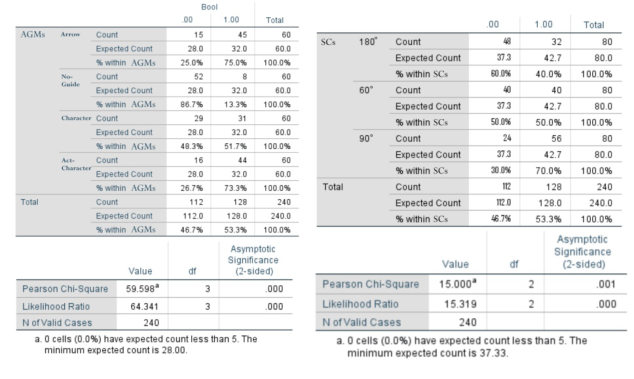
The guidance results were analyzed using the chi-square test as 0 cells had an expected count less than 5 (see Figure 7). The success rates of the four mechanisms were, in order from high to low: arrows (75%), act-characters (73.3%), character (51.7%), and no-guide (13.3%), with highly significant differences (χ2 = 59.6, p < 0.001). The success rates of the three guidance paths, in order from high to low, were 90 (70%), 60 (50%), and 180 (40%), with significant differences (χ2 = 15.0, p < 0.01).
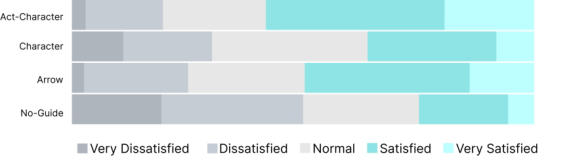
Finally, we collected questionnaires and analyzed the subjective satisfa- ction data of participants on the four mechanisms (see Figure 8). Participants
Figure 8: Satisfaction of attention guidance mechanisms.
preferred the arrow and act-character mechanisms, with the highest satisfa- ction expressed for act-characters, followed by the arrow. Participants had the lowest satisfaction with the no-guide mechanism.
DISCUSSION
The Effectiveness of Visual Characters As a diegetic mechanism, act-characters have been found to be an effective attention guidance mechanism, as they effectively capture the participants’ attention. While characters are also effective, they are more easily perceived as simply passing by when they lack interactive behavior. In terms of user satisfaction, act-characters were preferred by most participants due to their harmonious nature. However, some participants found the characters to be frightening, indicating that the horror valley effect should be considered in future studies.
High Identifiability of Arrows as a Attention Guidance Mechanism The shortest average reaction time for arrows indicates that they are easily identifiable, which is consistent with previous research (Wallgrün, 2020). This may be due to their directionality and participants’ inherent understan- ding of arrows. Arrows also performed best in terms of guidance results, making them a better option than characters without interactive behavior in terms of both user satisfaction and effectiveness.
Impact of Spacial Composition on Guidance Effectiveness The spacial composition can impact the reaction time and mechanism visibi- lity time for the participant, which may be reflected in the different guidance paths, directions, and the distance between the guide and the target object. In the 180
spacial composition, the participant needs to turn around, leading to potential interruptions during the process. Additionally, the distance between the participant and the guide object in the 60
spacial composition increases as the guidance progresses. The relationship between spacial composition and guidance effectiveness merits further investigation.
CONCLUSION
This study compared the effectiveness and user satisfaction of three attention- guided mechanisms (arrow, figure, wave) and a blank control group in three
The Effectiveness of the Attention Guidance Mechanisms in VR Museum 215 VR museum spacial compositions (60
, 90
and 180
) by evaluating mixed measurement data. Our experiment found that attention guidance mechani- sms can significantly improve user attention to the target, with act-characters and arrows showing the highest effectiveness. In addition to the compari- son of guidance mechanisms, we also concluded that the spacial composition affects guidance effectiveness, with 90
spacial being the most effective.
Future work should focus on exploring the impact of spacial composition on guidance effectiveness, including variables such as guidance object loca- tion, path, and distance, as well as evaluating the effectiveness of additional attention guidance mechanisms. Additionally, examining the impact of vari- ous existing virtual guides on guidance effectiveness and user preferences is of interest. Furthermore, exploring user information acceptance during VR museum experiment is also worth investigating.
ACKNOWLEDGMENT
This research is supported by Paradigm Construction and Theoretical Boun- dary of Design Research, National Social Science Foundation (20BG103).
REFERENCES
Cao, C., Shi, Z., & Yu, M. (2020). Automatic Generation of Diegetic Guidance in Cinematic Virtual Reality. In 2020 IEEE International Symposium on Mixed and Augmented Reality (ISMAR), pp. 600–607. Davidedi, S., Mastroberardino, S., St Jacques, P. L., Schacter, D. L., Santan-
gelo, V. (2022) “Remembering a Virtual Museum Tour: Viewing Time, Memory Activation, and Memory Destruction.” Front Psychol. pp. 869336. Fearghail, C. O., Ozcinar, C., Knorr, S., Smolic, A. (2018) “Director’s Cut - Analysis of Aspects of Interactive Storytelling for VR Films.” In: Rouse, R., Koenitz, H., Haahr, M. (eds). Interactive Storytelling. ICID 2018. Lecture Notes in Computer Science, vol 11318. Springer, Cham. Ge, X. (2022). Design of dynamic spatial composition relationship of virtual museum
based on knowledge representation theory. Industrial & Engineering Design, 5, 23–28. Hou, Y., Xu, L., Chen, L. (2022) “Hotspots and Cutting-Edge Visual Analysis of Digital Museum in China Using Data Mining Technology.” Comput Intell Neurosci. Lange, D., Stratmann, T. C., Gruenefeld, U., & Boll, S. (2020). “Hivefive: Immersion
preserving attention guidance in virtual reality”. Proceedings of the 2020 CHI Conference on Human Factors in Computing Systems, pp. 1–13. Li, J., Nie, J. W., Ye, J. (2022) “Evaluation of Virtual Tour in an Online Museum: Exhibition of Architecture of the Forbidden City.” PLoS One. pp. e0261607. Norouzi, N., et al. (2021). “Virtual Animals as Diegetic Attention Guidance Mech-
anisms in 360-Degree Experiences.” IEEE Transactions on Visualization and Computer Graphics, vol. 27, no. 11, pp. 4321–4331. Wallgrün, J. O., Bagher, M. M., Sajjadi, P., & Klippel, A. (2020). A Comparison of Visual Attention Guiding Approaches for 360
Image-Based VR Tours. In 2020 IEEE Conference on Virtual Reality and 3D User Interfaces (VR) (pp.83–91). Atlanta, GA, USA.
LISTED IN THE AHFE DIGITAL BOOKSTORE CATALOGUE
Explore the complete digital volume
Ergonomics In Design
Read this individual research paper free through the original publisher, or explore the full digital proceedings book.
ISBN 978-1-958651-53-7
Explore this ISBN in the AHFE Bookstore ↗Listed in the July 2026 bookstore catalogue; search by ISBN to confirm current availability · Digital book purchase optional