Mingyu Li, Danhua Zhao, Zhizi Liu, Xing Chen (2023). Research on Intelligent Cabin (scenario) Design from the Perspective of Tangible Interactive Narratives. In: Ergonomics In Design. AHFE Open Access, vol. 77, pp. 201–207. https://doi.org/10.54941/ahfe1003377
The intelligent cabin is a complex multi-scene spatial carrier that lacks a practical and reusable perspective in constructing its scene space and interaction actions, and design participants have fewer efficient visual presentation means to help understand this process. Narrative is a flexible approach, from the overall framework to the interaction feedback, to the dialogue interpretation of each character. The introduction of a narrative perspective on tangible interactions better restores the state of spatial interactions in the cabin and stimulates participants to think more deeply about the cabin concept, spatial location, and modes of interaction. In this article, we investigate the role that tangible interactive narratives play in the development of intelligent cabin scenarios. We show how participants can use these narratives to test the applicability and usability of conceptual ideas by engaging in realistic and coherent tangible interactive narratives.
The design of the cabin differs from traditional interior design due to the ongoing advancement of technology. While the aesthetic value of the model- ling is important, the focus of interaction on user needs becomes more important after the establishment of specific use scenarios in combination with in-car interaction. Or rather, purposeful engineering of the interior design has been replaced by a combination of the interior scene and human activity, interaction, and styling.
McNeil (McNeil, 1996) notes that humans have a natural tendency tow- ard narrative, which began to manifest itself some 40,000 y ears ago in a range of new narrative expressions, including cave art, ritual dance, and oral narrative. For thousands of years, all cultures have had narratives as part of their “tradition. These narratives create connections between the past, present and future. Changes to the cabin’s layout, interaction content, and
interaction forms will frequently emerge from the introduction of new tech- nology and scenarios. Designers must have a deeper understanding of the many components in the cabin while creating future concepts. Tversky and Lee (Tversky and Lee, 1998) refer to the way in which “language provides a systematic framework to describe space, “They argue that language can successfully represent space because space is schematised similarly in langu- age and cognition. The power of language as a tool for generating imagined space is thus not to be underestimated.
Design is user-centred, thus while creating an intelligent cabin, design parti- cipants must create designs that are as beneficial from the users’ point of view as they can. There are differences in designer’s affective appeal in a design and user’s affective response to the design.the success and creativity are not the same, the ultimate goal of design practice is to find solutions that are both creative and successful (Zhao et al., 2019). In terms of the use of narrative in design, Erickson (Erickson, 1996) argues that”Stories provide a good first pass at what is important, from the point of view of the users; they provide the designer with a glimpse of what the user’s terrain feels like, and thus provide a starting point for further exploration.” Designers can better comprehend the user’s viewpoint through storytelling. As Brunner (Mello, 1997) points out, storytelling is part of how humans translate their personal experience of understanding into forms of public cultural negotiation. This form can mani- fest itself in many ways, in products, in spaces, in services. The story allows us to understand and construct meaning around our needs. The consistency of design participants’ comprehension of existing design information can be improved via storytelling constructs. For designers, this story builds empa- thy, emotion and connection. Narrative is the bridge between imagination and creativity (Tully, 2012). Narrative may efficiently elicit associations and serve as a catalyst for creativity. According to Salen & Zimmerman (Tekin- bas and Zimmerman, n.d.), Designers, as the authors of the design process, must create an environment for people to experience. The Intelligent cabin combines many multisensory sensations. Design participants are better able to consider the design from the user’s perspective and subsequently develop a more user-engaging product system because they have the opportunity to become more personally involved with the user in the narrative and enter into their experience through the development of the story and time.
Design is by definition about constructing the future. The difficulty lies in the fact that designers cannot just stand in the present to envision future scenarios; the real needs of users in the context of the future need to be taken seriously. The design participants have to think about what kind of scenarios and experiences the future intelligent cabin users will need from the user’s perspective. Van der Heijden (Van der Heijden, 1996) points out scenarios are usually developed in groups of two, three, or four, each representing an equally plausible alternative future, so scenario stories have the potential to break old stereotypes and provide perspectives on design that are limited by perspectives beyond the present. Only by thinking outside the established way of design can we better design more authentically in the process of fra- ming the future. In today’s increasingly complex reality, greater demands are being placed on the role of design to anticipate the future and construct future
Research on Intelligent Cabin (Scenario) Design 203
scenarios. Fish (Fish, 2006) talks about the role of narratives in building the future, arguing that “narratives are simultaneously highly fictional and reali- stic constructions: although they do not exist, they have a very strictly defined sense of reality.” So, narratives can bring the conceptual design process closer to what real users will experience in the future.
A design team comprising members from many fields responsible for vari- ous design elements must collaborate on the Intelligent Cabin design. The ideal workflow eliminates the need for internal communication by ensuring that all design participants have a shared understanding of the design concept. When all of the participants are on the same page with the design concept, design activities go much more smoothly. The narrative approach can help software/hardware designers, planners, managers, suppliers, employees and citizen groups: “... Shape strategy and help others get on boards as they consistently confirm each other’s understanding of the ongoing experience. ”(Rasmussen, 2005). The combination of narrative and 3D design, physical prototyping, is an effective means of getting the minds of design participants into abductive thinking (Childs et al., 2013). Design participants can gain a more realistic perspective of design by using both prototypes and narratives, giving design participants a more realistic view of design.
The purpose of this paper is to explore the role of tangible interactive narratives in intelligent cabin (scenario) design between design participants and users. What is the potential of tangible interactive narratives in new technologies and new scenarios? This experience can be used to improve the design process through tangible interactive narratives, allowing for the identification and improvement of previous design elements that were unjustified.
ELEMENTS IN INTELLIGENT CABIN DESIGN The intelligent cabin is a sophisticated Container that embodies technology and interaction in design. Following the comprehension of user needs and the development of scenarios, design participants must utilize the available information to complete the design tasks of human-computer interaction and vehicle styling. The design participant represents the intelligent cabin by deli- berate transformation and other stylistic design means, paired with user needs and the interaction technology means required by the scene, during the design assignment. However, this type of output that remains on paper or in 2D-3D software is the designer’s concept path, which does not best describe the most realistic scenario needs of the intelligent cabin’s users. As a result, the design path closer to the user’s perspective is more targeted to reflect the user’s wants in the intelligent cabin.
In the process of transitioning automotive design from a single vehicle to a third space of living, we recommend extracting the important parts of the intelligent cabin for the user to better carry out the design activities of the intelligent cabin and from the user’s perspective.
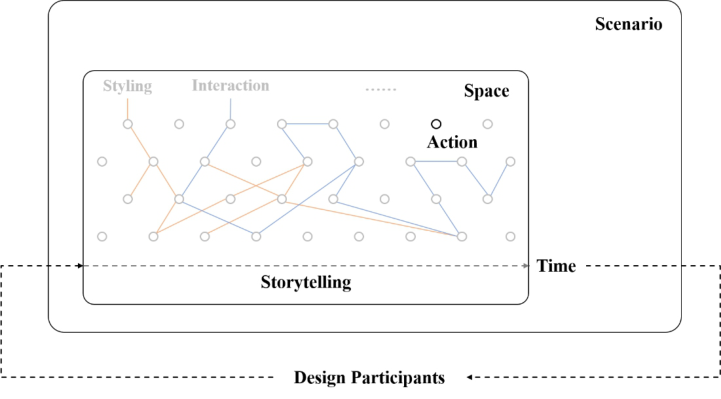
Time: The main aspect of the user’s experience inside and outside the cabin that the design participants need to take into account occurs during this time and is not just a single transient activity or a simple combination of
several transient activities, but a continuous period of time from identifica- tion, entering the vehicle, starting, driving, Driving Takeover, in-car activities, out-of-car activities to parking the car.
Scenario: In a design task, we often concentrate on conveying the user’s behaviour in a specific situation through a story that describes the entire process in this scenario. putting the participants in the design in the user’s position to better understand their requirements Space: The location and shape of the interactable components are inti- mately tied to the user’s position within the intelligent cabin, and different occupant roles can interact differently in various locations. The user could be in a position to carry out an interactive scene that better corresponds to their needs.
Actions: the user’s actions when interacting with various components loca- ted throughout the intelligent cabin. To meet their needs in various settings, the user will require new engagement activities at various locations.
This information can be interpreted as a story about the user, one that encompasses continuous time, particular scenes, spatial places, and intera- ction actions to help design participants better understand the user’s actual demands.
The narratologist Chatman (Chatman, 1980) has proposed a model of narrative communication based on semiotic communication. In which the narrative consists mainly of the real author, the real audience and the narra- tive text. In the discourse of intelligent cabin design, the framework of entity interaction narratives becomes more concrete (see Figure 1).
The design participants are both the creator and the recipient of the tangible interactive narratives in the design activity.
Research on Intelligent Cabin (Scenario) Design 205
By allowing the design participants to repeatedly access the actual user’s experience in a knowledge that encompasses the spatial location and intera- ction relations in the scene over time, the narrative text is transformed into a narrative experience with multiple temporal and spatial contents, making it a more useful input for the user.
The tangible interactive narratives need to be presented in a story form during the design participant’s experience.
The interaction actions in the space where the story is unfolding can be used to summarize and modify cabin-related aesthetics, interaction design, and other design components.
TANGIBLE INTERACTIVE NARRATIVES This paper’s research on tangible interactive narratives is based on actual design teams’ projects.
The project carries out the conceptual design of an intelligent cabin in the context of modern in-vehicle technologies, starting with human-computer interface, intelligent cabin, and intelligent experience design. The project is overseen by a professor of smart mobility design, and the design team consists of two persons responsible for styling design, one person for user research, and three people for interaction design.
Based on the pre-determined user and their requirements, the team develo- ped and enhanced the design of the cabin concept. The idea is an intelligent cabin design that will improve travellers’ ability to better comprehend and enjoy local culture while visiting a new city. The proposed solution focuses on providing the user with a full-flow experience as a traveling companion across three dimensions: a smartphone app, an in-car assistant, and intelligent cabin, with lengthy screens crossing the front and back seats. The experience of such an intelligent cabin design extends both inside and outside the vehi- cle, as well as before and after utilizing the car. This has made it very difficult to continue fine-tuning the program.
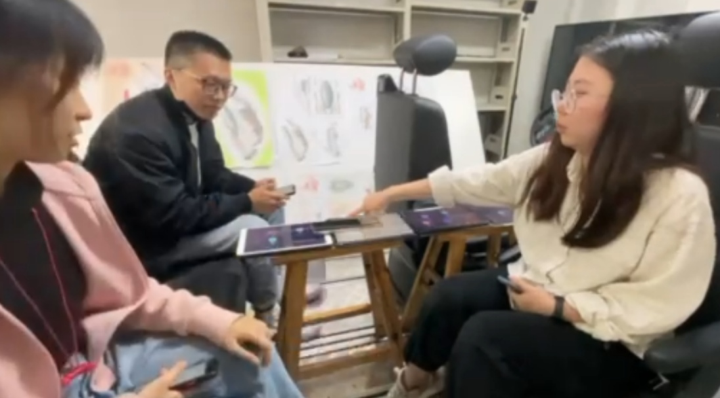
Four tablets were placed flat in the area where the simulated long screen would be in the cabin, the map interface displayed in the long screen in the cabin was opened, and the design participants’ cell phones were installed with the prepared app interaction interface prototype. This was done to create a same size spatial model and the preliminary interaction prototype for verifi- cation. The narration of the story and the control of the rhythm of the design experience in the cabin were added to the tangible interactive narratives, pla- cing the design participants in the situations of the many users in the scenario through the narration of the narrator. While the narrator allows the story to develop chronologically, the design participant performs interactions in the physical space in the corresponding scenario (See Figure 2).
The design participants went through the entire experience in the narra- ted storytelling, including calling the intelligent cabin service after stepping off the plane, introducing Chinese travel information on the highway, che- cking into the hotel, the travel schedule, beginning the journey, changing the journey’s destination, and ending the journey. Throughout this process, the design participants interacted with the app, smart assistant, and car using
Figure 2: The team is working on the intelligent cabin tangible interactive narratives.
their phones, voice, touch, and other action simulations. It is worth mentio- ning that the intelligent assistant in the solution will occasionally converse with the passengers in the local dialect of the destination. This form of interaction enables the design participants to actively take part in the deve- lopment of tangible interactive stories. The participants might find better timing and material for the dialect conversations after several rounds of tangible interactive narratives.
Design participants are confronted with multiple alternative scenarios when advancing a design solution, and each branch may represent a new story, a new scenario, some of which may fit the design concept in the current scenario, and some of which may be far from each other. With the concept of user-centred design, it is critical to move the focus from the designer to the user. The use of tangible interactive narratives enables appropriate refining of scenario actions in the design concept as well as the discovery of real diffi- culties through hands-on experience. This increases the comprehension and dissemination of the design concept among the design participants based on the initial idea.
CONCLUSION
Narrative is an intrinsic part of the human mind, and we engage in it all the time. However, in design activities, narrative can be used as a tool for the creative development of the designer’s conceptual imagination (Tully, 2012), and it can progress design activities more effectively by highlighting the user’s distinct identities. Using narrative during the design process enables funda- mental concepts like time, scene, space, and movement to be combined into stories, giving design participants a more genuine experience with the user.
The practicality and applicability of the tangible interactive narratives in the activities of intelligent cabin design are quite significant. It enables them
Research on Intelligent Cabin (Scenario) Design 207
to identify issues in various areas of interaction design, styling design, and spatial layout, and to improve and iteratively update the experience with the tangible interactive narratives. The narrative also enables design participants to deeply engage with the experience and transform it into an important mate- rial for design improvement. As you optimize and iterate, consider whether there are any instances where the transition is difficult and whether the actual user would have a bad experience.
ACKNOWLEDGMENT
This research is supported by Paradigm Construction and Theoretical Boun- dary of Design Research, National Social Science Foundation (20BG103), and Intelligent Network Product Human Factors Solution Design, Chong- qing Natural Science Foundation (CSTB2022NSCQ-MSX1463).
REFERENCES
Chatman, S. B., 1980. Story and discourse: Narrative structure in fiction and film.
Cornell university press. Childs, P., Zhao, Y., Grigg, J., 2013. Narrative in design development. 76 Proc. EPDE 2013 15th Int. Conf. Eng. Prod. Des. Educ. Dublin Irel. 05–06092013 108–113. Erickson, T., 1996. Design as storytelling. Interactions 3, 30–35. https://doi.org/10.
1145/234813.234817. Fish, R., 2006. What kind of narrative for what kind of future? Designing unaccomplished space-time., in: Warren, M., Yarwood, R. (Eds.), The Rural Citizen: Governance, Culture and Well Being in the 21st Century. Presented at the Rural Futures, University of Plymouth, Plymouth, UK. McNeil, L. D., 1996. Homo inventans: The evolution of narrativity. Lang. Commun.
16, 331–360. https://doi.org/10.1016/S0271-5309(96)00025-0. Mello, R., 1997. “Creating Pictures in My Mind”: A Qualitative Study of Children’s Responses to Storytelling in the Classroom, Primer: The Journal of the Massachusetts Reading Association. Rasmussen, L. B., 2005. The narrative aspect of scenario building - How story telling
may give people a memory of the future. AI Soc. 19, 229–249. https://doi.org/10. 1007/s00146-005-0337-2. Tekinbas, K. S., Zimmerman, E., n.d. Rules of Play. MIT Press. URL https://mitpress .mit.edu/9780262240451/rules-of-play/ (accessed 9.7.22). Tully, R., 2012. Narrative Imagination: a Design Imperative. Ir. J. Acad. Pract. 1.
https://doi.org/10.21427/D7S146. Tversky, B., Lee, P. U., 1998. How Space Structures Language, in: Freksa, C., Habel, C., Wender, K. F. (Eds.), Spatial Cognition: An Interdisciplinary Approach to Representing and Processing Spatial Knowledge, Lecture Notes in Computer Sci- ence. Springer, Berlin, Heidelberg, pp. 157–175. https://doi.org/10.1007/3-540- 69342-4_8. Van der Heijden, K., 1996. Scenarios: the art of strategic conversation. John Wiley
& Sons, Chichester, England : New York. Zhao, D., Li, R., Zhao, J., 2019. Affective judgment in creative design: A method of fitness evaluation to the problem/solution spaces. Int. J. Ind. Ergon. 71, 84–91. https://doi.org/10.1016/j.ergon.2019.02.008.
LISTED IN THE AHFE DIGITAL BOOKSTORE CATALOGUE
Explore the complete digital volume
Ergonomics In Design
Read this individual research paper free through the original publisher, or explore the full digital proceedings book.
ISBN 978-1-958651-53-7
Explore this ISBN in the AHFE Bookstore ↗Listed in the July 2026 bookstore catalogue; search by ISBN to confirm current availability · Digital book purchase optional