Yikai Zhong, Xing Chen, Danhua Zhao, Zhizi Liu (2023). The new interaction mode of human-vehicle in automatic driving: Overview of the Reification-Perception interaction. In: Human Factors in Transportation. AHFE Open Access, vol. 95, pp. 237–247. https://doi.org/10.54941/ahfe1003809
Under automatic driving, the driver and the vehicle systems control the vehicle together, interface interaction is no longer the main form of human-vehicle interaction. The new interactive form based on the reification-perception of the vehicle interior through the technology cluster emerge. The Intelligent Interior is capable to perceive the user and then makes the feedback close to the prior experience of users. Based on the review of the characteristics of human-vehicle interaction in the Intelligent Interior of the vehicle, this paper named human-vehicle interaction as Reification-perception interaction(RPI), and summarizes the current trend characteristics of human-vehicle interaction. Current study suggests that the RPI could be the new form of human-vehicle interaction formed by the cross-fusion of multiple interactions (Whole-Body interaction; Natural Interaction; Entity interaction). This paper proposes the relationship and structure mode of RPI which provides an appropriate and novel research direction for the human-vehicle future study.
The interaction between humans and vehicles has changed as a result of the development of autonomous driving technologies. There are now more than simply the two roles of user and vehicle in the Human-Vehicle Interaction (HVI). The human-vehicle relationship has become considerably richer with the advent of Intelligent Vehicle Systems, and there is a significant differe- nce from the traditional human-vehicle interaction. The driver’s job will no longer be restricted to dynamic driving as autonomous driving technology has now advanced to the stage of car-machine assisted driving (A. Herrmann et al. 2018). The deployment of an intelligent vehicle system will help dri- vers and free up their hands, but it will also increase the user’s demand for non-driving behavior (L. Yang et al. 2021). The ergonomics that apply to conventional vehicle interior design are no longer the only criteria, and a
new benchmark is required to assess and direct vehicle interior design in the context of autonomous driving.
This paper defines HVI as Reification-Perception Interaction (PRI), elabo- rates on the fundamental idea of Reification-Perception and the motivations behind its invention, outlines the current trends and characteristics of the development of HVI, and on this foundation proposes the new idea of “Cognitive Center of Gravity.” The new concept of “Cognitive Center of Gravity” is proposed, which provides a suitable and novel research direction for the future research of human-vehicle relationship.
REIFICATION-PERCEPTION INTERRACTION Basic Concepts of Reification-Perception Interaction
With the development of the vehicle Intelligent Interior level, the data chara- cterization level and scope of the interior have greatly expanded. Data now has a personal presence because everything about “Object” in automobile interiors is entirely digitalized and data has been given the power to attach to items. For instance, a vehicle interior can proactively sense the user’s state information and adapt the interior’s condition accordingly (active braking, volume adjustment, etc.) based on its surroundings. On the other side, a user can be identified by their physical characteristics (such as biological monitoring, eye movements, other physiological traits, and even emotional computing), which gives them a digital presence and gives digital information “human being” attributes.
“Reification”is generally defined as “a relationship between people taking on the nature of a thing.” According to (Timo Jütten, 2010), the term “Reification” has three degrees of interpretation. Reification first relates to the idea that individuals are treated as things; second, it denotes the idea that people modify their relationships with others through objects; and third, it denotes the traits of related objects in a social system. User engagement with vehicles is still the focus of this article. However, the user’s behavior and state are perceived and represented by the technology cluster. It can be considered that two aspects of transformation between Intelligent Interior (object) and users (people), one is the digitalization of objects (or people), the other is the reification (personification) of data. The relationship between human and Intelligent Interior systems is adjusted through the digitalization of people. In this sense, the HVI in the Intelligent Interior shows the characteristics of “Reification”.
Reasons for the Creation of Reification-Perception Interaction The so-called Ergonomics can be considered as the designer’s study of the human-machine layout prior to the development of the Intelligent Interior idea. The primary driving task of the driver is facilitated by the ergonomic interior design of the vehicle. The display made its way into the vehicle inte- rior, which led to an increase in the complexity of the HVI. There are lots of additional jobs in vehicle interior, the major interaction behavior is focused
The New Interaction Mode of Human-Vehicle in Automatic Driving 239
on the display and the main driving area. Therefore, the HVI was defi- ned as human-computer interface interaction in that moment (K. Bimbraw, 2015). With the advent of multi-modal and multi-channel interactive and the widespread adoption of automated driving and intelligent interiors, users of vehicle interiors are no longer restricted to interacting with displays. This frees up the user’s hands, shifting the cognitive load from the primary driving task to the secondary driving task. As a result, even though vehicle ergono- mics established the fundamentals of HVI, it is now unable to characterize the form of HVI.
The term “Space” was coined by architects (Wang Zhengtong et al. 2020), and vehicle interiors are comparable to architectural space. Because of the limitation of the vehicle interior space, the function of the interior space needs to be more specific. Before the advent of self-driving, vehicle designers stru- ctured interior aesthetics around the principal driving activity. Because of the ergonomics limitation and the engineering structure of the automobile itself, the vehicle design generally may be characterized as the manifesta- tion of ergonomics, and the vehicle interior users can only be defined as a car driver. When cars enter the age of self-driving, interior users will be able to remove their hands from the steering wheel with the assistance of an Intelligent Interior; the user’s cognition becomes redundant, and atten- tion turns to secondary duties (Joost C.F. de Winter et al. 2014). Therefore, interior designers have evolved from driver-centered design to interior design as scene design or service design; sub-driving tasks and tasks represent the definition of scene characteristic. The inclination for several driving tasks to use ergonomics as a framework to fill the inside space is a vehicle interior property.
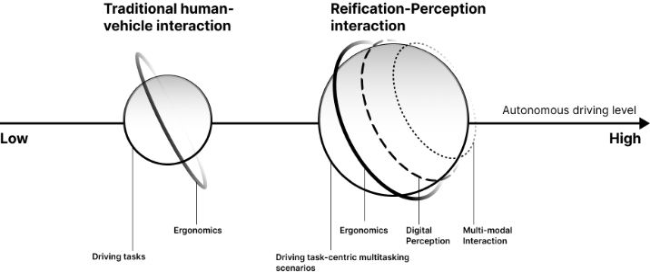
Support for secondary tasks is a consequence of the development of auto- nomous driving (A. K. Huemer and M. Vollrath, 2011). With the innovation of autonomous driving technology and the development of multimodal, mul- tichannel interaction technology, the focus of interior design will gradually shift to secondary tasks other than driving, and the focus of interior design will shift from the driver to the entire driving scenario in the vehicle. This study provides a schematic diagram of the RPI development structure in response to this status and trend (Figure 1). In the context of intelligence,
Figure 1: Human-vehicle RPI structure (draw by author).
RPI is a more complex category and its structure is based on automotive ergo- nomics, with driving tasks in the car as the primary task and task scenarios containing multiple secondary tasks as the core, including multimodal intera- ction and digital perception, as well as other characteristics of user behavior performance.
THE CHARACTERISTICS OF RPI: FUSION DESIGN OF MULTI-INTERACTIVE FORM Naturalization of In-Vehicle Interaction
Since the introduction of the automobile, there has been continuous inte- raction between humans and vehicles. As time progresses and technology advances, the method of interaction within vehicle interiors is continuously modernized. The effectiveness of information transfer between humans as “Object” and the automobile has been a fundamental concern in automotive interaction. Researchers have developed the idea of “interaction naturaliza- tion” in order to properly capture the user’s subjective experience of efficient information production and sharing.
Interaction Quality is the universal, objective and unbiased effectiveness of HMI (A. Schmitt et al. 2011). And one of the criteria for measuring the interaction quality of intelligent vehicles is the naturalness of intera- ction (Z. Tan et al. 2022). The greater the interaction quality, the closer the interaction behavior is to the human instinctual response, the more natu- ral the interaction behavior, and the closer the interaction behavior is to the human instinctive response (Y. Shi, 2018). Therefore, the most direct way to improve the interaction quality is to minimize the input and output costs of the interaction information, while making the interaction relation- ship between the two more consistent with the user’s a priori knowledge and mental model, so that the user and the car can perceive each other’s intentions more naturally and with less load. The research on the sense of natural interaction quality in the interior cannot be isolated from the research on the cognitive model and process of the user, according to this viewpoint.
With the advancement of technology, the interaction quality of vehicle interiors is gradually increasing, and the user’s behavior in the vehicle is com- pletely dataized by the vehicle system, thereby enhancing the vehicle system’s perception of user information and the user’s interaction behavior with the interiors. The gradual introduction of multimodal perception and physiolo- gical detection technologies for vehicle interiors (T. Nakagawa et al., 2017) has made the interaction between users in the car and the vehicle system in the past more robust. In the mechanical interaction stage, the user can only operate the vehicle’s interior via its limbs (levers, physical operation knobs, etc.), and the interior can then perceive the owner’s information and provide feedback. During the interaction procedure, the user releases infor- mation through various body parts in order for the inside of the vehicle to provide feedback. Perceptions of user information within the vehicle interior lag behind. Currently, in the Intelligent Interior, a variety of input channels (microphone, camera, touch screen, etc.) are integrated to sense the user’s
The New Interaction Mode of Human-Vehicle in Automatic Driving 241
behavior (eye movements, gestures, etc.) and physiological indicators (heart- beat, body temperature, etc.), which are transformed into data for input into the vehicle system, so that the user need not actively send information to the vehicle, but the vehicle actively uses sensing technology to obtain informa- tion (G. Wiegand et al. 2019). This considerably aids the establishment of normalized human-vehicle interaction. Moreover, research on anticipating human intentions is already underway, and car systems can potentially anti- cipate user behaviors and respond to them in advance using deep learning (B. I. Ahmad et al. 2017).
The essence of interaction naturalization is facilitating the seamless tran- sfer of the user’s existing knowledge and cognitive model to the under- standing of the new interaction behavior (Valli A., 2008). Combining the historical evolution of car interiors reveals that the HVI design approaches the user’s deeper cognitive level via the natural interaction concept and tech- nology cluster. The “Purpose in action” of the vehicle interior is closer to the user’s prior intention, allowing them to accomplish engaging activities with reduced time cost and cognitive burden (Turner P., 2008).
Entity Interaction The conventional HVI consists of a significant number of physically intera- ctive components (Zhang Jing, 2017), which are responsible for control and display. As automobiles transition to low-level Automated Driving, traditi- onal buttons are generally abolished and replaced by touch-sensitive virtual buttons, with a substantial number buried beneath the screen. Nevertheless, as evidenced by the retention of Tesla’s grill, the vehicle interior users’ physical operating demands have not lessened despite the absence of many physical components (Millar. G, 2018). It is owing to the user’s prior expertise and skill in dealing with the inside of a standard non-Intelligent Interior-equipped vehicles.
With the advancement of material technology, the interior solid compo- nents (steering wheel, IP, etc.) have evolved from automobile ergonomics artifacts to solid components with interaction properties. Intelligent surfa- ces, physical feedback, tactile stimulation, and other interaction technologies at the manufacturing level transform mechanical contact into natural inte- raction behavior. Its essence is the entity interaction concept of receiving feedback from actual action, which is consistent with the users’ past know- ledge and proficiency with the conventional vehicle interior. Mercedes-Benz, Baiteng, BMW, and numerous more automobile manufacturers revealed their visions of future entity interaction at CES 2020. The new design’s sensory shape promotes the user’s natural operation behavior and decreases the user’s learning cognitive load.
From Embodied Interaction to Whole Body Interaction In a broad sense, there are numerous ways in which humans and obje- cts while they undergo ongoing evolution. Since the 1970s, new types of interaction have evolved as the academic community has started to
question conventional graphical interface interactions. Users should uti- lize their human space talents to the most extent possible while inte- racting, according to these new interaction paradigms. For instance, in embodied interaction, people should use their bodies as essential tools and media to sense the physical world and carry out interaction activities (Svanaes D. and Young W., 2011).
The traditional graphic interface interaction concept, which emphasizes that “the body is the brain,” is broken by the appearance of embodied design. According to the concept of embodied interaction, cognition resides in the human brain, the body, and the physical world; these three components link and resolve issues. Dourish (Dourish P, 2001) and Streeck (Streeck J et al. 2011) made a point about embodied interaction; they hold that the human body is the critical tool for the user to perceive the physical world during embodied interaction. Additionally, the machine need to be an extension of the human body rather than just something that exists outside of it.
Embodied interaction underlines the constraints of learning cognition through physical contact. First and foremost, bodily sensation is a prere- quisite for embodied interaction. Users occasionally may receive incorrect information from the outside, which causes them to receive inaccurate feed- back from the vehicle’s interior. Second, embodied interaction emphasizes sensory processing of the external world, but ignore the elements from the inner world of human, just like visual abstraction, user emotion, physiologi- cal function. Instead of focusing on a person’s internal processes, embodied contact emphasizes the body’s external performance.
Whole-body interaction is a new field in the interaction of automotive inte- riors, which was first proposed by Buxton (1987). According to England (England, David et al., 2009), whole-body interaction was the collection of all signals in 2009 (physical, mental, cognitive, emotional, etc). Human sta- tes, such as cognitive load (Y. Liang et al. 2007), subtask (M. Muoz et al. 2016), emotion (X. Wang et al. 2019), location (Y. Xing et al. 2018), tire- dness (K. Li et al. 2020), etc., can be identified and collected by the system. Digital technology is used to incorporate the captured feedback into the digi- tal realm, which is subsequently transmitted back into the physical space and perceived by the user. Consequently, whole-body interaction can incorporate data from exterior and internal actions. In this regard, embodied design is a unique sort of whole-body engagement. For instance, fatigue driving dete- ction is a basic automobile interior interaction technology. During driving, the interior must be able to identify the driver’s physiological status. Driver fatigue detection involves monitoring the user’s eye movement frequency, human pulse, or body posture as an output with a statement of purpose (Deng Sanpeng et al. 2010). Different bodily positions convey distinct meanings in various settings. Consequently, while integrating user information, vehicle interiors necessitate both general interaction design thinking and numerous specialized interaction thinking in relation to the design process outlined previously.
With the advent of automated driving and intelligent interior, consumers are now able to dedicate more energy to non-driving duties. Cognitive load has become a prominent topic of study on RPI, both for driving tasks such as
The New Interaction Mode of Human-Vehicle in Automatic Driving 243
driving distractions (Sajad Ahmad Najar and Premjit Khanganba Sanjram, 2021) and for behavioral research beyond driving.
DISCUSSION
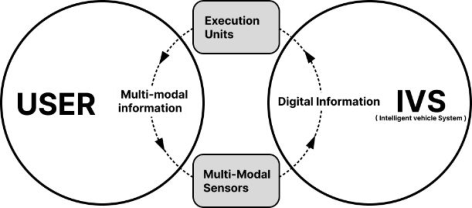
Basic Concept of RPI RPI senses and transmits information utilizing digital technology, and this digital technology-based contact with HVI is more natural than ever. In the phase of interior design, human behavior is considered the primary com- ponent of interior perception and design. In conclusion, the user’s interior activity results in digital information input to the vehicle system, which then provides feedback to the user via digital information output to various actu- ation units in the vehicle (screen, audio, smart surfaces, etc). As seen in Figure 2, the interior of the vehicle effortlessly communicates digital behavio- ral data between the user and the vehicle via multimodal information sensors and. The information is subsequently conveyed to the user via the guidance of the actuation unit, enabling the user to engage in more natural interaction behaviors.
Cognitive Center of Gravity Driving an automobile is a tremendously difficult task (W. Wang et al., 2020), requiring three layers of planning and the processing of about 1600 sepa- rate tasks. A huge number of secondary and tertiary activities beyond the driving task have evolved in the vehicle as the level of autonomous driving rises. This tendency has led to a polarization of existing interior designs for autonomous driving. On the one hand, extremely sophisticated self-driving interiors assume too many primary driving functions, causing the driver to lose concentration. Studies have shown that vehicle automation impairs brain load (M. R. Endsley, 1999) and situational awareness (N. A. Stanton and M. S. Young, 2005) and that reaction times increase with increasing levels of automation (Llaneras, R. E. et al. 2013). When the vehicle wants the user to take over driving, it cannot do so in a timely manner due to the low brain load. On the other hand, an excessive number of secondary and tertiary responsi- bilities make the interior of the smart cockpit more complicated than before. The complexity increases the user’s need for functionality and emotion; this contradicts the design philosophy of human-vehicle RPI.
Figure 2: Interactive mode of vehicle interior under RPI (draw by author).
Through study on the developmental aspects of RPI, it is also clear that the ultimate goal of interaction naturalization, Entity Interaction, and embodied interaction research is to minimize the cognitive load of the user. Recent stu- dies have demonstrated, however, that too little cognitive load while driving might result in driver distractions and slow reaction times (T. J. Gordon and M. Lidberg, 2015). This is due to the low cognitive load of the driver while driving, which results in focusing all attention on secondary tasks unrelated to driving, making it a transition period for the driver to recover during dri- ving when control of the vehicle is transferred from the vehicle system to the driver (A. Eriksson and N. A. Stanton, 2017), making it difficult for the driver to regain situational awareness when the driver is not yet actively involved in the driving process (H. E. B. Russell et al. 2016).
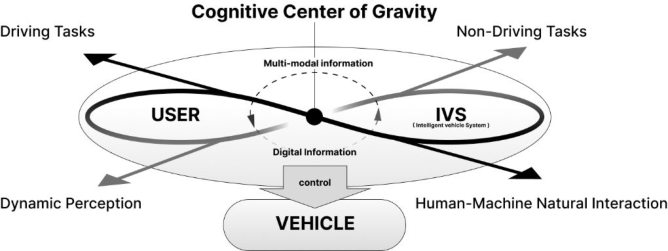
Too much cognitive load causes anxiety and reduces the driver’s state, while too little cognitive load causes distraction and prolongs the driver’s takeover driving and reaction time, hence increasing road safety risks. Based on the aforementioned issues, this research provides a model of interaction behavior dubbed “Cognitive Center of Gravity”(see Figure 3). For the purpo- ses of this work, Cognitive Center of Gravity, as one of the main parameters for measuring the quality of RPI, can be one of the important future rese- arch directions before the deployment of completely autonomous driving technology.
Figure 3: The relationship between the cognitive center of gravity and automobile interior under RPI (draw by author).
CONCLUSION
This study presents a concept of interaction in vehicle interiors and descri- bes a novel model of human-vehicle interaction in smart automobiles based on RPI. First, using in-vehicle technology (multimodal sensors, etc.), the user and the automobile can share information in ways other than only on the screen, making the information more varied and three-dimensional. Second, the vehicle system is no longer “hindsight” in RPI-based intelligent vehicle interiors. This means that the user no longer needs to send information to the vehicle system. Instead, the vehicle system will actively sense the user and provide feedback, making the feedback similar to the user’s previous experi- ences, making communication between the user and the vehicle system more
The New Interaction Mode of Human-Vehicle in Automatic Driving 245
efficient and natural. It improves the efficiency and naturalness of communi- cation between the user and the vehicle system. Through the use of physical and psychological sensing technologies, intelligent cockpits can process data directly and offer feedback. As a result of the cross-fertilization of many forms of interaction, current research reveals that RPI may be a new type of HVI. The study of user cognition in the smart cockpit has drawn designers’ atten- tion. Future study in the area of HVI may take new avenues suggested by the structural diagram of RPI and the link between the Center of Gravity and the Intelligent Interior.
ACKNOWLEDGMENT
This research is supported by Paradigm Construction and Theoretical Boundary of Design Research, National Social Science Foundation (20BG103), and Intelligent Network Product Human Factors Solution Design, Chongqing Natural Science Fundation (CSTB2022NSCQ-MSX1463).
REFERENCES
A. Eriksson and N. A. Stanton, “Takeover time in highly automated vehicles: Noncritical transitions to and from manual control,” Hum. Factors, vol. 59, no. 4, pp. 689–705, Jan. 2017. A. Herrmann, W. Brenner, and R. Stadler, Autonomous Driving: How the Driverless
Revolution Will Change the World. Bingley, U. K.: Emerald Group Publishing, 2018. A. K. Huemer and M. Vollrath, “Driver secondary tasks in germany: Using interviews to estimate prevalence,” Accident Anal. Prevention, vol. 43, no. 5, pp. 1703–1712, Sep. 2011. A. Schmitt, B. Schatz, and W. Minker, “Modeling and predicting quality in spoken
human-computer interaction,” in Proc. SIGDIAL Conf., Stroudsburg, PA, USA: Association for Computational Linguistics, 2011, pp. 173–184. B. I. Ahmad, J. K. Murphy, S. Godsill, P. M. Langdon and R. Hardy, “Intelligent Interactive Displays in Vehicles with Intent Prediction: A Bayesian framework,” in IEEE Signal Processing Magazine, vol. 34, no. 2, pp. 82–94, March 2017, doi: 10.1109/MSP.2016.2638699. Buxton, W. (1986) There’s More to Interaction than Meets the Eye: Some Issues in
Manual Input. In Norman, [M] //Human-Computer Interaction. San Francisco: Morgan Kaufmann Publishers Inc., 1987: 366–375. Deng Sanpeng, Xu Xiaoli, Yang Xuecui and Miao Dehua, “Research on the driver fatigue monitoring method based on the Dempster-Shafer theory,” 2010 Chi- nese Control and Decision Conference, Xuzhou, China, 2010, pp. 4176–4179, doi: 10.1109/CCDC.2010.5498408. Dourish. P. 2001. Where the action is the foundations of embodied interaction[M].
Cambridge: MIT Press, 2001. England, David;Randles, Martin;Fergus, Paul;Taleb-Bendiab, Azzelarabe. Towards an advanced framework for whole body interaction[J]. Lecture Notes in Computer Science (including subseries Lecture Notes in Artificial Intelligence and Lecture Notes in Bioinformatics), 2009, Vol. 5622(1): 32–40. G. Wiegand, C. Mai, K. Holländer, and H. Hussmann, “InCarAR: A design space
towards 3D augmented reality applications in vehicles,” in Proc. 11th Int. Conf. Automot. User Interface Interact. Veh. Appl., Sep. 2019, pp. 1–13.
H. E. B. Russell, L. K. Harbott, I. Nisky, S. Pan, A. M. Okamura, and J. C. Gerdes, “Motor learning affects car-to-driver handover in automated vehicles,” Sci. Robot., vol. 1, no. 1, pp. eaah5682, Dec. 2016. Joost C. F. de Winter, Riender Happee, Marieke H. Martens, Neville A. Stanton,
Effects of adaptive cruise control and highly automated driving on workload and situation awareness: A review of the empirical evidence, Transportation Research Part F: Traffic Psychology and Behaviour, Volume 27, Part B, 2014, pp. 196–217, ISSN 1369-8478, https://doi.org/10.1016/j.trf.2014.06.016. K. Bimbraw, “Autonomous cars: Past, present and future a review of the developments in the last century, the present scenario and the expected future of autonomous vehicle technology,” 2015 12th International Conference on Infor- matics in Control, Automation and Robotics (ICINCO), Colmar, France, 2015, pp. 191–198. K. Li, Y. Gong, and Z. Ren, “A fatigue driving detection algorithm based on facial
multi-feature fusion,” IEEE Access, vol. 8, pp. 101244–101259, 2020. L. Yang et al., “A Refined Non-Driving Activity Classification Using a Two-Stream Convolutional Neural Network,” in IEEE Sensors Journal, vol. 21, no. 14, pp. 15574–15583, 15 July15, 2021, doi: 10.1109/JSEN.2020.3005810. Llaneras, R. E., Salinger, J., Green, C. A.: Human factors issues associated with limite-
dability autonomous driving systems: drivers’allocation of visual attention to the forwardroadway. In: 7th International Driving Symposium on Human Factors in DriverAssessment, Training and Vehicle Design, pp. 92–98. University of lowa, lowa City (2013). M. Muñoz, B. Reimer, J. Lee, B. Mehler, and L. Fridman, “Distinguishing patterns in drivers’ visual attention allocation using hidden Markov models,” Transp. Res. F, Traffic Psychol. Behaviour, vol. 43, pp. 90–103, Nov. 2016. M. R. Endsley, “Level of automation effects on performance, situation awareness and
workload in a dynamic control task,” Ergonomics, vol. 42, no. 3, pp. 462–492, Apr. 1999. Millar, G., Tabrizian, P., Petrasova, A., Petras, V., Harmon, B., Mitasova, H., Meentemeyer, R., 2018. Tangible Landscape: A Hands-on Method for Teaching Terrain Analysis. https://doi.org/10.1145/3173574.3173954. N. A. Stanton and M. S. Young, “Driver behaviour with adaptive cruise control,”
Ergonomics, vol. 48, no. 10, pp. 1294–1313, Sept. 2005. Sajad Ahmad Najar, Premjit Khanganba Sanjram, Driving errors and gaze behavior during in-vehicle object and spatial distractions, Journal of Transportation Safety & Security, Volume 13, 2021 - Issue 4, pp. 381–413. Streeck J, Goodwin C, 2010, LeBaron C. Embodied interaction: language and body
in the material world[M]. Cambridge: Cambridge University Press, 2011. Svanaes D, Young W. Kinesthetic creativity in participatory design: a phenomenological perspective[C] //Proceedings of the 29th ACM International Conference on Human Factors in Computing Systems. New York: ACM Press, 2011: 45–48. T. J. Gordon and M. Lidberg, “Automated driving and autonomous functions on
road vehicles,” Veh. Syst. Dyn., vol. 53, no. 7, pp. 958–994, Jun. 2015. T. Nakagawa, R. Nishimura, Y. Iribe, Y. Ishiguro, S. Ohsuga, and N. Kitaoka, “A human machine interface framework for autonomous vehicle control,” in Proc. IEEE 6th Global Conf. Consum. Electron. (GCCE), Oct. 2017, pp. 1–3. Timo Jütten, 2010, What is Reification? A Critique of Axel Honneth. An Inter-
disciplinary Journal of Philosophy, Volume 53, 2010 - Issue 3, pp. 235–256. https://doi.org/10.1080/00201741003784606. Turner. P.2008. Towards an account of intuitiveness. Behavior & Information Technology, 2008, 27(6): 475–482.
The New Interaction Mode of Human-Vehicle in Automatic Driving 247
Valli. A., 2008. The design of natural interaction. Multimed Tools Appl 38, 295–305.
https://doi.org/10.1007/s11042-007-0190-z W. Wang et al., “Decision-making in driver-automation shared control: A review and perspectives,” in IEEE/CAA Journal of Automatica Sinica, vol. 7, no. 5, pp. 1289–1307, September 2020, doi: 10.1109/JAS.2020.1003294. Wang Zheng-tong, Zhao Dan-hua, Li Tian-tian.2020. Space Circulation in Automo-
tive Interior Design. Packaging Engineering, 2020, 41(16). X. Wang, Y. Liu, F. Wang, J. Wang, L. Liu, and J. Wang, “Feature extraction and dynamic identification of drivers’ emotions,” Transp. Res. F, Traffic Psychol. Behaviour, vol. 62, pp. 175–191, Apr. 2019. Y. Liang, M. L. Reyes, and J. D. Lee, “Real-time detection of driver cognitive distra-
ction using support vector machines,” IEEE Trans. Intell. Transp. Syst., vol. 8, no. 2, pp. 340–350, Jun. 2007. Y. Shi, “Interpreting user input intention in natural human computer interaction,” in Proc. 26th Conf. User Modeling, Adaptation Personalization, Jul. 2018, pp. 277–278. Y. Xing et al., “Identification and analysis of driver postures for in vehicle driving
activities and secondary tasks recognition,” IEEE Trans. Computa. Social Syst., vol. 5, no. 1, pp. 95–108, Mar. 2018. Z. Tan et al., “Human–Machine Interaction in Intelligent and Connected Vehicles: A Review of Status Quo, Issues, and Opportunities,” in IEEE Transactions on Intelligent Transportation Systems, vol. 23, no. 9, pp. 13954-13975, Sept. 2022, doi: 10.1109/TITS.2021.3127217. Zhang Jing. 2017. Research on Graphical Design Interactive Information of Househ-
old Drum Washing Machine Based on User Characteristics[D]. Changsha: Hunan University, 2017.
LISTED IN THE AHFE DIGITAL BOOKSTORE CATALOGUE
Explore the complete digital volume
Human Factors in Transportation
Read this individual research paper free through the original publisher, or explore the full digital proceedings book.
ISBN 978-1-958651-71-1
Explore this ISBN in the AHFE Bookstore ↗Listed in the July 2026 bookstore catalogue; search by ISBN to confirm current availability · Digital book purchase optional