Technical innovation provides new ways to upgrade the future cockpit systems of smart cars. It caused that auto companies equipped more functions of SCS (smart cockpit systems) with wonderful visual and tactile effects aiming to enhance the humanization of their interactive systems and achieve better interaction effects. However, the increased functionality of the SCS did not show significant effect on enhancing the UX (User Experience), for the reason of the chaotic functional logic, the lack of perception of the system and friendly human-computer interaction. To resolve these problems, this paper aims to present a new method for the upgrade of new SCS design on UX research that can analyze problems systematically and evaluate the variability of perceptual degree. This research proposes a human affairs centered design framework and evaluation model for managing UX within SCS. The elements of the affair can be abstracted on seven levels: subjects, objects, time, space, message, interaction and meaning. Since the new SCS is more inclined to human-robot interaction (HRI), both users and systems can be treated as subjects and objects simultaneously, which indicates that the framework contains dual subject and dual object. Furthermore, the evaluation model on the elements on these levels is composed of a horizontal dimension: perceptual degree of design, and a vertical dimension: variability of perceptual degree. The horizontal dimension is used to evaluate the various elements in the affair based on the products in the design phase, while the vertical dimension is based on the result of UX research. The hypothesis is that the framework can help the design and valuation of UX focusing on humanization and perception within the smart cockpit systems’ design. Validation occurred through a field study performed in a smart car in the design phase, where the basic functions of the prototype has already been realized. Preliminary results validate the usability of the framework and efficiency of the method, thus laying the ground for further research and discussions.
Technical innovations provide new ways to upgrade cockpit systems of smart cars. It caused the auto companies to equip more SCS (smart cock- pit systems) functions with wonderful visual and tactile effects aiming at enhancing the humanization of their interactive systems and obtaining bet- ter interaction effects. However, the increased functionality of the SCS did not show significant effect to improve UX (User Experience), for the reasons of chaotic functional logic, the lack of perception of systems and friendly human-computer interaction (Law E, Roto V, et al, 2008). In the field of human-vehicle interaction, as the complexity of SCS increases whereas users do not have enough professional experience, it has become more difficult to acquire perceptual UX design issues in scenarios (Ning Ma, Ya Hui Wang, 2022).
Human Affairs Centered Design Framework for Managing User Experience 93
The trend of SCS design recently can be concluded through a fieldwork with the SCS in design phases, of which the basic functions of the prototype has already been realized. The update can be summed up in three major design trends. The first is to increase the number of electronic displays and maximize the degree of digital interaction. For example, Alibaba invested in Saic Motor. Compared with the traditional car’s permanent screen in the middle of the front seat, the IM L7 of ZHIJI Auto company is added a long and flat screen to enhance the visual effect (Xiao Ou Niu, Yun Zhu, 2021). The second is to increase the intelligent peripherals of car and use the advan- tages of the “Internet of Vehicles”to further improve the user experience. For example, Weimar smart cars support the interconnection with MIJIA smart homes, such as MIJIA air conditioners, sweepers, rice cookers, etc. The last is to add more methods to input instructions and to make the SCS align with smart devices like mobile phones. For example, the HICAR automotive smart system adopted by the Huawei Smart Selection SF5, which Huawei coope- rated with Cyrus, supports voice, Input instructions in different operation modes such as gestures (Cheng Kai, 2022).
It can be concluded from above that various techniques are applied to the latest SCS, such as digital assistants, gesture interaction, augmented reality, etc. The use of these technologies will directly affect the evaluation of UX. A new qualitative analysis method is required for some subjective and perce- ptual issues such as the comprehension between users and cars, the impact of space and social relationships to UX, and whether the logic of functi- ons is humanized. Therefore, the design science of human affair could take advantage as a method for research.
A FRAMEWORK OF UX MANAGEMENT WITHIN SMART COCKPIT SYSTEMS A structural analysis on the design of the new SCS is needed before condu- cting research and evaluation, therefore a framework will be proposed in the next context. The first part described a “dual subject” model in detail which was mentioned above. And an elastic conceptual design evaluate tool of SCS UX management was proposed in the second part based on the features of the “dual subject” model.
Basic Framework of Human-Smart Cockpit System The current methods of affair centered design are mainly used in analyzing the target system of design process (Guanzhong Liu, Hesen Li, 2021). Under the premise of mastering this concept, the focus of the design of SCS has been the shift from “more humanized functions”and “multi-modal interaction”to “humanized services” (Yukihiro, Mitsuo, 1995). Therefore, in the reality of the upgrade of the existing SCS, the evaluation of user experience should pay more attention to the degree of emotional interaction (Bertolini, A, Carli, R, 2022). The UX problems make us reflect on the existing design framework of human-computer interaction, which should be transformed from traditional HMI (Human-Machine Interaction) to HRI (Human-Robot Interaction), to improve the mutual understanding between individuals and smart vehicles,
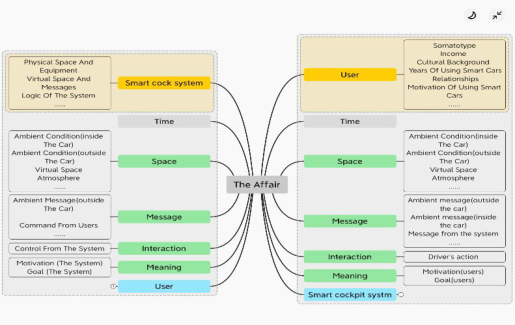
Figure 1: Basic framework scheme for facts of the affair of a user-smart cockpit system.
and the user friendliness of SCS. This means that in the event of human- vehicle interaction, both human and vehicle are subjects simultaneously, and the “single subject” model of original affair has changed to a “dual subject” model. In this mode, the users and SCS both could become the subject and the observed in the affair.
The design idea of a certain product always starts with finding and resea- rch the targets of planning affair which is to determine the target system of a certain design. Concretely, the target system is formed by the correlation of external factors and internal factors. Its external factors include the main behavioral purpose of the user’s different use environments, the location, the number of times the user uses the intelligent system, the user’s cultural back- ground, etc. The internal factors contain seat design, interactive screen design, intelligent interactive system design, etc.
The basic framework for an affair of a human-smart cockpit is composed of seven architectures: time, space, interactive behavior, message, meaning, and dual subjects—the driver and SCS (fig. 1). Since the amount of SCS have been or will be equipped with VR, or AR and other augmented reality systems, this framework also includes the virtual space. To take the influe- nce of external factors into account more comprehensively, the user’s relevant background information should be as detailed as possible, which will affect the reasoned result of the meaning architecture in the affair. It should be noted that the background information here needs to be carried out by the UX experts discussing the product positioning and determining the information required. And finally, a questionnaire will be completed after the redundant and less relevant information removed. Furthermore, “think-aloud” could be an appropriate tool in the test. UX experts could find the reasons for the deep- seated UX and evaluate the design problems based on the seven architectures through “deep description”.
Elastic Perceptual Evaluate Model of UX Management of Smart Cockpit System The UX test can be obtained based on the above framework. Likert scale is to obtain more professional and objective data. UX experts and designers score
Human Affairs Centered Design Framework for Managing User Experience 95
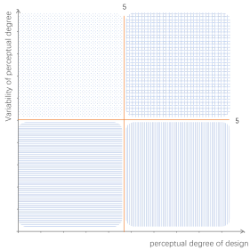
Figure 2: Elastic perceptual evaluate model in UX management of smart cockpit systems.
the first design model of products by giving a score from 1 to 10 for the perce- ptual degree of each element in the affair. For the evaluation at this stage, the scoring is completely based on the direct judgment and completely subjective ideas of designers and UX experts. And the elastic perceptual evaluate model on UX management of SCS is based on the results of UX tests. UX experts score the variability of perceptual degree of each element through the results of tests. In addition, the evaluation from UX experts based on UX testing should only consider the variability itself, and how an element is going to be in the subsequent design phase should not be considered at this stage.
As shown in figure 2, the scope can be divided into four parts according to the degree of the average value of 5. The affair elements in the dotted area are expressed as the low degree of perceptualized design at this stage with high variability, which means that the perceptual elasticity of the elements is large and there is a larger range of improvement. The elements located in the grid area mean that they are designed with a higher degree of sensitivity and a higher degree of changeability. The points in the range of lower half of the figure not highly adjustable due to various reasons such as safety standards, social consensus, conditions of user, etc. The chart helps to distinguish clearly which affair elements are the key considerations of perceptual design in the redesign stage.
METHODOLOGY
In the following passages, the methods used for the analysis and evaluation in the experiments will be described and partial sample chart will also be illustrated.
Materials before tests were as follow: 1. Audio/video equipment; 2. Cock- pit’s space of RC3 edition of BYTON M-Byte and outside environment for testing; 3. Users’ background information; 4. three paper materials: test script, user task card/score card, recording paper; 5. Environment initializa- tion. The user task card gave a series of specific task lists to the participants, which were set according to the tested modules in the system. The behavior issuer of the task list here were the users, and the purpose was to give beh- avior instructions instead of specifying the user’s behaviors and the orders of the behaviors. During the observation and recording process, interference
and guide behaviors were not given. On the other hand, the participants were encouraged to think aloud, which helps the experimenters to realize the user’s direct thoughts in real time and record it.
Participants: There were 6 users with 3 UX experts. All participants were from within the company, and the users were filtered according to the results of the company’s internal user research.
Experiment condition: The environment inside the car consisted of a closed space with a cockpit for the driver, three cockpits for passengers, a DD (driver display), a SED, CID (central infotainment display). The outside environment was a common outdoor parking lot with an illuminance at approximately 700~500 LUX and loudness at 40~50dB. The reason for choosing this time point was to simulate the user behaviors and mental state of after leaving work.
Research process: The study was divided into the following steps: 1. Analy- zing the users’ experience of current smart car space through the elements of the affair centered framework. 2. Scoring for the perceptual degree of each element in the design with the Likert scale tool. 3. Gathering the user back- ground information related the study with an online questionnaire. 4. Testing UX on the RC3 edition of BYTON M-Byte, taking notes within the method of “think-aloud” and observing, then explaining it based on the framework. 5. Evaluating the variability of perception of each element using the Likert scale tool. 6. Organizing the acquired data to form a two-dimensions diagram of the complete elastic perceptual design analysis.
RESULTS
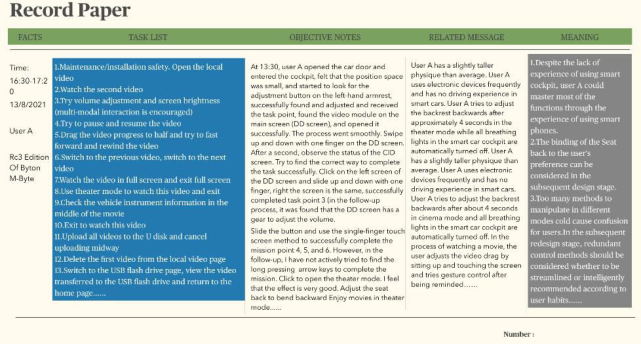
The results of UX study are presented as below. Among the above the expe- riments were taken in the company of BYTON Nanjing and provided the results. The results showed that there was a total of 5 usability issues discove- red in this test, out of which 2 were serious, mainly related to voice navigation and access control. For each module, in the experience evaluation of the user interface, the average score of the user interface was 4.2, the average score of the interface was 4.4, and the ease of operation was 4.7. The table below showed a partial sample of the recording and analysis results in which the rational facts and task lists were already completed before the test. Take Fig. 3 as the sample to indicate that having taken the objective evidence as notes in the third and fourth blank columns, the meaning of the affair could be infer- red by different UX experts according to their experience. In addition, the re-design points proposed in the next stage may be traceable for analysis on a valid basis since the process filling from the left to the right is a process from objective to subjective.
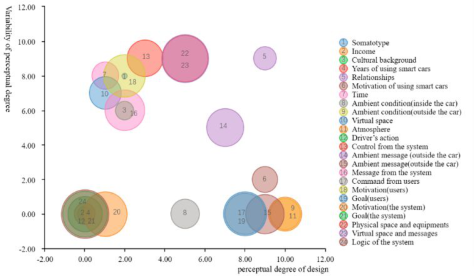
The results of elastic perceptual evaluation are presented as below. Three UX researchers A, B and C have answered the Likert scale score sheet (as shown in table 1) and retrograde evaluation for each element of the affair after going through the UX test. Accordingly, the figure below is plotted based on average assessment scores of the three UX researchers.
As can be seen from fig. 4, there were six items overlap at (0,0), which proved that UX researchers believed the elements of these transactions did
Human Affairs Centered Design Framework for Managing User Experience 97
Figure 3: Record and analysis paper of UX (part)Table 1. Likert scale score sheet(part).
Table available in the original PDF paper.
Average Score
Elements Degree of Perceptual Design
Variability of Perceptual Degree
UXer A
UXer B
UXer C
UXer A
UXer B
UXer C Somatotype 1 1 0 0 0 0 0.6,0 Income 0 0 0 0 0 0 0,0 Cultural background 5 4 6 0 0 0 5,0 Years of using smart cars 0 0 0 0 0 0 0,0 Relationships 8 8 8 0 0 0 8,0 Motivation of using smart cars 9 10 9 0 0 0 9.3,0 …… … … … … … … …
Figure 4: Elastic perceptual evaluation in UX management of smart cockpit systems of RC3 edition of BYTON M-Byte not need perceptual design, and there was not much room for their redesign. Most of remaining projects were mainly distributed in two areas, some of which were in the upper left area of the figure, which meant that these transa- ction elements were spaced with a highly elastic perceptual experience design and presented in a slightly perceptual design. Another part of the elements was concentrated in the lower right corner of the figure, which means that
this part of the elements had lower flexibility in terms of perceptual design. There were few elements distributed in the middle area of the figure. Such as ambient messages (outside the car), these elements were in a state where there was not much space for redesign and keeping the extent of the impact for UX relatively stable.
CONCLUSION
In conclusion, this study conducted the research and analysis of UX mana- gement of smart cockpits in the latest generation. A structured framework of interaction between SCS and users was proposed aiming to help designers understand and analyze the relationship of each element. An evaluate model focusing on perceptual design was carried out based on the dual subject fra- mework which provided a new method for evaluating and analyze the UX problems of SCS design. This research has been proved not only to be helpful for products in the middle stage of design but was also conducive to the design upgrade of UX issues for complex systems and found problems of UX accu- rately. The method has the advantages of no need for an appreciable amount of user samples, acting as a common language between UX experts and desi- gners, focusing on non-observed problems in user research statistics based on early quantification and identifying the relationships between components in a complex interactive system.
REFERENCES
Bertolini, A., Carli, R. (2022). “Human-Robot Interaction and User Manipulation.”, Baghaei, N., Vassileva, J., Ali, R., Oyibo, K. (eds) Persuasive Technology. PERSUASIVE. Lecture Notes in Computer Science, vol 13213. Springer, Cham. Cheng Kai. (2022). “The evolution from U to I, test drive AITO M5.”, Friends of
Cars, (Z3): 16–23. Guan-Zhong Liu, Sen-He Li. (2021), “Design Matterology: Abstraction and Concretization of the Targets.”, Packaging Engineering, 42(12), 1-6+31 Kellermann, T., Räth, D., Danz, D. & Heinath, M. (2020), “People and the HMI
ofthe Future.”, ATZ worldwide, Vol. 122 No. 11, pp. 26–31. Law E, RotoV, VermeerenAPOS, et al. (2008), “Towards a shareddefinition of user experience.”, Twenty-sixth Annual CHI Conference Extended Abstracts on Human Factors in Computing Systems-CHI’08, 2395–2398. Li Wenbo. (2017). Research on Human-Computer Interaction User Experience
Test and Evaluation of HMI Products of Intelligent and Connected Vehicles. Chongqing: Chongqing University. Ning Ma, Ya Hui Wang. (2022), “Analysis method of human-computer interaction task complexity in smart car cockpit.”, Journal of Graphics, 1-6 [-04-07]. Xiao-Ou Niu, Yun Zhu. (2021) “Zhiji rises again, can SAIC “kill a bloody road”?”,
Business School, (1):3. Ying-Lien Lee. (2010). “The effect of congruency between sound-source location and verbal message semantics of in-vehicle navigation systems.”., Safety Science, 8(6): 708–713. Yukihiro Matsubara, Mitsuo Nagamachi. (1995), “Hybrid kansei engineering
system and design support.”, Advances in Human Factors/Ergonomics, 20: 161–166.
Read this individual research paper free through the original publisher, or explore the full digital proceedings book.
ISBN 978-1-958651-44-5
Explore this ISBN in the AHFE Bookstore ↗Listed in the July 2026 bookstore catalogue; search by ISBN to confirm current availability · Digital book purchase optional