Yujie Zhu, Kun Pyo Lee, Lie Zhang, Stephen Jia Wang (2022). Meaningful Smart Health Data: A Design Guide for Transparent Data to Enhance Self-Reflection. In: Human Interaction & Emerging Technologies (IHIET 2022): Artificial Intelligence & Future Applications. AHFE Open Access, vol. 68, pp. 316–322. https://doi.org/10.54941/ahfe1002748
1 School of Design, The Hong Kong Polytechnic University, Hung Hom, Hong Kong Special Administrative Region; Laboratory for Artificial Intelligence in Design, Hong Kong Science Park, New Territories, Hong Kong Special Administrative Region ↗
2 Academy of Art & Design, Tsinghua University, Beijing, 100084, China ↗
3 School of Design, The Hong Kong Polytechnic University, Hung Hom, Hong Kong, Special Administrative Region ↗
Since the characteristic of the Internet of Medical Things (IoMT) is featured with connectivity, distribution, and context-awareness (Rowland et al., 2015; Chin et al., 2019), it has become a common understanding of constant monitoring from surrounding “Ubiquitous” Environment. Concerning such sensing and monitoring situation for humans, devices, and the context, this study tackles a raising concern of tracking personal health data without an awareness (Sun et al., 2019). The challenge has two folds. On one hand, the amount of health data being collected and transferred continually through the network between different devices in any place and anywhere. Ideally, high convenience should be achieved for supporting reviewing and reflective thinking of end-users’ daily activities and vital health signals through data. However, quantified self-reflection hasn’t been achieved to facilitate human behavioural change to reach various healthy living goals. On the other hand, due to the vital role of visualized data that could effectively sufficient human requirements, the challenges of health data transparency (including data privacy, data security, and data visualization for various stakeholders etc.) are not only demonstrated by scholars but also lead to the negative user experience of connected devices. This study proposes a human-centred approach that aims at ensuring make sense of data transparency to enhance the IoMT experience. For instance, “trust and privacy” are critical issues for IoMT (Haghi Kashani et al., 2021), “access and storage” of health data are obscured and untraceable, “access control of data” (Calvillo-Arbizu et al., 2021), and the opacity of data process and abstraction (Hepworth, 2019) are reasons for losing trust, which users cannot know and modify the decision-making result of their data. The gulf between user expectations and understanding of this emerging technology leads to negative experiences. Despite the market has witnessed a breakthrough in the adoption of IoMT, evidence has shown a large percentage of abandonment (Clawson et al., 2015). User experience (UX) is the significant factor that influences long-term use (Hermsen et al., 2017). Zou et al. (2020) demonstrate the gap between the user’s perception and data interaction. Furthermore, how users make sense of their data is identified as one of the reasons for abandonment and treated as the key design challenge for IoMT stakeholders (Lazar et al., 2015; Ravichandran et al., 2017; Attig & Franke, 2020). As such, a review of existing data transparency and visualization related works for health data is conducted and summarized in this paper, which incorporates the following three aspects:1)The user perception of quantified health data.2)The interconnection of self-reflection and meaningful data representation through data visualization and physicalization.3)The design approach for tracking, accessing, and controlling data.Besides such a review, a ‘data transparency’ based guiding framework is also proposed to contribute and explore the relationship between UX design and health data, which has limited evidence been provided (Hepworth, 2019). Finally, the proposed framework intends to be validated from the user perception identification of existing products and design practice for utilizing the framework to address the data challenges of the IoMT system.
Since the characteristic of the Internet of Medical Things (IoMT) is featu- red with connectivity, distribution, and context-awareness (Rowland et al. 2015, Chin et al. 2019), it has become a common understanding of constant monitoring from the surrounding “Ubiquitous” Environment. Concerning such sensing and monitoring situations for humans, devices, and the context, this study tackles a raising concern of tracking personal health data without awareness and lack of sufficient understanding of meaningful data.
In this context, meaningful data refers to useful information that can be enhanced the self-reflection of human activities to facilitate behaviour change. To reach various healthy living goals, meaningful health data aims to help users quantify and understand their health data and conditions. Meanwhile, the abundance of health data being collected and transferred continually through the network between different smart devices in any place and anywhere. The awareness of self-reflection, behaviour change, and pri- vacy protection are limited perceived by users. Because data representation or recommendations are obscured, abstracted, and unexplainable.
Meaningful Smart Health Data: A Design Guide for Transparent Data 317
The challenge has two folds. On one hand, users perceive useless data and negative experiences of IoMT devices, which lead to a large percen- tage of abandonment (Clawson et al. 2015). Ideally, high convenience should be achieved for supporting self-reflection of daily activities and vital health signals through meaningful health data. On the other hand, how transparent data can enhance users’ awareness from a user experience (UX) perspective has limited evidence been provided (Hepworth 2019). Existing approaches demonstrate solutions for data transparency from legal and technic perspecti- ves, such as the General Data Protection Regulation (GDPR) and blockchain. However, health data transparency (including data privacy, data security, and data visualization for various stakeholders etc.) is not only lacking awareness by users but also leads to the negative user experience of connected devices.
This paper explores the meaningful health data from three aspects: 1) Human perception, 2) Interconnection of self-reflection and meaningful health data, and 3) Design for meaningful health data. Besides such a review, a ‘data transparency’ based guiding framework is proposed to contribute and explore the relationship between UX design and health data.
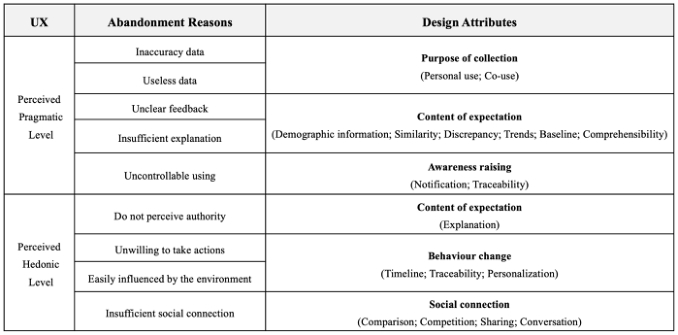
RELATED WORKS The gulf between user expectations and understanding of meaningful health data leads to negative experiences in the long-term using IoMT devices. To address abandoned issues, this study bridges the lens of Hassenzahl’s model of user experience (Hassenzahl 2018) with reflection models to reorganize abandonment reasons, and abstract design attributes to explore the values of health data (Figure 1).
Human Perception of Meaningful Health Data The perceived pragmatic level aims to achieve usability goals. The most con- ducted reasons are inaccuracy data and useless data (Clawson et al. 2015, Hermsen et al. 2017). Collected health data are shown as inaccurate records due to technic issues or are considered useless due to inconsistency with users’ expected data type. Second, unclear feedback and insufficient explanation are others discontinued reasons (Lazar et al. 2015). Health data can serve as a useful tool for users to understand their activities and set better goals. How- ever, demonstrating numbers does not make sense to users. Why feedback is recommended and what actions should do to fix issues are considered to be important information (Li et al. 2011, Feustel et al. 2018). Lastly, uncontrol- lable using is a widely concerned reason for abandonment (Attig and Franke 2020), since raising awareness of privacy protection. Users like to know what data are collected, what are the purposes of collecting, and who is data shared with. Without clearly tracing and controlling, they give up using their smart devices.
On the other hand, do not perceive authority, unwilling to take action, easily influenced by the environment (Lazar et al. 2015), and insufficient social communication (Hermsen et al. 2017) are abandonment reasons pro- posed at the perceived hedonic level. Despite most IoMT devices claim that
Figure 1: Summary of abandonment reasons and design attributes.
their algorithms or recommendations are based on research by authorita- tive sources, it is still difficult for users to trust the system due to a lack of transparency and accountability (Barth et al. 2022). Moreover, users also face barriers in maintaining motivation to change behaviours, since levels of goal and behaviour change are influenced by a variety of factors over time (Li et al. 2011). They are eager to find social connections through the same type of users to facilitate the achievement of goals (Feustel et al. 2018).
Interconnection of Self-Reflection and Meaningful Health Data Since proper reflection can enhance critical thinking and increase aware- ness, prior research efforts investigated theories of reflection to contribute meaningfulness of data. Fleck & Fitzpatrick (2010) proposed five levels of reflection that inspired design strategies for reflection. In the beginning, the revisiting level (R0) and reflective description level (R1) present informa- tion descriptively with limited analysis. Human explores if the purpose of data collection and content fits their expectations. Further, the dialogic refle- ction level (R2) refers to the ideation of relationships. Human investigates similarities and discrepancies of data from multiple perspectives. To achi- eve fundamental behaviour change, the transformative reflection level (R3) and the critical reflection level (R4) describe a more abstract level of refle- ction. Human seeks critical thinking their behaviour data and take actions to maintain their goals. What’s more, the extended work by Li et al. (2011) utilises an iterative stage-based model to investigate that purpose, context, history, factors, status, and differences are mostly concerned with data by users. Feustel et al. (2018) argued that social connection plays a critical role in personal health data. Human perceives others’ data as a baseline, which motivates the user to explore and reflect.
Design for Meaningful Health Data Limited prior research involves designing for reflection, which can be clas- sified into three categories: data visualization, data physicalization, and conversational system. Visualizations of tracking data are the most widely
Meaningful Smart Health Data: A Design Guide for Transparent Data 319
used approach since individuals can directly perceive patterns of data through visual appearance. Data can be presented in various graphical patterns. For instant, peak and valley, similar trends, and abnormal points can be easily recognized by users (Feustel et al. 2018, Bussone et al. 2019). Gamified style is another component of data visualization, which enhances social relationsh- ips between users. Through different shades of colours and elements in game design to emphasize ranking and competition, improving users’ engagement (Hepworth 2019). At the same time, the visual comparison is also evide- nced that peer health data could provide insight and enhance higher levels of reflection (Bussone et al. 2019). On the contrary, data physicalization is recognized as a non-visual sense, which provides an intuitive interaction approach with lower cognitive barriers. By manipulating physical represen- tation, individuals can understand, learn, and perceive more complex and deeper information (Jansen et al. 2015). Moreover, studies have demonstra- ted that physicalization could empower users’ desire for exploration and engagement, which conveys a playful approach to reflective thinking (Stusak et al. 2014).
With the development of natural language processing (NLP) techniques, personal counselling is indicated as a potential approach for enhancing self-reflection. Kocielnik et al. (2018) designed a conversational system to present individuals’ health data through dialogues from human-AI intera- ction. According to their investigation, the form of dialogue delivers effective reflection to empower humans to a deeper understanding of their health data at the dialogic reflection level (R2), meanwhile, motiving and persuading individuals to take actions to achieve behaviour change purposes.
Recently, transparent and comprehensible data are suggested to provide explanations of behaviour. Human is not just exploring what makes sense of their health data but are also seeking the reasoning and decision-making processes within the intelligent system. Schelenz et al. (2020) proposed a pra- ctical guideline for increasing the transparency of the intelligent system. They demonstrated that transparency refers to intelligible information to users, explainable outcomes with why and how it makes, and controllable and interactive data. Therefore, transparency can also serve as a reflective tool to enhance autonomy and increase trust.
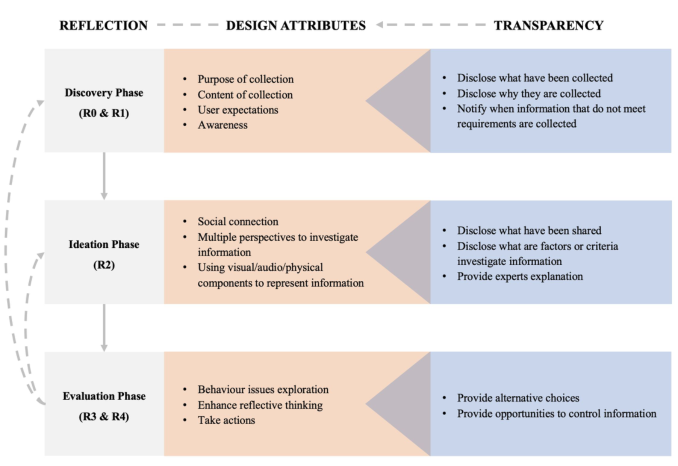
CONCEPTUAL FRAMEWORK Based on Fleck & Fitzpatrick’s reflection levels (2010) and Schelenz’s che- cklist for transparency (2020), a design guide framework is constructed. As shown in Figure 2, design attributes (orange) reorganize key features from human perceptions, which map to the iterative reflection phases (grey) based on the human-centred process. To boost deeper reflection, transparency recommendations (blue) are overlapped on the design attributes to further facilitate.
First, in the discovery phase, the user explores the goals, context, and con- tent of data collection to match their expectations. Designers should focus on providing information related to the revisiting level (R0) and reflective description level (R1). Information representation should be disclosed and
Figure 2: Framework for transparent data to enhance self-reflection. According to Fleck & Fitzpatrick’s five reflection levels (2010), R0: Revisiting level, R1: Reflective descri- ption level, R2: Dialogic reflection level, R3: Transformative reflection level, R4: Critical reflection level.
notified what and why has been collected to raise users’ awareness. Second, in the ideation phase, exploring and understanding personal health data from multiple perspectives is the major purpose of this phase, which is positioned in the dialogic reflection level (R2). Designers should consider the tradeoff between social connection with personal privacy. On one hand, shared data empower users to reflect on their behaviour from peer data and comparison. On the other hand, users have the right to trace and protect their privacy. Transparent data plays a critical role in this phase. Lastly, higher reflection levels (R3 and R4) are required in the evaluation phase. To address funda- mental behaviour change and reflective thinking, users need to explore issues and take action to fix problems. Experts’ recommendations, instructions, and user engagement could serve as practical approaches. Designers should provide alternative options to help users understand how system recommen- dations are decided and controllable operation to engage in the system based on their requirements. Through these transparency design approaches, deli- vering interactive information to help the user maintain self-reflection and percept the meaningfulness of their health data.
DISCUSSION
Reflection models provide a theoretical perspective to explore the meaning- fulness for users. To make sense of a myriad of health data, this study proposes that transparency could provide a more intelligible approach to faci- litate deeper reflective thinking, which enhances not only raise awareness of data privacy but also understanding of meaningful health data. In addition,
Meaningful Smart Health Data: A Design Guide for Transparent Data 321
this paper reorganises design attributes based on prior works from the user experience perspective, which maps to iterative human-centred reflection phases. These attributes provide applied guidance for designers to consider in different contexts. In addition, presenting transparent and comprehensive information cannot guarantee the outcome of enhancing the understanding of the data. Instead, it may load additional cognitive requirements that con- fuse users into abandonment. Following this logic, further analysis should focus on the tradeoff between human perception and appropriate transparent information to avoid frustration and discouragement caused by overthinking. Moreover, the proposed framework should be validated from different per- spectives. Our future studies intend to evaluate it from user perception of different scenarios, and design practices of utilizing the framework to figure out the potential of transparency to enhance the self-reflection.
CONCLUSION
This paper aims at ensuring make sense of data and transparency to enh- ance the IoMT experience. Meaningful health data is argued from human perception, self-reflection, transparency, and design approach aspects. Design attributes under such context are summarized to address issues of meaning- fulness and awareness from the user experience perspective. Moreover, a human-centred conceptual framework is proposed to explore the intercon- nection of transparency and reflective thinking. The presented framework could be a design practice tool for future extension.
ACKNOWLEDGEMENT
This research is funded by the Laboratory for Artificial Intelligence in Design (Project Code: RP2-4) under the InnoHK Research Clusters, Hong Kong Special Administrative Region Government.
REFERENCES
Attig, C. and Franke, T. (2020). Abandonment of personal quantification: A review and empirical study investigating reasons for wearable activity tracking attrition. Computers in Human Behavior, vol. 102, pp. 223–237. Barth, S., Ionita, D. and Hartel, P. (2022). Understanding Online Privacy-A Syste-
matic Review of Privacy Visualizations and Privacy by Design Guidelines. ACM Computing Surveys, vol. 55, no. 3, pp. 1–37. Bussone, A., Stumpf, S. and Wilson, S. (2019). Designing for Reflection on Shared HIV Health Information. In: The Biannual Conference on Italian SIGCHI Chapter, CHItaly’19 September 23-25, Padova. New York: ACM, pp. 1–10. Chin, J., Callaghan, V. and Allouch, S.B. (2019). The Internet-of-Things: Reflections
on the past, present and future from a user-centered and smart environment per- spective. Journal of Ambient Intelligence and Smart Environments, vol. 11, no. 1, pp. 45–69. Clawson, J., Pater, J.A., Miller, A.D., Mynatt, E.D. and Mamykina, L. (2015).
No longer wearing: investigating the abandonment of personal health-tracking technologies on craigslist. In: Proceedings of the 2015 ACM International Joint Conference on Pervasive and Ubiquitous Computing, UbiComp’15 September 7-11, Osaka. New York: ACM, pp. 647–658.
Feustel, C., Aggarwal, S., Lee, B. and Wilcox, L. (2018). People Like Me: Designing for Reflection on Aggregate Cohort Data in Personal Informatics Systems. Procee- dings of the ACM on Interactive, Mobile, Wearable and Ubiquitous Technologies, vol. 2, no. 3, pp. 1–21. Fleck, R. and Fitzpatrick, G. (2010). Reflecting on reflection: framing a design
landscape. In: Proceedings of the 22nd Conference of the Computer-Human Interaction Special Interest Group of Australia on Computer-Human Interaction, OZCHI’10 November 22-26, Brisbane. New York: ACM, pp. 216–223. Hassenzahl, M. (2018). The Thing and I: Understanding the Relationship Between User and Product. In: Blythe M. and Monk A., eds. Funology 2, Human-Computer Interaction Series. Springer International Publishing, pp. 301–313. Hepworth, K. (2019). A Panopticon on My Wrist: The Biopower of Big Data
Visualization for Wearables. Design and Culture, vol. 11, no. 3, pp. 323–344. Hermsen, S., Moons, J., Kerkhof, P., Wiekens, C. and De Groot, M. (2017). Determinants for Sustained Use of an Activity Tracker: Observational Study. JMIR mHealth and uHealth, vol. 5, no. 10, p. e164. Jansen, Y., Dragicevic, P., Isenberg, P., Alexander, J., Karnik, A., Kildal, J., Subra-
manian, S. and Hornbæk, K. (2015). Opportunities and Challenges for Data Physicalization. In: Proceedings of the 33rd Annual ACM Conference on Human Factors in Computing Systems, CHI’15 April 18-23, Seoul. New York: ACM, pp. 3227–3236. Kocielnik, R., Xiao, L., Avrahami, D. and Hsieh, G. (2018). Reflection Companion: A Conversational System for Engaging Users in Reflection on Physical Acti- vity. Proceedings of the ACM on Interactive, Mobile, Wearable and Ubiquitous Technologies, vol. 2, no. 2, pp. 1–26. Lazar, A., Koehler, C., Tanenbaum, T.J. and Nguyen, D. (2015). Why we use and
abandon smart devices. In: Proceedings of the 2015 ACM International Joint Con- ference on Pervasive and Ubiquitous Computing, UbiComp’15 September 7-11, Osaka. New York: ACM, pp. 635–646. Li, I., Dey, A.K. and Forlizzi, J. (2011). Understanding my data, myself: supporting self-reflection with ubicomp technologies. In: Proceedings of the 13th internatio- nal conference on Ubiquitous computing, UbiComp’11 September 17-21, Beijing. New York: ACM. p. 405. Rowland, C., Goodman, E., Charlier, M., Light, A. and Lui, A. (2015). Designing
connected products: UX for the consumer Internet of things. 1st ed. Sebastopol: O’Reilly. Schelenz, L., Segal, A. and Gal, K. (2020). Best Practices for Transparency in Machine Generated Personalization. In: Adjunct Proceedings of the 28th ACM Confere- nce on User Modeling, UMAP’20 Adjunct July 14-17, Genoa. New York: ACM, pp. 23–28. Stusak, S., Tabard, A., Sauka, F., Khot, R.A. and Butz, A. (2014). Activity Scul-
ptures: Exploring the Impact of Physical Visualizations on Running Activity. IEEE Transactions on Visualization and Computer Graphics, vol. 20, no. 12, pp. 2201–2210.
Read this individual research paper free through the original publisher, or explore the full digital proceedings book.
ISBN 978-1-958651-44-5
Explore this ISBN in the AHFE Bookstore ↗Listed in the July 2026 bookstore catalogue; search by ISBN to confirm current availability · Digital book purchase optional