Wei Gong, Stephen Jia Wang (2025). Driving with Empathy: Understanding Novice Drivers’ Emotional Needs in Interaction with In-Vehicle AI Systems. In: Human Factors in Design, Engineering, and Computing. AHFE Open Access, vol. 199, pp. 1644–1652. https://doi.org/10.54941/ahfe1006975
As artificial intelligence (AI) becomes increasingly embedded in intelligent vehicles, emotion-aware human–vehicle interaction (HVI) systems have the potential to support drivers not only functionally but also emotionally. However, most existing in-vehicle AI systems are designed for experienced users, often overlooking the emotional stress and learning needs of novice drivers. This study explores novice drivers’ perceptions, expectations, and affective experiences when interacting with emotional AI in driving contexts. Through semi-structured interviews with 20 novice drivers and thematic analysis, it is revealed that novice drivers' needs for in-vehicle AI systems mainly focus on four aspects: situational awareness, behavioral guidance, emotional support, and interaction preferences. The findings reveal that novice drivers expect intelligent systems to provide not only functional assistance but also empathetic support and adaptive interaction that responds to their emotional states. This study contributes to a deeper understanding of human–AI interaction in driving contexts by highlighting how emotional safety and perceived empathy influence user trust and engagement. The insights offer practical guidance for designing adaptive and empathetic in-vehicle intelligent systems.
Driving is not only a cognitive and operational task, but also an experience imbued with emotional dimensions. Compared with experienced drivers, novice drivers often face higher emotional stress and cognitive load, and are more sensitive to negative feedback (Krasniuk et al., 2024). Prior studies have shown that novice drivers are more prone to anxiety, distraction, and overestimation of their driving competence—factors that can lead to unsafe driving behaviors and reduced learning efficiency (Stephan et al., 2024; Scott-Parker et al., 2012; Yang et al., 2019). These psychological characteristics suggest that driving performance is influenced by emotional states and motivational processes, as well as operational skills.
With the widespread adoption of artificial intelligence (AI) in intelligent vehicles, in-vehicle AI systems are gradually becoming the core of human– vehicle interaction (Labbo et al., 2024). In addition to providing driving guidance and behavioral monitoring, these systems perform emotion
Driving With Empathy: Understanding Novice Drivers’ Emotional Needs 1645
regulation functions through affective computing and real-time feedback mechanisms. Affective computing enables AI to sense users’ states through multimodal data—such as voice, gaze, and physiological signals—thereby offering more personalized and empathic support. Recent studies indicate that emotion-aware AI can enhance user trust, reduce cognitive load, and improve overall driving experience (Wang et al., 2022). However, most existing systems are designed primarily for experienced drivers, often neglecting the unique emotional and learning needs of novice drivers who are still developing their sense of control and confidence. Understanding how these users perceive and expect emotional support from in-vehicle AI is essential for creating systems that enhance both safety and emotional well-being.
This study investigates novice drivers’ perceptions of affective in-vehicle AI systems, with a particular focus on how they interpret and respond to the emotional and behavioral support such technologies provide. Through semi-structured interviews with 20 novice drivers, we examined their needs, expectations, and emotional experiences when interacting with AI in driving contexts. By analyzing the interview data, we aim to uncover users’ genuine pain points and provide empirically grounded, user- centered insights for optimizing future in-vehicle AI systems—ultimately contributing to the development of emotionally supportive intelligent driving technologies.
RELATED WORK
Challenges of Novice Drivers In road safety research, novice drivers represent a relatively vulnerable group, as their high cognitive load, limited situational awareness, and emotional instability often result in unsafe driving behaviors (Scott-Parker et al., 2012). They tend to experience heightened anxiety, distraction, and delayed reactions, particularly when confronted with complex traffic situations or critical feedback from other road users (Freydier, 2014). Empirical evidence indicates that such negative emotional states increase cognitive load, impair hazard perception, and lead to slower reaction times and greater variability in vehicle control (Molloy et al., 2023; Loeb et al., 2015). These weaknesses are further exacerbated in high-risk environments such as nighttime driving, unfamiliar routes, or adverse weather conditions (Klauer et al., 2011; Gao et al., 2015).
Traditional driver education programs, such as the GDE framework (Jawi et al., 2017) and coach-based instructional models (Üzümcüo˘glu et al., 2021), have improved operational driving competence but often overlook the emotional dimension of driving. Training environments rarely help novice drivers learn how to regulate emotions such as fear, frustration, or overconfidence, despite these being decisive factors in real-world driving performance. Although human instructors play an important role in early driving education, their guidance often relies on personal experience and can be influenced by fatigue or emotional fluctuation, resulting in inconsistent teaching quality. Furthermore,
1646 Gong and Wang
novice drivers frequently experience emotional friction or even conflict with instructors during training, and such negative interactions can diminish learners’ focus and trust (Waylen & McKenna, 2008). Most critically, traditional approaches tend to emphasize procedural correctness while neglecting the cultivation of emotional regulation, environmental awareness, and anxiety management skills among novice drivers. This gap contributes to crises and accidents when they transition to real-world road driving. Consequently, an increasing number of studies advocate integrating emotional and psychological perspectives into driver support technologies.
Emotional AI in Vehicles With the rapid development of affective computing and embodied artificial intelligence, affective AI has become a highly promising technology in the domain of intelligent vehicles (Wang et al., 2022; Duan et al., 2022). These systems integrate multimodal sensing technologies—such as facial expression, vocal tone, and physiological signal analysis—to detect drivers’ emotions in real time. Emotional response feedback delivered through adaptive voice, visual cues, or ambient prompts has been shown to reduce cognitive load and improve driving concentration (Huo et al., 2023; Mavadati, 2015). Commercial applications, including Toyota’s e- Palette, the Cerence–Smart Eye system, and NIO’s NOMI, demonstrate a growing public interest in artificial intelligence technologies that can enhance user engagement and in-vehicle psychological comfort (Toyota Motor Corporation, 2020; Cerence Inc. & Smart Eye, 2024; NIO, 2024; Zeekr, 2024).
Research has shown that emotion-aware artificial intelligence can enhance both the functional and psychological dimensions of driving. By recognizing emotional states, such systems can intervene earlier than traditional warning mechanisms—for example, activating safety functions when stress or anger is detected (Oh et al., 2021). Beyond direct safety benefits, affective AI can also foster driver well-being by building trust and alleviating anxiety, particularly under complex or high-risk conditions. Corresponding studies in human–computer interaction have further demonstrated that emotion- adaptive systems can effectively balance efficiency and cognitive workload (Villani et al., 2021).
However, current affective AI technologies largely assume that users possess stable driving competence and emotional self-regulation. Their feedback mechanisms remain highly scripted, focusing primarily on convenience or entertainment rather than empathy or learning support. As a result, novice drivers—who often experience uncertainty, low confidence, and emotional fluctuation—derive limited benefit from such systems. To address these limitations, artificial intelligence must evolve beyond passive responsiveness toward emotionally attuned and context-aware interaction (Russell & Norvig, 2016). Understanding how novice drivers perceive and emotionally resonate with these systems is therefore essential for advancing human-centered intelligent mobility solutions.
Driving With Empathy: Understanding Novice Drivers’ Emotional Needs 1647
METHODOLOGY
This study employed a qualitative research approach to explore novice drivers’ cognition, emotional experiences, and expectations regarding in- vehicle affective artificial intelligence (AI) systems. Given the contextual and individual variability of emotions and subjective experiences, semi-structured interviews were conducted to gain an in-depth understanding of novice drivers’ psychological responses and needs in both real and imagined driving scenarios.
A total of 20 novice drivers were recruited for this study. Novice drivers were defined as licensed individuals who had driven less than 1,000 kilometers and fewer than 50 times since obtaining their driver’s license (Lyu et al., 2018; Wang et al., 2010). The participants’ average age was 29.5 years (SD = 1.6), including 12 females (60%) and 8 males (40%). Convenience and snowball sampling were used for recruitment. Invitations were distributed via social media, and participants were encouraged to recommend peers who met the inclusion criteria. All participants had prior exposure to intelligent driving technologies to ensure a shared understanding of the topics discussed.
Interviews were conducted individually, either face-to-face or through online video calls, each lasting approximately 30 to 45 minutes. Prior to the formal interview, participants completed a demographic questionnaire and signed an informed consent form. All audio recordings were anonymized to protect participants’ privacy. The interview questions focused on three main areas: emotional experiences during driving, trust and expectations toward AI systems, and perceptions of in-vehicle voice and affective feedback.
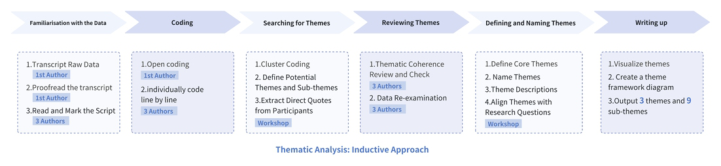
An inductive thematic analysis (Clarke & Braun, 2013) was employed to identify shared patterns through iterative processes of coding, clustering, and theme refinement. The researchers independently coded the data, followed by cross-comparison and discussion to ensure analytical consistency. The complete process of data analysis is shown in Figure 1. Ultimately, four overarching themes were identified—situational awareness, behavioral guidance, emotional support, and interaction preferences—which together provided the analytical framework for the subsequent findings.
Figure 1: Summary of key steps in thematic analysis.
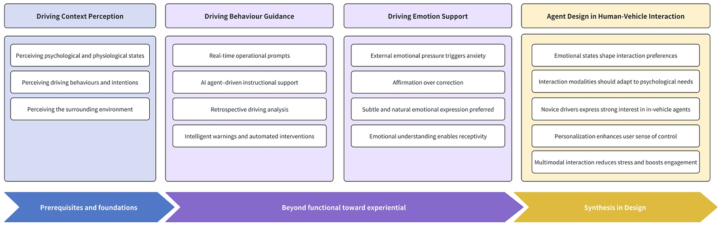
FINDINGS Based on semi-structured interviews and thematic analysis of 20 novice drivers, this study identified four core themes that reflect their key
1648 Gong and Wang
psychological needs and experiences when interacting with in-vehicle affective artificial intelligence (AI) systems (as shown in Figure 2): situational awareness, behavioral guidance, emotional support, and interaction preferences. Together, these themes reveal the central role of emotion in novice driving experiences and illustrate how affective AI is perceived as an important source of safety and trust.
Figure 2: Overview of 4 main themes and 16 sub-themes.
Situational Awareness Most participants believed that in-vehicle AI should be able to perceive their driving states and emotions in order to provide more targeted assistance. They expected the system not only to recognize external driving conditions (such as road situations and traffic density), but also to sense their internal psychological states and fatigue levels. For example, one participant noted: “If it could tell when I’m nervous and remind me to slow down, it’d be like having a co-driver who really understands me” (P7).
Others hoped the system could respond proactively before they explicitly expressed a need. As one participant stated, “It’d be better if it could anticipate my needs—like suggesting a rest when I’m too tired” (P4). These comments suggest that novice drivers value the feeling of being understood more than mere technical prompts. Timely, accurate, and gentle feedback helps them alleviate tension and uncertainty, thereby enhancing their trust and reliance on the AI system.
Behavioral Guidance Many participants described anxiety and unease resulting from their lack of driving proficiency. For instance, one participant remarked, “I have no sense of the car’s width, especially when turning—I often misjudge it” (P13); another added, “Reversing at night is particularly hard—I get really flustered” (P5). They hoped that AI could offer voice or visual prompts at critical moments—such as during lane changes, when maintaining distance, or avoiding blind spots—to help them stay focused and calm (P18).
At the same time, some drivers emphasized that they did not want the AI to “interfere too much,” preferring to retain a sense of autonomy. One participant explained, “I want it to remind me, but let me decide what to do” (P4). This attitude reflects novice drivers’ psychological need for autonomy
Driving With Empathy: Understanding Novice Drivers’ Emotional Needs 1649
during the learning phase—they desire support, but also respect. Some participants further suggested that the AI could provide post-trip feedback to help them reflect on and improve their driving habits (P3).
Emotional Support Almost all participants mentioned experiencing emotional stress while driving, such as pressure from tailgating vehicles, criticism from passengers, or tension caused by complex traffic conditions. Many indicated that if AI could express emotional understanding and reassurance through tone or words, it would greatly ease their anxiety. One participant said, “I don’t want it to just say ‘you’re wrong’—I want it to say ‘it’s okay, relax” (P2).
Several participants also pointed out that negative feedback from human passengers often made them feel embarrassed or nervous, whereas AI’s “calm tone” made them feel more at ease: “People get impatient and scold me, but AI doesn’t—that makes me more willing to listen to it” (P6). Overall, participants believed that an AI capable of recognizing emotions and responding appropriately could help them maintain psychological balance and foster more positive emotional engagement with driving. “If the system could notice that I’m nervous and respond in a gentle tone, I’d immediately feel understood” (P1).
Interaction Preferences Most novice drivers felt that interactions between AI and driver should flexibly adapt to different driving situations. Under stressful or high-load conditions, they preferred brief voice feedback or visual cues, whereas in more relaxed states, they were more receptive to lighthearted tones or extended interactions. For example, one participant remarked, “When reversing, I don’t want too many instructions—I just want it to stay quiet” (P6); another noted, “When I’m driving smoothly, it can talk a bit more, but when I’m tense, it’s better not to interrupt” (P2).
Moreover, participants expressed varied preferences regarding AI voice, tone, and even “personality style.” Some favored a gentle female voice (P12), while others preferred a neutral or professional tone (P8). A few participants hoped the AI could “switch roles” or offer “personalized settings” to better match their emotional states (P7).
As one driver summarized, “If the AI could talk like someone I’m familiar with, I’d find it easier to accept its suggestions” (P9). This indicates that flexible and personalized interaction styles are essential for affective AI to gain user acceptance.
CONCLUSION AND FUTURE WORK Through qualitative interviews with 20 novice drivers, this study reveals the role of affective artificial intelligence (AI) in emotion regulation and trust formation within intelligent driving contexts. The findings indicate that when interacting with in-vehicle affective AI, novice drivers not only attend to the system’s functionality and safety, but also place considerable emphasis on its performance in emotional understanding, empathic feedback,
1650 Gong and Wang
and psychological support. The study identifies “emotional safety” and the “feeling of being understood” as core factors in the development of user trust. These results extend current understandings of “emotionally intelligent interaction”within the field of human–machine interaction (HMI), and provide psychological grounding for AI’s transformation from cognitive assistance to emotional support.
And the findings also contribute to advancing the practical implementation of affective AI in automotive human–machine interfaces (HMI), offering a new perspective for enhancing user experience in intelligent driving systems at the applied level. In particular, for novice drivers, AI systems capable of emotional perception and adaptive feedback can support emotion regulation and psychological stability during learning and decision-making processes, thereby enhancing driving confidence and safety.
Future work could be deepened in two directions. First, attention should be given to the influence of cultural differences on emotional expression and trust patterns in human–AI interaction, as the meanings of “empathy” and “companionship” may vary significantly across cultural contexts. Second, there is a need for systematic investigation into issues of privacy and data ethics—particularly regarding how to balance personalized experience and data security when AI continuously monitors users’ emotions and behaviors. Further exploration of these issues will help advance more inclusive and ethically grounded applications of affective AI in human-centered mobility and interaction design.
ACKNOWLEDGMENT
This research was funded by the University’s Research Centre for Future (Caring) Mobility (P/ID: P0042701), the Hong Kong Polytechnic University.
REFERENCES
Castro, C. (2008) Human factors of visual and cognitive performance in driving.
Boca Raton, FL: CRC Press. Cerence Inc. & Smart Eye (2024) Smart Eye and Cerence to showcase AI-driven immersive companions with perception capabilities [Press release]. Available at: https://www.cerence.com.cn/newsinfo/6755531.html (Accessed: 20 October 2025). Clarke, V. and Braun, V. (2013) ‘Teaching thematic analysis: Overcoming challenges
and developing strategies for effective learning’, The Psychologist, 26(2), pp. 120–123. Duan, J., Yu, S., Tan, H. L., Zhu, H. and Tan, C. (2022) ‘A survey of embodied AI: From simulators to research tasks’, IEEE Transactions on Emerging Topics in Computational Intelligence, 6(2), pp. 230–244. https://doi.org/10.1109/ TETCI.2021.3130262. Freydier, C. (2014) Attention divisée en simulation de conduite automobile: Influence
de l’expérience et impact de l’alcool. PhD thesis. Aix-Marseille Université. Gao, L., Yu, X. and Hou, L. (2015) ‘Research for the novice driver’s capacity of hazard perception and response’, in 2015 International Conference on Engineering Management, Engineering Education and Information Technology (EMEEIT 2015), pp. 355–360. Paris: Atlantis Press [conference].
Driving With Empathy: Understanding Novice Drivers’ Emotional Needs 1651
Huo, F., Zhao, Y., Chai, C. and Fang, F. (2023) ‘A user experience map design method based on emotional quantification of in-vehicle HMI’, Humanities and Social Sciences Communications, 10(1), pp. 1–10. https://doi.org/10.1057/s41599–023- 01588–4. Jawi, Z. M., Deros, B. M., Rashid, A. A., Isa, M. H. and Awang, A. (2017) ‘The roles
and performance of professional driving instructors in novice driver education’, Sultan Qaboos University Medical Journal, 17(3), e277. Klauer, S. G., Simons-Morton, B. G., Lee, S. E., Ouimet, M. C., Howard, E. H.
and Dingus, T. A. (2011) ‘Novice drivers’ exposure to known risk factors during the first 18 months of licensure: The effect of vehicle ownership’, Traffic Injury Prevention, 12(2), pp. 159–168. Krasniuk, S., Toxopeus, R., Knott, M., McKeown, M. and Crizzle, A. M. (2024) ‘The effectiveness of driving simulator training on driving skills and safety in young novice drivers: A systematic review of interventions’, Journal of Safety Research, 91, pp. 20–37. Labbo, M. S., Qu, L., Xu, C., Bai, W., Atumo, E. A. and Jiang, X. (2024)
‘Understanding risky driving behaviors among young novice drivers in Nigeria: A latent class analysis coupled with association rule mining approach’, Accident Analysis & Prevention, 200, 107557. Loeb, H. S., Kandadai, V., McDonald, C. C. and Winston, F. K. (2015) ‘Emergency braking in adults versus novice teen drivers: Response to simulated sudden driving events’, Transportation Research Record, 2516(1), pp. 8–14. Lyu, N., Cao, Y., Wu, C., Xu, J. and Xie, L. (2018) ‘The effect of gender, occupation
and experience on behavior while driving on a freeway deceleration lane based on field operational test data’, Accident Analysis & Prevention, 121, pp. 82–93. https://doi.org/10.1016/j.aap.2018.07.034. Mavadati, S. (2015) Spontaneous facial behavior computing in human-machine interaction with applications in autism treatment. PhD thesis. Denver, CO: University of Denver. Molloy, O., Molesworth, B. and Li, J. (2023) ‘Examining self-reported young novice
and young experienced drivers’ speeding behavior: An exploratory study’, in Proceedings of the Human Factors and Ergonomics Society Annual Meeting, Vol. 67, No. 1, pp. 1331–1336. Los Angeles, CA: SAGE [conference]. NIO (2024) Tech Talk | Why can NOMI GPT understand you? [Technology briefing].
Available at: https://www.nio.cn/smart-technology/20240802004 (Accessed: 20 October 2025). Oh, G., Ryu, J., Jeong, E., Yang, J. H., Hwang, S., Lee, S. and Lim, S. (2021) ‘DRER: Deep learning–based driver’s real emotion recognizer’, Sensors, 21(6), 2166. https://doi.org/10.3390/s21062166. Russell, S. J. and Norvig, P. (2016) Artificial intelligence: A modern approach. 3rd
edn. Upper Saddle River, NJ: Pearson. Scott-Parker, B., Watson, B., King, M. J. and Hyde, M. K. (2012) ‘Young, inexperienced, and on the road: Do novice drivers comply with road rules?’, Transportation Research Record, 2318(1), pp. 98–106. Stephan, K., Stephens, A. N., Scully, M., Mitsopoulos-Rubens, E. and Newstead, S. V.
(2024) ‘Outcome evaluation of the P drivers Program: Randomised controlled trial of a program to improve safe driving among novice drivers’, Accident Analysis & Prevention, 201, 107569. Toyota Motor Corporation (2020) Toyota releases the evolution of the practical application of e-Palette [Press release]. Available at: https://www.toyota.com.cn/ toyotatimes/tinfo/index.php?t_id=244 (Accessed: 20 October 2025).
1652 Gong and Wang
Üzümcüo˘glu, Y., Öz, B., Özkan, T. and Lajunen, T. (2021) ‘Investigating driving instructors: The mediating roles of driving skills in the relationship between organizational safety strategies and driver behaviours’, Transportation Research Part F: Traffic Psychology and Behaviour, 76, pp. 38–46. Villani, V., Sabattini, L., Zanelli, G., Callegati, E., Bezzi, B., Bara´nska, P. and Fantuzzi,
C. (2021) ‘A user study for the evaluation of adaptive interaction systems for inclusive industrial workplaces’, IEEE Transactions on Automation Science and Engineering, 19(4), pp. 3300–3310. Wang, Y., Song, W., Tao, W., Liotta, A., Yang, D., Li, X. and Zhang, W. (2022) ‘A systematic review on affective computing: Emotion models, databases, and recent advances’, Information Fusion, 83, pp. 19–52. https://doi.org/10.1016/ j.inffus.2021.02.009. Wang, Y., Zhang, W., Reimer, B., Lavallière, M., Lesch, M. F., Horrey, W. J. and Wu, S. (2010) ‘The effect of feedback on attitudes toward cellular phone use while driving: A comparison between novice and experienced drivers’, Traffic Injury Prevention, 11(5), pp. 471–477. https://doi.org/10.1080/ 15389588.2010.495761. Waylen, A. E. and McKenna, F. P. (2008) ‘Risky attitudes towards road use in pre-
drivers’, Accident Analysis & Prevention, 40(3), pp. 905–911. Yang, L., Zhang, X., Zhu, X., Luo, Y. and Luo, Y. (2019) ‘Research on risky driving behavior of novice drivers’, Sustainability, 11(20), 5556. Zeekr (2024) Product information of the 2024 Zeekr 001 [Product launch report]. Available at: https://www.zeekrlife.com/ informationDetail?columnId=1480482892664233984&newsId=155658880361 1648000 (Accessed: 20 October 2025).
LISTED IN THE AHFE DIGITAL BOOKSTORE CATALOGUE
Explore the complete digital volume
Human Factors in Design, Engineering, and Computing
Read this individual research paper free through the original publisher, or explore the full digital proceedings book.
ISBN 978-1-964867-75-5
Explore this ISBN in the AHFE Bookstore ↗Listed in the July 2026 bookstore catalogue; search by ISBN to confirm current availability · Digital book purchase optional