Ziyi Chen, Meichen Liu, Mingyuan Zhang, Stephen Jia Wang (2026). The Interplay of Gender and Anthropomorphism in AI Avatar Design: An Empirical Study on User Experience in Financial Contexts. In: Usability and User Experience. AHFE Open Access, vol. 232, pp. 101–111. https://doi.org/10.54941/ahfe1008039
The design of AI virtual assistant (AVA) avatars significantly shapes user perceptions and experience. However, the interplay between avatar gender, anthropomorphism, and contextual task demands remains underexplored, particularly in specific cultural settings. Grounded in the Computers Are Social Actors (CASA) paradigm and Social Role Theory, this study investigates how these two key design attributes influence user experience within the financial service context of Hong Kong. We conducted an exploratory mixed-methods experiment employing a 2 (avatar gender: male vs. female) × 4 (anthropomorphism level: none, low, medium, high) design. Fourteen participants interacted with a series of avatar conditions while completing standardized financial tasks, followed by in-depth semi-structured interviews. Quantitative results, interpreted with caution due to the small sample size, indicated no statistically significant effect of avatar gender on perceived trust, emotional engagement, or anthropomorphism. Qualitative thematic analysis revealed three core insights: (1) a strong context-dependency of user preferences, where professional settings prioritize functionality and moderated anthropomorphism, while entertainment contexts favor expressive and customizable avatars; (2) a complex relationship with anthropomorphism, where moderate levels foster trust and approachability, whereas high realism can induce discomfort or psychological distance; and (3) a prevailing neutral stance toward avatar gender in task-oriented financial interactions, though underlying cultural stereotypes still persist. The study contributes by providing nuanced and context-sensitive evidence that explores the applicability of gender in professional AVA design and clarifies the boundary conditions of anthropomorphism's benefits.
In recent years, AI has increasingly shaped daily life, changing how people communicate, work, and access services. AI virtual assistants (AVAs) now serve as essential interfaces for human-machine interaction (Li & Sung, 2021; Schmidt et al., 2018). Despite technological progress, AVAs face major challenges in real-world use. Research and user feedback indicate that current AVAs frequently lack engagement and deliver a disappointing user experience (Kelly, Kaye & Oviedo-Trespalacios, 2023). As AI services Received January 23, 2026; Revised April 2, 2026; Accepted April 19, 2026; Available online July 20, 2026
become more widespread, refining AVA design to sustain engagement is crucial to driving adoption.
The strategic use of avatars is an effective way to improve AVA interactions. According to the Computers Are Social Actors (CASA) paradigm (Reeves & Nass, 1996), users treat computers and AI systems as social entities when these systems display human-like cues, such as avatar appearances. Avatars, as visual symbols, shape users’ psychological and emotional perceptions (Miao et al., 2022). Human-computer interaction research shows that attributes such as avatar gender and anthropomorphism directly affect users’ behavioral responses (Li, Luximon & Zhang, 2023; Rao & Troshani, 2024). However, most studies focus on broad contexts, and empirical data on user interactions in the Hong Kong market are limited. This study addresses this gap by experimentally examining how two avatar design factors (gender and anthropomorphism) impact user experiences with AVAs in Hong Kong. Specifically, the research investigates: (1) How does avatar gender influence users’ intention to use the AVA? (2) How does the level of avatar anthropomorphism affect user experience?
By focusing on a specific user group and applying empirical methods, this research aims to provide evidence-based insights for the design of more effective AVAs in Hong Kong, and to guide institutions in optimizing their digital service strategies.
RELATED WORK
Avatar for AI Assistants Avatars have emerged as a critical component in human-computer interaction (HCI) systems, serving as digital embodiments with both form and behavioral realization (Miao et al., 2022). AVAs nowadays often use avatar. For example, major financial institutions like HSBC and Bank of China have deployed avatar-based virtual assistants in their mobile banking apps to provide financial advice. These implementations demonstrate how avatars can effectively establish social presence (Crolic et al., 2022; Zhang et al., 2020). Avatars in AVAs have evolved beyond static representations, now incorporating behavioral cues, dynamic facial expressions, and natural voice interactivity to simulate human-like engagement (Hudson & Hurter, 2016). This enhanced realism has been shown to significantly improve users' perception of trustworthiness and their willingness to adopt AI-assisted services (Song & Shin, 2024).
Avatar Gender and User Perception An avatar’s gender plays a significant role in shaping user interaction and experience with AVAs. Grounded in Social Role Theory (Eagly & Wood, 2012), users often bring pre-existing societal norms and expectations into their interactions with gendered avatars. These expectations influence not only how avatars are perceived but also how users engage with them. Empirical studies underscore the impact of avatar gender on user
The Interplay of Gender and Anthropomorphism in AI Avatar Design 103 behavior and perception. For instance, Lehdonvirta et al. (2012) observed that users tend to select avatars that align with their biological sex and exhibit gender-typical behaviors in virtual environments, including help- seeking tendencies that mirror real-world interactions. Further evidence comes from multiplayer gaming environments, where Ratan et al. (2019) found gendered avatars to engage differently based on user expectations and game dynamics.
Gender-based expectations also permeate human-AI interaction, shaping how users interpret the capabilities and personalities of AVAs. Ratan and Sah (2015), along with more recent work by Chang et al. (2024), found that gender stereotypes similarly applied to artificial agents. Male-presenting avatars are more often perceived as authoritative, competent, and suitable for analytical or leadership roles, particularly in sectors such as finance, technology, and law. Conversely, female-presenting avatars are frequently evaluated as more empathetic, approachable, and emotionally intelligent, leading users to prefer them in roles involving customer service, education, or healthcare.
Anthropomorphism Anthropomorphism refers to the attribution of human-like characteristics to non-human agents or objects (Aggarwal & McGill, 2012; Epley et al., 2007). In the context of AVAs, anthropomorphism plays a critical role in shaping users’ perceptions and behavioral intentions. By humanizing the interface, designers aim to foster more natural and engaging interactions between users and AI systems (Li & Sung, 2021). A growing body of empirical research suggests that higher levels of anthropomorphism in AVAs can enhance user trust, emotional connection, and overall satisfaction (Han, 2021; Li, Luximon & Zhang, 2023; Rao & Troshani, 2024). These effects are particularly significant in service contexts, where perceived warmth and intelligence are essential to user acceptance. However, overly human-like avatars can also elicit discomfort or unease, a phenomenon known as the uncanny valley effect (Song & Shin, 2024).
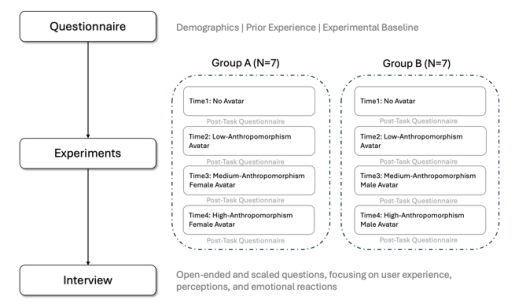
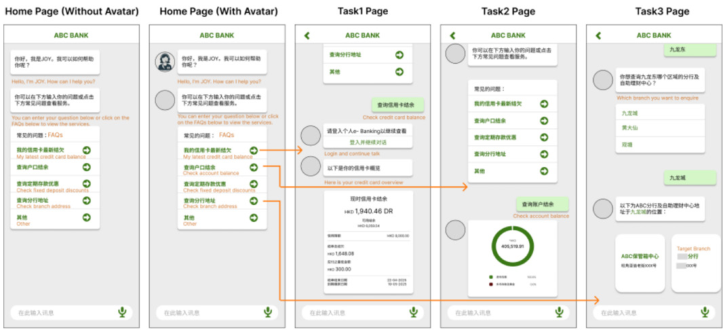
RESEARCH METHOD This study examined how avatar gender and anthropomorphism affect user experience with financial AVAs in Hong Kong. The experiment employed a mixed design: between-subjects (participants interacted with either a male or female avatar), and within-subjects (four levels of anthropomorphism: no avatar, low, medium, and high). Figure 1 shows the procedure. Participants completed four anthropomorphism conditions sequentially (no avatar, low, medium, high), performing three financial tasks per condition, as shown in Figure 2. After each, they answered a post-task questionnaire measuring trust, emotional engagement, and perceived anthropomorphism. A post- experiment interview explored avatar perceptions, emotional connection, and preferences.
Figure 1: Experimental procedure.Figure 2: Virtual assistants used in the experiments.
Fourteen participants were recruited via online platforms. They were randomly assigned to one of two groups: Group A interacted with female avatars, while Group B interacted with male avatars. All participants provided informed consent and completed a demographic questionnaire at the beginning of the study. Table 1 shows the brief demographic data.
Table 1: Demographic data.
Table available in the original PDF paper.
Group A Age Gender Group B Age Gender
2 22 Female 1 25 Female
3 24 Male 4 27 Male
5 25 Female 7 25 Male
6 28 Male 8 25 Male
9 28 Male 11 25 Female
10 26 Female 12 21 Female
13 22 Male 14 23 Male
QUANTITATIVE RESULTS For quantitative analysis, reliability tests, between-subject comparisons, and within-subject comparisons were conducted for the post-task questionnaire, using Stata.
Between-group comparisons were conducted at Time Points 3 and 4. Given violations of the normality assumption, Mann–Whitney U tests were employed to assess differences in subscale scores between the two groups (Nachar, 2008). The data, shown in Table 2, revealed no statistically significant differences between Group A and Group B on any subscale at either time point. These results indicate that group membership did not have a significant effect on participants’ experience following exposure to gendered avatars.
Table 2: Mann-Whitney U tests.
Table available in the original PDF paper.
Time U(Rank Sum) z Exact p Significance TRU 3 49.5 0.388 0.727 No
4 53 −0.065 0.979 No EMO 3 55 −0.322 0.784 No
4 55 −0.320 0.777 No ANT 3 53 −0.064 0.980 No
4 53.5 −0.128 0.921 No
A series of repeated measures ANOVAs was conducted to examine changes across the four time points (see Table 3). In Group A, a significant main effect of time was observed for ANT (p = .0002), but no significant time effects were found for TRU (p = .272) or EMO (p = .477). In Group B, significant within-subject effects were detected for both the EMO (p = .035) and ANT (p = .002), while TRU did not show a statistically significant change across time points (p = .140).
Table 3: ANOVAs.
Table available in the original PDF paper.
Group Variables MS F p Significance A TRU 0.07 1.41 0.2719 No
EMO 0.40 0.86 0.4772 No ANT 3.78 11.57 0.0002 Yes
B TRU 0.64 2.07 0.1401 No EMO 1.38 3.58 0.0346 Yes
ANT 2.80 7.33 0.0021 Yes
QUALITATIVE ANALYSIS To complement the quantitative findings, open-ended responses from participants were analyzed using thematic analysis.
Context Diversity Users’ needs and preferences are often shaped by the specific contexts in which their interactions with AVAs occur. As one participant noted, “It (needs and wants) corresponds to different scenarios…My preferences are highly distinct across different scenarios” (P7). Drawing on the interview data, we identified three primary contextual domains that influence user expectations and experiences with AVAs.
In professional or formal settings, such as financial services or customer support, users typically seek accurate, and efficient information. These interactions are often goal-directed. As one participant explained, “I usually ask questions when I encounter a specific difficult problem” (P11). Users tend to focus primarily on task completion, showing limited concern for the avatar’s appearance: “When seeking answers to relatively objective questions, I feel that the presence or absence of an avatar doesn’t have much of an impact” (P4). However, despite a diminished emphasis on visual features, users still articulated preferences related to the avatar’s presentation, especially when these qualities reinforce professionalism. An avatar perceived as professional and human-like was helpful in enhancing user trust: “A more professional and anthropomorphic avatar, one that appears both more professional and more human-like, might make me feel more trusting” (P7). Multiple participants suggested that an anthropomorphic design, when aligned with professional attributes, conveys reliability and expertise, thus supporting effective engagement in formal settings.
In contrast, entertainment-oriented contexts, such as gaming or leisure applications, foreground emotional engagement and visual appeal. Here, the avatar’s appearance plays a central role in shaping user experience and enjoyment. Users in these contexts valued aesthetic qualities and customization options that allowed them to express identity and foster emotional connection. Customizable avatars were described as more relatable and enjoyable, often eliciting affective responses such as affection or playfulness. Participants described avatars in entertainment contexts as “lovable” (P4, P13), “selectable” (P13), and “more approachable” (P13), indicating a strong link between avatar personalization and user engagement.
The home setting, characterized by intimacy and domesticity, represents the private and personal context. Here, users tend to prefer non-human avatars, such as cute, intimate, plant- or animal-like characters rendered in comic or cartoon styles, evoking feelings of familiarity and relaxation rather than emotional connection.
The Role of Anthropomorphism in Shaping User Interaction Users generally did not perceive significant differences in the accuracy or informational quality of AVAs across varying levels of anthropomorphism. As P5 remarked, “As long as you can help me solve the problem, I wouldn’t particularly differentiate the impact these kinds of avatars have on my experience”. However, the emotional dimension of user experience appeared more sensitive to the avatar’s degree of anthropomorphism. For example, P5 also noted, “When I am not in a good mood, avatars that are more visually
The Interplay of Gender and Anthropomorphism in AI Avatar Design 107 pleasant or feel more approachable might help meet my emotional needs and provide some comfort”.
Highly anthropomorphic avatars evoke a sense of communicating with a real person. P14 stated “It might create a feeling more akin to communicating with a real person”. Consequently, users tend to engage more seriously, moderating their behavior and language. For instance, “I might ask more detailed questions, similar to how I would when speaking with a human customer service representative” (P1).
Users interacting with human-like avatars expect more professional and comprehensive responses. “A virtual assistant with a human-like avatar makes me expect it to provide an experience closer to that of a real customer service assistant” (P11). However, such heightened expectations are not always met: “When such a human-like assistant fails to meet my needs, I feel a sense of emotional frustration” (P11). Some users remain sceptical of anthropomorphic avatars altogether, preferring more mechanical or robotic representations that align with their conceptualization of AI. As one user commented, “I think a robot-style avatar is great because it feels more like what artificial intelligence should look like” (P3).
While high anthropomorphism can enhance authenticity and engagement, it may also evoke negative emotions, particularly depending on the context. In this study’s professional setting, users reported feelings of emotional detachment with the most human-like avatar: “The last one, which looks completely human, actually makes me feel a bit emotionally detached” (P9). This effect may result from users imposing stricter self-monitoring during interactions, making them feel less relaxed.
Avatar Gender: Neutrality and Stereotypes Users generally did not exhibit strong preferences for avatars of a specific gender. Many participants expressed that whether the avatar was male, female, or gender-neutral “probably would not make much of a difference” (P8), especially when interacting with objective, information-driven tasks. For many users, gender did not influence their perception of the accuracy or usefulness of the information provided. Some participants even preferred avatars without explicit gender cues, finding them more comfortable and neutral.
Although avatar gender did not affect users’ perceptions of informational accuracy, participants recognized the influence of societal gender stereotypes on their experiences. Several users noted that, in real life, many bank assistants tend to be female, which contributed to a sense of familiarity when interacting with female avatars. These observations reflect underlying cultural and social biases that continue to shape expectations around gender roles, even in virtual interactions.
DISCUSSION
This study contributes to ongoing research in human-computer interaction by examining how users perceive avatar design in the specific context of professional financial services. Through a mixed analysis, we extend current
understandings of avatar-based interactions. These findings confirm some established theories while challenging or complicating others, thereby offering both theoretical and practical insights for the design of AVAs.
Firstly, our study found that users exhibited minimal sensitivity to avatar gender in financial service interactions. This suggests that, in task-oriented environments where professionalism and functionality are prioritized, demographic cues such as gender become secondary to competence and reliability. This supports prior research indicating that utilitarian contexts may suppress stereotypical responses to gendered design (e.g., Zhang et al., 2020). However, the qualitative data revealed subtle exceptions. A minority of participants associated male-presenting avatars with authority in investment- related tasks, while female-presenting avatars were occasionally perceived as more approachable for customer service. This nuanced response suggests that while gender may not be a primary design consideration, completely ignoring it could overlook minor but potentially meaningful user biases.
Secondly, participants consistently favored avatars with moderate anthropomorphic features, aligning with earlier findings that human-like cues can enhance credibility and perceived social presence (Han, 2021; Li, Luximon & Zhang, 2023; Rao & Troshani, 2024). Furthermore, our results reaffirm the uncanny valley effect (Mori, MacDorman & Kageki, 2012). Avatars with highly realistic and human-like appearances occasionally provoked discomfort or detachment, suggesting a tipping point beyond which realism undermines trust. Designers should aim for visual styles that evoke familiarity and warmth without exceeding realism thresholds that elicit user unease.
A particularly noteworthy finding is the importance of cultural and contextual adaptability. Users’ perceptions of what constitutes a professional or trustworthy avatar were informed by local aesthetics and social norms. Hong Kong-based participants, for instance, associated specific visual elements, such as color schemes and facial expressions, with institutional legitimacy, rooted in regional advertising and service experiences. This underscores the inadequacy of universal design templates for AVAs and supports emerging scholarship on the cultural specificity of digital agent design (Li, Luximon & Zhang, 2023; Rao & Troshani, 2024). Moreover, participants emphasized that their expectations of avatar design varied across interaction types. Preferences diverged depending on whether the context was formal, playful, or private. These results extend the framework proposed by Praetorius et al. (2021) by identifying concrete avatar attributes, such as gender, animation style, and anthropomorphic intensity, that must be tailored to fit each interactional domain. Designing modular AVA systems capable of adjusting visual and behavioral attributes in real-time may represent a promising avenue for enhancing both usability and user satisfaction across settings.
Limitations and Future Works While this study provides important insights into avatar design in financial service settings, several limitations warrant consideration. First, the sample
The Interplay of Gender and Anthropomorphism in AI Avatar Design 109 was small and restricted to users in Hong Kong. Future research should recruit broader, more diverse populations to validate these findings and investigate cultural variation in avatar preferences.
Second, the study depended exclusively on self-reported interview data, which may overlook implicit attitudes or actual behavioral responses. Future research should use complementary methods, such as interaction logging or biometric assessment.
Third, this study addressed perceptions rather than behavioral outcomes such as disclosure willingness or task performance. Subsequent studies should employ longitudinal or experimental approaches to assess how different avatar attributes affect engagement and decision quality over time. Additionally, future research could analyze how demographic factors, such as age, education, digital literacy, and financial expertise, shape user responses to AVAs in professional environments.
CONCLUSION
This study provides valuable insights into how avatar gender and anthropomorphism influence user experience with AVAs, particularly within the context of financial services in Hong Kong. The findings reveal that while avatar gender has minimal impact on users’ perceptions in professional settings, the level of anthropomorphism plays a significant role in shaping trust, emotional engagement, and user satisfaction. Importantly, user preferences for avatar design are highly context-dependent, with distinct needs emerging across formal, entertainment, and private scenarios. These results underscore the necessity of designing avatars that are adaptable to specific service environments and culturally sensitive to user expectations. By incorporating context-aware avatar design strategies, financial institutions and other service providers can enhance the effectiveness and acceptance of AVAs, ultimately improving digital service quality and user experience. Future research should explore these dynamics across broader demographic groups and diverse application domains to further refine avatar design guidelines.
ACKNOWLEDGMENT
The project was funded by the University's Research Centre for Future (Caring) Mobility, the Hong Kong Polytechnic University (P-ID: P0042701); Guangzhou Automobile Group Co., Ltd. (Collaborative) (P0043990);AIoT- Enabled Explanations for Healthcare: An Exploration on User Acceptance & Trust (P0043542); Collaborative Research with World-leading Research Groups (P0039528).
REFERENCES
Aggarwal, P. and McGill, A.L., 2012. When brands seem human, do humans act like brands? Automatic behavioral priming effects of brand anthropomorphism. Journal of consumer research, 39(2), pp. 307–323.
Chang, Y.C., Rea, D.J. and Kanda, T., 2024, March. Investigating the impact of gender stereotypes in authority on avatar robots. In Proceedings of the 2024 ACM/IEEE International Conference on Human-Robot Interaction (pp. 106– 115). Crolic, C., Thomaz, F., Hadi, R. and Stephen, A.T., 2022. Blame the bot:
Anthropomorphism and anger in customer–chatbot interactions. Journal of Marketing, 86(1), pp. 132–148. Eagly, A.H. and Wood, W., 2012. Social role theory. Handbook of theories of social psychology, 2(9), pp. 458–476. Epley, N., Waytz, A. and Cacioppo, J.T., 2007. On seeing human: A three-factor
theory of anthropomorphism. Psychological review, 114(4), p. 864. Han, M.C., 2021. The impact of anthropomorphism on consumers’ purchase decision in chatbot commerce. Journal of Internet Commerce, 20(1), pp. 46–65. Hudson, I. and Hurter, J., 2016, June. Avatar types matter: review of avatar literature
for performance purposes. In International conference on virtual, augmented and mixed reality (pp. 14–21). Cham: Springer International Publishing. Kelly, S., Kaye, S.A. and Oviedo-Trespalacios, O., 2023. What factors contribute to the acceptance of artificial intelligence? A systematic review. Telematics and informatics, 77, p. 101925. Li, Q., Luximon, Y. and Zhang, J., 2023. The influence of anthropomorphic cues
on patients’ perceived anthropomorphism, social presence, trust building, and acceptance of health care conversational agents: within-subject web-based experiment. Journal of medical Internet research, 25, p. e44479. Li, X. and Sung, Y., 2021. Anthropomorphism brings us closer: The mediating role of psychological distance in User–AI assistant interactions. Computers in human behavior, 118, p. 106680. Lehdonvirta, M., Nagashima, Y., Lehdonvirta, V. and Baba, A., 2012. The stoic male:
How avatar gender affects help-seeking behavior in an online game. Games and culture, 7(1), pp. 29–47. Miao, F., Kozlenkova, I.V., Wang, H., Xie, T. and Palmatier, R.W., 2022. An emerging theory of avatar marketing. Journal of Marketing, 86(1), pp. 67–90. Mori, M., MacDorman, K.F. and Kageki, N., 2012. The uncanny valley [from the
field]. IEEE Robotics & automation magazine, 19(2), pp. 98–100. Nachar, N., 2008. The Mann-Whitney U: A test for assessing whether two independent samples come from the same distribution. Tutorials in quantitative Methods for Psychology, 4(1), pp. 13–20. Praetorius, A.S., Krautmacher, L., Tullius, G. and Curio, C., 2021. User-avatar
relationships in various contexts: Does context influence a users’ perception and choice of an avatar?. In Proceedings of Mensch und Computer 2021 (pp. 275–280). Ratan, R.A., Fordham, J.A., Leith, A.P. and Williams, D., 2019. Women keep it real: Avatar gender choice in league of legends. Cyberpsychology, behavior, and social networking, 22(4), pp. 254–257. Ratan, R. and Sah, Y.J., 2015. Leveling up on stereotype threat: The role of avatar
customization and avatar embodiment. Computers in Human Behavior, 50, pp. 367–374. Reeves, B. and Nass, C., 1996. The media equation: How people treat computers, television, and new media like real people. Cambridge, UK, 10(10), pp. 19–36. Rao Hill, S. and Troshani, I., 2024. Chatbot anthropomorphism, social presence,
uncanniness and brand attitude effects. Journal of Computer Information Systems, pp. 1–17.
The Interplay of Gender and Anthropomorphism in AI Avatar Design 111 Schmidt, B., Borrison, R., Cohen, A., Dix, M., Gärtler, M., Hollender, M., Klöpper,
B., Maczey, S. and Siddharthan, S., 2018, October. Industrial virtual assistants: Challenges and opportunities. In Proceedings of the 2018 ACM international joint conference and 2018 international symposium on pervasive and ubiquitous computing and wearable computers (pp. 794–801). Song, S.W. and Shin, M., 2024. Uncanny valley effects on chatbot trust, purchase intention, and adoption intention in the context of e-commerce: The moderating role of avatar familiarity. International Journal of Human–Computer Interaction, 40(2), pp. 441–456. Zhang, Y.G., Dang, M.Y. and Chen, H., 2020. An explorative study on the virtual
world: Investigating the avatar gender and avatar age differences in their social interactions for help-seeking. Information Systems Frontiers, 22(4), pp. 911–925.
LISTED IN THE AHFE DIGITAL BOOKSTORE CATALOGUE
Explore the complete digital volume
Usability and User Experience
Read this individual research paper free through the original publisher, or explore the full digital proceedings book.
ISBN 979-8-950676-08-6
Explore this ISBN in the AHFE Bookstore ↗Listed in the July 2026 bookstore catalogue; search by ISBN to confirm current availability · Digital book purchase optional