Feng Zhixiang, Yuhe Mao (2023). Design and Verification Methodology of the Pilot's View of Civil Aircraft Non-openable window. In: Physical Ergonomics and Human Factors. AHFE Open Access, vol. 103, pp. 83–90. https://doi.org/10.54941/ahfe1003038
The design goal of Pilot compartment view is to provide the necessary view for the safe flight of the crew under any scenario.For non-openable window aircraft,the design and verification of pilot’s view are summarized into three levels by establishing fault trees with insufficient pilot’s view,and specific design considerations and verification methods are proposed for each level.
INTRODUCT ION As an important functional component of the cockpit, the cockpit windsh- ield needs to provide pilots with a wide, clear and undistorted view while bearing structural load and aerodynamic impact, so as to obtain enough information to ensure the pilots’ completion of various maneuvers. Insuf- ficient compartment view and poor visual ergonomics will directly threaten flight safety. Therefore, the design and verification of pilot compartment view is an essential work for aircraft development and airworthiness.
The recent advanced aircraft adopt the wide window design of large area hyperboloid windshield for the reduction of nose resistance and improvement of aerodynamic efficiency. Simultaneously, the traditional openable side win- dow is changed to enclosed windshield so as to reduce aircraft weight and cockpit noise and to improve cockpit air tightness, etc.
The openable side window is the last resort to ensure the minimum view with completely blocked windshields in situations of insects, birds, dust, mud, sand or strong convective climate like hail, or failure of defogging system, wiper system, etc. For non-openable side window, other means of maintai- ning a clear view should be explored. A design and verification method is proposed in this paper aiming at the design features of non-openable side window.
GENERAL PATH OF DESIGN AND VERIFICATION OF NON-OPENABLE SIDE WINDOW A typical civil aircraft cockpit windshield system should have broad, clear and undistorted basic compartment view. In addition, a protection system of
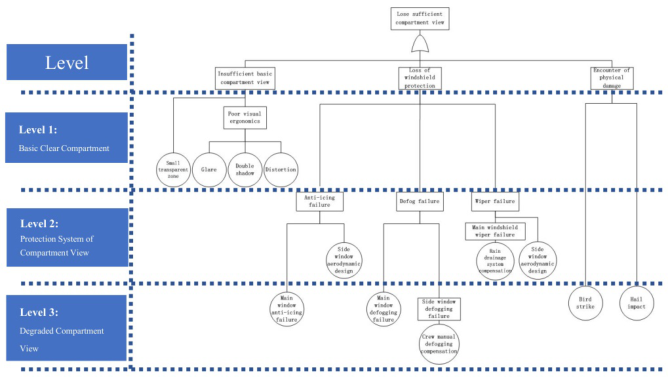
compartment view should be designed to enable the aircraft with the ability of maintaining a clear compartment view in extreme natural environment like ice, frost, fog, rain, etc. The fault tree of losing sufficient compartment view is shown in Figure 1, including insufficient basic compartment view, loss of windshield protection and encounter of physical damage such as hail.
Because the loss of complete compartment view is catastrophic, the design goal of cockpit compartment view is that the necessary compartment view for safe flight should be provided in any scenario. By decomposing the fault tree with insufficient compartment view, the design and verification of civil aircraft non-openable window is summarized into three levels.
(a) Level 1: Basic Clear Compartment View. The cockpit compartment view needs to firstly meet the basic performance requirements to provide a wide enough compartment view and possess excellent visual effect, to ensure that the pilot can safely complete all maneuvers within the operating limits. (b) Level 2: Protection System of Compartment View. The availability of compartment view should be ensured in any predictable operation con- dition, including ice, frost, fog, rain and other natural environment. The protection system of windshields including windshield wiper system (Xiangzhuan Wang, Binhui Liu, 2011), windshield heating system (Xie- gang Qiu, Fenghua Han, 1985), etc., should be designed to ensure that the cockpit has the ability to maintain a clear compartment view. (c) Level 3: Degraded Compartment View. In the current technological conditions, the aircraft cannot completely predict and avoid extreme weather conditions such as hail. As a transparent piece, the windshield would break inevitably in the event of physical damage such as a hail strike, leading to the degradation of compartment view. Partial wind- shield protection function still cannot support the failure probability to achieve the level of “extremely unlikely”. When the windshield
Design and Verification Methodology of the Pilot’s View 85
protection function fails, the compartment view would be degraded in related weather conditions. In this case, the means and ability should be considered to guarantee the necessary compartment view for safe operation.
DESIGN AND VERIFICATION METHODOLOGY OF THE PILOT’S VIEW OF NON-OPENABLE WINDOW AIRCRAFT Basic Clear Compartment View
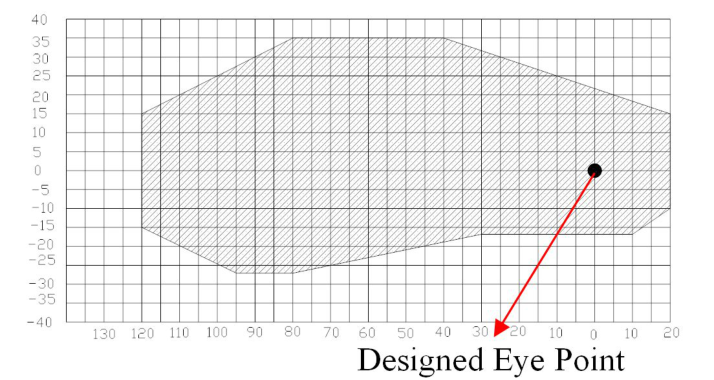
The requirement of basic clear compartment view includes the range of com- partment view and visual effect. The range of compartment view should be wide enough to reach the requirement of AC25.773.1 (Federal Aviation Administration 1993) which specifies the transparent range design require- ment, as shown in Figure 2, and meet the landing view range requirement and the obstacle view requirement (Li Y, et al. 2011).
As an optical component, the windshield would result in the poor visual efficacy of compartment view if there is a problem in the design or prepara- tion, which appears as the lack of clarity or distortion of compartment view. The traditional flat glass or single curved glass has the characteristics of small area and small curvature, and it is easy to design and prepare and has good visual effect. Hyperboloid windshields with large area and large curvature are difficult to prepare, and are more likely to have problems such as glass defects, uneven interface layer, optical distortion and sub-image deviation, resulting in poor visual efficacy. Therefore, it is necessary to put forward the requirements of laminated structure, optical uniformity, transmittance and physical characteristics of windshield glass.
When carrying out the verification of the basic clear compartment view, the design iteration can be carried out through the compartment view simulation based on human vision, and the verification can finally be carried out through the pilot subjective evaluation method of flight test.
Figure 2: Basic clear compartment view.
86 Feng and Mao
Protection System of Compartment View The aircraft needs to have a clear view in adverse natural conditions, which requires the cockpit windshield to protect against ice, frost, fog, rain and other natural phenomena.
(a) For the windshield protection of ice and frost, a heating system of windshield can be designed to realize the anti-ice/deicing function. The minimum view range is considered in the icing protection area. Gene- rally, the main windshield area can cover the minimum view area. Therefore, only the main windshield area is designed with anti-icing heating function. For the anti-icing design of the side windshield, the aerodynamic design of the aircraft can ensure that there will be no icing phenomenon in the side windshield area. (b) For the windshield protection of fog, a windshield heating system can be designed. Different from the windshield anti-ice function, the heating power of the defogging function is generally small. In addition, ventila- tion system can also be designed to achieve the function of fog removal. The protection area for fogging needs to meet the protection of the com- plete view area, thus, both the main and side windshields need to be protected. (c) For the windshield protection of rain, a windshield wiper system can be designed to achieve the function of rain removal. In addition, a rain drainage system can be designed by using rain removal liquid. The design of the rain protection area considers the minimum view area, thus only the main windshield needs to be designed with rain protection function.
The verification of windshield protection system is mainly through ice wind tunnel test, windshield wiper system laboratory test, flight test in conditions of heavy rain, high temperature and humidity, natural icing envi- ronment to verify the effectiveness of windshield protection function in a variety of adverse natural environment.
Degraded Compartment View The loss of all view is considered disastrous. When the view protection system of the cockpit windshield loses its function or the windshield is degraded due to physical damage (such as encountering hailstone), the compartment view is still required to ensure the pilot’s safe control of the aircraft. The pilot should use normal aircraft instruments and land the aircraft without special flight skills. For the aircraft with “openable side window” in the cockpit, the side window can be opened to supplement the view after the aircraft height drops to the condition of unpressurized cabin. And for the aircraft with “non- openable side window” in the cockpit, the windshield of the cockpit should be required to have stronger protection ability. After the physical impact of hail, the main windshield should have sufficient residual view, and the side windshield should keep the view from being degraded.
For the failure of windshield protection function, when the anti-icing hea- ting function fails, the icing protection of the side windshield is guaranteed by pneumatic design, so it can still maintain a relatively adequate view. When
Design and Verification Methodology of the Pilot’s View 87
the side windshield defogging function fails, the unit needs to manually defog to improve the view, and the unit’s workload is required to be in an acceptable range. To verify the view of the aircraft with “non-openable side window” after degradation, the protection ability of the windshield can be verified through the windshield impact test of hail, and the windshield damage form is simulated on the test platform and verified through the scene verification test of human in the environment. The degraded view will still allow pilots to fly safely. The scene test of human in the environment can be ground test, flight test or simulation test.
TEST AND VERIFICATION TECHNOLOGY OF INSUFFICIENT COMPARTMENT VIEW WITH NON-OPENABLE WINDOWS Overview of Test Method
The verification of cockpit insufficient compartment view with non-openable windows involves two steps. Firstly, through the laboratory test, determine the main and side windshield damage and the view impact after the hail impa- cts the windshield. Secondly, the effect of hailstorm impact is simulated on the windshield of the simulator, and the simulation test is conducted to verify that the pilot could land safely with insufficient compartment view.
The windshield test specimen is installed on a fixed stand according to the installation angle of the true mechanism, and the impact target point is marked on it. Hail with a specific speed is used to impact the predetermi- ned target point. After the completion of all hail impacts, the damage degree of windshield is obtained and its impact on the compartment view can be assessed.
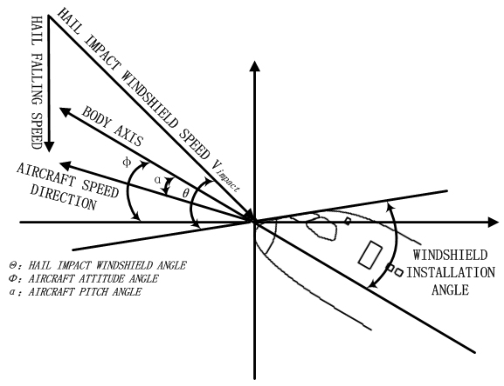
The influence of hail impact on cockpit compartment view mainly depends on the speed and angle of hail impact on windshield, which are mainly related to aircraft speed, hail size and descending speed, windshield installation angle and aircraft attitude. The geometric diagram is shown in Figure 3.
Figure 3: Schematic diagram of hail impacting windshield.
88 Feng and Mao
Test Parameter Calculation Selection of Hail Parameters Three hail sizes, 0.5 inch, 1 inch and 2 inch, are selected for the experiment, because the size range of these three hail sizes can cover about 95% of the size distribution range of hail in nature. According to EASA.2008/5 “Hail Threat Standardization”, the statistical values of maximum hail descent velocity of these three sizes are 13.92 m/s, 21.56 m/s and 27.84 m/s.
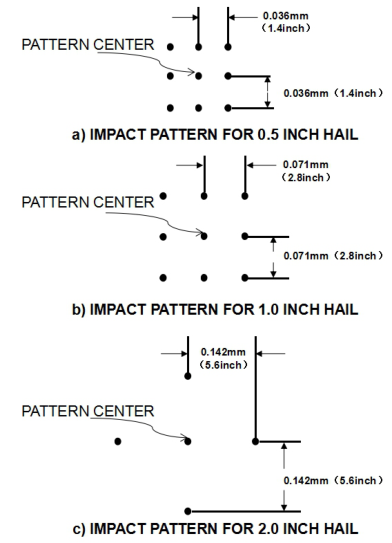
Three sizes are used to impact the same set of windshield to verify the cumulative effect of different sizes of hail. The hail impacts the windshield in the order from small size to large size. The distribution of hail of three sizes on the windshield is shown in Figure 4, among which the pattern centers of the three distribution are the same. The pattern center is the point on the windshield surface where the angle between the direction of hail path and the normal direction of windshield surface is the smallest. It is also the point closest to the direction of hail path in the normal direction.
Selection of Aircraft Parameters Since cyclones can throw hail upward, the altitude at which an aircraft may encounter hail during operation covers the envelope of normal aircraft ope- ration. The true airspeed first increases and then decreases with the increase of altitude at normal atmospheric pressure. The altitude corresponding to the maximum true airspeed should be selected as the altitude of test flight. In addition, the aircraft’s normal cruising mach number is selected as the
Figure 4: Impact pattern of windshield with hail impact.
Design and Verification Methodology of the Pilot’s View 89
aircraft’s speed in the test, which is harsh enough according to the results of probabilistic calculation. According to the selected aircraft normal cruising speed and altitude, the corresponding aircraft true airspeed Vfly can be calcu- lated. This true airspeed is used as input to calculate the hail exit velocity Vhit in the calculation test. The attitude of the aircraft should be based on test fli- ght data to obtain the attack angle α and attitude angle ϕ of the aircraft at the selected altitude and speed, typical weight and center of gravity.
Determination of Hail Impact Parameters According to Figure 3, the speed of hail impacting the windshield is shown in Formula 1.
Equation reproduced from the original PDF.
2 + Vfly 2 −2VhailVflyCOS(90 + φ −α) Formula 1.
The angle of hail impacting the windshield is shown in Formula 2.
θ = Angle_of_Windshield_Installation !
V2
impact −V2
fly + V2
−α Formula 2.
+ arccos
hail 2VflyVhail
The hail exit speed is corrected based on the calculated speed of hail impa- cting windshield, and the installation angle of windshield on the test stand is adjusted according to the angle of hail impacting windshield. The hail impact is completed one by one according to the impact point distribution.
Experimental Evaluation and Criterion After the hail impact windshield test is completed, the visual acuity chart of the damaged windshield can be used to preliminary evaluate the degradation degree of the pilot’s compartment view. Then the effect of hail impact is simu- lated on the windshield of the simulator, and the simulator test of approach and landing is carried out. The test sites should include non-precision appro- ach (VOR approach) and precision approach (ILS approach). The criterion of success of the test is that the crew can safely land the aircraft on the runway within the acceptable workload range.
CONCLUSION
A good cockpit compartment view is essential for the safe operation of an aircraft. In the process of the design and verification of the view of non- openable side window, the design should be carried out from three levels: basic clear view, view protection system and degraded view. Reasonable and feasible tests should be designed for verification, so as to ensure the safe flight of the crew in any scenario.
ACKNOWLEDGMENT
The authors would like to acknowledge to all those who have helped us during the writing of this thesis. We gratefully acknowledge the help of our colleague Miss Zhu Xinyang due to her patience and encouragement.
90 Feng and Mao
REFERENCES
Federal Aviation Administration (1993). Advisory Circular AC 25. 773-1: Pilot Compartment View design Considerations. U. S. Department of Transportation. Li Y, et al. (2011). Method study of airworthiness design and verification about pilot
compartment view. Aeronautic Standardization & Quality (05): 6–10. Xiangzhuan Wang, Binhui Liu (2011). Study of the ground test method for aircraft windshield wiper system. Civil Aircraft Design and Research, 4: 28–30. Xiegang Qiu, Fenghua Han (1985). Aircraft anti-icing system. Beijing: Aeronautic
Specialty Textbook Read and Edit Group.
LISTED IN THE AHFE DIGITAL BOOKSTORE CATALOGUE
Explore the complete digital volume
Physical Ergonomics and Human Factors
Read this individual research paper free through the original publisher, or explore the full digital proceedings book.
ISBN 978-1-958651-79-7
Explore this ISBN in the AHFE Bookstore ↗Listed in the July 2026 bookstore catalogue; search by ISBN to confirm current availability · Digital book purchase optional