Shalinda Shafie, Shamsul Bahri Mohd Tamrin, Ng Yee Guan, Dayana Hazwani Mohd Suadi Nata (2023). Development of a Comprehensive Human Factor and Ergonomics Checklist for Workplace Inspections Using a Macroergonomics Approach. In: Physical Ergonomics and Human Factors. AHFE Open Access, vol. 103, pp. 1–7. https://doi.org/10.54941/ahfe1003028
1 Universiti Putra Malaysia Consultancy and Services, 43400 Serdang, Selangor Malaysia ↗
2 Department Environmental and Occupational Health, Faculty Medicine and Health Sciences, Universiti Putra Malaysia (UPM), 43400 Serdang, Selangor, Malaysia ↗
3 Center for Toxicology and Health Risk Studies, Faculty of Health Sciences, Universiti, Kebangsaan, 50300 Kuala Lumpur, Malaysia ↗
Lack of time and manpower as well as a fragmented inspection process are some of the challenges faced by industrial hygiene inspectors from the Malaysian Department of Occupational Safety and Health (DOSH) in carrying out their duties especially regarding industrial hygiene and ergonomics related workplace inspections. To streamline the inspection process and ensure a comprehensive assessment of the workplace, a study was carried out to develop a comprehensive Human Factors and Ergonomics (HFE) checklist. To our knowledge, there is no publicly available checklist covering all three ergonomics domains (physical, cognitive and organizational) that is designed to facilitate workplace inspection and regulatory enforcement process by industrial hygienists and inspectors.The study was divided into several phases. During the first phase, a literature review was carried out looking at existing checklists, assessment methods and industrial hygiene and ergonomics standards that fell within the scope of our study. During this phase, the applicable local regulations and current enforcement methods by inspectors were also analyzed. Based on this a draft checklist was developed. The checklist utilizes a macroergonomics approach where the different socio-technical components of the work system are assessed: the design of each task, the personnel carrying out the task, the physical environment the task is being carried out as well as the management systems and culture of the organization. To encourage a more holistic approach to assessing HFE, the checklist also borrows techniques from diverse fields outside of industrial hygiene such as human error engineering, organizational psychology, and industrial design.The second phase of the study involved multiple discussion sessions with DOSH inspectors, academics and professionals in various fields and industry to further refine the checklist so that it can be used both by inspectors carrying out workplace inspections as well industrial hygienists and safety practitioners to identify areas for improvement in their own workplaces. The checklist was also tested at by safety practitioners at 2 workplaces and by DOSH inspectors at 7 workplaces. During the tests, both regulatory inspectors and industry safety practitioners gave positive feedback on the approach and scope of the checklist. The inclusion of lesser-known elements related to cognitive ergonomics and organizational psychology were well-received even though these are not explicitly regulated by local law. However, since a macroergonomics approach was used in the checklist, there were concerns raised regarding the level of detail and time required to complete the checklist.The checklist is still being developed and the next phase of the project which will start in 2023 includes a Pilot Program where in-depth testing of the checklist will be undertaken at multiple workplaces in different industries throughout the country.
The enforcement of industrial hygiene regulations in Malaysian workplaces is carried out by officers from the Malaysian Department of Occupational Safety and Health (DOSH). However, the inspection process itself can be very fragmented. Multiple are visits to the same workplace are required as each visit only focuses on a single element of industrial hygiene such as noise or heat stress. This is an inefficient use of resources and places a burden on both DOSH officers and workplaces in terms of manpower and time spent. In addition to that, DOSH is advocating a new approach to their enforce- ment process where they aspire to ensure that all three ergonomic domains (physical, cognitive, and organisational) is assessed during the workplace inspections which is a change from previous practices which focused heavily only on physical aspects of ergonomics and industrial hygiene.
To streamline the workplace inspection process, a study was carried out to develop a comprehensive Human Factors and Ergonomics (HFE) checklist for the use of both DOSH officers when conducting inspections and industry health and safety practitioners to aid in improving health and safety in the workplace.
To our knowledge, there is no publicly available checklist which covers the three ergonomics domains designed to facilitate workplace inspection and regulatory enforcement process by industry health and safety practitioners and officers.
METHODS
Human Factors and Ergonomics (HFE), being a multi-disciplinary and user- centric science, complements field of industrial hygiene which focuses on making the working environment safe for workers (Fraser, 1984). Hence, in developing the checklist a macroergonomics approach analysis each of the sociotechnical systems of the work system to improve health, safety, and productivity was utilised. The sociotechnical systems include job design, human interaction with hardware and software, internal working environ- ment, external environment and organizational design (Hendrick, 2002; Kleiner, 2006). Using a macroergonomics approach would ensure a compre- hensive assessments of each sociotechnical system as well cover aspects all three of the ergonomics domains.
Checklist Development The development of the checklist began with a literature review of all existing local regulations and guidelines. Next the scope of the literature review was widened to include existing, publicly available standards and checklists focu- sing specifically on the enforcement of industrial hygiene requirements. This was then followed up by searching through literature on principles, concepts and methods in macroergonomics, human error identification and analysis, cognitive error analysis, mental wellness as well ergonomics principles in design. These fields were reviewed as some of the established methods used can be adopted into the checklist.
Development of a Comprehensive Human Factor and Ergonomics Checklist 3
The initial draft of the checklist was developed based in part on Interna- tional Labour Organization’ Ergonomics Checklist from the 4th Edition of the Encyclopaedia of Occupational Health and Safety (International Labour Office, 1998) as well as the requirements of ISO 6385:2016 - Ergonomics principles in the design of work systems (International Organization for Stan- dardization, 2016). Using these as a basis, the checklist was then adapted to suit local regulations and guidelines and further refined with the input from DOSH officers as well as industry health and safety practitioners.
Initial Testing Initial testing of the checklist was carried out through a focus group discus- sion with various subject matter experts and stakeholders. The participants of the focus groups included DOSH officers as well as subject matter experts and industry practitioners from the fields of industrial design, organisational psychology, industrial hygiene and occupational health and safety.
Participants were asked to comment on each checklist item regarding the ease of understanding, practicability of the requirements, suitability across multiple industries, comprehensiveness and scope of the checklist, and the overall process flow. Participants were also encouraged to provide suggesti- ons to improve the checklist based on their experiences and best practices in their respective industries.
Following that, further testing of the checklist was done by conducting a workplace test. A total of nine workplaces in the manufacturing sector participated in the initial tests where the checklist was used to assess a chosen work activity. This was done by the respective workplaces’ health and safety manager at two workplaces and by DOSH officers at the remaining seven workplaces to ensure that the checklist can be used by both parties.
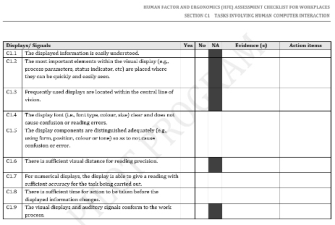
HFE CHECKLIST AND CHECKLIST GUIDE Two documents (Figure 1) were produced namely the HFE Checklist which contains the checklist items for assessment and the HFE Checklist Guide which provides additional explanation and information on each checklist item. The checklist consists of eight sections as summarised in Table 1 below.
Figure 1: Snapshot of the HFE checklist (left) and HFE checklist guide (right).Table 1. Sections in the checklist and its description.
Table available in the original PDF paper.
Section Description A Workplace Details In this section, a brief overview of the workplace and its activities is required. B Screening In this section, a screening process is carried out to identify only medium- and high-risk work activities for further assessment. C Task Based Assessments
In this section work activities are broken down into tasks using the Hierarchical Task Analysis method. Depending on interactions required by the worker, the task will be assessed in Subsections C1-C4. C1 Tasks Involving Human Computer Interaction
For assessment of tasks where the worker interacts with a computer. This subsection focuses on ensuring that the visual information displayed, and the controls used are functional and suitable for the task. It also encourages workplaces to consider aspects relating to human error, cognitive error and mental workload when doing the assessment. C2 Tasks Involving Machinery
This subsection covers the design of the controls, appropriate safeguarding and warning signals as well as the inspection and maintenance of machinery and vehicles. C3 Tasks Involving Tools
For assessment of tasks where the worker interacts with a hand tool or other portable equipment such as ladders and trolleys. This subsection covers the design of the tool itself and its suitability to the task. C4 Task Ergonomics
An assessment of the physical ergonomics of the task. All tasks need to be assessed using a suitable method and control measures put in place if necessary. C5 Task Design An assessment of the design of the task itself in terms of the skill and knowledge required, manhours spent, as well as the required tools, equipment, and personal protective equipment. D Confined Space An assessment of tasks requiring confined space entry. This section will determine whether the required procedures and systems for confined space entry (e.g., permit to work system, safety and emergency procedures, provision of suitable PPE, etc.) are available and have been implemented. E Job Design This section assesses the job position of worker. Since a worker in one job position is required to complete many tasks, the assessment looks at the overall work schedule of the job, the training required as well cognitive aspects such as mental overload as well as job satisfaction and emotional wellness. F Environmental Assessments of the Work Area
This section assesses the work area where a task or set of tasks is being carried out. It looks at noise exposure, heat stress, lighting and local exhaust ventilation to ensure that they meet the prescribed limits and are assessed using suitable methods. G Organisational Elements Assessment
This section assesses elements of the organisation including management policy can commitment and the safety and health management systems in place.
Development of a Comprehensive Human Factor and Ergonomics Checklist 5
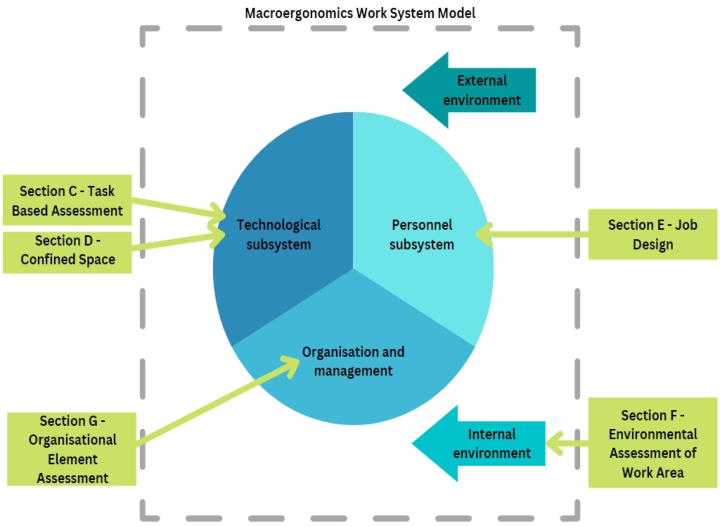
Figure 2: Mapping each checklist section to the macroergonomics work system model.
Each section of the checklist will cover one of the sociotechnical systems described in macroergonomics as shown in Figure 2. The process takes bottoms-up approach starting from assessing how a task is done, how a job position is designed, to assessing the internal environment of the workplace and finally followed by an assessment of the management of the organisation. External environment were excluded from the checklist since it is generally beyond control of the workplace.
SCORING Initially there was no intention to score the checklist as the it was meant for a tool to assist DOSH officers and health and safety practitioners in conducting workplace inspections. However, to facilitate DOSH officers and workplaces in tracking the progress as adjustments and improvements are made, a sim- ple scoring system was put into place. Currently, each item in the checklist is arbitrarily weighted based on the three ergonomic domains of physical, cognitive, and organisational. This scoring system will be reviewed as more data is collected through additional testing of the checklist at workplaces.
FEEDBACK FROM INITIAL TESTING Feedback from the industry testers and DOSH officers have been positive especially in regards towards the systematic and comprehensive approach of the checklist. A summary of the feedback received during the initial testing at workplaces is summarised in Table 2.
Table 2. Feedback obtained from initial testing at workplaces.
Table available in the original PDF paper.
Positive feedback Areas for improvement Can be time consuming to complete The checklist provides a systematic and comprehensive approach to the assessment of industrial hygiene related issues.
Some checklist items require expert knowledge to assess which may be costly
Introduces, encourages assessment of fields not currently regulated or well-known such as human error, cognitive error and mental workload
Smaller companies with limited manpower and expertise may find some of the requirements to taxing to implement Initial testing at workplaces have only been carried out at workplaces in the manufacturing industry. Applicability in other industries have not yet been tested. Chemical related assessments were not included in the checklist.
WAY FORWARD: PILOT PROGRAM Throughout 2023, a pilot program will be carried out at multiple workplaces in different industries across the nation. Identified workplaces include a com- bination of large and medium-sized companies with established health and safety management systems as well as smaller enterprises with very young and immature HSE systems. The aim of the pilot is to test the checklist in as many different workplaces and situations as possible so that the data collected can be used to further improve the checklist.
CONCLUSION
The checklist system will provide a tool that can be used for an integrated industrial hygiene inspection process that comprehensively covers all three ergonomics domains.
ACKNOWLEDGMENT
The authors would like to acknowledge that this project was funded by the Malaysian Department of Occupational Safety and Health.
REFERENCES
Fraser, T. M. (1984). Ergonomics and industrial hygiene: a complementary relationship. Am. Ind. Hyg. Assoc. J. 45, B5-6, B8. Hendrick, H. W. (2002). An Overview of Macroergonomics, in: Macroergonomics:
Theory, Methods, and Applications. Lawrence Erlbaum Associates, Inc., New Jersey, pp. 1–24.
Development of a Comprehensive Human Factor and Ergonomics Checklist 7
International Labour Office. (1998). Chapter 29 - Ergonomics. Encycl. Occup.
Health Saf. 4th Ed.: https://www.ilocis.org/documents/chpt29e.htm (accessed 7.20.21). International Organization for Standardization. (2016). ISO 6385:2016 - Ergonomics principles in the design of work systems. Kleiner, B. M. (2006). Macroergonomics: Analysis and design of work systems. Appl.
Ergon., Special Issue: Fundamental Reviews 37, 81–89.
LISTED IN THE AHFE DIGITAL BOOKSTORE CATALOGUE
Explore the complete digital volume
Physical Ergonomics and Human Factors
Read this individual research paper free through the original publisher, or explore the full digital proceedings book.
ISBN 978-1-958651-79-7
Explore this ISBN in the AHFE Bookstore ↗Listed in the July 2026 bookstore catalogue; search by ISBN to confirm current availability · Digital book purchase optional