Sandra Mejias, Marcelo Soares (2022). The Evaluation of Work Systems and Products: Considerations from the Cultural Ergonomics. In: Advances in Ergonomics In Design, Usability & Special Populations: Part I. AHFE Open Access, vol. 18. https://doi.org/10.54941/ahfe100799
This paper presents a conceptual model that combines Ergonomics and Design. The authors combine the expertise of both disciplines to begin the construction of an investigation. The argument of the article is that the integration of the evaluation of systems of work and Cultural Ergonomics considering product can raise the optimization of human performance in work systems and integrate the products to its users. A conceptual model is presented, and its components and interactions are explained. The interaction between system – client’s work - products is an important feature in this model. Aspects of the Macroergonomics as an intervention tool considered are: participation, commitment and action investigation. The expected results are: improved productivity, quality of work and the suitability of the product to the user at higher levels than those achieved previously. The model is then applied to case studies in Recife, Brazil and Villa Clara, Cuba.
Ergonomics and Design are disciplines that when joined today, attempt on one hand, satisfying needs, comfort and users’ safety and on the other hand, integrate the products that these users use in a determined context. Their methodologies of evaluation can be at times topics of conflict when the ergonomists and designers work together in consultancy teams. Their different visions in the way of projecting a problem and its solutions have established a variety of methodologies that include different steps. The production engineers, ergonomists and occupational safety specialists are attentive to the advances of these disciplines and they have been called each and everyday to take part in the procedures that are put in practice to optimize the human performance in the business sector and the use of consumer goods, in general.
Ergonomics In Design, Usability & Special Populations I (2022) https://openaccess.cms-conferences.org/#/publications/book/978-1-4951-2106-7
Macroergonomics, as a sub-discipline of Ergonomics, it has shown its emergent character which has been perceived since the 70s by the Human Factors Society developing a set of tools and methodologies for the analysis of work systems in the following years. Although the term has been divulged a lot, it is still new to those specialists that besides working in the entrepreneur field do not know the utilities and advantages that it contributes to designing in general and, in particular, to the work systems design. The divulged results with more frequency since the late 90s show its effectiveness to attain ergonomic compatibility in work systems. In this case, the reports over the years (Hendrick, 1993, Hendrick, 2003; Hendrick, 2008; Kleiner and Drury, 1999; Mejias and Huaccho, 2011; Guimaraes, et al., 2012; Guimaraes, et al., 2012b) indicate how the macroergonomics interventions enable increasing the productivity and quality regarding to previous stages. Other results have been attained like increase of participation, commitment and involvement of employees in the decision making of the organization through the implementation of ergonomic programs and in various cases making use of one of its leading tools: Participative Ergonomics (PE). The reports in the bibliography revised confirm the advantages of making use of PE today ( Noro and Imada, 1991; Haines and Wilson, 1997; Kuorinka, 1997; de Jong and Vink, 2002; de Looze, et al ., 2003; van der Molen, et al., 2005 ). Also, the effectiveness of macroergonomics in optimizing the performance in complex systems and supply chains, in particular, has been stated (Huaccho and Mejias, 2010; Marrero, Huaccho and Mejias, 2013) confirming that independent of the type of work system, its utility is extended without limits to improve the performance of systems in general.
With these events together, ergonomists have focused in putting their competences in practice such that ergonomic attributes are present in design and development of consumer goods with the objective of ensuring that they are safe, efficient and reliable. Likewise, methodologies have emerged from designers' theoretic conceptions and these have accomplished important contributions to obtain superior quality products (Soares, 1998; Ahram, Karwowski and Soares, 2011; Sala-Diakanda and Soares, 2011; Diniz and Soares, 2011). Nevertheless, with the advances achieved in both disciplines (Ergonomics and Designing), a good integration of human factors in the work systems is not always achieved and neither does an optimal product suitability to the user and his context always exist. The first important problem to attend to would then be the fractioning of the elements of each discipline during ergonomic intervention, to which not considering the cultural factors of each region or social group is added in the present.
Cultural Ergonomics (CE), an important branch, is it then mandatory to be considered. Furthermore, it has been demonstrated recently what can be efficient for a culture is not for others and moreover, it has been observed that people's behavior modifies from country to country and among the regions of the same country even in the presence of similar information that the systems generate ( Smith Jackson, et al., 2011;Michael et al., 2004). Also, important studies demonstrate the fact that ergonomic intervention can be a tool to back up the process of cultural transformation. Hence, understanding the influence of culture in people's behavior is a premise of CE (Cavalcanti, 2003) which supposes that this recent branch cannot be kept far from the conception of the macroergonomics intervention tools.
The second problem that must not be neglected is that in spite of how much the development of ergonomic intervention programs has advanced (Kleiner, 1999; Kleiner and Shewchuk, 2001; Taveira, et al, 2003; Claire & Albayrak, 2004; Dzissah et al., 2005; Kleiner, 2006; Villenueve, 2007), it is considered that many of them still have some deficiencies that permit satisfactory improvements but no all the possible ones. This happens because the human factors study continues with an individual approach; still the focus is on physical factors only or on cognitive aspects and sometimes the essential worry is the anthropometric dimensioning to accomplish the adequate designing. Even, if the intervention tools detect a set of existent problems, it is observed that the associated intervention programs do not emerge like part of a systemic and integral analysis of ergonomic demands and it is reflected in a list of independent ergonomic actions to solve each particular problem found. Also, it is added to the above that specialists have more worries today due to man's social and cultural context.
What is stated previously calls for the need to count on references with more documented experiences with a multi- disciplinary approximation which integrates the planning of ergonomic programs based in one integral and systemic analysis of demands and approaching the work system and product as a whole. Hence, it can be useful to conceptualize the principal elements that permit a holistic approach that is projected from the investigation area towards the evaluation of systems and products involving physical, cognitive, social, organizational, environmental and cultural aspects to improve working conditions and establish strategies of macroergonomics interventions from planning, evaluation of work systems, products and environments to ensure that it is compatible with the needs, abilities and limitations of the human factor.
Ergonomics In Design, Usability & Special Populations I (2022) https://openaccess.cms-conferences.org/#/publications/book/978-1-4951-2106-7
The investigation questions that have motivated this article are: Does a possibility exist to optimize more the human performance and suitability of a product to the user if the work system, product and user are integrated in the macroergonomics intervention tools? Can CE be considered in this integration and contribute to better results?
This article starts from the hypothesis, that better solution results can be obtained when there is an integration in the macroergonomics intervention tools, not only from the theoretic point of view of Ergonomics and Design including CE.
This article is structured in four sections. Section two covers literature revision of two interrelated concepts: Macroergonomics and Design, putting emphasis on macroergonomics tools that have been used in Brazil and Cuba. Section three presents the proposal of a conceptual model as a starting point to design intervention tools which involve work systems, products and users. Section four discusses the proposal of the model. Finally, section five presents some conclusions to continue the investigation.
LITERATURE REVIEW
In a work system where workers perform, various products exist and at times, these have a high level of complexity and the human factor interacts with them during a workday. This interaction of the human body with products occurs starting from a set of actions, movements, displacements, postures that must be accomplished in a comfortable, safe, reliable and efficient manner facilitating the realization of activities with a high performance and making possible that the interaction does not occur in a forced manner violating the principles of economy of movements, as well as possibilities and limitations of the human body.
When it is not taken in account in the man-product interface that physical, mental as well as social possibilities of the human being occur in a short, medium and long term, the occurrence of occupational diseases, incidents and accidents put the workers' health at risk. Unfortunately, many accident investigation methodologies that are used in the countries do not consider them as a result of the product's inadequate design and the causes are directed principally to the human factor and his neglect. Thus, the effects are not only realized in the commented field and an accident that results due to the use of a deficient product puts at risk the producer's permanence and sale of that same product in the market (Williams and Noyes, 2011). A possible reason to why these accidents occur without associating them to the design could be the absence of methods to evaluate the ergonomic risks in a product in some cases. Some authors state that most of the evaluation methods concentrate on the possibility of existence of failures, that is to say the evaluation of technical risks (Zunjic, 2011).
What has been commented before allows observing that when products are already inserted in the work system, the intervention program suggests a tendency towards technical measures to decrease the negative design effects and also carry out capacitation to develop new competences in the use of these products. This is necessary in many occasions when it is not possible to buy new products immediately. However, these measures do not turn out to be completely efficient to raise workers' performance and this constitutes a reason more for ergonomists and designers to come together to produce a superior quality product. Now, it is not enough that the integration be produced only in this field of man-product interface because if criteria are not applied together with work systems, the quality product that is to be obtained only remains as a conception and the production will not be able to satisfy the consumers. It is precise to notice in this investigation field that many designers including ergonomists take for granted and still do not recognize the present necessary existence of the Macroergonomics-Product interface also known as Man-Machine-Organization-Technology-Product Systems, when they mention the traditional roles that Ergonomics plays in product development.
Undoubtedly, its acknowledgement is still only recognized in a conceptual framework of ideas and the division between ergonomists and designers still exists in the evaluation methods of work systems and products, thus not being possible to achieve a common and comprehensible language flow that allows the transmission of information to the designer such that he can put in practice the essential ergonomics attributes to the designing and development of the product. The above would allow attaining not only the interrelationship between the user and product, but also with the work system.
The cases in which a product is designed and developed without the participation of ergonomists should be recognized and stated too. The experience of the authors of this article in Latin America confirms that it is usual that their role has not been recognized in this field in most of our countries in the present. In some cases, neither do the Ergonomics In Design, Usability & Special Populations I (2022) https://openaccess.cms-conferences.org/#/publications/book/978-1-4951-2106-7 pre-graduate study programs in some countries dedicate enough time to the study of Ergonomics. In other cases, in the universities with developed postgraduate programs, separation of the topics imparted and the tools that are recommended to be applied do not have a connection with Ergonomics and Design.
As it is perceived, the problems that ergonomists and designers face are many and diverse and all of them are a barrier towards the design of high performance work systems and efficient, safe and reliable products. Eason (1984) confirmed that usability is a variable that changes with time and it is a good question to ask oneself if usability also changes with the variations that are produced in the work systems. Of course, the authors' answer is affirmative and they accord that the user is the center of design but they consider that it would be incomplete without the work system analysis, its organization demands and the social and cultural context.
Digging into these bibliographic revision, the three ergonomic intervention tools that are recognized and divulged in Brazil were analyzed. These tools are used in pre-graduate and postgraduate studies and in companies' consultancies. They are: the systemic approach of the Man-Task-Machine system (MTMS) (Moraes e Mont´Alvao, 2003), the Work Ergonomics Analysis (Santos & Fialho, 1997; Vidal, 2002) and the Macroergonomics Work Analysis (Guimarães, 1999). In the selection of a tool or the other to carry out investigation related to monographs or consultancies, the opinion of advisors and consultants prevails. They select the tool to use considering which one is more didactic in their opinion and in some cases because they are the authors or coauthors of the tool or also because it is the one that they adopt for the courses that they impart or receive as students. . This makes some tools to be more used than the rest as it is shown in studies carried out some years back. These studies showed that the methodology most used was the Work Ergonomics Analysis methodology proposed by Santos & Fialho (1997) as well the one proposed by Vidal (2003), as a result of an analysis of 162 investigations presented in the Brazilian Ergonomics Association Congresses (ABERGO) , where 118 of them used the said methodology (D´ Garcia, 2005).
However, all the tools have been useful to investigators for their particular intentions. If the Man-Task-Machine system methodology is analyzed, it is possible to notice that the authors fulfilled their objective on creating a systemic and systematic tool that combines a set of logical steps to detect existent ergonomic problems in a work place. It offers techniques and methods that allow modeling the operation and functioning of a system up to knowing what problems to attend to with priority. It is being used in the present to study a system that focuses on the interaction between man and product. However, authors recognize it as a microergonomics tool and although participation is a characteristic that distinguishes it from the rest, it lacks some present requirements discussed before.
Another methodology of French tradition and not only recognized in Brazil but in many parts of the world is Work Ergonomics Analysis (WEA) (Santos e Fialho, 1997). Its concepts defined by different authors (Laville, 1977; Faverge 1955 apud Santos, 1997; Guérin, 2001; Wisner, 2004; Vidal, 2003) aim at its important use in characterizing and studying the interrelation between a worker and the proceeding task to make a positive transformation of reality. Under these concepts, the Brazilian authors propose a methodology that does not focus only on the systemic task analysis approach but considers macroergonomics variables for activity analysis. Authors consider it a participative administration tool with great capability in microergonomics diagnostic. On the other hand, the methodology proposed by Vidal (2003) forms part of the WEA contributions showing a methodical, participative, acclimatized and contextual itinerary through a series of systematic methods and techniques proposed in each of its steps. The author conceptualizes the macroergonomics analysis starting from organizational analysis and a company's organizational environment. The applications of both methodologies today do not perceive the need to evaluate work systems and a product together and occasionally they only recommend related studies.
Another methodology that is recognized in Brazil is Work Macroergonomics Analysis which is based on the macroergonomics analysis process proposed by Hendrick (2000) where interactions in the social and organizational context prove a better adaptation of a work system and conceptions of new systems basing fundamentally on the participative process right from the beginning of its application and all through the ergonomics study. It is the methodology that is usually applied in ergonomic interventions and/or user focused work macroergonomics analysis. The possibility that it offers by determining ergonomic demand items to solve problems conceived from "the user's voice" is an important characteristic to identify problems that are not observed by specialists. It considers designers to be as important as ergonomists when it comes to proposing solutions and creation of new product prototypes.
The similarities and differences between the methodologies mentioned have been studied and in a precise way, it has been shown that they all have a systemic focus and positive transformation of reality using a set of social science Ergonomics In Design, Usability & Special Populations I (2022) https://openaccess.cms-conferences.org/#/publications/book/978-1-4951-2106-7 techniques and mathematical statistics (D´ Garcia, 2005). Participation is a common characteristic although not all the methodologies posses this important component in the same measure. At the same time, all have been structured to be put in practice by consultants due to their complexity level being appropriate for specialists in the material. Their differences arise from the different focuses, steps and methodologies that authors have added to them from their vision as ergonomists.
A hybrid model created by D´ Garcia (2005) rises from the analysis carried out before. It is used by ergonomists in ergonomic interventions in production, commercial and service systems and it provides opportunities to reduce or add steps if it is necessary for a project. According to the author, this hybrid model starts from the interdisciplinary principle presented by Wisner (2004) that recognizes the particular thinking mode of each professional that is involved in its investigation.
In Cuba, the macroergonomics intervention tool is recognized in the improvement of work systems (Mejias Herrera, 2003) and it is used in diverse interventions to solve ergonomic demands in manufacture and service processes. Its distinctive characteristics allow participation in the different hierarchy levels by ergonomic teams that participate in all the process' steps through a negotiation process. It presents important recommendations to develop intervention programs from the evaluation of the existent state of art and the difficulties that have been met in the world before to evaluate the efficiency, efficacy and effectiveness of its application. Also, ergonomic programs are distinguished by their systemic character and integral demands approach, suggesting solutions that are equally integral and not a list of actions to be executed. However, like the methodologies commented before, their level of application requires capacitation for those who have not used them before.
CONCEPTUAL MODEL TO EVALUATE WORK SYSTEMS AND PRODUCTS The analyses carried out from the references consulted by the authors of this article establish in their criteria the need to establish conceptual considerations that allow designing a model that supports the design of procedures to evaluate work systems and products together in a brief time. The proposals will mark a new phase in the study of Ergonomics and will allow in the first place, offering a "work system requirement profile" to designers such that they can provide the products that are needed. In the second place, once what is mentioned before is achieved, it will be possible to optimize the work systems performance and the products that they produce will be safe, efficient and reliable.
The needs stated should be selected from the practical field to show how the interaction between Ergonomics and Design should be produced. Specialists have dealt with the topic recently recognizing how experts perceive this interaction in the Ergonomic disciplines, Usability and user participation detecting that it occurs from different visions resulting in an intercultural problem (Röbig, 2011). Figure 1 shows this relationship as it is interpreted in the model to be proposed.
From the representation above, guidelines for the performance of engineers, designers and ergonomists are established. These include the following:
Ergonomics, Usability and Macroergonomics in particular Participative Ergonomics are disciplines considered to have the same level of importance and they interrelate mutually hence being employed in the steps of conception, development and use of work systems and products.
Conception, development and use of work systems influence directly in the design, development and use of products and vice versa. The arrows that establish this interrelation indicate that in the analysis of one or another system, it is precise that ergonomists and designers consider both systems such that the proposal can be more integral and oriented to the users.
Ergonomics In Design, Usability & Special Populations I (2022) https://openaccess.cms-conferences.org/#/publications/book/978-1-4951-2106-7
User s
Produ ct
Work system
Cultural context
Figure 1. Proposal for the integration of Macroergonomics and Design.
Figure available in the original PDF paper.
The study of the particularities of work, social and cultural environment where work systems function as well as the way the designing and use of products will be done is an important requirement to consider guaranteeing usability and superior performance results of the users.
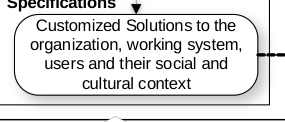
It can be observed that Ergonomics and Design include Cultural and Product Ergonomics more and more each and every day in order to obtain positive transformations in work systems and products. The considerations taken in account allow formulating the Conceptual Model for the evaluation of work systems and products (See Figure 2). The conceptual model construction was based on the following premises:
Avoid erroneous practices that are common in some companies such as effect change processes without a systemic orientation, which concentrate on the observation of determined parts of the system to eradicate the existent symptoms.
Although macroergonomics focus is inherent in this model, it is not limited to it. There are important functions in the Business Administration field such as Strategic Management and Total Quality that are present in the proposed model.
The future projection and adequate system management should increase the system's performance and the usability of products through the definition of adequate ergonomic demands to obtain desired results depending on the projected ergonomic program.
The ergonomic actions emerge as a process which unites production and service problems (these being safety, quality, organizational and technological problems among others) and those of the use of products (these include: design, development and utilization of products) to find ergonomic solutions.
An organization's development is supported by its capacity to learn and expand its knowledge through joint thinking and learning as well as guaranteeing the incorporation of consultants not as external change agents but as investigators, whose presence is necessary, integrate themselves into the group that produces change and help to induce it by transmitting their knowledge.
The conceptual model possesses a dialectic character since it expresses a continuous improvement process.
https://openaccess.cms-conferences.org/#/publications/book/978-1-4951-2106-7 Ergonomics In Design, Usability & Special Populations I (2022)
Externals
Social and Cultural Enviroment
ERGONOMIC
DEMANDS
Actions
DEMAND
Internals
Strategic Directions
ERGONOMIC MODEL
OPERATIVE MODEL Validation of ergonomic
Analysis of work
demands
use
system and usability of it´s
Product products
problems
Alternative Solutions Management
OPERATIVE MODEL Products Work System
Profile Profile
STRATEGIC CONTEXT
Analysis of dysfunctions Macroergonomics -
problems
Compatibility between work
Product interface
Production
and service
system, the product and its cultural context
RESEARCH MODEL Actions
Conception of
Basic Configuration
ergonomic solutions
Solutions Designs
EXECUTIVE PROYECT Management
Solutions Implementation
C O N T I N U O U S I M P R O V E M E N T P R O C E S S
Specifications Management Customized Solutions to the organization, working system,
users and their social and cultural context
Decision
I N T E R V E N T I O N T E A M
External Consultancy
Group
CONTINUOUS SPACE FOR PARTICIPATION AND EXPERTISE
CONTRIBUTION FROM SPECIALIST AND USERS Participation process, rising negotiation and mutual construction
PHILOSOPHICALS
COGNITIVE
B A S E S
STRUCTURALS
CULTURAL
Figure 2. A Conceptual model for the evaluation of work systems and products (Source: Adapted from Mejías Herrera, 2003)
Ergonomics In Design, Usability & Special Populations I (2022)
Characteristics of the conceptual model
Pertinence looks for solutions adapted to an organization, in particular its users, derived from structural, philosophic, cultural and cognitive bases which support it and should be considered in order to be successful in any proposal that is formulated.
It materializes in three mutually dependent ergonomic aspects: a strategic action construction, a construction in a social and cultural environment and an ergonomic model.
The strategic context where an organization is developed, determined by production and product use problems is an essential characteristic that generates strategic orientations. These orientations establish demands of different nature but do not constitute the only way that demand emerges. Other demand sources can be identified. One of them is the one that originates from the interior of companies and expresses the points of view of the different levels of administration, direct and indirect workers and their social and cultural environment. On the other hand, some demands originate from the exterior of the company and are formulated by orientations of syndicate organizations, ministerial institutions and users of products who work in the organization. All these demands that arise are integrated systemically in an ergonomic demand such that the ergonomic teams does not lose its correct direction of use by concentrating attention on isolated and secondary problems (from the technical point of view), irrelevant problems (from the social and cultural point of view) or inadequate problems (from the strategic point of view). According to the defined limits of the demands and the multidiscipline nature of the problems, it is possible to determine how many and which ergonomic equipment are necessary as well as the limits of the ergonomic model to be defined.
The ergonomic actions derived from the ergonomic demand are not conceived as an isolated initiative but instead inserted in projects of change that arise at the work place level and work system level (operational level) as well as the organization level (strategic context).
The social and technical principles rely on a methodological and contextualized itinerary that combines both social and cultural aspects, technical practices since they include a continuous improvement process where change, review and adjustment of solutions are inserted in the strategic context.
The social construction of the model shows a participation process, negotiation rise and mutual construction. It offers a continuous social aspect that contributes to internal and external competences expressed by its part in the formation of ergonomic intervention teams at the operational level to study work systems and products, where all the members and users are considered as "specialists of their own problems" and even though they can not solve them alone, they will at least be able to identify them. On the other hand, it is expressed in the participation of external users who contribute important elements to increase the usability of products which are made. This competence management process supports the technical project which is developed in the organization in the search for ergonomic solutions and establishes a communication channel that reaches up to the highest levels of the organization.
It is necessary to employ an external consultancy to define the limits of the problems when required. The most notable long term benefits are produced when the consultant works as a collaborator and uses part of his personal competences, elaborates methods, principles and guidelines which guarantee the measures initiated in the consultancy.
The presence of a Decision group constitutes an important characteristic of the model, that is to say the role played by the ergonomic team as well as the external consultant in obtaining effective solutions. The Decision group is integrated by people with hierarchical and technical decision power who come together and interact dynamically in all the organization's hierarchical levels ensuring the achievement of the planned ergonomic actions.
The ergonomic model which the conceptual model establishes requires a conception of scientific requirements that sustain concrete necessities of action in practice. These requirements are directed at the work system analysis and the usability of its products, analysis of the dysfunctions of the Macroergonomics-Product relation, the conception of ergonomic solutions and their implementation, deriving from these the construction of operative, investigation and executive models respectively that generate alternative solutions paving the way for the modeling of possible results to be obtained and adapting the solutions to the user's specifications, work
Ergonomics In Design, Usability & Special Populations I (2022) system, organization itself and existent resources incorporated through ergonomic programs. All the above in a determined social and cultural context that distinguishes the environment where the organization operates.
Inputs The essential input in the model is demands generated by:
The strategic orientations, external exigencies and internal necessities of the company and users.
Behaviors of production levels, work quality, results of indicators related to the work force, its work conditions and health, satisfaction of users (internal and external) with the products.
Internal and external competences put in action resulting from the different levels of the organization and users in general.
The results of the meetings held by work groups in different areas of the organization.
External competences proceeding from consultants based on knowledge, skills, attitudes, behaviors, experience acquired and values.
Outputs The model’s principle outputs are ergonomic actions which are generated in the ergonomic model's limits. These actions are derived from:
The operative model characterized by the validity of the ergonomic demands detected and the beginning of the construction of alternative solutions which will lead to a deep analysis in order to know the compatibility level between the work system, product and cultural context.
The investigation model involves an experimental process which searches for possible alternative solutions that can be adapted to the demands identified and the generation of ergonomic programs to obtain the desired results.
The executive project manages the solutions adapted to the organization, work systems and their users in a determined social and cultural context.
DISCUSSION
The proposed conceptual model is based on conceptual formulations, knowledge, experience and existent applications in specialized references and emphasizes the necessity of a new interface in the historic development of Ergonomics: the Macroergonomics-Product interface also known as Man-Machine-Organization-Technology- Product Systems interface. The development of this interface in the present should allow overcoming the deficiencies which affect the work systems' performance and products' usability which are studied with low levels of interconnection. The absence of evaluative diagnoses of causes of accidents in work systems provoked by inadequate design of products or analysis of few work environment variables, the social, cultural and organizational variables context results in problem reports and the corresponding solutions proposed not reaching higher user performance levels, safety, efficiency and satisfaction with the products that are used. The consideration of the interface from the model is a call for designing procedures from its premises, characteristics, inputs and outputs, which allow defining ergonomic demands in a systemic and integral way in the first place. Secondly, the evaluation of work systems and products has results such as: characterization of a process and its work places, a direct and indirect users’ profile which includes their quality of life and expectations among other elements of interest in the initial evaluation stage. The ergonomists should start constructing a Work System Profile and User Profile which allows studying what is lacking in a product that does not satisfy the necessities of a work system and how the actual work system conception makes difficult the performance with the product. What is mentioned above means passing Ergonomics In Design, Usability & Special Populations I (2022) to a superior stage of evaluation where the dysfunctions of the Macroergonomics-Product interface allow evaluating the existent compatibility level in a determined cultural context. The outputs at the end of any procedure designed to evaluate should allow relying on a Work System Profile and Product Profile which contain the requirements that are needed to optimize the performance established by the work system and safe, efficient and reliable products. In developing countries, the absence of this evaluation is perceived with more intensity due to the existence of products that are not adapted to the existent organizational and cultural context. However, today, it is a contemporaneous problem which is also seen more or less in developed countries.
CONCLUSIONS
The advances in the development of Ergonomics suggest that studies should be carried out constantly in work places, work systems and processes and publish the results obtained. However, scientific investigation does not stop and it is characterized by proposals, debates and exchange of ideas, which generate recommendations to elevate the level of existent studies. Also, the proposals should ensure that ergonomists and designers speak a common language and unify their work methodologies. None of the above is completely effective if Cultural Ergonomics is not considered because a good conception or proposal of recommendations after an evaluation will lack the cultural characteristics of the region or country and the effects will be harmful to the users and work systems. The proposed conceptual model is intended to be a starting point for new procedures to emerge and exceed the expectations established in the formulation made.
ACKNOWLEDGMENTS
The present investigation is supported by the CAPES/MES Cuba Docentes Program which is offered by the Ministry of Education of the Federal Government of Brazil for the development of post-doctorate scholarships in Brazilian Universities. The authors are grateful to this institution for the offered opportunity.
REFERENCES
Ahram, T.; Karwowski, W. and Soares, M.M. (2011), Smarter products, user-centered systems engineering. In: Karwowski, W., Soares, M.M. and Stanton, N. Human factors and ergonomics in consumer product design: methods and techniques, Boca Raton, CRC Press, 83-96. Cavalcanti, J. (2003), Análise ergonómica da Sinalizacao de seguranca: um enfoque da ergonomia informacional e cultural.
Work 41, 3427-3432. D´ Garcia, G. (2005), ¨Estudo comparativo entre três metodologias de intervenção ergonomizadora: proposta preliminar para um modelo híbrido de intervenção¨, Programa de pós-graduação em engenharia de produção, UFPE, Recife. de Jong, A.M., Vink, P. (2002),¨Participatory ergonomics applied in installation work¨. Applied Ergonomics, 33, 439-448. de Looze, M. P., van Rhijn, J. W., Tuinzaad, B. (2003),¨A participatory and integrative approach to improve productivity and
ergonomics in assembly¨, Prod. Plann. Control 14, 174-181. Diniz, R. and Soares, M.M. (2011), User-centered design method to attend users’ needs during product design process: a case study in a public hospital in Brazil. In: Karwowski, W., Soares, M.M. and Stanton, N. Human factors and ergonomics in consumer product design: methods and techniques. Boca Raton, CRC Press, 455-476. Eason, K. D. (1984). ¨Towards the experimental study of usability¨, Behaviour and Information Technology, 3, 2, 133-143. Guimarães, L. M. et al. (1999), ¨Intervenção Macroergonômica em empresa do setor eletromecânico: um estudo de produtividade¨, In: I Encontro África Brasil de Ergonomia, V Congresso Latino-Americano de Ergonomia, IX Congresso Brasileiro de Ergonomia, V Congresso Latino-Americano de Ergonomia, IX Congresso Brasileiro de Ergonomia, Seminário de Ergonomia da Bahia, Anais do ABERGO. Guimaraes, L. M., Anzanello, M.J., Renner, J. S. (2012), ¨A learning curve-based method to implement multifunctional work
teams in the Brazilian footwear sector¨, Applied Ergonomics, 43, 541-547. Guimaraes, L. M., Ribeiro, J. L. D., Renner, J. S. (2012b), ¨Coste benefit analysis of a socio-techical intervention in a Brazilian footwear¨, Applied Ergonomics, 43, 948-957. Guérin, F.,Laville, A., Daniellou, F., Duraffourg, J., Kerguelen, A. (2001), ¨Compreender o Trabalho para Transformalo – a
prática da ergonomía¨, Tradução: Giliane M. J. Ingratta e Marcos Maffei. São Paulo, Editora Edgard Blücher. Haines, H., Wilson, J., Vink. P., Koningsveld, E. (2002), ¨Validating a framework for participatory ergonomics¨. Ergonomics, Ergonomics In Design, Usability & Special Populations I (2022)
45, 309-327. Hendrick, H. W. (1993), ¨Macroergonomic: a new approach for improving productivity, safety and quality of work life¨. In: 2º Congresso latino Americano e 6º Seminário Brasileiro de Ergonomia. Anais ABERGO do 1993. Florianópolis. Hendrick, H. W. (2000), ¨Introduction to Macroergonomics¨, Proceedings of the International Ergonomics Association
2000/HFES 2000 Congress, San Diego, USA, pp. 539 – 542. Hendrick, H. W. (2003), ¨Determining the cost-benefits of ergonomics projects and factors that lead to their success¨, Applied Ergonomics, 34, 419-427. Hendrick, H. W. (2008), ¨Applying ergonomics to systems: Some documented "lessons learned". Applied Ergonomics, 12, 418-
426. Huaccho Huatuco, L. and Mejias Herrera, S, (2010), ¨Towards effective supplier-customer collaboration: a Macroergonomics perspective¨. In Vitanof V. I. and Harrison D. (Eds.), Advances in Manufacturing Technology XXIV. Proceedings of the 8th International Conference on Manufacturing Investigation, Durham, ICMR 2010, pp 332-336. Kleiner, B. and Drury, C. (1999), ¨Large scale regional economic development: macroergonomics in theory and practice¨.
Human Factors and Ergonomics in Manufacturing, 9, 151-163. Kuorinka, I. (1997), ¨Tools and means of implementing participatory ergonomics¨. International Journal of Industrial Ergonomics, 19, 267-270. Laville, A. (1977), Ergonomia. São Paulo, EPU, 1977. van der Molen, H. F., Sluiter, J. K., Hulshof, C.T.J., Vink, P., van Duivenbooden, C., Colman, R., Frings-Dresen, M.H.W.
(2005), ¨Implementation of participatory ergonomics intervention in construction companies¨, Scand. Journal Enviroment Health 31, 191-203. Marrero Oviedo, M.; Huaccho Huatuco, L., Mejias Herrera, S. (2013), ¨Macroergonomics evaluation of a beer distribution process¨, Proceedings of the 27th Annual British Academy of Management Conference , Liverpool, BAM, Vol. 1, 1-20. Michael et al., (2004), ¨Cultural Ergonomics-Advances in Human Performance and Cognitive Engineering Investigation Series¨,
Elsevier Science & Technology Books. Mejias Herrera, S. (2003d),¨Herramienta de intervención macroergonómica para el mejoramiento de los sistemas de trabajo¨, PhD Thesis Universidad Central Marta Abreu de Las Villas, Cuba. Mejias Herrera, S. and Huaccho Huatuco, L. (2011), ¨Macroergonomics Intervention Programmes: Recommendations for their
design and implementation¨, Human Factors and Ergonomics in Manufacturing and Services, 21, 227-243. Moraes, A. de and Mont’ Alvão, C. (2003), Ergonomia: Conceitos e Aplicação, Rio de Janeiro, Ed. 2AB. Noro , K. and Imada, A. S. (1991), ¨Participatory Ergonomics¨, Taylor & Francis, London. Röbig, S., Didier, M. and Bruder, R. (2011), ¨Ergonomics and Usabilityinan International Context¨, Human Factors and Ergonomics in Consumer Product design: Uses and Applications, CRC Press, Taylor & Francis Group. Santos, N. and Fialho, F. A. P. (1997), Manual de Análise Ergonômica no Trabalho. Curitiba, Gênesis, 1997. Smith-Jackson, T. L., Iridiastadi, H., Geun, C. (2011), ¨Cultural Ergonomics Issues in Consumer Product Design¨, Human
Factors and Ergonomics in Consumer Product design: Uses and Applications, CRC Press, Taylor & Francis Group. Sala-Diakanda, S.N. and Soares, M.M. (2011), Model-based framework for influencing consumer products conceptual designs.
In: Karwowski, W., Soares, M.M. and Stanton, N. Human factors and ergonomics in consumer product design: methods and techniques, Boca Raton, CRC Press, 63-82. Soares, M.M. (1998), Translating user needs into product design for disabled people: a study of wheelchairs. Ph.D. Thesis.
Loughborough Univrsity. Vidal, M.C.R. (2002), Ergonomia na Empresa – útil, prática e aplicada. 2ed. Rio de Janeiro, Ed. Virtual Científica. Williams D. J. and Noyes, J. M. (2011), ¨Reducing the risk to consumers: implications for designing safe consumer product¨.
Human Factors and Ergonomics in Consumer Product design: Uses and Applications, CRC Press, Taylor & Francis Group. Wisner, A. (2004), ¨Questões Epistemológicas em Ergonomia e Análise do Trabalho¨. In: Daniellou, F. (coord). A Ergonomia em Busca e seus Princípios: debates epistemológicos. São Paulo, Edgard Blucher, 2004. p.29-56. Zunjic, A. (2011), ¨Consumer product risk assessment¨, Human Factors and Ergonomics in Consumer Product design: Uses and
Applications, CRC Press, Taylor & Francis Group.
Ergonomics In Design, Usability & Special Populations I (2022)
LISTED IN THE AHFE DIGITAL BOOKSTORE CATALOGUE
Explore the complete digital volume
Advances in Ergonomics In Design, Usability & Special Populations: Part I
Read this individual research paper free through the original publisher, or explore the full digital proceedings book.
ISBN 978-1-4951-2106-7
Explore this ISBN in the AHFE Bookstore ↗Listed in the July 2026 bookstore catalogue; search by ISBN to confirm current availability · Digital book purchase optional