Cockpit crew alerts are primarily used to draw the attention of flight crews to be aware of failures, malfunctions, abnormal states or unexpected state changes in aircraft and aircraft systems. After the 80s of the 20th century, the design of the cockpit crew alert system has made great progress, which can integrate vision, hearing and touch to more effectively provide alerts for the flight crew. New technology applications also bring new challenges and difficulties. As aircraft systems become more complex, so do the number and form of crew alerts. How to quickly locate the most urgent and prioritized faults when multiple faults exist at the same time has become an urgent problem to be solved.In this paper, the sequencing method of crew alerts in the cockpit of civil aircraft is studied, and a method for crew alert priority evaluation is proposed. In this method, a set of crew alert priority evaluation index system is first established and each index scoring standard is given, and then the weight of different indicators is determined by the Precedence Chart to form a multi-index comprehensive evaluation model, and then the crew alarm is evaluated one by one to form a crew alarm ranking list.When establishing the priority evaluation index system, first of all, from the aspects of crew alert awareness and urgency of crew operation, "Impact on aircraft status", "Impact on crew", "Impact on passengers" and "Eventual risk without crew reaction" are selected as the indices. Then, from the aspects of fault impact, crew operation content and fault isolation after crew operation, "Affected system", "Function loss" and "Consequence on aircraft after crew action" are selected as the supplementary indicators; Finally, a set of crew alert priority evaluation index system is formed by combining the two aspects.When formulating the scoring standards for each indicator, according to the content of each indicator, combined with subjective evaluation and objective data, the scoring standard is formed, such as loss of function, different scores can be given according to complete loss, loss of one-third, loss of half, etc.When determining the weights of different indicators, the importance of each index in the flight crew when performing flight tasks is comprehensively weighed by the scoring of flight crews and flight experts. After analyzing the crew alerts one by one, the index score and weight can be superimposed to obtain a comprehensive score, and the crew alert ranking list can be obtained through the comprehensive score.The crew alert sequencing method proposed in this paper can help the flight crew quickly locate the fault that needs to be solved first when multiple faults exist at the same time, so as to effectively reduce the cognitive load of the pilot, improve the operational efficiency, ensure flight safety, and provide a new thinking for the cockpit crew alert sequencing of civil aircraft.
Cockpit crew alarms are primarily used to attract the attention of flight crew to be aware of failures, malfunctions, abnormal states or unexpected state changes in aircraft and aircraft systems. After the 80s of the 20th century, the cockpit crew warning system has made great progress, which can inte- grate vision, hearing and touch to provide warnings for the flight crew more effectively. New technology applications also bring new challenges and dif- ficulties. As aircraft systems become more complex, so do the number and form of crew alarms. How to quickly locate the most urgent and prioritized alarm when multiple alarms exist at the same time has become an urgent problem to be solved.
At present, there is no complete evaluation system for the ranking of crew alarms, and there is no relevant method in the current airworthiness regulati- ons and standard system, most of which only give recommended alarm levels and ranking requirements (Liu and Wang, 2022; Federal Aviation Admini- stration, 2010; SAE, 1988; EASA, 2012). Most of the existing civil aircraft are sorted by alarm level, and sorted chronologically within the same level, that is, the alarm triggered later is displayed at the top of the alarm of the same level. However, a small number of civil aircraft have already tried the crew alarm sequencing design and have gained some practical experience. At the same time, scholars at home and abroad have also studied this problem, and the literature (Yuanyuan and Wang, 2018; Boda, 2016; Liang, 2019) has made preliminary explorations on the ordering principle of crew alarms from
different angles such as alarm level, priority suppression and voice alarm, and achieved certain results. However, most of the research focuses on the principle of ranking, and further research is needed on the relevant priority evaluation system.
In this paper, the sequencing method of crew alarms in the cockpit of civil aircraft is studied, and a method for crew alarm priority evaluation is propo- sed. In this method, a set of crew alarm priority evaluation index system is established and the scoring standards of each index are given, and then the weight of different indices is determined by the Precedence Chart to form a multi-index comprehensive evaluation model, and finally the crew alarm is evaluated one by one to form a crew alarm ranking list.
PRIORITY EVALUATION INDEX SYSTEM According to FAA AC25.1322-1 Flightcrew Alerting, in order to meet their intended function(s), alerts must be prioritized based upon urgency of flightcrew awareness and urgency of flightcrew response (§ 25.1301(a)). Normally, this means time-critical warnings are first, other warnings are second, cautions are third, and advisories are last (§ 25.1322(b)) (Federal Aviation Administration, 2010).
Considering the impact of the fault on the flight status, crew and pas- sengers, as well as the impact of failure not being dealt with, is the main factor in judging the urgency of the flight crew awareness and the urgency of the flight crew response. Therefore, when establishing the priority evalu- ation index system, “Impact on aircraft status”, “Impact on crew”, “Impact on passengers” and “Eventual risk without crew reaction” are selected as indices.
Because the prioritization is coarsely granular based on urgency of flight crew awareness and urgency of flight crew response, there will be a large number of alerts at the same priority. In order to solve this problem, “Affected system”, “Function loss”and “Consequence on aircraft after crew action”are selected as supplementary indicators from the aspects of fault impact, crew operation content and fault isolation after crew operation.
Based on the above two considerations, a set of crew alarm priority evaluation index system is formed, as shown in Table 1.
Table 1. Cockpit crew alarm priority evaluation index system.
Table available in the original PDF paper.
No. Indices Definition
The consequences of not responding to failures
1 Impact on aircraft status The effect of the fault on the operating state of the aircraft 2 Impact on crew The impact of the failure on the body and workload of the crew 3 Impact on passengers The impact of the fault on the passenger 4 Eventual risk without crew reaction
The impact on the aircraft after the crew responds
5 Affected system The system affected by the failure before the crew responds 6 Function loss Degree of loss of function 7 Consequence on aircraft after crew action
Civil Aircraft Crew Alarm Ranking Method 177
INDEX SCORING CRITERIA Referring to SAE ARP 4761 “Guidelines and Methods for Conducting the Safety Assessment Process on Civil Airborne Systems and Equipment” (SAE, 1996), the three indices of “Impact on aircraft status”, “Impact on crew” and “Impact on passengers” can be divided into different levels from the perspective of safety, and corresponding scores can be set for each level based on experience. The classification and corresponding scores of the indicators” Impact on aircraft status”, “Impact on crew” and “Impact on passengers” are detailed in Tables 2, 3 and 4.
Table 2. Scoring criteria for “Impact on aircraft status”.
Table available in the original PDF paper.
Impact on aircraft status Score No impact on operational capability or safety 1 Slightly reduce functional characteristics or safety margins 2 Significant reduction in functional characteristics or safety margins 3 Greatly reduce functional characteristics or safety margins 4 Generally damage the aircraft 5
Table 3. Scoring criteria for “Impact on crew”.
Table available in the original PDF paper.
Impact on crew Score No impact on the crew 1 Slightly increase the workload 2 Physical discomfort or significant increased workload 3 Physical distress or excessive workload affects the ability to perform tasks 4 Death or incapacity 5
Table 4. Scoring criteria for “Impact on passengers”.
Table available in the original PDF paper.
Impact on passengers Score Inconvenience 1 Physical discomfort 2 Physical pain, possible injuries 3 A small number of passengers or cabin crew have had serious or fatal injuries 4 Multiple deaths 5
According to the degree of impact of the failure on the aircraft, the impor- tance of the aircraft system, the degree of loss of function and the impact of the fault treatment on the aircraft, combined with experience, the indi- ces of “Eventual risk without crew reaction”, “Affected system”, “Function loss” and “Consequence on aircraft after crew action” are divided into diffe- rent levels, and corresponding scores are set for each level. The classification and corresponding scores for the indicators “Eventual risk without crew rea- ction”, “Affected system”, “Function loss” and “Consequence on aircraft after crew action” are detailed in Tables 5, 6, 7 and 8.
Table 5. Scoring criteria for “Eventual risk without crew reaction”.
Table available in the original PDF paper.
Score
Eventual risk without crew reaction
Score Eventual risk without crew reaction Redundancy loss 1 Fire 5 System function limited 2 Flight control loss 6 Flight Plan affected 3 Cockpit depressurization 7 Aircraft limit exceeded 4 crash 8
Table 6. Scoring criteria for “Affected system”.
Table available in the original PDF paper.
Affected system Score Affected system Score Else 0.5 Automatic flight system 4.5 Auxiliary power system 1 Fuel system 5 Lighting system 1.5 Landing gear / brake system 5.5 Communication system 2 Hydraulic system 6 Anti-icing system 2.5 Power system 6.5 Navigation system 3 Flight control system 7 Environmental control system 3.5 Engine system 7.5 Doors system 4 All aircraft 8
Table 7. Scoring criteria for “Function loss”.
Table available in the original PDF paper.
Function loss Score Less than 1/4 1 1/4 2 1/3 3 1/2 4 2/3 5 3/4 6 l 7
Table 8. Scoring criteria for “Consequence on aircraft after crew action”.
Table available in the original PDF paper.
Consequence on aircraft after crew action Score No consequence 1 Redundancy loss 2 Performance reduced 3 Flight envelope reduced 4 Aircraft operation restricted 5
COMPREHENSIVE EVALUATION MODEL Considering the different importance of different indices in the flight crew’s flight mission, a multi-parameter comprehensive scoring method is adopted to establish a comprehensive scoring model for cockpit crew alarm priority as follows:
composite score=a* “Impact on aircraft status” +b* “Impact on crew” +c* “Impact on passengers”+d* “Eventual risk without crew reaction”+e*
Civil Aircraft Crew Alarm Ranking Method 179
“Affected system” +f* “Function loss” +g* “Consequence on aircraft after crew action”.
In the formula, a, b, c, d, e, f, and g are the weights of the indices, which can be used to adjust the influence of each index on the composite score.
The weight of each index can be calculated by the Precedence Chart (Xinzheng and Yan, 2001), and the weight table of the precedence chart is constructed as follows: First: organize flight crews and flight experts to score the importance of each index, as shown in Table 9;
Table 9. Expert scoring indicates example.
Table available in the original PDF paper.
No. Index 1 Index 2 Index 3 Index 4 Index 5 Index 6 Index 7 Expert 1 5 4 3 5 4 4 3 Expert 2 4 4 2 5 4 4 3 ...... ...... ...... ...... ...... ...... ...... ...... Expert n 5 5 3 4 5 4 2 Average value 4.6 4.1 3.3 4.4 4 3.7 2.7
Second: calculate the average value of each index, and then use the average value for pairwise comparison; Third: when the average value is relatively larger, it is 1 point, when the average value is relatively smaller, it is 0 points, and when the average value is exactly equal, it is 0.5 points.
Fourth: a larger average value means a higher importance and a higher weight, as shown in Table 10.
Table 10. Example of weight calculation table of precedence chart.
Table available in the original PDF paper.
Index 1 Index 2 Index 3 Index 4 Index 5 Index 6 Index 7 Index 1 0.5 0 0 0 0 0 0 Index 2 1 0.5 0 1 0 0 0 Index 3 1 1 0.5 1 1 1 0 Index 4 1 0 0 0.5 0 0 0 Index 5 1 1 0 1 0.5 0 0 Index 6 1 1 0 1 1 0.5 0 Index 7 1 1 1 1 1 1 0.5 Index score 6.5 4.5 1.5 5.5 3.5 2.5 0.5 Weight value 26.5% 18.4% 6.1% 22.4% 14.3% 10.2% 2.1%
Since the precedence chart relies on the subjective judgment of expert sco- ring, the weight of each index needs to be continuously verified and corrected based on experience.
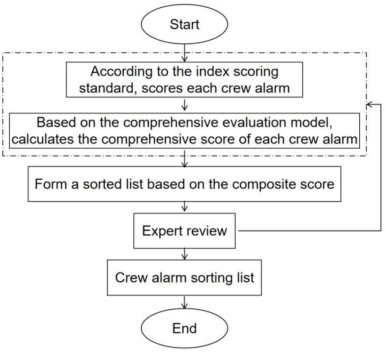
PRIORITY EVALUATION PROCESS When prioritizing, it is necessary to analyze the crew alarms one by one to obtain the scores of various indices. The composite score is then calculated by the comprehensive evaluation model. The crew alarm ranking list can be obtained through the composite score sorting. The crew alarm ranking list
also needs to be reviewed by experts to verify and adjust the sorting order. The alarm prioritization process is shown in Figure 1.
Figure 1: Flow chart of crew alarm priority assessment.
CONCLUSION
In this paper, the sequencing method of crew alarms in the cockpit of civil aircraft is studied, and a method for crew alarm priority evaluation is propo- sed. In this method, a set of crew alarm priority evaluation index system is established and the scoring standards of each index are given, and then the weight of different indices is determined by the Precedence Chart to form a multi-index comprehensive evaluation model, and finally the crew alarm is evaluated one by one to form a crew alarm ranking list. In the case of multiple faults at the same time, the crew alarm system can be displayed in sorted list order to help the flight crew quickly locate the fault that needs to be solved first, so as to reduce the cognitive load of the flight crew, improve operatio- nal efficiency, and ensure flight safety. The proposed method provides a new thinking for the sequence of civil aircraft cockpit crew alarms.
REFERENCES
EASA. (2012). AMC 25. 1322 Alerting Systems. Federal Aviation Administration. (2010). AC25.1322, FLIGHTCREW ALERTING. Huang Boda. (2016) “Alert Inhibit Design Consideration for Flight Crew Alerting System of Civil Aircraft”, proceedings of the 5th International Forum on Avionics for Civil Aircraft in 2016. pp. 160–166. Jin Xinzheng, Li Yan. (2001) Comparative Study and Application of Precedence
Chart and Analytic Hierarchy Process in Determining Weights. Chinese Journal of Health Statistics. April. Vol. 18, No. 2. pp. 119–120. Liang Tuan-jie. (2019). Design of Cockpit Voice Alarm. The 17th China Aviation Measurement and Control Technology Annual Conference. pp. 460–463. Liu Hui, Wang Bin. (2022). Research on the Display and Alarm Information Priority
Ranking Method for Helicopter. ELECTRONIC PRODUCT RELIABILITY AND ENVIRONMENTAL TESTING. Vol. 40 No. 2. Apr. pp. 60–66
Civil Aircraft Crew Alarm Ranking Method 181
Sae. (1988). ARP4102-4 Flight deck alerting system. Sae. (1996). ARP 4761 Guidelines and Methods for Conducting the Safety Assessment Process on Civil Airborne Systems and Equipment. Yin Yuanyuan, HE Wang. (2018). The Design Principle for Flight Crew Alert
Hierarchy of Civil Aircraft. AIRCRAFT DESIGN. Vol. 38 No. 4. pp. 67–70.
LISTED IN THE AHFE DIGITAL BOOKSTORE CATALOGUE
Explore the complete digital volume
Human Factors and Systems Interaction
Read this individual research paper free through the original publisher, or explore the full digital proceedings book.
ISBN 978-1-958651-60-5
Explore this ISBN in the AHFE Bookstore ↗Listed in the July 2026 bookstore catalogue; search by ISBN to confirm current availability · Digital book purchase optional