Ruina Tian (2022). Integrated design of electrical equipment bay layout for civil aircraft based on ergonomics. In: Ergonomics In Design. AHFE Open Access, vol. 47, pp. 310–317. https://doi.org/10.54941/ahfe1001950
A large amount of electrical and electronic equipment is arranged in the E-E bay of a civil aircraft, which is one of the most densely arranged zones on the aircraft. Since the E-E bay is also a zone that needs to be inspected and maintained frequently, the ergonomic design of this zone is also particularly important. Generally, in order to improve the cargo space of the aircraft, the E-E bay should carry out the comprehensive integrated design of the space layout as much as possible under the premise of meeting the inspection and maintenance requirements, so as to improve the space utilization rate. From the perspective of ergonomic design of the E-E bay, this paper proposes the integrated design concept and implementation path of the system layout in the E-E bay for maintenance personnel. Furthermore, ergonomic design considerations are put forward from the aspects of accessibility of maintenance channels, system space allocation, and integrated design of system equipment racks, LRU maintenance, and equipment disassembly. This paper has reference significance for carrying out the system integrated layout design of E-E bay based on ergonomics.
In recent years, with the improvement and development of aircraft system, the accidents caused by aircraft mechanical failure have been greatly reduced, while the accidents related to human factors are increasing. How to ensure aviation safety through human factor design has become the focus of civil aviation industry.
In previous studies, more focus are on the performance of flight crew, fol- lowed by the performance of air traffic controllers, and less attention are paid to the research of human factors in aircraft maintenance. However, with the increasing improvement of aircraft reliability and safety, maintenance errors have become the main cause of flight accidents and incidents. According to statistics, human errors account for 80% of all aviation maintenance error accidents worldwide. It can be seen that the hazards caused by human errors in aviation maintenance is huge, and the importance of human factors in aircraft maintenance cannot be underestimated. Civil aircraft design based on ergonomics has attracted more and more attention. For example, in cockpit design, the concept and idea of ergonomics have played an increasingly important role.
Integrated Design of Electrical Equipment Bay Layout for Civil Aircraft 311
With the rapid development of avionics technology, the electronic and electrical equipment of civil aircraft has also developed rapidly. The modu- lar integration, increase of quantity and function of civil aircraft onboard equipment has played a positive role in improving aircraft performance and reliability. At the same time, the layout design of electronic and electrical equi- pment of civil aircraft is more complex and has greater challenges. Therefore, the layout design of electronic and electrical equipment bay based on ergo- nomics is helpful to reduce the occurrence of follow-up maintenance human factors, and is of great importance to improve the design quality and reduce the problems in operations.
From the perspective of human factors, this paper will put forward the implementation path of integrated design of space layout of electronic and electrical equipment bay for maintenance crew, and put forward the ergo- nomic design considerations of electronic and electrical equipment bay in several aspects. This paper has certain reference significance for carrying out the system layout integration of electronic and electrical equipment bay and improving the level of ergonomic design.
LAYOUT DESIGN FEATURES OF E-E BAY The electronic and electrical equipment bay of civil aircraft, abbreviated as E-E bay, is the installation and operating area of onboard equipment. The design objective and principle is to provide appropriate installation space and operating environment for onboard equipment, meet the requirements of equipment installation and operation, and ensure its safe and effective operation.
The design of E-E bay must ensure the normal operation and safe opera- tion of the aircraft. The layout and equipment installation of electronic and electrical equipment bay must ensure safety, reliability and maintainability and meet the requirements of airworthiness regulations. Due to the limited space of E-E bay, considering that this area is an area with high frequency of maintenance and inspection, the layout design of this area should focus on the requirements of human factors from the overall perspective and on the basis of meeting the airworthiness regulations.
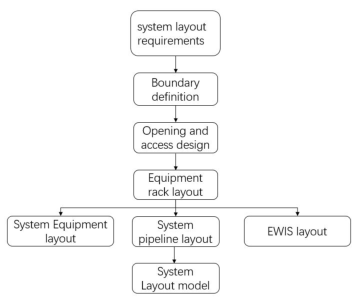
The integrated design of E-E bay layout includes many aspects, such as compartment boundary definition, opening and maintenance access design, equipment rack layout, pipe line and equipment layout, and integrates the design of human factors into the integrated design of layout. The layout design process of E-E bay is shown in Figure 1.
HUMAN FACTOR DESIGN THEORY Murphy’s Law
n, p In the n-fold Bernoulli test, the probability of K errors in event A ispk (q is the probability of no errors, P is the probability of errors, q = 1-p):
n, p
Equations and mathematical formulas are available in the original paper PDF.
pk
312 Ruina
Figure 1: The layout design process of E-E bay.
Since 0 < q < 1, the probability that an error will not occur is:
That is, when the number n is large enough, it is impossible that an error does not occur.
On the other hand, the probability of at least one error is:
Equations and mathematical formulas are available in the original paper PDF.
n, p
n, p
pk
The above equation shows that in the n-fold independent Bernoulli test, if enough tests are done, the probability of one error is 1.
Murphy’s Law is an important experience summarized by the aviation industry for a long time, which fully explains the inevitability of maintenance human errors. Since human error is bound to occur, how to avoid it as much as possible in the design of aircraft E-E bay is the key point of civil aircraft human factor design. We should not miss the risk of every potential human error and analyze its causes, so as to find the design method to prevent acci- dents and avoid human errors, so as to improve the design quality and safety of aircraft.
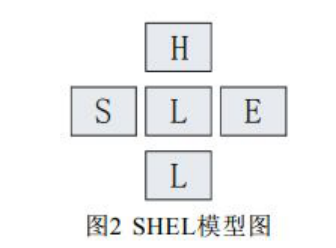
SHEL Model SHEL is composed of the initials of Software, Hardware, Environment and Livewire. Its basic idea is that errors are easy to occur at the contact between people-centered and hardware, software, environment and others.
SHEL model highlights the importance of human factors, analyzes acci- dents from the relationship between human and various interfaces, and comprehensively finds out the causes of accidents, which is of great help to improve the design quality. For the layout design of E-E bay based on ergo- nomics, optimize the SHEL model interface to achieve a reasonable match between human and the four interfaces.
Integrated Design of Electrical Equipment Bay Layout for Civil Aircraft 313
Figure 2: SHEL model.
1) Optimize man-machine interface During the layout design of E-E bay, the following three problems should be prevented: Emphasize on function and performance but neglecting main- tainability requirements; Pay attention to the ergonomic design of aircrew operating interface (such as cockpit panel), but neglect the ergonomic design of ground crew maintenance interface; Pay attention to the ergonomic design requirements of main equipment (such as aircraft) but neglect the ergonomic design requirements of auxiliary equipment (testing equipment, tools, etc.).
2) Emphasize on the improvement of human environment interface For a long time, the working environment of aviation maintenance crew is very bad, and the human environment interface has not attracted enough attention. By incorporating the maintenance evaluation into the layout scheme trade-off model, the impact of human environment interface on maintenance crew is fully considered in the scheme stage, and the layout sch- eme is designed and optimized based on the requirements of human factors engineering.
3) Create a high-quality human-human interface Aircraft design is an activity jointly completed by many departments, many specialties and many engineering and technical staff. Objectively, it is required to have good organization, coordination and control. At the same time, the design should listen to the opinions of customers at the early stage, introduce operators into the design, fully respect the opinions of customers, and make the design process customer-centered.
HUMAN FACTOR DESIGN OF E-E BAY Ergonomic maintainability refers to the design that can provide a safe, effi- cient and comfortable working environment for the operation of airline ground maintenance crew. The space of E-E bay is usually narrow, and some areas are difficult to access. The operation of ground maintenance crew is easy to cause human errors in operation, damage to components and fatigue of maintenance crew. Therefore, it is necessary to focus on human factor design in accessibility, error prevention, and maintenance safety and so on.
314 Ruina
Table 1. Accessibility design of E-E bay.
Table available in the original PDF paper.
1 Are the aircraft’s equipment or components configured in different accessibility locations depending on the size of the failure frequency?
2 Are the aircraft’s equipment or components configured in different accessibility locations based on weight and volume? 3 Is it possible to check or replace parts of any malfunctioning device without
remove other equipment or parts? 4 Are there enough space for maintenance crew, GSE and tools for onboard equipment that needs to be repaired with ground maintenance equipment and tools? 5 Are the test access and inspect access of the equipment conveniently located for
maintenance crew to access and operate? 6 Are dedicated access hatch installed for frequently disassembled connectors, switches and test access points? 7 Are fast fasteners used for access hatch of LRUs? 8 Does the cables and wirings have good accessibility? 9 For a LRU with multiple connectors, can each plug or socket be unplugged
independently without removing other plugs or sockets?
Maintainability is directly related to aviation safety, maintenance cost and flight punctuality. At present, maintenance crew have been a part of the evaluation of the whole human-machine system, and their workload, com- fort, safety and operability need to be fully considered. At the same time, it is necessary to use computer-aided design tools and human modeling software system to test and verify the maintainability of the design scheme (such as operating tools, accessibility, etc.).
Based on Murphy’s Law and SHEL model, E-E bay layout design fully captures the operation contents and processes of maintenance crew, sort out the requirements and criteria of layout integration design, and implements them in each layout design process to avoid human errors from the beginning.
Accessibility Design In the integrated design of E-E bay layout, based on compartment subdivi- sion, the opening, maintenance channel and equipment rack station shall be decided first to ensure the accessibility of LRU and pipelines. The accessi- bility layout design shall be carried out by analyzing the failure frequency of components, maintenance operation time, weight, volume, maintenance tools, maintenance channel size, etc.
In the development of accessibility design, human posture evaluation is an important content. Therefore, it is necessary to study human body size to provide effective data for layout design and analysis. Some mature human posture comfort evaluation methods (such as RULA evaluation method) can also be used to make an overall evaluation of human posture.
Table 1 lists the contents that need to be designed and evaluated in the accessibility design of E-E bay, and it is necessary to ensure that the layout design results of E-E bay meet the criteria requirements in the table.
Integrated Design of Electrical Equipment Bay Layout for Civil Aircraft 315
Table 2. The main contents of error-proof design for E-E bay layout.
Table available in the original PDF paper.
1 Are design considerations and measures taken to prevent errors during
connection and installation so that errors can be detected immediately even if they occur?
2 If left, right (or top, bottom) and circumferentially symmetrically parts are not
interchangeable in function, is there measures been taken in structure and connection design so that they cannot be mis-assembled? 3 Are there maintenance marks, symbols or instructional signs at easy-to-observe locations where maintenance crew are required to pay attention to or where maintenance errors are likely to occur, indicating whether there are accurate data on the signs and the relevant precautions? 4 Are special design measures adopted for key equipment or components that are
prone to maintenance errors that if installed wrongly it can’t be installed? 5 Are positional installations possible for onboard equipment and accessories? 6 Are there design measures for controllers that are critical to security and tasks to prevent program error execution? 7 Does the control handle operate in the same direction as the controlled object
or indicator? 8 Does the use of markers conform to the relevant standards? Can markings be kept clear and firm during use, storage and transportation of aircraft?
Error-Preventive Design E-E bay has many onboard equipment of different systems, water/wastewa- ter pipelines, cables, air conditioning pipelines, etc. Most of the equipment or pipelines use redundant design to improve safety, but the error-proof design of E-E compartment poses a challenge. For the error-proof layout design of E-E compartment, measures should be taken from product design to ensure the correct operation of critical maintenance operations. Error-proof design includes three aspects. First is to take measures in product design so that no errors can occur in the maintenance operation. Second, the design should ensure that no errors occur when operating in accordance with human’s habits. Third, it refers to that certain fault-tolerant technologies have been adopted in the design so that operation errors will not cause serious conse- quences. The main contents of error-proof design for E-E bay layout are listed in Table 2.
Maintenance Safety Design E-E compartment is an area with frequent inspection and maintenance. Maintenance crew need to enter the compartment for operation, while a large number of electronic devices are more precise. To avoid damage to onboard equipment and injuries to maintenance crew during maintenance, maintenance safety design is required. (see Table 3).
HUMAN FACTOR SIMULATION OF E-E BAY In order to improve design simulation ability and ensure efficient, safe and comfortable operation environment and tools for maintainers, review
316 Ruina
Table 3. The content of the maintenance safety design for E-E holds.
Table available in the original PDF paper.
1 Are there steps or pedals designed to be fixed to the aircraft for important
equipment areas that require access such as steps or pedals?
2 Can maintenance crew be prevented from performing maintenance work in
environments near high temperatures, high pressures, toxic substances, microwaves, radioactive substances and other harmful substances? 3 Are there eye-catching signs and text warnings in easy-to-see locations where dangers may occur? 4 Are the edges of the structural opening and hatch components chamfered and
circular? 5 Are emergency switches, buttons or handles protected? 6 Can high voltage parts, pipes and cables be identified and confirmed by the maintenance crew?
standards and processes based on human factors should be established at the beginning of the design. Human factors in maintenance should be fully considered in the design. And Ergonomic review should be carried out by digital human modeling to assembly, maintenance tool design, and the safety and efficiency of maintenance process. For example, an immersive simula- tion environment can be used to simulate the maintenance process to validate and optimize the design of tools and operation processes. It can effectively simulate and evaluate the accessibility and visibility of work space at a lower cost at the beginning of the design, to avoid the high cost of future impro- vements. By carrying out ergonomic analysis, general layout, assembly and maintenance evaluation in advance, design defects can be found and reme- died early, and the closed-loop iteration of “design-analysis-improvement” can be realized.
CONCLUSION
The integrated layout design of electronic and electrical equipment bay is an important activity in aircraft design. The layout design based on human factors consider the needs of customers at the early stage of design, integrate the design elements of human factors, and carry out the simulation verifi- cation of human factors, and improve the design maturity, which can avoid a large number of design changes in the later stage of design and make the layout more reasonable. It is of great help to improve the level of ergonomics engineering for future maintenance, is an important guarantee for the com- mercial success of aircraft projects, and is of great significance to improve the safety and reliability of aircraft.
REFERENCES
Curt Graeber. (2002) “The role of human factors in improving aviation safety”.
International Aviation, pp. 63–65. International Civil Aviation Organization (ICAO). (2006) “Safety Management Manual”. New York: The U N Secretariat.
Integrated Design of Electrical Equipment Bay Layout for Civil Aircraft 317
Li J R, Khoo L P, Tor S B. (2003) “Desktop virtual reality for maintenance training: an object oriented prototype system(V-REALISM) “. Computers in Industry, 52(2), pp:109–25. Per Langaa Jensen (2002) “Human factors and ergonomics in the planning of
production”. Industrial Ergonomics, pp:121–13. Wampler,J.L.(2003) “ Integrating maintainability and data development”. Reliability and Maintainability Symposium. Annual, pp:255–262.
LISTED IN THE AHFE DIGITAL BOOKSTORE CATALOGUE
Explore the complete digital volume
Ergonomics In Design
Read this individual research paper free through the original publisher, or explore the full digital proceedings book.
ISBN 978-1-958651-23-0
Explore this ISBN in the AHFE Bookstore ↗Listed in the July 2026 bookstore catalogue; search by ISBN to confirm current availability · Digital book purchase optional