Karla Beatriz Agostinho, Leonardo Martins Kebbe, Emilin Odilia Rossi De Carvalho Goulart, Rita Cristina Sadako Kuroishi, Vitoria Camilli Pereira Ramos, Maria Eduarda Harumi Eizo, Livia Karla Roque, Geovana Cristine Agostinho, Fausto Medola, Carla Da Silva Santana Castro (2025). Students’ Perceptions About Using the Aging Effects Simulator. In: Human Systems Engineering and Design (IHSED2025): Future Trends and Applications. AHFE Open Access, vol. 198. https://doi.org/10.54941/ahfe1006804
The use of simulation technologies in teaching and learning contributes to the preparation of healthcare professionals, by supporting the experience of changing places, providing better future professional practice. Objective: To understand university students' perceptions of the use of the "Advanced Simulator of the Effects of Aging," which seeks to simulate musculoskeletal, auditory, visual, and tactile changes in previously programmed activities of daily living. Method: This is an exploratory, observational, qualitative and quantitative study. Data were analyzed using content analysis. Results: Eighteen university students from a public university in the state of São Paulo, Brazil, participated in the study. The average age of the participants was 25.6 years, 17 female and 2 male. The data generated the thematic categories: "Limitations of the Simulator" and "Effects of Simulator Use." Regarding the limitations of the simulator, the size of the equipment's components made it difficult to fit bodies with different biotypes, influencing movement control and task completion. Stands out that overloading wrist and/or ankle weights seemed to worsen task performance, especially after a few minutes of use, which could compromise the performance evaluation if considering the beginning and end of the activity. Discomfort in performing tasks with equipment attached to the body was reported, which in itself would affect performance. Regarding the effects of the simulator, limitations on vision and mobility were the most frequently described. The change in the visual field influenced balance and other components of neuromuscular performance, task planning, and perception of safety. Cognitively, participants reported that they needed to recruit more attention, causing greater fatigue, slowness and consequently, limited overall performance. Discussion: From the perspective of the technology development process, simulation practice represents an opportunity to raise the project team's awareness of users' potential difficulties, thus contributing to the development of solutions that better meet their needs. Empathy strategies implemented in the design process can benefit students' creative process and promote the development of better-performing solutions (YESILTEPE; DEMIRKAN, 2025). Conclusion: The experience of raising awareness about the difficulties arising from the aging process brought students closer to the functional changes experienced by older adults, sometimes highlighting negative aspects of functional losses and describing the experience as frustrating, and sometimes fostering empathy with older adults when they identified the important changes of aging. Awareness-raising initiatives can benefit the training of students in the healthcare field and those working on projects and technology development focused on older adults. They highlight the need for a simulator that has items of varying sizes to be used with different biotypes and that the visual changes proposed by the simulator are more realistic compared to those experienced by older adults. The results point to the need to adapt the use of this aging simulation system to teaching purposes, associated with participant feedback to minimize anxiety and the development of ageist attitudes towards aging.
The phenomenon of population aging has been intensifying worldwide in recent years, according to the World Health Organization (WHO, 2020). It is estimated that by 2050, the elderly population will exceed 2 billion (WHO, 2020), causing significant changes in sociodemographic structures. In this scenario, these individuals may require increasing assistance tailored to their needs, requiring health professionals and other professionals with specific soft skills and hard skills (Liu et al., 2024) to provide better care and outcomes for this group in the face of new demands and challenges in health systems (WHO, 2015).
Students in the health field and other areas of knowledge need to broaden their recognition of the demands and needs that affect the daily lives of older adults, as this goes beyond technical knowledge about the changes that come with the aging process. In this sense, several strategies have been developed and implemented to expand the caregiving skills of health students (Burgess et al., 2020; Martínez-Arnau et al., 2022), making it possible to better meet the needs of the growing elderly population. Among the strategies adopted, the simulation of procedures stands out (Son, 2021).
Simulated learning experiences are common in the pre-registration curricula of many health professions. Since its implementation in the learning process as an auxiliary teaching method, simulation has proven to be a valuable tool in providing the acquisition and development of essential skills and promoting student leadership in the teaching-learning process (Yamane et al., 2019). However, it should be noted that simulation should be used as a supplement to the undergraduate teaching process, not restricting students’ practice to it and providing opportunities for interaction with real people (Coelho et al., 2017).
Among the advantages of this teaching methodology, we highlight the possibility of repetition—as many times as necessary—until proficiency is achieved, without worrying about inconveniencing the user or patient, the experimentation of authentic clinical situations, practice in a safe
environment, learning from mistakes, experiencing standardized experiences, and receiving feedback on the practice involved in learning (Carvalho et al., 2021). In addition, different situations with varying degrees of complexity can be offered, depending on the learning objectives and stage of the student’s training (Carvalho et al., 2021). Thus, simulation is a practice that promotes the acquisition of gerontological knowledge, understanding of the difficulties faced by older adults, and, consequently, improvement in the care provided (Silva et al., 2018; Son, 2021).
The use of the aging effects simulator consists of using various motor and/or sensory constrictors to enable the user to experience the limitations arising from the aging process, as well as the main difficulties in performing daily activities (Tremayne et al., 2011 apud Coelho et al., 2017; Almeida, 2013). From the perspective of the technology development process, simulation provides an opportunity to raise awareness among the project team about potential user difficulties, thereby contributing to the development of solutions that better meet their needs. Empathy strategies implemented in the design process can benefit students’ creative process and promote the development of better performing solutions (Yesiltepe; Demirkan, 2025).
Although the precise design and delivery of simulated practice are not defined, Imms and colleagues (2017) suggest an experience that offers high levels of authenticity and complexity that should directly replicate real placement interactions and should be evaluated in a similar manner. Simulation scenarios offer cognitive, psychomotor, and affective experiences, contributing to the transfer of knowledge from the classroom to clinical and social environments (Tuoriniemi, Schott-Bauer, 2008) that seek to approximate human anatomy, physiology, and responses to the health- disease process. This teaching/learning methodology seeks, through practical experience, to identify areas of motor and sensory impairment in the aging process, describe the main difficulties in performing daily activities, and broaden understanding of the challenges faced by older adults, thereby contributing to the improvement of care provided. They also offer cognitive, psychomotor, and affective experiences, improving self-confidence, clinical reasoning, clinical competence, clinical judgment, and decision-making, contributing to the transfer of knowledge from the classroom to clinical and social environments (Abram; Forbes, 2019).
Despite good results in simulated activities, there is still a lack of implementation and studies beyond the fields of medicine, nursing, and primary care (Yamane et al., 2019). Given the importance of simulation in the training of healthcare students, this study aimed to understand university students’ perceptions of their experience using the “Advanced Aging Effects Simulator,” identifying the effects produced on the user and how the simulator affects the performance of everyday tasks.
METHODS
This study was conducted with students enrolled in a health course at a public university in the interior of the state of São Paulo, Brazil. It was approved by
Students’ Perceptions About Using the Aging Effects Simulator 503 the Human Research Ethics Committee of the Hospital das Clinicas of the Ribeirao Preto Medical School of the University of São Paulo.
The students were invited to participate at the location where they carried out their academic activities or scheduled in advance and performed the simulation at the Gerontechnology Research and Innovation Laboratory (LAPITEG) on the university campus. After accepting, they underwent an experience with the aging effects simulator and then answered a questionnaire. Data collection took about 60 minutes, with 30 minutes devoted to the simulation activity and 30 minutes to completing the sociodemographic and perception questionnaires about the use of the simulator.
The material used for the simulation was the “Advanced Aging Effects Simulator” from Civiam Brasil, which sought to simulate the musculoskeletal, auditory, visual, and tactile changes associated with the aging process. The following table describes the activities and tasks performed by the participants.
Table 1: Components of the civiam Brazil simulator.
Table available in the original PDF paper.
Simulator Components 01 pair of special vision restriction glasses 01 set of earplugs (foam ear protectors) 01 pair of back protectors to restrict trunk movement 01 folding cane 01 pair of pads for finger restriction 01 pair of pads for elbow restriction 10 pairs of cotton gloves for touch 01 pair of weights (500g) for the wrists 01 pair of pads for knee restriction 01 pair of weights (1kg) for the ankles
Table 2: Activities and tasks of daily living performed using the simulator.
Table available in the original PDF paper.
Activity Figure Item Used Level of Difficulty
Time Used Low 1 min Open a glass jar with a lid
Gloves and goggles
Low 2 min
Open a door with keys
Gloves and goggles
Continued
Table 2: Continued Activity Figure Item Used Level of Difficulty Time Used
Table available in the original PDF paper.
Medium 2 min
Take a pill out of a package
Gloves and movement restrictor for upper limbs with weight
Pour water into a cup
Gloves, wrist weights, and goggles
Medium 2 min
Gloves and restrictor for lower and upper limbs
Put on a shirt/blouse/ pants
Medium 5 min Low 2 min Gloves, wrist weights, and goggles
Flip through and read a magazine
Students’ Perceptions About Using the Aging Effects Simulator 505
Table 3: Communication activities and tasks performed using the simulator.
Table available in the original PDF paper.
Activity Figure Item Used Level of Difficulty
Time Used Low 3 min
Gloves and goggles
Typing and sending a message on your cell phone
Low 5 min
Starting a group conversation
Ear protection
Table 4: Mobility activities and tasks performed using the simulator.
Table available in the original PDF paper.
Activity Figure Item Used Level of Difficulty
Time Used High 3 min Walk 3 meters down a hallway
All equipment sets
Medium 5 min
Simulate going to the bathroom
All equipment sets
Continued
Table 4: Continued Activity Figure Item Used Level of Difficulty Time Used
Table available in the original PDF paper.
High 5 min
Go up and down stairs All equipment sets
Medium 2 min
Sit down and stand up from a chair
All equipment sets
RESULTS
Seventeen participants were female and two were male, aged between 19 and 45 years, with an average age of 25.6 years, residing in a city in the interior of the state of São Paulo. Two reported having no contact with elderly people, considering their nuclear or extended family. Four had daily contact, ten had monthly contact, and two had sporadic contact with elderly people. Six participants reported being involved in daily (3) and monthly (3) care activities.
The results are presented according to thematic categories based on content analysis techniques (Bardin, 2011), in which the content that emerged from the core meanings was allocated to categories originating from the questionnaire questions. The data were organized into two categories: “Simulator Limitations” and “Effects of Simulator Use” which gave rise to the subcategories effects on the user, on perception, and on task performance.
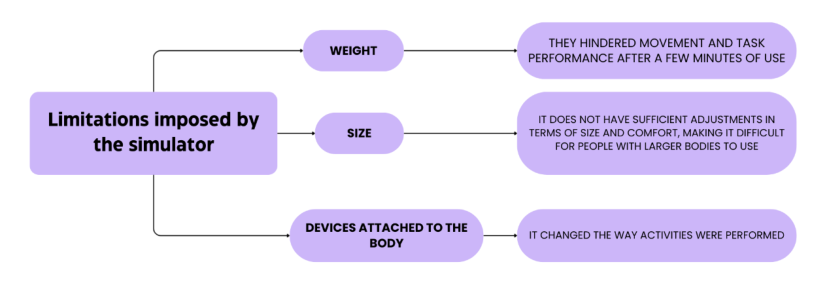
Regarding the Limitations of the Simulator The main aspects highlighted by users relate to the size of the equipment components, making it difficult to put on larger or wider bodies or to perform the task of restricting movement. Participants also pointed out that the weight of the armbands or anklets made it harder to do the task, especially after a few minutes of use, which could mess up the performance evaluation if you look at the start and end of the activity. Another highlight was the discomfort of performing tasks while wearing equipment connected to the body, which in itself would alter performance.
Students’ Perceptions About Using the Aging Effects Simulator 507
Figure 1: Limitations of the “aging effects simulator” equipment.
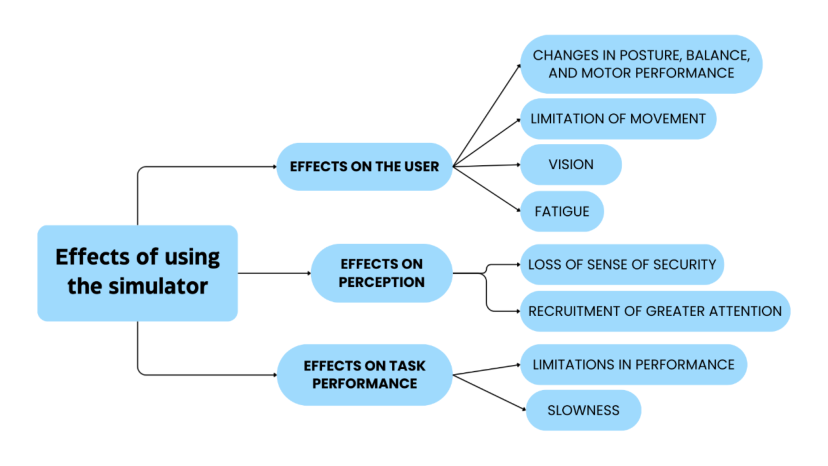
Effects of Using the Simulator The most notable effects were those that limited vision and mobility. The change in the visual field influenced balance and other neuromuscular performance components, task execution, and the user’s perception of safety. In the cognitive sphere, they reported that they needed to pay more attention when performing the task, which also led to greater fatigue, slowness, and consequently limited overall performance, in addition to difficulties in planning due to changes related to loss of body awareness.
Figure 2: Perceptions of the simulation experience.
The students describe their experiences as frustrating and limiting, perceiving aging as a period of overall loss, especially of skills, independence, and autonomy. They mention that the simulator allowed them to realize what they had imagined and to experience firsthand what it is like to perform everyday activities with limitations.
On the other hand, they consider that the simulation brought a view of aging as an immediate, not gradual, process, and therefore, they do not go through the adaptations to bodily changes as the older people do.
DISCUSSION
According to Oliveira et al. (2022), in a study on adolescent students’ perceptions of aging, they highlight this process in a negative way, in which there is deterioration in health, a need for care, and physical and emotional dependence. However, they also perceive aging as a process that can be positive, as it results in greater maturity, accumulation of experiences, and wisdom.
The simulation experience developed allowed for awareness raising, task planning, and understanding of the needs, strengths, and obstacles experienced by older adults. The students also mentioned that this experience allowed them to understand society’s view of older people as individuals with limitations and disabilities, but that they also felt a sense of admiration for finding people who were active and participatory despite their physical limitations. Empathy and patience were the feelings experienced by several study participants, in addition to the recognition that active and healthy aging could prevent the loss of functional capacity.
In view of the global outlook on aging and recommendations on health policy formulation and health service provision for aging populations, the World Health Organization (2015) highlights that many common perceptions and assumptions about older people are based on stereotypes and that intergenerational relationships have the potential to change the culture surrounding aging.
It is clear that participants in the simulation experience focus on physical limitations and difficulties, as well as the multimorbidities resulting from advancing age. This view can lead to prejudice and discrimination by younger generations, who consider older people to be different individuals with negative characteristics (Ribeiro et al., 2018). In this sense, it is necessary to value the simulation experience as a tool that triggers reflection and is capable of deconstructing negative representations and stereotypes about aging and old age, requiring teachers to explore the potential that this teaching resource offers.
The simulation experience allowed us to realize the need for more time to complete everyday tasks and to adapt the movements to be performed, making tasks that were previously perceived as simple now seem complex. These data corroborate the view of aging as a complex, progressive, and dynamic phenomenon involving deleterious mechanisms that influence individuals’ ability to perform basic daily functions (Heikkinen, 1998; Leite et al., 2020). As such, the challenge to be faced is to maintain functional capacity for as long as possible, enabling a long and high-quality life.
The students highlight the simulation activities as positive, making them think that such awareness of the difficulties requires empathy, designing or adapting environments to make them more suitable and friendly, safe and comfortable, and promoting quality of life for the older adults. In a study conducted by Bowden et al. (2021), aging simulation improved healthcare professionals’ knowledge about aging, empathy levels, and attitudes toward older adults. Nelson et al. (2023) emphasize that teaching in elderly care should be designed for all undergraduate health professional curricula and
Students’ Perceptions About Using the Aging Effects Simulator 509 that educators should use their teaching skills to attract and inspire health students to elderly care. In this regard, aging simulation provides an empathetic learning opportunity for students to reflect on the challenges faced by older adults. Experiences such as this can also benefit students in fields such as design, architecture, and engineering by promoting awareness of the functional difficulties that can be associated with the aging process, in order to support the development of more effective solutions that are better suited to the needs of elderly users. Experiencing situations of functional difficulties can contribute to the development of awareness and empathy among design students (Medola et al., 2018).
Despite the contributions resulting from the use of the aging effects simulator, it is important that the system offers different sizes of constrictors, allowing the trunk limiter and knee and elbow restraints to be small, medium, large, and extra-large, or ways to adapt the equipment so that it is flexible and can be used by people of different biotypes.
Similarly, it is important that vision modifiers can have variations in glasses that function as a visual simulator with changes in sharpness, central and peripheral vision that more closely approximate the reality experienced by the elderly.
Finally, it is necessary that simulation experiments do not reinforce prejudice against old age and that they are carefully used to raise awareness of the changes that occur in the aging process. It is necessary for older people to be included in this simulation process so that they can contribute positively to this construction of the imaginary of old age, highlighting the changes that are part of the entire process of human development.
Gerontechnology, being a multidisciplinary approach to the diverse needs of older adults, is concerned with its significant role in ensuring better care and a better quality of life for older adults and their caregivers. The appropriate use of technology with the aim of educating conscious individuals can be achieved through formal and informal education. In this sense, the fact that education has a significant relationship between participation and successful aging must be considered, and technology must be used efficiently (Harwood; Giles; Palomares, 2005). The older population and, in parallel, intergenerational interactions are increasing, and the active involvement of universities, public education centers, non-governmental organizations, government incentives, and volunteer individuals, as well as the relationship between older and younger individuals, can be improved through technology (Özsungur, 2020).
CONCLUSION
The experience of raising awareness about the changes that come with aging, sometimes highlighting the negative aspects of functional decline, sometimes mobilizing empathy in the face of the important changes experienced by older adults, encourages students to develop new perspectives on this population. Awareness initiatives can promote the training of students, caregivers, and professionals from different fields, especially those working in the design and development of technologies focused on the older people.
ACKNOWLEDGMENT
We are grateful to the Interunit Postgraduate Program in Bioengineering, Coordination of Higher Education Personnel Improvement – CAPES and Foundation for Support of Teaching, Research, and Assistance at the Hospital das Clinicas of the Ribeirao Preto of FMRP-USP – FAEPA for financial support in the form of financial aid and scholarships
REFERENCES
Abram, Marissa D.; Forbes, Maryann O. High-Fidelity Simulation: An Application to Psychopharmacological Training for the Psychiatric Nurse Practitioner Student. Issues in Mental Health Nursing, [S. I.], v. 40, n. 3, pp. 260–267, Jan. 2019. Bowden, Alera et al. The impact of ageing simulation education on healthcare
professionals to promote person-centred care towards older people: A literature review. Nurse Education in Practice, [S. I.], v. 53, 2021. Burgess, Annette et al. Tips for teaching procedural skills. BMC Medical Education, [S.
I.], v. 20, S2, Dec. 2020. Coelho, Adriana et al. The use of the aged simulation suit in nursing students: A scoping review. Revista de Enfermagem Referência, [S. I.], IV série, n. 14, pp. 147–158, Sep. 2017. Czekajlo, Michael et al. Medical simulation as a professional tool that affects patient safety
used in the learning process. Polski merkuriusz lekarski : Organ Polskiego Towarzystwa Lekarskiego, [S. I.], v. 38, n. 228, pp. 360–363, Jun. 2015. Gonçalves, Rui et al. Impact of debriefing associated with simulated practices on the development of skills in nursing students. Simulation in nursing education. Coimbra, pp. 125–133, 2014. Harwood, Jake; Giles, Howard; Palomares, Nicholas A. Intergroup communication:
Multiple perspectives. Peter Lang, New York, v. 2, pp. 1–20, 2005. Liu, Justina Yat Wa et al. The Effects of Immersive Virtual Reality–Assisted Experiential Learning on Enhancing Empathy in Undergraduate Health Care Students Toward Older Adults with Cognitive Impairment: Multiple-Methods Study. JMIR Medical Education, [S. I.], v. 10, p. e48566, Feb. 2024. Martínez-arnau, Francisco Miguel et al. Interventions to improve attitudes toward older
people in undergraduate health and social sciences students. A systematic review and meta-analysis. Nurse Education Today, [S. I.] v. 110, p. 105269, Mar. 2022. Medola FO, Sandnes FE, Ferrari ALM, Rodrigues ACT. Strategies for Developing Students’ Empathy and Awareness for the Needs of People with Disabilities: Contributions to Design Education. Studies in Health Technology and Informatics, v. 256, pp. 137–147, 2018. Nelson, Elaine E C, Spence, Andrew D, Gormley, Gerard J. Stepping into the shoes of
older people: A scoping review of simulating ageing experiences for healthcare professional students. Age and Ageing, [S. I.], v. 52, n. 12, Dec. 2023. Oliveira, Francine Moralles et al. Adolescents’ perceptions of aging, old age, and being elderly. Research, Society and Development, [S. I.], v. 11, n. 13, e162111335150, 2022. Organização Mundial da Saúde (org.). Decade of Healthy Aging: Action Plan 2021-
2030, [S. I.], p. 30, 2020. Organização Mundial da Saúde (org.). World Report on Aging and Health. Geneva, Switzerland, p. 30, 2015.
Students’ Perceptions About Using the Aging Effects Simulator 511 Özsungur, Fahri. Gerontechnological factors affecting successful aging of elderly. The
Aging Male, [S. I.], v. 23, n. 5, pp. 520–532, 2020 Putter-katz, Hanna et al. Student evaluation of simulation-based training in a communication sciences and disorders program. Journal of allied health, [S. I.], v. 47, n. 2, pp. 113–120, 2018. Silva, Fillipi André dos Santos et al. Simulation in health training: A focus on geriatrics. UFPE. Nursing Journal on line, [S. I.] v. 12, n. 8, p. 2205, Aug. 2018. Son, Hae-Kyoung. The Effects of Simulation Problem-Based Learning on the Empathy, Attitudes toward Caring for the Elderly, and Team Efficacy of Undergraduate Health Profession Students.International Journal of Environmental Research and Public Health, [S. I.] v. 18, n. 18, p. 9658, Sep. 2021. Yes¸iltepe, Melis, Demirkan, Halime. Influence of empathic design process on universally designed kitchen environments in an online project-based course. International Journal of Technology and Design Education. 2025. https://doi.org/
10.1007/s10798-025-09995-w Zairi, Ihsen et al. The value of simulation in learning clinical reasoning. La Tunisie medicale, [S. I.], v. 98, n. 6, pp. 466–474, Jun. 2020.
LISTED IN THE AHFE DIGITAL BOOKSTORE CATALOGUE
Explore the complete digital volume
Human Systems Engineering and Design (IHSED2025): Future Trends and Applications
Read this individual research paper free through the original publisher, or explore the full digital proceedings book.
ISBN 978-1-964867-74-8
Explore this ISBN in the AHFE Bookstore ↗Listed in the July 2026 bookstore catalogue; search by ISBN to confirm current availability · Digital book purchase optional