Emilin Odilia Rossi De Carvalho Goulart, Fausto Medola, Rita Cristina Sadako Kuroishi, Karla Beatriz Agostinho, Carla Da Silva Santana Castro (2025). Technology and environmental design for the safety of people with autism. In: Human Systems Engineering and Design (IHSED2025): Future Trends and Applications. AHFE Open Access, vol. 198, pp. 493–499. https://doi.org/10.54941/ahfe1006803
People with autism need a safe environment, free from potential risks and that facilitates movement so that they can continue to perform their tasks and maximize their abilities (FLEMING; ZEISEL; BENNETT, 2020). This study aimed to explore the safety measures implemented by family members of people with autism in the home environment. An exploratory, descriptive, and qualitative study, approved by the Research Ethics Committee of the Hospital das Clínicas of the Ribeirão Preto Medical School of the University of São Paulo, in which 26 caregivers of people with autism participated. Data were collected through in-depth interviews. The study questions were based on environmental adaptations for well-being and safety measures adopted. The main thematic categories identified were: Modifications in environmental design and Technology resources. The category "Modifications in environmental design" generated the subcategories "Access Control Strategies" and "Modification of structure and rearrangement of furniture." Access control modifications included the installation of gates and keyed doors to isolate rooms and control access to medicines, plants, and animal feed. Regarding structural strategies, accessibility features were adopted, such as leveling the floor and removing steps, installing ramps, handrails, corner guards, and grab bars, removing shower stalls, widening doorways and passageways, installing non-slip flooring, and installing safety screens and nets, among others. Furniture and rugs were removed to increase free space and reduce environmental risks. Technology features included the installation of surveillance cameras, assistive devices such as shower chairs, bed safety rails, motion sensors, furniture corner guards, and floor signage, as well as increased supervision and surveillance. The main changes are based on the fact that 20 of these subjects were children living with autism and had no perception of the potential risk of the environment. Safety is the most frequently adopted measure for environments in which neurotypical individuals live, taking into account their cognitive, sensory, experiential, and sociodemographic specificities (Lee, 2022). Conclusion: Knowledge about the specific needs of a group of individuals should inform design and technology choices that can contribute to a full life in a safe and functional environment.
People with autism need a safe environment, free from potential risks and that facilitates movement so that they can continue to perform tasks and maximize skills (Fleming, Zeisel, Bennett, 2020).
The domestic environments for these individuals required specific adaptations to ensure safety, due to their particularities that affect the perception and response to potential dangers, increasing the risks of accidents and unsafe situations in the home (Mostafa, 2014; Nagib, 2014; Kahveci, Caylak, Kara, 2023; Silva et al., 2024).
Domestic environments for these individuals require specific adaptations to ensure safety, due to their particularities that affect the perception and response to potential dangers, increasing the risks of accidents and unsafe situations in the home (Mostafa, 2014; Nagib, 2014; Kahveci, Caylak, Kara, 2023; Silva et al., 2024). To achieve this, these environments must go beyond traditional physical accessibility, including adaptations that promote a predictable, structured, and safe space, such as installing locks and alarms adapted to sensory sensitivities, clearly organizing the environment with visual labeling, controlling noise and lighting, and securely securing furniture and barriers that prevent falls and unsupervised escapes (Nagib, 2014; Mostafa, 2019; Tola et al., 2021; Matos et al., 2023; Silva et al., 2024; Brown et al., 2024; Johnson et al., 2025).
In this context, assistive technology emerges as a strategic resource to mitigate risks and increase home safety, in addition to promoting inclusion, autonomy, and quality of life (Cardoso et al., 2021; Oliveira et al., 2024).
This study aimed to explore the safety measures implemented by family members of people with autism in their home environment.
METHODS
This is an exploratory, descriptive, and qualitative study, approved by the Research Ethics Committee of the Hospital das Clínicas of the Ribeirao Preto Medical School of University of Sao Paulo. This is a convenience sample, consisting of 26 family members of people with autism and a professional caregiver, who were interviewed in depth based on a previously established set of questions. The study questions were based on environmental adaptations for well-being and the safety measures adopted. Content analysis was used for data processing.
RESULTS
The results presented below were collected from May 13, 2024, to February 3, 2025, through face-to-face interviews. The interviewees had an average age of 48, 12 years of education, 5 lived in their own homes and the others lived in rented or family-owned homes. All reported having made adaptations as a safety measure to facilitate engagement in activities or reduce general stimuli.
The data collected were based on 30 individuals with autism: eight females and 22 males. The average age was 10.6 years. Five individuals were
Technology and Environmental Design for the Safety of People With Autism 495
independent in basic activities of daily living, verbally, and received a level of support of 1, 16 were semi-dependent and received a level of support of 2, and 9 were dependent and received a level of support of 3.
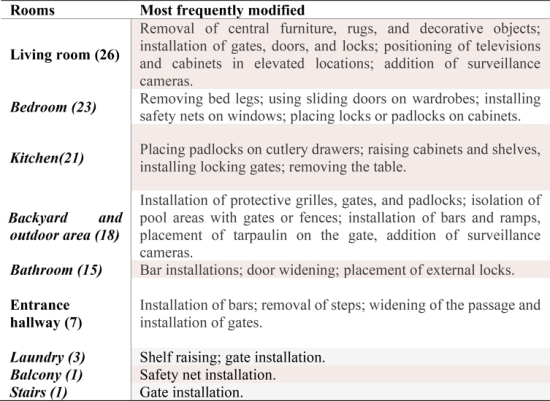
Regarding environmental adaptation, 27 family members considered it essential to adapt the home environment to the sensorimotor needs of individuals with Autism Spectrum Disorder (ASD), while three reported not perceiving such a need. However, a discrepancy was identified between the subjective perception expressed and the practices actually adopted, since even among those who did not recognize this need, modifications were made to the home space. Regarding physical spaces, the most frequently adapted environments stood out, with interventions aimed at promoting the safety and functionality of individuals, as illustrated in the following figure.
Figure 1: Rooms most frequently modified in the home environment and their main modifications, according to the interviewees’ reports (author’s own, 2025).
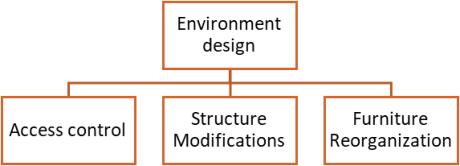
Using thematic content analysis, the categories “Modifications in the environment design” and “Technological resources adopted” were identified. The “Modifications in the environment design” category generated the subcategories “Access control strategies” and “Modifications in the structure and reorganization of furniture,” as summarized in the following figure:
Figure 2: Summary of analysis categories (author’s own, 2025).
Regarding changes to access control, the measures below describe the main strategies adopted by the interviewees.
Table 1: Access control measures, frequencies and purposes (author’s own, 2025).
Table available in the original PDF paper.
Main Purpose Measurement/Adaptation Frequency (n.)
17 Prevent poisoning and contact with dangerous substances
Relocation of chemicals and abrasives to inaccessible locations
10 Restrict access to risk areas (swimming pools, bathrooms, upper floors, kitchens)
Prevent poisoning and contact with hazardous substances Installation of internal and external doors/gates Canvas at the front gate 1 canvas cover on the front gate Padlocks on cabinets/doors 10 Block access to sharp objects, cleaning products, chemicals Chains on cabinets/doors 10 Same as above Extra locks on doors 9 Limit access to restrooms Lock Drawers 7 Prevent access to sharp, fragile or small objects Additional locks on cabinets 5 Physical blocking of access to dangerous objects Medication reallocation 2 Avoid inadequate intake Food reallocation 7 Restrict unsupervised access Storing animal feed in cabinets 6 Avoid inadequate intake Storage of cleaning products in overhead cabinets with locks
7 Avoid ingesting inedible elements
5 Prevent ingestion and contact with toxic substances Removal of flowers and gardening tools
5 Same as above
Lifting flowers/gardening tools to inaccessible locations The structural modifications subcategory included physical changes to the property aimed at reducing environmental risks and promoting accessibility. The most frequent interventions in this subcategory involved installing grab bars, constructing access ramps, and removing steps. Other examples included installing non-slip flooring, widening doorways, cementing outdoor areas, and installing floor markings to prevent falls. These modifications demonstrate families’ efforts to adapt the physical environment to their children’s functional needs, reducing risks such as slipping, physical barriers, and mobility difficulties.
The furniture rearrangement subcategory included actions aimed at redistributing and adapting objects and furniture in the home to facilitate movement and eliminate structural risks. Reports included removing sharp or potentially breakable objects and elevating cabinets and televisions to reduce accidents caused by collisions, falls, or unauthorized access. Redesigning the furnished space, including comprehensive strategies for redistributing and emptying the space, was mentioned by 17 participants. Measures adopted included removing excessive furniture such as bookshelves, chairs, and
Technology and Environmental Design for the Safety of People With Autism 497
tables that obstructed circulation; reducing the amount of furniture in living rooms; and strategically positioning items such as sofas and TVs away from windows, doors, or hallways. Organization of the space to facilitate children’s mobility was also mentioned, creating a more open environment. Another common practice was removing rugs, mentioned by 18 participants, specifically to prevent slipping, reduce obstacles to movement, facilitate children’s mobility, and prevent falls in high-traffic areas.
Also in this context, the relocation of decorations, flowers, decorative vases, and gardening tools to elevated locations was identified in seven cases, with the direct goal of preventing accidents with fragile items.
Regarding the implemented technology resources, the use of surveillance cameras was described by four participants, as a complementary strategy to direct supervision. The cameras were installed in living rooms, backyards, outdoor areas, and near the pool. Their main purpose was to enhance remote monitoring and prevent unauthorized exits from the residence.
DISCUSSION
The main changes are based on the fact that 20 of these subjects were children living with autism and had no perception of the risk that the environment could pose. Safety is the most frequently adopted measure for environments in which neurotypical individuals live, taking into account their cognitive, sensory, experiential, and sociodemographic specificities (Lee, 2022).
It was found that the adoption of preventive measures to avoid the risk of accidents in the home environment, related to adaptations in environmental design (access control, structural modifications, and furniture rearrangement) and the use of technology resources, corroborates other studies (Ceridwen, McCann, 2017; Kahveci, Caylak, and Kara, 2024; Ramos, Lopez, 2024). These measures aim to avoid the main dangers inside and outside the home environment, related to difficulties with spatial perception, the usefulness of objects, and the finish of furniture due to injuries that the child may sustain in moments of crisis (Ramos, Lopez, 2024). These objects should be strong enough to withstand angry behavior (Kahveci, Caylak, Kara, 2024).
When exploring the experience of caregivers of autistic children in Australia, a key theme emerged: the growing need for restraint to meet the complex and idiosyncratic needs of this population, through micro-scale modifications to the physical structure and spatial organization of the home environment (Ceridwen, McCann, 2017). Therefore, safe boundaries should be established in these environments to provide freedom of movement in enclosed areas, in addition to the installation of locks and cameras (Kahveci, Caylak, Kara, 2024).
The strategy of intensifying supervision and surveillance through the use of technology (installation of security cameras) and assistive devices (bath chairs, bed safety rails, motion sensors, furniture corner protection, and floor markings) was also used by families in this study.
Sari et al. (2015) demonstrated that 89% of mothers constantly supervised their children and that there was a significant correlation between the Injury
Behavior Checklist and the safety measures adopted at home. This confirms the positive impact of adopting preventive measures against inappropriate behavior in autistic children (Kahveci, Caylak, Kara, 2024). In this case, families may prefer to use more solid, rounded, or fixed furniture (Kahveci, Caylak, Kara, 2024), as evidenced by the families in this study, with the removal of breakable objects and objects with sharp edges (09) and the placement of cabinets and TVs in higher locations (07).
CONCLUSION
This study found that changes to the home environment due to safety concerns are measures taken by most family members of individuals with autism. Regarding the home environments in which changes were implemented due to safety concerns, the most common were the living room, bedroom, and kitchen. The implemented measures were organized into three main categories: access control, most often for measures to prevent contact with hazardous substances and high-risk areas; structural changes, most often for accessibility and fall risk reduction measures, such as installing grab bars, removing steps, and installing non-slip flooring; and rearranging furniture to facilitate mobility within spaces, remove breakable objects, and elevate cabinets and televisions to prevent collisions. Home safety is a concern among family members of individuals with autism spectrum disorder and requires reorganization and modification of the environment.
Understanding, from the perspective of family members of individuals with autism, the main risks and safety measures implemented in the environment can contribute to the work of professionals in designing and adapting spaces, furniture, and equipment in the home environment.
ACKNOWLEDGMENT
We are grateful to the Interunit Postgraduate Program in Bioengineering, Coordination of Higher Education Personnel Improvement – CAPES and Foundation for Support of Teaching, Research, and Assistance at the Hospital das Clinicas of the Ribeirao Preto of FMRP-USP – FAEPA for financial support in the form of financial aid and scholarships.
REFERENCES
Black, Melissa Heather et al. (2022). Considerations of the built environment for autistic individuals: A review of the literature, Autism, Volume 26, No. 8, pp. 1904–1915. https://doi.org/10.1177/13623613221102753 Cardoso, Eduardo; Castelini, Alessandra Lopes de Oliveira; Sousa, Célia Maria
Adão de Oliveira Aguiar. (2021). Práticas inclusivas em contexto: ações de comunicação acessível em Portugal e no Brasil, Revista Ibero-Americana de Estudos em Educação, Araraquara, Volume 16, Número esp. 4, pp. 2990–3004. doi: 10.21723/riaee.v16iesp.4.16063. Fleming, Richard; Zeisel, John; Bennett, Kirsty. (2020). World Alzheimer Report 2020: Design Dignity Dementia: dementia-related design and the built environment, Alzheimer’s Disease International, Inglaterra, Volume 1, No. 1, p. 12.
Technology and Environmental Design for the Safety of People With Autism 499
Gul Kahveci; Emrah Caylak; Donay Nisa Kara. (2023). The effect of the home environment on children with autism spectrum disorder, International Journal of Developmental Neuroscience, [S. I.], v. 84, pp. 14–21. https://doi.org/10.1002/ jdn.10304. Lee, Chaiwoo. (2022). Tecnologia e envelhecimento: o quebra-cabeça do design,
desenvolvimento e distribuição, Nature Aging, Volume 2, pp. 1077–1079. Mostafa, Magda; Sotelo, Marlene; Honsberger, Toby; Honsberger, Christine. (2023).
The impact of ASPECTSS-based design intervention in autism school design: A case study, Archnet-IJAR: International Journal of Architectural Research. https:// doi.org/10.1108/arch-11-2022-0258 Nagib, Wasan; Williams, Allison. (2014). Toward a therapeutic and autism-friendly home environment, Tese (Mestrado em Arts) – McMaster University, Hamilton, Ontario, 227 p. Disponível em: https://macsphere.mcmaster.ca/handle/11375/ 16447. Owen, Ceridwen; McCann, Damhnat. (2018). Transforming Home: parents’
experiences of caring for children on the autism spectrum in Tasmania, Australia, Housing Studies, Volume 33, No. 5, pp. 734–758. https://doi.org/10.1080/ 02673037.2017.1390075 Ramos, Larissa L. A.; Lopes, Yasmin F. (2024). Arquitetura de interiores inclusiva: ambientes residenciais sensíveis a crianças com Transtorno do Espectro Autista (TEA), Gestão & Tecnologia de Projetos, São Carlos, Volume 19, No. 1. https: //doi.org/10.11606/gtp.v19i1.211966. Tola, G. et al. (2021). Built environment design and people with Autism Spectrum
Disorder (ASD): A scoping review, International Journal of Environmental Research and Public Health, Volume 18, No. 6, p. 3203. https://doi.org/10.3390/ ijerph18063203.
LISTED IN THE AHFE DIGITAL BOOKSTORE CATALOGUE
Explore the complete digital volume
Human Systems Engineering and Design (IHSED2025): Future Trends and Applications
Read this individual research paper free through the original publisher, or explore the full digital proceedings book.
ISBN 978-1-964867-74-8
Explore this ISBN in the AHFE Bookstore ↗Listed in the July 2026 bookstore catalogue; search by ISBN to confirm current availability · Digital book purchase optional