Tingmin Yan, Zihe Chen (2023). Attention Training Products for Preschool Children using AHP-TOPSIS. In: Human Interaction & Emerging Technologies (IHIET 2023): Artificial Intelligence & Future Applications. AHFE Open Access, vol. 111, pp. 110–120. https://doi.org/10.54941/ahfe1004015
This study aimed to explore the design elements and their corresponding weights for attention training products for preschool children to enhance their effectiveness. A mixed-methods approach was used to investigate factors related to attention training in preschool children. An evaluation matrix for the design elements of attention training products was constructed for preschool children using an Analytic Hierarchy Process, and a weight analysis was conducted. The Technique for Order Preference by Similarity to Ideal Solution was then utilized to obtain positive and negative ideal solutions for the three attention training product designs, and the best design was selected based on their relative closeness. The results revealed that genetic factors (C13), health level (C14), and family upbringing (C34) were important design elements for attention training products for preschool children. Among the three tested designs, the clip-on-ball toy was found to be the best solution. These findings provide valuable insights for the optimized design of attention training products for preschool children and practical application in the product development cycle's design and selection stages.
Compared to their peers, children with attention deficits have slower cogni- tive development, are more likely to experience learning difficulties, deve- lopmental reading disorders, response inhibition problems, impaired visual memory, and poor auditory discrimination, and usually have accompan- ying social difficulties that affect their social development. If the attention deficit persists to a certain degree, it can lead to behavioral disorders such as attention-deficit/hyperactivity disorder (ADHD). Research indicates that a child’s academic performance is closely related to their ability to sustain attention, which can improve their learning ability, increase their level of concentration while learning, improve symptoms of attentional diffusion and hyperactivity, and promote their future learning abilities, social adaptation, and overall development. Therefore, focusing on attention development in preschool children is important for their cognitive development.
Based on the cognitive resource theory of attention, attention plays a cru- cial role in coordinating various cognitive tasks and activities, thereby aiding children in comprehending and assimilating pertinent features and informa- tion about their surroundings. Children between the ages of three and six are
Attention Training Products for Preschool Children Using AHP-TOPSIS 111
generally classified as preschool children, and during this period, their atten- tional abilities are in the nascent stage and continually evolving. Based on the characteristics of child psychology and physiology, researchers have explored the developmental characteristics and factors influencing attention in presch- ool children. Through experimentation, Ridderinkhof (Ridderinkhof, 2000) proved that a child’s attention level is closely related to their age and that the voluntary deployment of attention is one of the most profound adva- nces in information processing efficiency in children. Sung believed that the lack of attention in children is closely related to sleep problems. Sung (Sung, 2008) view was that a child’s attentional processes occur through genetic neural mechanisms that have a high correlation with genetic factors. Mathis (Mathis, 2015) postulated that a child’s attentional processes are closely lin- ked to the family environment and that delayed attention control is more prevalent among children growing up in poverty. Simultaneously, parenting stress and critical instruction styles can harm children’s attention.
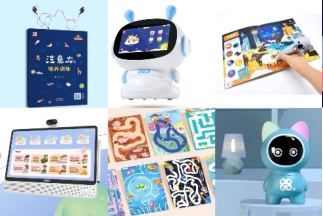
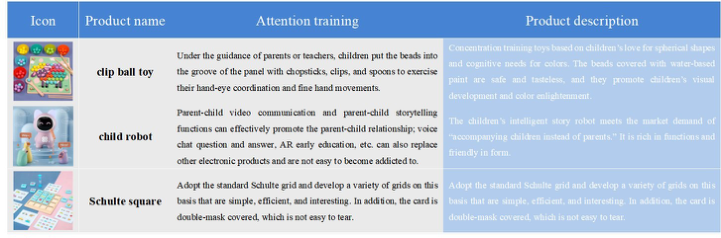
Several forms of attention training products for preschool children exist, which can be roughly divided into categories such as toys, electronic produ- cts, and paper-based books. Different categories focus on different aspects of attention training: toy category primarily includes puzzle games, buil- ding blocks, spot-the-difference games, and obstacle avoidance games, which guide children to exercise their observation, perception, memory, and hand- eye coordination through gameplay to enhance their concentration. Electro- nic products primarily include early childhood education machines, story robots, and companion robots that help children enter a state of concen- tration by providing a wealth of early education resources, interesting and novel interactive methods, and warm and intimate emotional experiences while playing the roles of educators, guides, and companions. Paper-based books primarily include story immersion books and maze card games, which guide children to enter a high-intensity state of concentration by providing rich visual, auditory, and tactile information to improve their attention levels. Although the forms of attention training products for preschool children are diverse, many challenges remain in the market, such as the lack of scientific evidence, homogenization of products, and lack of personalized products.
Figure 1: Common attention-training products for preschoolers.
Currently, research focus on product design for preschool children is pri- marily centered on designing products for special groups (such as those for
112 Yan and Chen
children with autism and intervention products for aggressive behavior), toy products (such as puzzle toys and early education toys), and interface intera- ction products (such as children’s app interfaces); however, it has not focused specifically on product design for attention training. Research on attention training for preschool children is primarily concentrated in the fields of edu- cation, psychology, medicine, and so on, and research combining it with product design remains relatively scarce. Therefore, this study introduces relevant theories from psychology and other fields, attention game expe- riments, and AHP-TOPSIS quantitative evaluation methods to conduct a hierarchical analysis of the design elements of attention training products for preschool children, further explore the factors related to attention training for children, and employ the TOPSIS method to select the optimal design solu- tion, providing theoretical support for subsequent attention training products for preschool children.
Attention Experiment and Related Factors Analysis for Preschool Children Under regular conditions, such as daily learning and meals, 3-year-old chil- dren can concentrate for approximately 3 to 5 minutes, while 4-year-olds can concentrate for up to 10 minutes, and 5–6-year-olds for around 15 minu- tes. However, under gaming conditions, preschoolers showed a significant improvement in attention levels. Among them, 4–5-year-olds are in a sensi- tive period of attention development, with notable individual differences and a moderate average attention span, making them suitable for participation in focus group game experiments.
Thus, for this experiment, a total of 24 participants were randomly selected from a senior kindergarten affiliated with Nanjing Yixian primary school, comprising 12 boys and 12 girls. A series of user studies were conducted, including focus group game experiments, in-depth home-school interviews, and questionnaire surveys to explore the associated factors that affect the attention of preschool children using a combined qualitative and quantitative research method.
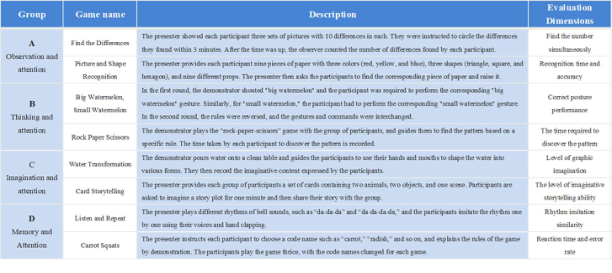
Attention-Focus Group Game Game for Preschool Children (1) Experimental Design Among the five basic factors of intelligence in preschool children, attention is the foundation of observation, imagination, memory, and thinking. There- fore, this focal group game experiment analyzes the attention of preschool children through a total of 8 games, with each group focusing on diffe- rent aspects: Group A focuses on observation, Group B focuses on thinking, Group C focuses on imagination, and Group D focuses on memory.
(2) Experimental procedure The 24 participants were divided into four groups of six each, with each parti- cipant numbered according to sex: G1 for the first female participant and B3 for the third male participant. Each group was assigned an observer to record the participants’ behaviors during different focus group games via audio and
Attention Training Products for Preschool Children Using AHP-TOPSIS 113
Figure 2: Experimental design of an Attention-focus group game game for preschool children.
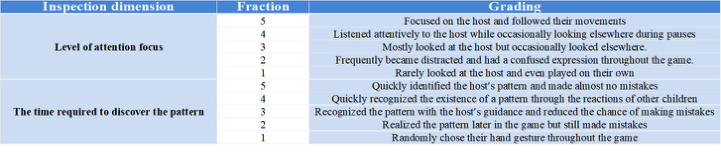
video. The facilitator organized the games, announced the rules, and issued game commands. The observers used a 1-3-5 rating scale to score the par- ticipants’ performance in each game dimension according to the respective evaluation criteria. The scores were then averaged to quantify participants’ abilities in each area. The evaluation criteria for each game dimension, such as storytelling with cards, are as follows:
Figure 3: Dimensions and scoring standards for the regular game of rock-paper- scissors. (3) Data processing The scoring data collected during this evaluation were summarized into five categories: observation, imagination, memory, thinking, and attention. Each aspect was scored based on the average score of the content. For example, thinking ability was scored based on the correctness rate of the posture of large and small watermelons and the time taken to discover the rules of cut- ting, wrapping, and hammering. Attention was scored based on the average concentration scores for the four games. A five-force analysis and comparison were performed on each child’s abilities to evaluate the differences between individuals.
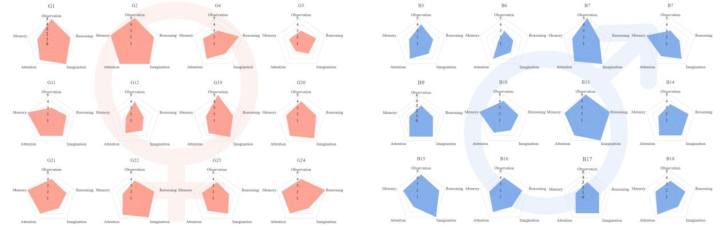
(4) Experimental results Based on a longitudinal comparison of the five abilities of preschool children, the scores for observation, imagination, memory, thinking, and attention of the 24 participants were found to be uneven, with large differences between individuals. Based on the comprehensive assessment of the five abilities, if a child’s performance was outstanding in one aspect, then their evaluation
114 Yan and Chen
Figure 4: Longitudinal comparison of the five abilities of preschool children.
scores for the other four abilities were also considerable, indicating excellent overall competence. This phenomenon can be summarized as “strong in one, strong in all. The attention level score was close to the average score of all abilities, which can, to a certain extent, represent the overall ability of an individual child.
Through a horizontal comparison, gender differences were found to signi- ficantly impact the five abilities of the children. Girls’ attention performance was relatively better than that of boys of the same age, which may be rela- ted to the slower development of boys’ prefrontal cortices compared to girls before school age. Boys performed slightly better than girls on imagination and memory. Individual differences in attention among girls were greater, whereas differences in imagination and memory among boys were greater. Additionally, significant age-related differences existed in attention levels, and attention performance showed an increasing trend with age.
In-Depth Interviews With Typical Participants From Families and Schools (1) Interview outline In-depth interviews were conducted to supplement the game’s experimental method. Based on the results of the game experiment, G2 and B13 were sele- cted as typical positive participants, and G5 and B6 were selected as typical negative participants. Interviews were conducted separately with the child participants, their parents, and early childhood education workers.
Face-to-face, open-ended interviews were conducted with the children. Through flexible and free conversations with the children, verbal commu- nication information and non-verbal information, such as facial expressions, postures, and actions, could be obtained, thus comprehensively collecting information on children’s psychological and behavioral characteristics. For parents, semi-structured telephone interviews were conducted, primarily focusing on direct information gathering regarding parent-child relation- ships, parental cultivation awareness, family environment, and children’s habits. Semi-structured face-to-face interviews were conducted with early
Attention Training Products for Preschool Children Using AHP-TOPSIS 115
childhood education workers, primarily collecting information on chil- dren’s performance at school and the relationship between families and schools.
(2) Analysis of interview results In-depth interviews with typical positive participants from families and sch- ools revealed that these children had outgoing personalities, strong social awareness, and a wide range of interests. Their family environment was often warm and harmonious, and their parents had relatively high levels of educa- tion and held stable professions such as teachers and doctors. Parents had a better understanding of their children’s education, scientific expectations, and judgments about them. A quiet and tidy environment in the home can reduce their tendency for distraction, which helps improve their focus on learning and entertainment. Early childhood education workers paid greater attention to these children, providing them with different levels of prompting, guidance, and encouragement, which significantly improved their attention levels.
In-depth interviews with typical negative participants from families and schools revealed a lack of interactive communication between parents and children in their families. The lack of companionship was an important rea- son for their attention levels being lower than average. In various learning activities in kindergarten, these children did not like to show themselves; however, they liked to integrate into the collective. They performed well in cooperative interactive games, indicating that the attention of children lacking companionship can be compensated for to a certain extent through peer interactions.
Analysis of Design Elements of Preschool Children’s Attention Cultivation Products AHP-TOPSIS Method The Analytical Hierarchy Process (AHP) is a model-based method that is used to solve complex problems composed of interrelated elements. It is used to classify complex decision-making objectives and determine the weight of each element through subjective weighting. However, the TOPSIS method is an evaluation method that is suitable for multi-indicator and multi-plan decision analysis. The core objective is to determine the positive and negative ideal points and calculate the distance from the evaluation object to these points. The optimal and worst sets for each index were obtained using this design scheme.
Although the AHP method compares two factors at the same level and constructs a judgment matrix to determine the weight of each index of the evaluation object, it does not cover all aspects of demand assessment and empowerment. However, the TOPSIS method is limited in this area. There- fore, the establishment of the AHP-TOPSIS comprehensive evaluation model can complement the advantages of both methods and provide an optimal solution while reducing errors.
116 Yan and Chen
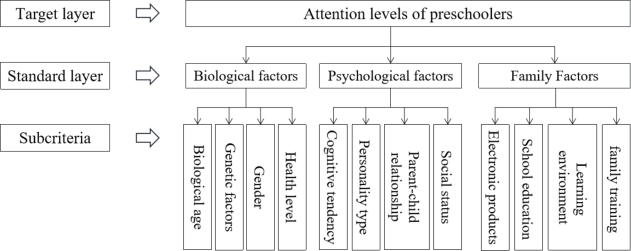
Hierarchical Analysis Model for Product Design Elements Owing to the mutual influence and restriction among the various factors related to the attention training of preschool children, it is necessary to comprehensively construct the analytic hierarchy process model through the AHP method and determine the weight of each evaluation factor. Combined with the above-mentioned experimental method, interview method, and que- stionnaire survey, all evaluation indicators were comprehensively classified and processed, and 12 evaluation indicators were established for the three dimensions, as shown in Figure 5.
The target layer is the factor influencing preschool children’s attention levels. The criteria layer is composed of the aforementioned biological, envi- ronmental, and psychological factors. The substandard layer divides the elements of the standard layer. Biological factors include the four evaluation elements of biological age, gender, heredity, and health level. Psycholo- gical factors include the four evaluation elements of cognitive tendency, personality type, parent-child relationship, and social status. Environmental elements included four evaluation elements: learning environment, electronic products, school education, and family training.
Figure 5: Analytical hierarchy model of attention level of preschool children.
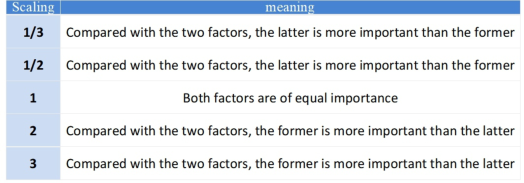
Construction of Judgment Matrix and Determination of Weights of Influencing Factors Construct a judgment matrix and calculate the weights of the influencing factors for the above-mentioned analytical framework for attention cultiva- tion in preschool children. The three factors of the criterion level were C1, C2, and C3, and the 12 factors of the sub-criteria level were C11, C12,..., and C34. Five authoritative experts, including child pedagogy and child psych- ology experts, were selected to participate in the input and evaluation of the elements of the judgment matrix. The judgment scales are presented in Figure 6.
Finally, the AHP judgment matrix and weights of the attention level of preschool children are obtained, as presented in Table 1.
According to the AHP data matrix, perform a hierarchical analysis and a consistency check, where the weight value is, and are the eigenvalue and
Attention Training Products for Preschool Children Using AHP-TOPSIS 117
Figure 6: Analytical hierarchy model of attention level of preschool children.Table 1. Judgment matrix and weight of each level.
Equations and mathematical formulas are available in the original paper PDF.
cij Pn
n
λ and ω are the eigenvalues and eigenvectors of the judgment matrix:
[Aω]i
To verify whether the elements of the matrix are logical, we checked the consistency of the judgment matrix. If CR ≤0.1, the test is passed. The formula for the consistency test is as follows:
The four judgment matrices passed the consistency test, and the results were valid. The target weights of the sub-criteria layer were obtained and sorted according to the weighted processing of the criterion layer.
Application Examples of Product Design Evaluation Objects of Attention Cultivation Product Design According to the AHP-TOPSIS comprehensive evaluation model, after obtai- ning the total ranking of the target weights, three typical product evaluation
118 Yan and Chen
Figure 7: Target weight calculation and sorting.
cases—toys, electronic products, and paper books—were selected. The TOP- SIS method was used to optimize the design schemes for preschool children’s attention training products.
Figure 8: Analytical hierarchy model of attention level of preschool children.
Design Evaluation Process Based on the TOPSIS Method The 12 evaluation indicators determined by the evaluation elements of the sub-criteria layer were as follows: reducing the influence of age factors, redu- cing the influence of gender factors, reducing the influence of genetic factors, improving health levels, cultivating cognitive tendencies, cultivating sound characters, cultivating parent-child relationships, improving social skills, cre- ating a good learning environment, reducing the use of electronic products, improving the quality of school education, and improving the quality of family training. The 12 evaluation indicators were positive for the positive and negative evaluation indicators.
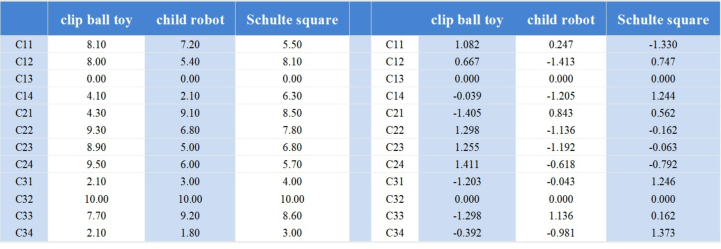
We selected five preschool teachers and five parents of school-age chil- dren and evaluated the 12 factors of the three categories of preschool children’s intelligence development products on a scale of 0–10 (0 = extre- mely dissatisfied; 10 = very satisfied) and constructed the initial evaluation matrix.
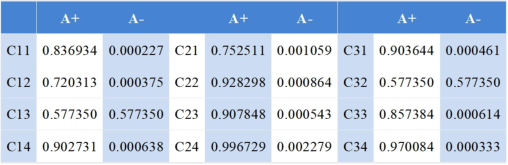
After standardizing the initial evaluation matrix and combining it with the target weight, we obtain a weighted standardized decision matrix as follows: Assuming that the positive ideal solution is A+ and the negative ideal solution is A−, subsequently:
a+
aij
1 , a+ 2 , · · · , a+ m
a−
aij
1 , a− 2 , · · · , a− m
Attention Training Products for Preschool Children Using AHP-TOPSIS 119
Figure 9: Initial evaluation matrix and weighted standard decision matrix.Figure 10: Positive and negative ideal solution calculation.Figure 11: Positive and negative ideal solution calculation.
Calculate the Euclidean distance of the optimal solution for the clip ball toy, child robot, and Schulte squared distance.
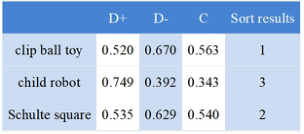
Calculate the Euclidean distance between the two ends of the clip ball toy, children’s robot, and Schulte grid, calculate the relative proximity, and sort them; the greater the relative proximity, the closer it is to the optimal solution.
According to the sorting results, it can be concluded that the first solution, the clipped ball toy, was better than the other two solutions.
CONCLUSION
To design products that focus on cultivating attention in preschool children, exploring the developmental characteristics of attention and using the AHP method to analyze the related factors that affect attention levels is neces- sary. This study proposes a comprehensive evaluation method for products designed to cultivate attention in preschool children using the AHP-TOPSIS method, which establishes an evaluation system for 12 key factors at physi- ological, psychological, and environmental levels. This method can be used
120 Yan and Chen
to evaluate and rank multiple fuzzy-oriented products for cultivating atten- tion in preschool children, providing a reference for evaluating and selecting design plans for products related to attention with practical applications and theoretical value.
REFERENCES
Mathis, Erin TB, and Karen L. Bierman. “Dimensions of parenting associated with child prekindergarten emotion regulation and attention control in low-income families.” Social Development 24.3 (2015): 601–620. Ridderinkhof, K. Richard, and Odin van der Stelt. “Attention and selection in the
growing child: views derived from developmental psychophysiology.” Biological psychology 54.1–3 (2000): 55–106. Sung, Valerie, et al. “Sleep problems in children with attention-deficit/hyperactivity disorder: prevalence and the effect on the child and family.” Archives of pediatrics & adolescent medicine 162.4 (2008): 336–342.
Read this individual research paper free through the original publisher, or explore the full digital proceedings book.
ISBN 978-1-958651-87-2
Explore this ISBN in the AHFE Bookstore ↗Listed in the July 2026 bookstore catalogue; search by ISBN to confirm current availability · Digital book purchase optional