Ziyan Dong, Li Xu (2023). Product Design to Effectively Alleviate Emotional Exhaustion Caused by Long Hours of Digital Interactive Work. In: Human Interaction & Emerging Technologies (IHIET 2023): Artificial Intelligence & Future Applications. AHFE Open Access, vol. 111, pp. 130–138. https://doi.org/10.54941/ahfe1004017
With the rapid development of the Internet, more and more people must use electronic devices such as computers to do their work digitally and interactively. We have observed that employees who work with computers for long periods of time may be resistant to electronic devices. In previous studies, the specific sources of this resistance and the factors influencing it have not been clearly identified. The purpose of this article is to study the emotional exhaustion caused by prolonged digital interactive office work, analyze the antecedent space leading to this emotional exhaustion, reveal the psychological mechanism of the fatigue process, and further explore product design research that effectively alleviates the emotional exhaustion caused by computer office work in the Internet era.Methods: The design investigates the non-experimental, cross-sectional correlation. We administered an online questionnaire to participants. Participants had to be people who use computer offices for long periods. The questionnaire contained questions related to emotional states (depression, anxiety, etc.) and certain concomitant behavioral manifestations (overexertion, avoidance, excessive rest, etc.). At the same time, the intensity of the participants' perceived fatigue was statistically assessed with the help of the Fatigue Scale. In the data analysis, we adjusted for individual characteristics, work nature, and work environment in order to explore the antecedent space of emotional exhaustion.Conclusion: The analysis of the data obtained from the questionnaire showed that there was a positive correlation between the time users spent working on computers and emotional exhaustion. Most participants had emotional exhaustion accompanied by physical fatigue. In addition, in the subgroup analysis, we found that emotional exhaustion caused by long hours of computer work was influenced by factors such as work environment atmosphere and complexity of work content. This study helps us to find the direction of product design research to alleviate emotional exhaustion. Employees who work with computers for long hours need adequate rest time and. If necessary, a certain degree of psychological intervention. Based on the above results, the research and design are closely integrated with the psychological and physiological needs of the computer office group. The design principles for products to alleviate emotional exhaustion are summarized in order to design products that can improve the quality of life of people who use digital interactive work for long periods. At the same time, the relevant product design can somehow guide people's behavioral activities and work styles in specific scenarios, meet the needs and services of the business, explore its potential market advantages, and better enhance the quality of people's office environment in the future.
Product Design Study to Effectively Alleviate Emotional Exhaustion 131
INTRODUCTION
In the occupational literature, fatigue is “a response of vulnerable individu- als to high demands or workload and an inability to meet individual goals” (Hardy, 1997), while in clinical research, it refers to “subjective, unpleasant feelings of tiredness that have multiple dimensions varying in duration, unple- asantness, and intensity” (Piper, 1989). When we concentrate on one thing for a long time, we usually feel tired. Medically speaking, exhaustion features as a core symptom in various diagnostic categories including melancholia, nervousness, neurasthenia, depression, chronic fatigue syndrome (CFS or ME) and burnout. Yet these diagnostic categories are not simply synony- mous with exhaustion: most of them combine exhaustion with a range of other symptoms. Exhaustion may be the consequence of other symptoms or else their cause. It is striking that we rarely find discussions of exhaustion in its pure form in the medical literature but generally encounter it embedded in more complex symptom clusters, the constellations and names of which are subject to change and which are in themselves already revealing (Schaffner, 2016). There are three types of fatigue. Normal fatigue: it is related to labor intensity and working time. The greater the labor intensity, the longer the working time, and the deeper the degree of fatigue. Fatigue in case of physi- cal diseases: a variety of physical diseases can cause physical strength and energy consumption, manifested as fatigue. This fatigue is a symptom of physical diseases, and when the condition improves, the fatigue will also disappear slowly. Emotional exhaustion: this kind of fatigue is closely rela- ted to unpleasant emotions, mainly caused by long-term mood tension, worry, bitterness, and depression, rest cannot eliminate this kind of fatigue, and only when the mood is comfortable, the fatigue will slowly disappear. It is a symptom, and there is usually no serious discomfort. Emotional exhaustion is associated with laxity and leads to laziness. Emotional exh- austion is unlikely to persist over time unless it is secondary to a physical illness. Because the concept and the status of fatigue are ambiguous, phe- nomena in which fatigue is prominent, such as depression, irritability, and depressed mood, are often considered to be a chain reaction resulting from fatigue.
Some sociologists even see exhaustion as a positive social phenomenon. Exhaustion was caused by the very processes that characterized the modern age—recent technological inventions, the faster pace of life, a shift from physical to intellectual labour—being exhausted could be seen as a positive quality (Schaffner, 2016). However, emotional exhaustion is related to peo- ple’s mental activities. However, while there is a growing body of research on fatigue, there is no clear idea of the mechanisms underlying individual psychological changes.
Emotional exhaustion is different from physical fatigue caused by conti- nuous work and energy consumption of the body. Many factors (complex information bombardment, space congestion, noise, bad working conditi- ons, illness, family discord, interpersonal tension, career setbacks, etc.), are also important factors to induce emotional exhaustion. Psychological fatigue often has the nature of subjective experience and is not completely a reflection of changes in objective physiological indicators.
132 Dong and Xu
Advanced information and communication technologies (ICTs) have become increasingly prevalent in companies and are revolutionizing work habits (Vayre, 2019). Despite the negative consequences of problematic internet use, the internet is of necessity for many people in modern times, especially for particular groups. For example, college students and highly educated adults use the internet more frequently than other populations (Vicente, 2013).
The literature on the effects of using electronic interactive technology for office work in the workplace reveals conflicting results. Several stu- dies have found that these technologies improve operational management and decision-making communication within organizations, and change work environments and management styles.It can get rid of the limit of time and space, thus increasing the employee’s autonomy and flexibility. Nevertheless, several studies have shown that more and more employees complain of an increase in workload, a longer workday, and feeling overloaded and ove- rwhelmed (Thomas, 2014). As far as consequences are concerned, some studies have shown that long hours of digital interactive work has a detri- mental effect on both the physical and mental health of employees. In many cities, especially first-tier cities, many employees need to work in front of electronic-interactive products for a long time. What’s more, many employees feel physically and mentally exhausted due to the unscienti- fic and uncontrolled overtime system. Long hours working digitally often leave them in an unhealthy mood. This resistance is a sign of emotional exhaustion that can manifest differently in different situations.The work is in a state of stress for a long time, and people begin to have job burnout.
Due to the negative consequences of emotional exhaustion on employees, enterprises, and the whole society, we began to study the causes of employee fatigue. Some situational factors are taken into account. Fatigue, however, is a personal cognitive and emotional state. We do not have a deep understan- ding of the impact of fatigue in terms of employee differences and external factors. The main objective of this study was to explore how internal and external factors are associated with emotional exhaustion through electronic interactive working.
MATERIALS AND METHODS
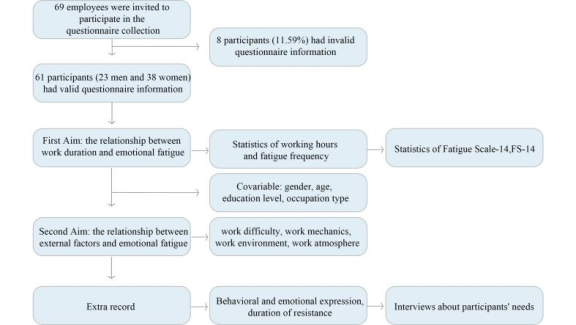
Given our research objectives, we conducted a study among office workers who use computers for their work. We looked for employees working in different cities and focused more on employees working in Internet-related industries. A total of 69 participants completed the online survey. Partici- pants must use a computer daily. After excluding invalid data (n = 8), the final sample eligible for the primary analysis consisted of 61 participants (see Figure 1).
The questionnaire survey was used to get the statistics on the length of the participants working with a computer. It also recorded how often the parti- cipants felt tired. The fatigue state of participants was obtained by Fatigue Scale-14. Fatigue has always been a difficult symptom to define and describe, especially the subjective feeling of fatigue. Among them, 1 to 8 was physical fatigue. 9 to 14 was mental fatigue, a total of 14 points.
Product Design Study to Effectively Alleviate Emotional Exhaustion 133
Figure 1: The main research model of the study.
The survey included information on the participants’ gender, age, and education level. As an indicator of personally identifiable information, we classified the occupation type of the participants. Of course, because the study is about digital-Interactive work, we prefer the Internet industry when recruiting participants. At the same time, we calculated the educational level of the participants: high school and below, undergraduate, graduate, and above. The above information is an individual factors, not the main research content, but it still affects the experimental results.
And in the subgroup analysis, we studied the related factors that may have an impact on the fatigue state of the participants, to find the intermediary factors of fatigue degree. It includes work difficulty (simple or complex), work repeatability (mechanical repetition or need for innovation), work envi- ronment (separate office or public environment), and work atmosphere (free or serious).
At the same time, we measured the behavioral and emotional performance of the participants in the face of emotional exhaustion. We collected data on the persistence of resistance, or the tipping point of emotional exhaustion, and measured the direction of resistance to mobile phone use. These data can help us understand the psychological mechanism of emotional exhaustion in participants, and help us find the optimal plan to relieve emotions.
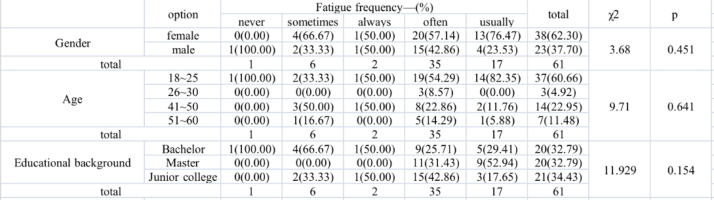
DATA ANALYSIS First, descriptive statistical distributions of all covariates at five levels of fatigue (“never”, “sometimes”, “often”, “usually”, and “always”) were analyzed (see Figure 2). The scale includes information on gender, age, and literacy. According to the information obtained from the data, the p-value was more than 0.05, and there was no established correlation between age, gender, and education level and the perception of fatigue.
We then measured the physical and mental fatigue scores on the fatigue scales the participants filled out. We found that physical fatigue and mental fatigue generally occur together. In the analysis, we took the median working
134 Dong and Xu
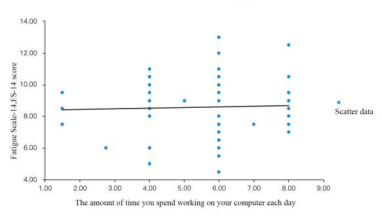
Figure 2: Cross (chi-square) analysis.Figure 3: Scatter plot of the time spent and the fatigue scale.
time interval as the node (“3 ∼5h” is counted as “4h”). Since there are few statistics, we use the scatter plot to see the changes more intuitively (see Figure 3). With the increase in working hours, the score on the fatigue scale increased gradually, and the two show a positive correlation.
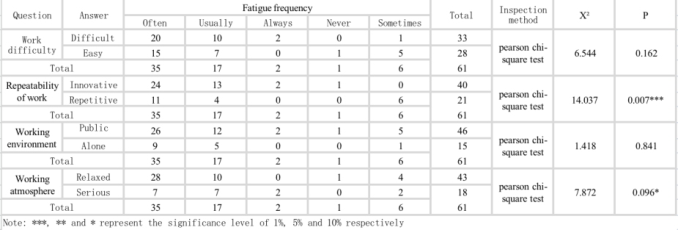
The person Chi-square test was used to study the differences in fatigue frequency -- work difficulty, work repetition, work environment, and work atmosphere (see Figure 4). It can be seen that different fatigue frequencies samples do not show significant effects on work difficulty, work environment, and work atmosphere (p > 0.05). The P-value of the pearson Chi-square test between work repetition and fatigue frequency was 0.007***, showing a significant difference. The results of effect quantification showed that the Cramer’s V value of the analysis item (job repetition) was 0.48 (see Table 1), so the degree of difference between job repetition and fatigue frequency was moderate.
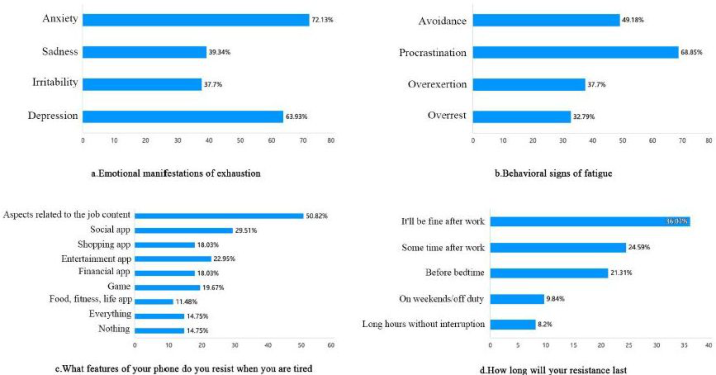
We measured the participants’ behavior and emotions when they were tired (see Figure 5). The choices were: “avoidance, procrastination, overexertion, over rest”and “anxiety, depression, irritability, depression.” According to the questionnaire, when the participants were tired, the most common behavior was procrastination (42 people, 68.85%), and the most common emotions were anxiety (44 people, 72.13%) and depression (39 people, 63.93%).
We conducted an additional analysis to explore which aspects of mobile phone use dominated participants’ resistance and how long it lasted. To fur- ther investigate the differences between Internet use (see Figure 5). More than half of people are reluctant to engage in work-related activities after work, with social activities coming in second. About 36.07 percent of participants
Product Design Study to Effectively Alleviate Emotional Exhaustion 135
Figure 4: Emotional exhaustion and chi-square test of related factors.Table 1. Quantitative analysis of effect.
Table available in the original PDF paper.
Analysis item Phi Crammer’s V c coefficient lambda Work difficulty 0.328 0.328 0.311 0.179 Repeatability of work 0.48 0.48 0.433 0.286 Working environment 0.152 0.152 0.151 0 Working atmosphere 0.359 0.359 0.338 0.111
Figure 5: Four statistical charts.
said the resistance would disappear after work, and more than half said it would last for a while.
In terms of emotional exhaustion, we used an event-perception view.Integrate the influence of environmental situation and individual dif- ference on the psychological stress of the subjects (Sheng, 2023). We inte- rviewed 60 participants who felt tired. We set up three specific scenarios: “Weekday afternoon, you’re tired, you want something to help you,” “Where do you want this product to help you,” “Where do you want this product to help you,” to understand the psychology of the user. According to the conversation, 78.69% of the users want to take a break. The options for
136 Dong and Xu
stress relief and entertainment are also high. According to the data, in terms of product demand, users prefer products to help them relieve physical fati- gue and psychological pressure. We’ve noticed that users are more willing to make changes from their state. In the concrete interview of the subjects, people often mentioned the friends we could talk to, the massage chair, and the psychologist, which provided new ideas for our research.
DISCUSSION
Through the above research, we find that in the face of digital interactive work, employees show the dual fatigue phenomenon of physical fatigue and mental fatigue. Less than a third of participants’ emotional exhaustion disap- peared immediately after work, and some participants’ emotional exhaustion continued into the weekend. And most of the participants were unwilling to use their phones for socializing and work-related activities after work. In addition, in the subgroup analysis, we found that the repetition rate of com- puter office work was correlated with the frequency of fatigue and that people who engaged in creative electronic interactive work were more likely to expe- rience fatigue. This study is helpful for us to find the direction of product design to alleviate emotional exhaustion. Employees who work in front of computers for a long time need sufficient rest time. If necessary, they need to accept a certain degree of psychological intervention. Make clear the psych- ological and physiological needs of the computer office group, and combine the research and design closely.
Information overload and system features overload can significantly deplete users’ available resources, posing a threat to or causing a loss of resources, resulting in stress and a high level of emotional exhaustion. When experiencing information overload, users tend to receive and process an excessive amount of information than they can handle, resulting in conti- nuous depletion of psychological resources. According to the COR theory, resource depletion, threats, and reduced returns on investment all have nega- tive effects on an individual’s mental and physical health. The aforementioned loss and the lack of investment caused by social media may result in users’ emotional disorders or even exhaustion, which in turn creates a behavioral tendency to refuse to use social media (Sheng, 2023). According to the above logic, a long period of electronic-interactive work can be used as a mediator to link emotional exhaustion with indirect influencing factors.
Based on the previous information, we propose the following design pri- nciples and ideas. Interactivity principle: coordinate the relationship between users, products, and spaces. Find design opportunities in specific scenarios, and find a comfortable and healthy balance between users and space. For peo- ple who work alone and in public areas, the need for environmental change is different. For the public area office, the product design should take more into account privacy and harmony and not affect others. The principle of ease of use: the essence of the existence of office fatigue relief products is to provide users with office and life convenience. The product should not be too complicated in form, and the information conveyed to the user in the form of the product should be simple and direct. Let the user’s operation become an
Product Design Study to Effectively Alleviate Emotional Exhaustion 137
unconscious act and reduce the sense of burden brought to the user by lear- ning. Especially in the face of this study, the user with long hours of computer work should no longer become an emotional burden. Directivity principle: Directivity means that products with specific functions should be designed for a fixed purpose, reducing unwanted factors that hinder users’ judgment. There is no need for overly redundant features, thus making the purpose of the user’s use more clear.
In terms of functions, our interviews showed that more participants wan- ted the product to help them relieve physical and mental fatigue, followed by companionship functions. Emotional products should be used more in office space. Alleviating psychological fatigue and resistance of employees can also bring higher work efficiency for enterprises to a certain extent. Therefore, more psychology can be applied to the design process.Empathy theory is the main psychological basis for design to reflect value “value resonance”, and is an important design theoretical foundation framework and the scientific method to guide the development of design thinking as a whole. The the- ory of value and empathy is to synchronize the value perception process and emotional activities of both the social subject and the object of the design subject, forming a state of mind in which they can perceive and experience each other’s empathy. Designers need to realize this state of mind before they can fully satisfy the needs of social clients and social people in a particular field in the overall design thinking of design creation (Junliang Chen, 2022). For users with emotional exhaustion, we should pay more attention to their psychological changes, empathize with users and find pain points.
The strength of this study lies in the diversity of its study population, which includes both men and women, representing different socioeconomic groups. Also, we used a fatigue scale to calculate the fatigue level of participants, making the data more intuitive and valid. Our study was also enhanced by subgroup analysis, which included different external factors and facili- tated the finding of relevant influences that affect emotional exhaustion. In addition, unlike previous studies, we investigated participants’ duration of resistance and specific functions while using the phone, which made it easier to find entry points for healing product design.
The main limitation of this study is related to the small size of the statisti- cal population. The number of participants in the questionnaire was 69, with a final valid count of 61. The small number of participants in the experiment does not allow for an objective assessment of the benefits. In order to thorou- ghly verify the validity of the conclusion, more employees should be involved in the investigation in future work. And update the data results to the relevant conclusions. Second, the article used a cross-sectional survey, which could not examine the temporal relationship between emotional exhaustion and work and the change in participants’ moods in the next phase.
CONCLUSION
In general, there was a positive correlation between the amount of time users spent working on computers and emotional exhaustion. Emotional exhau- stion was also associated with physical fatigue in most participants. The
138 Dong and Xu
study found that the emotional exhaustion caused by long hours of com- puter work was affected by the working environment, the complexity of the work content, and other factors. Among them, job repetition has a significant difference, innovative work is more likely to cause people’s resistance. There- fore, employees who face computer work for a long time need sufficient rest time. If necessary, they need to accept a certain degree of psychological inte- rvention. According to the above results of analysis and induction, combined with the computer office group’s psychological and physiological needs, the research and design are closer together. To help users relieve the emotional exhaustion, we put forward three design principles: interactivity, usability, and directivity. Meanwhile, we should strengthen the research on psycholo- gical empathy with users. As a direct implication of the results of this study, relevant product design can, to some extent, guide people’s behavior activi- ties and working methods in specific scenes, meet the needs and services of the business, explore its potential market advantages, and better improve the quality of people’s office environment in the future.
ACKNOWLEDGMENT
Ziyan Dong is the first author. She has contributed to the term, concept actua- lization, and investigation. She has contributed to writing, methodology, and formal analysis. Li Xu is the second and corresponding author. She is respon- sible for ensuring that the descriptions are accurate. She has contributed to conceptualization and validation.
REFERENCES
Hardy, G. E., Shapiro, D. A., & Borrill, C. S., J. (1997). Fatigue in the workforce of national health service trusts: Levels of symptomatology and links with minor psychiatric disorder, demographic, occupational and work role factors. Journal of Psychosomatic Research. INCOSE INSIGHT Volume 43 No. 1. pp. 83–92. Junliang Chen, J. (2022). Research on Product Design Based on Design Psycho-
logy. Footwear Technology and Design. INCOSE INSIGHT Volume 2 No. 14. pp. 37–40. [in Chinese]. Piper, B. F., Rieger, P. T., Brophy, L., Haeuber, D., Hood, L. E., Lyver, A., & Sharp, E. (1989). Recent advances in the management of biotherapy-related side effe- cts: Fatigue. Oncology Nursing Forum. INCOSE INSIGHT Volume 16 No. 6. pp. 27–34. PMID: 2480583. Schaffner, A. K. (2016). Exhaustion and the Pathologization of Modernity. J Med
Humanit 37. pp. 327–341. Sheng N., Yang C., Han L., Jou M. (2023). Too much overload and concerns: Antecedents of social media fatigue and the mediating role of emotional exhaustion. Computers in Human Behavior. INCOSE INSIGHT Volume 139, art. 107500. Thomas, K. J. (2014). Workplace Technology and the Creation of Boundaries: The
Role of VHRD in a 24/7 Work Environment. Advances in Developing Human Resources. INCOSE INSIGHT Volume 16 No. 3. pp. 281–295. Vayre, E., & Vonthron, A.-M. (2019). Identifying Work-Related Internet’s Uses—at Work and Outside Usual Workplaces and Hours—and Their Relationships With Work–Home Interface, Work Engagement, and Problematic Internet Behavior. Frontiers in Psychology. INCOSE INSIGHT Volume 10. Vicente, P.; Reis, E. (2013). The “frequency divide”: Implications for internet-based
surveys. Qual Quant. INCOSE INSIGHT Volume 47. pp. 3051–3064.
Read this individual research paper free through the original publisher, or explore the full digital proceedings book.
ISBN 978-1-958651-87-2
Explore this ISBN in the AHFE Bookstore ↗Listed in the July 2026 bookstore catalogue; search by ISBN to confirm current availability · Digital book purchase optional