Li Xu, Ao Yu, Yuquan Zhou, Xiaoxuan Jiang (2024). Design Strategies of Outdoor Fitness Equipment for Elderly Community Based on KJ Method and KANO. In: Human Factors in Aging and Special Needs. AHFE Open Access, vol. 133, pp. 168–177. https://doi.org/10.54941/ahfe1004905
The global aging phenomenon is becoming increasingly serious, as is the case in China. In order to enable the elderly to have better physical fitness, daily outdoor fitness activities are essential. However, the current outdoor fitness equipment in the communities has some problems, which cannot provide support for the fitness of the elderly and may even pose potential safety hazards. The subjects of this study are elderly people with outdoor activities abilities. Older adults often turn to fitness equipment within their closer community as their first choice for fitness. The specific research process is as follows: firstly, information on outdoor fitness behaviors and the environment of the elderly in the community were collected through non-structured observations, user interviews, and questionnaires. The researchers used the KJ method to sum up and summarize the behavioral habits of outdoor community elderly fitness equipment, personalized needs and opinions on existing products, and sorted out the data on users' cognition, tendencies, behavioral styles and needs. They also segment the raw demand data into five types: appearance demand, functional demand, ease-of-use demand, psychological demand, and safety demand. Secondly, encode and integrate the raw demand categories and product functions according to each original category. Next, design a questionnaire using the KANO model to survey the 2nd Level functional indicators based on the original requirements and product features. The satisfaction levels were categorized as Expectation, supposed to be so, dispensable, reluctant acceptance, and dissatisfaction. The main target of the questionnaire survey was the elderly group over 60 years old who use outdoor fitness equipment for exercise in the community, and the sample size was 120. We conduct a questionnaire survey of the target users, collate the data information obtained from the research, and the original demand data of the target users for both positive and negative aspects of the level 2 functional indicators. After obtaining the user demand degree data, the raw data needs to be processed using the KANO model to obtain the demand type of each function and calculate its demand degree index. User evaluation can be classified into six functional attributes based on the KANO model: Must-have demand indicator (M), Expected demand indicator (O), Excited demand indicator (A), Undifferentiated demand indicator (I), Reversed demand indicator (R), and Questionable demand indicator (Q). After obtaining the basic functional priorities, and then the satisfaction index formula is used to calculate the satisfaction and dissatisfaction coefficients for each demand indicator. The formula is: Satisfaction coefficient = (A+O)/(A+O+M+I),Dissatisfaction coefficient = [(O+M)/(A+O+M+I)] × -1.Finally, the results of the calculation are introduced into the design of community outdoor fitness equipment, and the function modules with higher demand values are given priority in the design to obtain community outdoor fitness equipment that meets the use of the elderly.This study aimed to assess the needs of the elderly community and their satisfaction with outdoor fitness equipment. Based on the findings, suitable equipment was designed to improve their physical fitness.
Population ageing has become a major problem facing human society in the twentieth century. According to population data published by the National Bureau of Statistics, China is now the world’s largest country with an elderly population (Jakovjevic et al., 2021). It is obvious that the elderly population base is huge and the health of the elderly should also be taken seriously. The
Design Strategies of Outdoor Fitness Equipment 169
quality of life of the elderly is affected by the increased probability of illness due to the continuous deterioration of their physical functions and immunity (Marcos-Pardo et al., 2023). Fitness as a strengthening of the elderly has gained the attention of the general elderly population (Paudel et al., 2024). However, the actual use of public fitness facilities in the community is far from satisfactory, and most of them are poorly positioned for the use of the population, the equipment is homogenized and some of the equipment is also subject to potential safety hazards. These problems seriously undermine the motivation of middle-aged and elderly people to participate in the process of physical exercise. Traditional design has limitations in accurately capturing the true needs of older adults, while the KJ method and Kano, as a scientific method used in the product design process, can accurately analyze user needs and obtain user satisfaction, providing ideas for solving this problem and arousing new thinking among the public (Veiltch et al., 2020).
RESEARCH METHODS FOR OUTDOOR FITNESS EQUIPMENT FOR OLDER PEOPLE IN THE COMMUNITY The KJ analysis method, also known as the A-type diagramming method and affinity diagramming method, is a quality management tool proposed by Japanese scholar Jiro Kawakita. It is a rigorous and scientific methodology, which aims to systematically collect, integrate, deeply analyze and reanalyze the relevant facts, ideas and insights of the unknown areas of the research object, and to show its inner complex relationship through a reasonable form of illustration. In applying the KJ method, the first step is to identify the target user groups, and then conduct detailed research and analysis in order to accurately capture their core needs. Then, record the demand points in text form, and conduct in-depth thinking and analysis to reveal the potential connection between them. The information is then organized and categorized to form a clear classification and merger diagram. In this way, we can grasp the essence of the problem through the phenomenon and find the optimal path to solve the problem (Yuan et al., 2021).
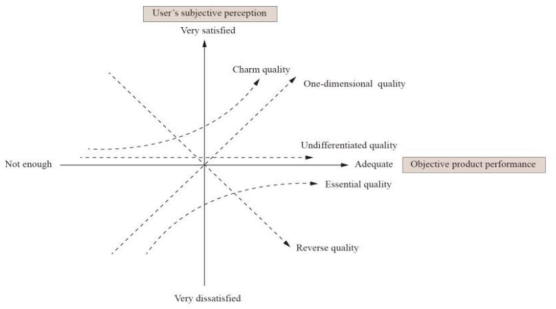
Figure 1: Kano model.
The Kano model was developed by Noriaki Kano, a professor at Tokyo University of Technology, Japan (Salahuddin and Lee 2021). The model accurately represents the relationship between product functionality and user satisfaction, and classifies the quality elements that affect customer satisfac- tion into the following five categories based on the scoring results: Reverse quality (R), Undifferentiated quality (I), Essential quality (M), Onedimen- sional quality (O), and Charm quality (A) (see Figure 1). In the Kano model, the user requirements are set up with two opposite questions, i.e., the degree of satisfaction of the user with and without the quality element, and each quality element has five options: favorite, inevitable, not matter, acceptance, and dislike, and the type of each requirement element is analyzed based on the user’s scores (Liu and Wang, 2022).
CURRENT STATUS AND PROBLEMS OF RESEARCH ON OUTDOOR FITNESS EQUIPMENT FOR THE ELDERLY IN THE COMMUNITY Community elderly care is the main elderly care model in my country. Due to the openness, gathering, and fitness of community fitness equipment, it has become one of the main places for outdoor activities for the elderly. At present, my country’s research on outdoor fitness equipment still has shortcomings. The existing public fitness facilities in the community lack innovation in the design of structure, shape, color, and material, do not analyze the pain points and difficulties in the fitness process of the elderly, and cannot truly meet the real needs of the elderly group. There is still a long way to go in the research on fitness equipment suitable for aging in the community in our country. The real needs of the elderly should be fully con- sidered in future designs, and we strive to contribute to the research on fitness equipment suitable for aging in our country.
PRODUCT DESIGN ANALYSIS BASED ON THE KJ METHOD AND KANO MODEL The product functional design method based on the KJ method and KANO model is proposed for the user needs. Firstly, the KJ method is applied to explore the potential needs of users and categorize their complex needs into an ordered and internally related list of product features for users. Then uses its list of functions to design the KANO questionnaire, and then the model is processed for the requirements to derive the coefficient of satisfaction and dissatisfaction of the users of the product functions. Finally, the relationship between user demand indicators, product functionality, and user satisfaction was derived, providing a basis for the subsequent design of age-appropriate community seniors (Lin and Chen, 2018).
The 5 steps of the process of obtaining the list of product features required by the user through the KJ method are as follows:
1. Selection of interviewed groups: Respondents were identified for inter- views, and the group of respondents consisted of older adults who can care for themselves in their daily lives, family members of older adults, and designers in the field of age-friendly design.
Design Strategies of Outdoor Fitness Equipment 171
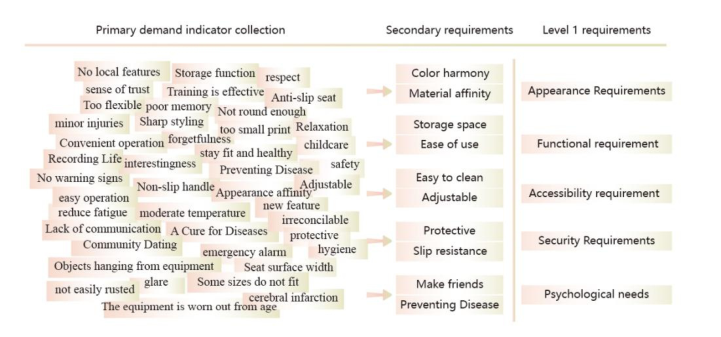
2. Establishment of the format of the visit: A combination of questionnaires, telephone interviews, and in-depth interviews to gather the real needs of users. 3. Collection of interviewed information: Respondents were told to discuss the topic of designing age-friendly products for outdoor fitness equip- ment in the community and to use brainstorming to gather and record information. 4. Hierarchical categorization information: Classify the collected informa- tion in an orderly manner, search for the potential relationship between the information, eliminate the content of cards with similar content, and merge similar needs to form a group of the same type, i.e., the “three-level demand indicator”; Then categorize upwards, i.e., “secondary demand indicators”; Using the same methodology, they are categorized into broad groups, i.e. “Tier 1 demand indicators”. 5. Building a list of requirements: The list of needs was established to cap- ture the concrete needs of seniors when it comes to outdoor fitness. The research of the Bay Area Hai Shang Shulin citizens Puzzle Fitness Court point, the famous home fitness point, Xuhui Street fitness point, and other communities to carry out research, through the research of the total number of questionnaires recovered a total of 108, the validity of the questionnaire 100 questionnaires, the questionnaire validity rate of 92 percent. The KJ method is used to filter and transform user needs, pain points, and future ideas into initial demand indicators and collate them, and finally collate the cards to make a list of functional requirements for aging outdoor fitness equipment, which contains five first-level demand indicators, including appearance requirements, functional requirements, accessibility requirements, psychological needs, and security requirements (See Figure 2).
Figure 2: Classification of the KJ method.
The 3 steps of the process of obtaining satisfaction with product features through the kano model are as follows:
1. Design a Kano questionnaire based on product function
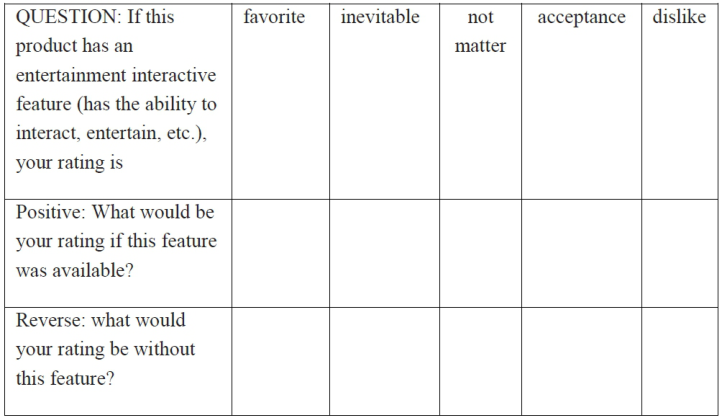
Based on the list of product requirements and the list of product fea- tures, a questionnaire was designed based on the Kano model to ask questions on the secondary indicators. To get the different perspectives of older people on each feature, the questionnaire was divided into 2 dimensions, i.e., users’ attitudes towards the product when it has a certain feature and when it doesn’t have a certain feature were comprehensively explored. The answer to this question is to set up the option to “Classify the level of satisfaction into five levels: favorite, inevitable, not matter, acceptance, and dislike”. The list of functions in the questionnaire was illustrated with textual or pictorial explanations to facilitate the respon- dents’ clear perception of certain structural functions and to facilitate the elderly understanding of the questions (See Figure 3).
Figure 3: Kano model questionnaire.
2. Obtaining Sample Information
The main target of the questionnaire survey is the elderly group over 60 years old who are familiar with the outdoor fitness equipment in the com- munity and have used it, as well as the family members of the elderly. 150 questionnaires were distributed in total, and 24 invalid questionnaires were excluded (e.g. 24 invalid questionnaires (such as choosing “satis- fied” or “dissatisfied” for all the questions), and 126 valid questionnaires were recovered, with a validity rate of 84 percent.
3. Analysis of acquired data
According to the standard table of Kano model survey results (see Table 1), the data analysis of valid questionnaires was conducted to obtain a quantitative table of survey results analysis of each functional requirement of outdoor fitness products. In Table 3, M is the essential demand indicator, O is the one-dimensional demand indicator, A is the
Design Strategies of Outdoor Fitness Equipment 173
charm demand indicator, I is the undifferentiated demand indicator, R is the reverse quality indicator, and Q is the suspicious demand indicator.
Calculations by SPSS resulted in a categorical evaluation of the attribution of each functional requirement for outdoor fitness products (see Table 2). It can be seen that the essential needs of outdoor fitness products are non-slip function, rounded shape, and non-glare color. the Onedimensional demand for outdoor fitness products is lighting function.; glamour type needs of out- door fitness products are storage function, multiple functions, entertainment interaction, size adjustment, fatigue relief, massage function, and material affinity; On-differentiated needs of outdoor fitness products are lost and found easy-to-clean materials, and angle restrictions.
Table 1. Kano model survey results criteria.
Table available in the original PDF paper.
Users’ Attitudes Towards Demand
Outdoor Fitness Equipment in the Community Has a Certain Function favorite inevitable not matter acceptance dislike
Outdoor fitness equipment in the community does not serve a particular function
After the attribution classification of fitness equipment requirements, the demand satisfaction index SSI and dissatisfaction index DDSI analyses are car- ried out, and the SSI and DDSI are calculated to show the extent to which achieving this functional requirement has an impact on increasing satisfaction or eliminating dissatisfaction, as shown in Equation (1).
SSI = (SA + S0(SA + S0 + SM + SI) DDSI = [(S0 + SMSA + S0)(SA + S0 + SM + SI)] × −1 (1) According to the statistical results, the SSI and dissatisfaction DDSI results for each functional requirement of outdoor fitness products were obtained (see Table 2).
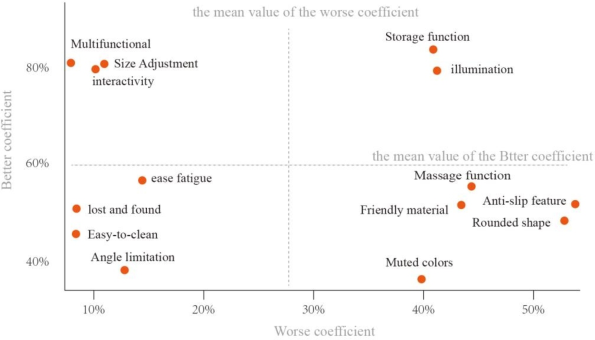
According to the statistical results, the results of satisfaction SSI and dis- satisfaction DDSI for each functional requirement of outdoor fitness products were obtained (see Table 2). Taking the mean value of SSI and DDSI as the crit- ical line, construct a four-quadrant scatter-plot of satisfaction with functional requirements of outdoor fitness equipment products with the satisfaction and dissatisfaction coefficients as the vertical and horizontal coordinates respectively, and obtain a four-quadrant scatter-plot of satisfaction with each functional requirement of the product (see Figure 4).
Table 2. User demand attribute analysis.
Table available in the original PDF paper.
User Demand Kano Attribute SSI DDSI Anti-slip feature M 52.14% -53.85% Rounded shape M 48.72% -52.99% Muted colors M 36.52% -40% illumination O 80.17% -41.38% Storage function A 83.52% -41.03% Multifunctional A 81.9% -7.76% interactivity A 81.2% -11.11% Size Adjustment A 81.03% -10.34% ease fatigue A 57.26% -14.53% Massage function A 55.56% -44.44% Friendly material A 52.14% -43.59% lost and found I 51.3% -8.7% Easy-to-clean I 46.15% -8.55% Angle limitation I 38.26% -13.04%
Figure 4: Four-quadrant scatter plot of satisfaction with functional requirements of outdoor fitness equipment.
It can be seen that the larger the SSI value, that is, if the outdoor fitness equipment has a certain function, the stronger the effect of user satisfac- tion, the faster the satisfaction rises; the larger the DDSI value, that is, if the product does not have a certain function, the stronger the effect of user satisfaction will be reduced, the faster the satisfaction falls. According to the results of the quadrant scatter-plot distribution: Quadrant 1 shows a high SSI and high DDSI, indicating that consumer satisfaction will increase if outdoor fitness equipment is designed to provide storage and lighting functions, and vice versa. Those falling into Quadrant 2 present functional requirements with high SSI values and low DDSI values. This means that outdoor fitness equipment does not provide functionality, storage, and interaction without a decrease in user satisfaction, and if it does, there is a significant increase in satisfaction. Those that fall into Quadrant 3 present functional require- ments with low SSI values and low DDSI values, with fatigue relief, lost and found, easy-to-clean materials, and angle restriction functional requirements.
Design Strategies of Outdoor Fitness Equipment 175
These functions can be retained or deleted based on the overall design with- out excessive impact on consumer satisfaction. Those that fall into quadrant 4 present functional needs with low SSI values and high DDSI values. Mas- sage function, material friendliness, anti-slip function, rounded shape, and non-glaring colors are must-haves for the design, and consumer satisfaction is not revealed in these needs, but without providing these design features, the level of dissatisfaction rises dramatically.
EXPLORING THE DESIGN OF OUTDOOR FITNESS EQUIPMENT FOR THE ELDERLY IN THE COMMUNITY After an in-depth analysis of the outdoor fitness needs of the community’s elderly groups, we summarize and refine the targeted aging-friendly design strategies, aiming to provide specific guidance for the design of aging-friendly outdoor fitness equipment to meet the diversified needs of the elderly in the fitness process. At the same time, we will also be on the aging outdoor fitness equipment design program to explain in detail, the specific design strategy is as follows.
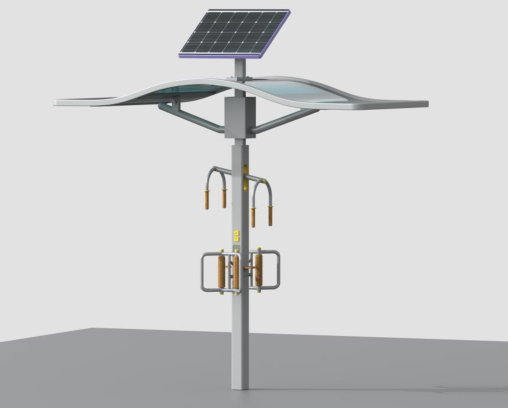
The design is carried out according to the prioritization principle of the Kano model requirements, Essential > Charming > Onedimensional > Non- differentiated, where the non-differentiated design requirements are not used as design references. When designing age-appropriate outdoor fitness equipment, priority should be given to meeting functional needs with high Better-Worse coefficient values. The ranking order of product functions in essential needs is: anti-slip function > rounded shape > color is not harsh; the ranking order of product functions in glamour needs is: storage function > multiple functions > entertainment interaction > size adjustment > fatigue relief > massage function > material affinity. The order of product functions in the expectation type demand is the lighting function. Firstly, when designing the outdoor fitness equipment based on the essential needs, the handle of the equipment is designed with non-slip function, and the friendly wood material is used. The colors are low saturation and the corners are rounded. Secondly, when designing the outdoor fitness equipment based on glamour needs, the equipment is equipped with a storage function on both sides, a High inter- active drop-down, and a solar-powered electric adjustable lumbar massage. In addition, the equipment is equipped with a lighting function based on the desired demand.
In general, as a public facility for the elderly in the community, the overall design of outdoor fitness equipment needs to show a simple and clear appear- ance, a stable and reliable structure, and an easy-to-understand operation method. While following universal design principles, we have deeply consid- ered the actual needs of different user groups, carefully selected appropriate materials from an ergonomic perspective, and optimized their use. Finally, we completed the product renderings of this outdoor fitness equipment, striving to provide a safe and comfortable fitness environment for the elderly (see Figure 5).
Figure 5: Product renderings of outdoor fitness equipment.
CONCLUSION
The KJ-Kano integration method is applied to the design process of com- munity fitness equipment for the elderly, which realizes the precise interface between user needs and product design, and thus results in the best design solution. This method effectively solves the problem of subjectivity and ambi- guity in the division of user demand attributes in traditional product design, significantly simplifies the complexity of information, and improves the accu- racy of information. By reducing the gap between users and designers, the KJ-Kano integration method successfully transforms users’ emotional needs into rational product design, ensuring that community fitness equipment can effectively meet the outdoor fitness needs of the elderly. In conclusion, the KJ-Kano design method based on the priority order of user needs as a reference will undoubtedly help to improve the design of outdoor fitness equipment in the aging community in the future.
ACKNOWLEDGMENT
I would like to thank the elderly people who actively cooperated with me during the research process.
REFERENCES
Jakovjevic, M. et al. ( 2021). Aging and Global Health. Handbook of Global Health: With 362 Figures and 152 Tables. Lin, X. and Chen, T (2018). A qualitative approach for the Elderly’s needs in service
robots design. ACM International Conference Proceeding Series, 2018. 67–72. Liu, Y. and Wang, W. (2022). Research on Quality Evaluation of Product Interactive Aging Design Based on Kano Model. Computational Intelligence and Neuroscience, 2022.
Design Strategies of Outdoor Fitness Equipment 177
Marcos-Pardo, P. J. et al. 2023. Physical and psychological effects of outdoor fitness equipment training on middle-aged and older adults: Study protocol of a randomised controlled trial. BMJ Open Sport and Exercise Medicine, 9. Paudel, C. et al. (2024). Designing outdoor fitness areas for older adults: A conjoint
analysis study. Leisure Studies. Salahuddin, M. and Lee, Y. A. (2021). Identifying key quality features for wearable technology embedded products using the Kano model. International Journal of Clothing Science and Technology, 33, 93–105. Veiltch, J et al. (2020). Designing parks for older adults: A qualitative study using
walk-along interviews. Urban Forestry and Urban Greening, 54. Yunk, Y. et al. (2021). Demand Analysis of Telenursing for Community-Dwelling Empty-Nest Elderly Based on the Kano Model. Telemedicine and e-Health, 27, 414–421.
LISTED IN THE AHFE DIGITAL BOOKSTORE CATALOGUE
Explore the complete digital volume
Human Factors in Aging and Special Needs
Read this individual research paper free through the original publisher, or explore the full digital proceedings book.
ISBN 978-1-964867-09-0
Explore this ISBN in the AHFE Bookstore ↗Listed in the July 2026 bookstore catalogue; search by ISBN to confirm current availability · Digital book purchase optional