Justine Caylor, Robert Hammell (2022). Dynamic Multi-Criteria Decision-Making for Identifying Vulnerable Communities for Emergency Planning. In: Intelligent Human Systems Integration (IHSI 2022): Integrating People and Intelligent Systems. AHFE Open Access, vol. 22. https://doi.org/10.54941/ahfe1001019
Effective decision-making is critical for emergency planners before, during, and after emergencies or disasters. Making a timely decision in these situations is complicated and dynamic, presenting conflicting criteria amongst numerous alternatives. This work proposes augmenting the Multi-Criteria Decision-Making (MCDM) hybrid methodology of AHP-TOPSIS with dynamic-case handling (DCH) calculations. This method is evaluated with an illustrative example of three interrelated scenarios that rank ten counties based on vulnerability related to the COVID-19 pandemic. Empirical results demonstrate that the AHP-TOPSIS method coupled with DCH calculations is a realistic decision-making approach.
Intelligent Human Systems Integration (IHSI 2022): Integrating People and Intelligent Systems https://openaccess.cms-conferences.org/#/publications/book/978-1-7923-8988-7
INTRODUCTION
Each year, numerous major emergencies are recorded in the United States. These emergencies range from hydro-meteorological natural disasters (i.e. hurricanes, floods, tornados) to epidemiological incidents (i.e. 2019 COVID-19 pandemic). These events can cause life-changing physical and economic impacts for years, especially to the most vulnerable communities. It is critical that effective, realistic, and timely decisions are made before, during, and after emergencies. Decision- making for emergency planners can be difficult and complex due to the many dynamically changing factors. Therefore, a decision-making framework that can aid in these emergency decision tasks and be adjustable for the dynamic nature of these settings is needed.
The work explores using dynamic multi-criteria decision-making, specifically dynamic AHP-TOPSIS, to assist in the decision-making process during emergency scenarios. The scenarios are related to the ongoing COVID-19 pandemic, with the goal of ranking the most vulnerable communities out of a set of 10 counties in the United States based on influential criteria. The dynamic method is compared with the ranks generated by the traditional method of AHP-TOPSIS without dynamic calculations.
The remainder of this paper is organized in the following four additional sections. Section Two provides a background on Multi-Criteria Decision-Making. Section Three provides details of the proposed methodology. Section Four presents and discusses the results. Concluding remarks are given in Section Five.
MULTI-CRITERIA DECISION-MAKING Multi-Criteria Decision-Making (MCDM) methods provide an algorithmic way of evaluating, prioritizing, and selecting the most optimal alternative from a set of available ones (Xu & Yang, 2001; Campanella & Ribeiro, 2011a, 2011b). A common method used in research involving complexity is a hybrid method that combines two or more MCDM methods to optimize the strengths and minimize weaknesses of the methods (Velasquez & Hester 2013). A popular combination is Analytical Hierarchy Process (AHP) and Technique for Order of Preference by Similarity to Ideal Solution (TOPSIS); AHP is used to elicit the criteria weights and TOPSIS ranks the alternatives.
While there are numerous MCDM methods that could be selected to address decision making in dynamic and complex environments; it can be a difficult task itself to determine which one(s) to use. Previous work proposed a taxonomy of 11 questions that can provide assistance to selecting an MCDM method (Caylor, Hammell, & Raglin, 2021). Based on the case study used for the work reported herein, AHP- TOPSIS was the hybrid method chosen.
AHP and TOPSIS
Intelligent Human Systems Integration (IHSI 2022): Integrating People and Intelligent Systems https://openaccess.cms-conferences.org/#/publications/book/978-1-7923-8988-7
AHP was developed by Thomas L Saaty (Saaty, 1977; Saaty, 1986; Saaty, 1988) and uses pairwise comparisons and judgments from experts to derive priority measurements (Saaty, 2008). AHP consists of three main parts: 1) hierarchically decomposing and breaking down the problem into criteria and sub criteria; 2) determining the priorities of the criteria and sub criteria; and 3) synthesizing the priorities to determine which criteria have the highest priority and should be acted upon to influence the problem situation (Saaty, 1990a; Wan et al., 2015). This allows decision makers to understand how their judgments affect the decision choice, and drives decisions that best suit their goal and problem understanding, versus making the “correct” choice (Wan et al., 2015). Space limitations prohibit a detailed discussion; see (Saaty, 2007; Saaty, 1990b; Ishizaka & Labib, 2014) for further information.
TOPSIS, presented by Hwang and Yoon in the 1980s, is based on the idea of minimizing the distance from the positive ideal solution and maximizing the distance from the negative ideal solution (Aruldoss, Lakshmi, & Venkatesan, 2013; Hwang & Yoon, 1981; Opricovic & Tzeng, 2004; Cui et al., 2011; Thor, Ding, & Kamaruddin, 2013; Singh & Malik, 2014). The closeness of the alternatives to the ideal solution is evaluated using Euclidean distance (Wolfe, 2018); by comparing the relative distances, the preference order of the alternatives is determined. Details regarding the method and its six calculation steps can be found at (Opricovic & Tzeng, 2004).
Dynamic MCDM As a way to capture dynamicity that real-world decisions present, especially in emergency situations, the standard MCDM method has been expanded upon into Dynamic MCDM (DMCDM). With DMCDM, the static rating values generated from traditional methods are aggregated with historical information to produce a new dynamic represented rating (Varela & Ribeiro, 2014). Following the aggregation methodology presented in (Campanella & Ribeiro, 2011b), this work adds the dynamic calculation to the static AHP-TOPSIS method using simple probabilistic sum. To go along with the mechanism of historical information, there is also a retention policy and stopping criterion included. The retention policy for the historical set allows alternatives to be carried over from iteration to iteration (Campanella & Ribeiro, 2011b). The stopping criterion is providing the indication that the decision process is over.
METHODOLOGY
Explanation of dataset The COVID-19 Community Vulnerability Index (CCVI) was created by Surgo Ventures that was inspired by and builds upon the CDC’s Social Vulnerability Index (SVI) with COVID-19 risk factors (Surgo Ventures, 2021). The seven factors that were considered in the CCVI as criteria for vulnerability include 1) socioeconomic
Intelligent Human Systems Integration (IHSI 2022): Integrating People and Intelligent Systems https://openaccess.cms-conferences.org/#/publications/book/978-1-7923-8988-7 status, 2) minority status & language, 3) household & transportation, 4) epidemiological factors, 5) healthcare system factors, 6) high-risk environments, and 7) population density. Percentile scoring ranges from 0-1 (least vulnerable to most vulnerable), and these scores are binned into five different categories: ‘very low’, ‘low’, ‘moderate’, ‘high’, and ‘very high’. In this study, the seven factors are used as the criteria for the proposed dynamic MCDM method.
The proposed method of utilizing AHP-TOPSIS coupled with DCH for identifying vulnerable communities was evaluated in a case study using information of ten counties that were rated as having the top COVID-19 related deaths (as of August 10th, 2021). The ten counties include Los Angeles (CA), Maricopa (AZ), Miami-Dade (FL), Cook (IL), Harris (TX), San Bernadino (CA), Kings (NY), Queens (NY), Bronx (NY), and Wayne (MI) (https://coronavirus.jhu.edu/us-map). These counties were selected based on their relevance to the ongoing emergency and their specific vulnerabilities.
DMCDM Approach When planning for actions before, during, and after emergencies, the goal is to make the most effective decision possible with realistic considerations of the criteria that have influence on the decision. AHP allows for pairwise judgements of the criteria to determine prioritization. TOPSIS ranks the available alternatives based on mathematical computation that will have the smallest distances to the positive ideal solution and farthest distance to the negative solution. It is not realistic to assume that factors would remain static in emergency scenarios, but would rather be of a dynamic nature. For the reasons above, a hybrid MCDM methodology augmenting AHP- TOPSIS with DCH calculations applied to account for dynamic features is considered. The results of the hybrid, dynamic method will be compared to the hybrid method without the dynamic calculation to observe the differences (if any) between the two to see if these calculations, in fact, properly address when dynamic changes occur.
In this study, dynamic AHP-TOPSIS is proposed to be used in an emergency planning scenario to establish the most vulnerable county, and what happens when the criteria dynamically change. AHP is used to calculate the weights of the criteria (socioeconomic status, minority status & language, household & transportation, epidemiological factors, healthcare system factors, high-risk environments, and population density). Preference weights for this case study were determined based on the findings from literature (Surgo Ventures, 2021). The criteria weights are calculated using AHP and are incorporated into TOPSIS, and the alternatives are then ranked. To account for dynamic changes that can happen in emergency situations, calculations are made that aggregate the historic alternative scoring and the new scoring to come up with a new realistic impression of the alternatives.
Intelligent Human Systems Integration (IHSI 2022): Integrating People and Intelligent Systems https://openaccess.cms-conferences.org/#/publications/book/978-1-7923-8988-7
RESULTS
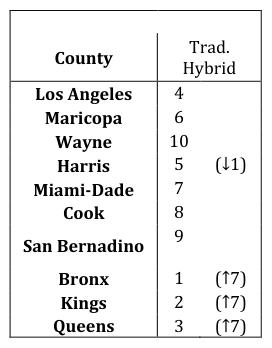
To establish a baseline, AHP-TOPSIS was used to determine the most vulnerable communities out of the set of alternatives (as described in the previous section) given the seven criteria factors. Table 1 highlights the resulting ranks, with 1 being the most vulnerable to 10 being the least vulnerable. So, in this situation: Los Angeles, Maricopa, and Wayne counties are ranked as the top three most vulnerable and potentially more at-risk, whereas Bronx, Kings, and Queens counties are the least vulnerable.
It should be noted that the ranking in Table 1 does not exactly match the ranking of the counties if they are ordered from most to least COVID-19 deaths per the original dataset. However, to provide a reference with which to compare the changes generated in the three scenarios, a baseline ranking using AHP-TOPSIS was needed. This ensures that subsequent comparisons are not affected by the efficacy of the AHP- TOPSIS hybrid method itself (a consideration beyond the scope of this paper), but instead only reflect differences between the performance of the two methods being compared.
The expectation is that DCH calculations will allow for a more realistic approach for ranking and determining an alternative when the criteria or alternatives are dynamic, which is common in emergency or disaster scenarios. For this paper, the focus is on the possible dynamisms of criteria as time progresses. It is hypothesized that the hybrid approach with DCH integrated will result with different rankings than the traditional hybrid method, even though they follow the same methodology of AHP-TOPSIS.
To provide a way to understand how the rankings compare, a rank evaluation metric of Kendall tau distance is used. Kendall tau distance measures the number of pairwise disagreements between rankings. That is, the distance represents the number of swaps needed in a simple bubble-sort to make a ranking match some other ranking. The distance value can range from 0, indicating a perfect matching ranked list, to the total number of pairs between the lists that indicate totally inverse rankings (Etesamipour & Hammell, 2019).
Scenario One The first scenario focuses on the criteria of ‘healthcare system factors’. In this scenario, hospitals in the counties of Maricopa, Harris, and Wayne are assumed to reach capacity, thus increasing the vulnerability score for this criterion. This was done by increasing the factor’s value from “high” to “very high”. The expectation is that the counties that had their vulnerability factor increased should rise in the resulting vulnerability ranking.
Table 2 depicts the vulnerability ranked results using both the traditional hybrid method and the hybrid method with DCH. The first thing to notice is that the vulnerability rankings of the three counties (shaded) in which the ‘healthcare system factors’ criterion was increased are now ranked as the top three most vulnerable (#1, #2, and #3) by the hybrid with DCH method. For the traditional hybrid method, Los
Intelligent Human Systems Integration (IHSI 2022): Integrating People and Intelligent Systems https://openaccess.cms-conferences.org/#/publications/book/978-1-7923-8988-7
Angeles County is still ranked as the second most vulnerable; Harris County is only at number 4.
Another notable result is that the ranking produced by the traditional hybrid method has a Kendall tau distance of 2 when compared to the baseline shown in Table 1. The distance for the DCH-augmented method is 4. The larger Kendall tau distance indicates that there is more change in the ranking produced by the DCH-augmented method which, in this scenario, signifies that this method is adjusting to the new
Table 1. Baseline Ranking Table 2. Ranking for Scenario 1 from AHP-TOPSIS Hybrid County Trad. Hybrid County Trad. Hybrid Hybrid w/DCH Los Angeles 4 Los Angeles 2 4 Maricopa 6 Maricopa 3 (↓1) 2 (=) Wayne 10 Wayne 1 (↑2) 1 (↑2) Harris 5 (↓1) Harris 4 (=) 3 (↑1) Miami-Dade 7 Miami-Dade 5 5 Cook 8 Cook 6 6
information more accurately and effectively.
Scenario Two In Scenario Two, the dynamic change that occurred is on the criteria of ‘high-risk environments’ and ‘socioeconomic status’. In this fictional scenario, it is assumed that counties in New York and Texas have opened up commercial establishments to the public, which in turn will necessitate that more people will have to report to work. To account for that, the individual vulnerability score for ‘high-risk environments’ was increased to “very high” while the score for “socioeconomic status” was decreased one category to a level of either “moderate” or “high” for the counties in the states of Texas (Harris) and New York (Kings, Queens, and Bronx). During the pandemic, having establishments open back up requires essential workers to report, which can be risky and raise vulnerabilities, but it helps economy and income for families. With the dynamic changes, it is hypothesized that the four counties would increase in vulnerability ranking, and potentially rank in top positions (as the criterion of ‘high-risk environments’ holds the third strongest weight out of the seven criterion).
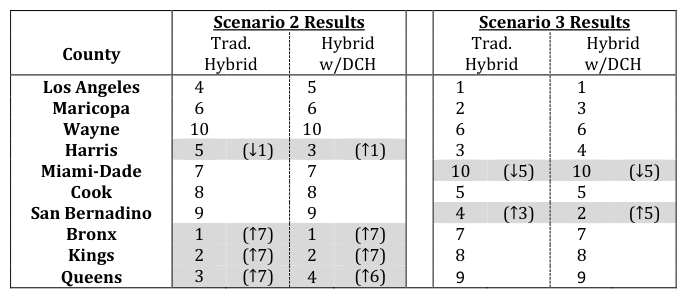
The Scenario 2 results shown in Table 3 display the new ranks from both methods (results for the counties with changed vulnerability scores are shaded). For the
Intelligent Human Systems Integration (IHSI 2022): Integrating People and Intelligent Systems https://openaccess.cms-conferences.org/#/publications/book/978-1-7923-8988-7 dynamic hybrid method, Harris, Kings, Queens, and Bronx now rank as the top four vulnerable counties (i.e. ranks #1, #2, #3, and #4) after this change. Additionally, both methods resulted with Bronx and Kings ranked as first and second, respectively. The traditional hybrid method counterintuitively ranked Harris County down in vulnerability. Compared to the original baseline ranking, the Kendall distance for the traditional hybrid method is 26, and the hybrid method with DCH has a distance of 26. This indicates that despite the differing rankings, the amount of change is the same for both methods.
Scenario Three In fictional Scenario Three, the criterion of ‘population density’, ‘healthcare system factors’, ‘household & transportation’, and ‘socioeconomic status’ are altered to explore the methods if a significant number of individuals from communities in select major cities either moved in or moved out. In this scenario, criteria are increased in vulnerability up a level for San Bernadino and decreased in vulnerability down a level for Miami-Dade, assuming people are moving into San Bernadino and out of Miami- Dade respectively. Due to the decrease in vulnerability for the criteria of Miami- Dade, it is expected that it would decrease in the final ranking, and vice versa for San Bernadino County.
The Scenario 3 results given in Table 3 show the new ranks from both methods (results for the counties with changed vulnerability scores are shaded). Both methods performed as expected, but the hybrid method showed more change. Both methods ranked Miami-Dade County last, as the least vulnerable county after the change; however, the hybrid method more correctly puts San Bernadino County at a higher rank than the traditional method (ranking #2). The Kendall distance from scenario 3 to the original baseline ranking for the traditional hybrid method is 9, and the hybrid method with DCH has a distance of 11, again indicating more change with the DCH method.
Table 3. Rankings for Scenarios 2 and 3 Scenario 2 Results Scenario 3 Results County Trad. Hybrid Hybrid w/DCH
Intelligent Human Systems Integration (IHSI 2022): Integrating People and Intelligent Systems https://openaccess.cms-conferences.org/#/publications/book/978-1-7923-8988-7
CONCLUSIONS
Emergency planners have the critical job of having to make effective and timely decisions in order to provide the correct aid before, during, and after emergencies or disasters. Decisions made in these types of environments need to be realistic in the considerations of the criteria for the available alternatives and be able to handle the dynamic nature that can affect the criteria or alternatives. This work proposes that the Multi-Criteria Decision-Making (MCDM) hybrid methodology of AHP-TOPSIS integrated with dynamic-case handling (DCH) calculations can be leveraged for decisive tasks in dynamic emergency situations. This is highlighted by exploring the method in three fictional scenarios related to the current COVID-19 pandemic with respect to the important task of determining and ranking the most vulnerable communities.
When dynamic change occurs, it was hypothesized that it would have an influence on the decisions to be made. When the changes increase the vulnerability of an alternative, it was expected that it would raise the final ranked score, and vice versa for a decrease. AHP-TOPSIS coupled with DCH was compared to the traditional hybrid method of AHP-TOPSIS without the DCH as a way to observe if there are any improvements. The results support the expectations; in each scenario, both methods handled the dynamic criteria changes as expected. The empirical effects demonstrated that the dynamic AHP-TOPSIS method had a slight performance advantage in representing the changes in the first and second scenarios. This validates the potential of the method as an appropriate foundation and proof of concept for future work.
Some limitations of this study include the constraints on identifying vulnerabilities based on the number of criteria included, that only a select number of counties were chosen for this study, and the focus of this study was on the emergency event of the COVID-19 pandemic. Future work will continue expanding upon this proof of concept by exploring different emergency scenarios with different criteria and alternatives. Furthermore, integrating fuzzy logic into the dynamic AHP-TOPSIS method with be investigated. Additionally, scenarios where subsequent changes are based off of earlier changes will be used as a way to show how the dynamic method can retain historical changes.
REFERENCES
Aruldoss, M., Lakshmi, T. M., & Venkatesan, V. P. (2013). A survey on multi crite-ria decision making methods and its applications. American Journal of Information Systems, 1(1), 31-43. Campanella G, Ribeiro RA. (2011b). Multiple attribute decision making in a dynamic
environment. World Conference on Soft Computing. Campanella, G., & Ribeiro, R. A. (2011a). A framework for dynamic multiple-criteria decision making. Decision Support Systems, 52(1), 52-60. Caylor, J., Hammell, R., and Raglin, A., “Preliminary Evaluation of Multi-Criteria
Decision-Making Methodology for Emergency Management”. In Proceedings
Intelligent Human Systems Integration (IHSI 2022): Integrating People and Intelligent Systems https://openaccess.cms-conferences.org/#/publications/book/978-1-7923-8988-7 of the 12th International Conference on Applied Human Factors and Ergonomics (AHFE 2021). Cui, Z. X., Yoo, H. K., Choi, J. Y., & Youn, H. Y. (2011, February). Multi-criteria group decision making with fuzzy logic and entropy based weighting. In Proceedings of the 5th International Conference on Ubiquitous Information Management and Communication (pp. 1-7). Etesamipour, B., & Hammell, R. J. (2019, May). Aggregating Information Toward
Military Decision Making. In 2019 IEEE 17th International Conference on Software Engineering Research, Management and Applications (SERA) (pp. 19-26). IEEE. https://coronavirus.jhu.edu/us-map Hwang, C. L., & Yoon, K., (1981). Multiple attribute decision making methods and applications, Springer-Verlag, New York. Ishizaka, A., & Labib, A. (2014). A hybrid and integrated approach to evaluate and
prevent disasters. Journal of the Operational Research Society, 65(10), 1475- 1489. Opricovic, S., & Tzeng, G. H. (2004). Compromise solution by MCDM methods: A comparative analysis of VIKOR and TOPSIS. European journal of operational research, 156(2), 445-455. Saaty, T. (1990b). How to make a decision: The analytic hierarchy process. European
Journal of Operational Research, 48(1), 9–26. doi:10.1016/0377-2217(90) 90057-I Saaty, T. L. (1977). A scaling method for priorities in hierarchical structures. Journal of mathematical psychology, 15(3), 234-281. Saaty, T. L. (1986). Axiomatic foundation of the analytic hierarchy process. Management
Science, 32(7), 841–855. doi:10.1287/mnsc.32.7.841 Saaty, T. L. (1988). What is the analytic hierarchy process?. In Mathematical models for decision support (pp. 109-121). Springer, Berlin, Heidelberg. Saaty, T. L. (1990a). Decision making for leaders: the analytic hierarchy process for
decisions in a complex world. RWS publications. Saaty, T. L. (2007). Time dependent decision-making; dynamic priorities in the AHP/ANP: Generalizing from points to functions and from real to complex variables. Mathematical and Computer Modelling, 46(7-8), 860-891. Saaty, T. L. (2008). Decision making with the analytic hierarchy process. International
journal of services sciences, 1(1), 83-98. Singh, A., & Malik, S. K. (2014). Major MCDM Techniques and their application-A Review. IOSR Journal of Engineering, 4(5), 15-25. Surgo Ventures (2021) Vulnerable Communities and COVID-19: The Damage Done, and
the Way Forward. https://precisionforcovid.org/ccvi Thor, J., Ding, S. H., & Kamaruddin, S. (2013). Comparison of multi criteria decision making methods from the maintenance alternative selection perspective. The International Journal of Engineering and Science, 2(6), 27-34. Varela, M. L. R., & Ribeiro, R. A. (2014). Distributed manufacturing scheduling based
on a dynamic multi-criteria decision model. In Recent Developments and New Directions in Soft Computing (pp. 81-93). Springer, Cham. Velasquez, M., & Hester, P. T. (2013). An analysis of multi-criteria decision making methods. International journal of operations research, 10(2), 56-66. Wan, W. M. F. B., Nor, N. M. M., & Jalil, M. A. (2015). Identification of potential crime
tactical path-finding using Analytical Hierarchy Process (AHP) in situational crime prevention. In Proc. The 7th Int. Conf. on Information Technology, Jordan (pp. 1-7).
Intelligent Human Systems Integration (IHSI 2022): Integrating People and Intelligent Systems https://openaccess.cms-conferences.org/#/publications/book/978-1-7923-8988-7
Wolfe, S. R. (2018). Retrieving Structured Items via Utility Estimation (Doctoral dissertation, UC Santa Cruz). Xu, L., & Yang, J. B. (2001). Introduction to multi-criteria decision making and the
evidential reasoning approach.
Intelligent Human Systems Integration (IHSI 2022): Integrating People and Intelligent Systems https://openaccess.cms-conferences.org/#/publications/book/978-1-7923-8988-7
LISTED IN THE AHFE DIGITAL BOOKSTORE CATALOGUE
Explore the complete digital volume
Intelligent Human Systems Integration (IHSI 2022): Integrating People and Intelligent Systems
Read this individual research paper free through the original publisher, or explore the full digital proceedings book.
ISBN 978-1-7923-8988-7
Explore this ISBN in the AHFE Bookstore ↗Listed in the July 2026 bookstore catalogue; search by ISBN to confirm current availability · Digital book purchase optional