Miguel Angel Quiroz Martinez, Eduardo Xavier Moreira Bermello, Wilmer Paul Carrillo Leon, Luis Briones (2022). A Hybrid Approach Entropy - TOPSIS for the Selection of Machine Learning Classifiers for Software Defect Prediction. In: Intelligent Human Systems Integration (IHSI 2022): Integrating People and Intelligent Systems. AHFE Open Access, vol. 22. https://doi.org/10.54941/ahfe1001088
The software is developed with much more complex functionalities to meet user requirements. Therefore, it is more vulnerable and subject to defects during the software development life cycle (SDLC). There are many efforts to avoid and reduce the number of defects, ensure good performance, and achieve defect-free software before releasing it to the market. To minimize the effort and optimize testing using Machine Learning, classifier models can be created to classify and predict which modules of the developed software may or may not be more prone to defects. There is a wide variety of classifier models; however, there is no classifier model that performs better than another in general terms. Various performance metrics can be used using multiple historical data sets to compare and evaluate classifier models. To select the best classifier model, a hybrid approach combining two multi-criteria decision making (MCDM) methods, Entropy and TOPSIS, is proposed. Entropy is used to calculate the criteria weights, and TOPSIS compares and ranks the alternatives. The results show that the proposed hybrid method can make the distribution of weights more reasonable and the selection of other options more efficient.
Currently, software development is perhaps one of the areas advancing by leaps and bounds over time. Although, software plays a very important role in the world of technology, it has become indispensable in business and daily life, increasingly efficient, equipped with new resources and functionalities to meet users' needs. Consequently, it makes its development much more complex, vulnerable, and subject to defects. Defects (commonly called bugs) are well-known and unavoidable during the software development life cycle (SDLC), which can cause non-compliance with requirements, undesired behaviors, or incorrect results in functionalities.
Most of the defects are introduced as a consequence of the human factor, which is usually produced and found in the different phases of the SDLC, not only in the development phase. During the entire SDLC, more than 50% of the time is spent maintaining quality and reliability to ensure good performance and achieve defect-free software before re-lease, making it exhausting, costly, and time-consuming to test all the complete soft-ware modules. To solve this problem, many researchers have focused their research on the Artificial Intelligence (AI) branch called Machine Learning (ML) and how it can be used to optimize the tests to be performed to shorten testing cycles, reduce effort and increase their efficiency. Software testing, thanks to Machine Learning, can create classifier models to accurately classify and predict which modules of the developed software may be more prone to defects or not prone to defects. Supervised machine learning classifier models can be trained from one or more historical software defect data sets, using data mining to prepare and extract patterns be-tween data labeled in the defective or non-defective category and descriptive attributes.
There is a wide variety of Machine Learning classifier models that behave differently depending on the amount and distribution of the data provided, some of which are very efficient and popular such as k nearest neighbors (kNN), Support Vector Machines (SVM), Naïve Bayes (NB), Random Forests (RF), Neural Networks (NN), among others. Despite this, no classifier model performs better than another in a general way, so various performance metrics have emerged to compare and evaluate the classification of classifier
Intelligent Human Systems Integration (IHSI 2022): Integrating People and Intelligent Systems https://openaccess.cms-conferences.org/#/publications/book/978-1-7923-8988-7 models used for a given problem. For this reason, this paper proposes a hybrid approach that combines two multi-criteria decision making (MCDM) methods: Entropy weight combined with the TOPSIS method. Where Entropy is used to calculate the objective weights of the criteria combined with TOPSIS to compare and rank a finite number of alternatives in order of preference. The rest of the article is structured as follows: Section 2 explores the Preliminaries, Section 3 describes the MCDM Method: Entropy and TOPSIS, Section 4 the Empirical Case Study and its result. Finally, Section 5 sets out conclusions and directions for future work.
PRELIMINARIES: DATASET DESCRPTION This study used 3 datasets: Apache, Safe, ZXing. All these datasets are obtained from the ReLink project, it was developed by Wu, et al and has been widely used in Software Defect Prediction research. They are based on source code linkage data information deduced from version control. Table 1 shows a description and detail of each dataset.
MACHINE LEARNING CLASSFIER MODELS Classifiers are supervised machine learning models that identify patterns or trends using a set of labeled input data in order to help the models correctly classify the data and predict the appropriate output label for new instances. A brief description is used for each classification model that was used: k Nearest Neighbors (kNN) is a feature similarity-based model. It consists of storing the features of the classes of the training examples. When classifying a new instance, it compares the similarity with the existing examples and places the new instance in the class that is most similar. Support Vector Machines (SVM) is a model based on constructing in the form of a decision surface an optimal hyperplane that defines the largest margin of linear separation between two or more input data classes. Naïve Bayes (NB) is a model based on a strong assumption of independence between predictors, based on Bayes theorem, which finds the probability that a particular feature is related or not to any
Intelligent Human Systems Integration (IHSI 2022): Integrating People and Intelligent Systems https://openaccess.cms-conferences.org/#/publications/book/978-1-7923-8988-7 other feature. Random Forests (RF) is a model based on the combination of a large number of independent decision trees operating as a forest. Within this forest, each decision tree gives a prediction of the class, and the class with the most "votes" is the prediction of the model. Neural networks (NN) are a model based on the functioning of the nervous system, formed by a set of neurons and brain connections, where the ability to memorize and associate facts helps to solve problems such as complex classification tasks.
PERFORMANCE EVALUATION METRICS A confusion matrix, also called error matrix or contingency table, is normally used to obtain values such as True Positive (TP), True Negative (TN), False Positive (FP), False Negative (FN), False Positive (FP), and False Negative (FN). See, TP is the amount that "Defaults" were correctly predicted as such, TN is the amount that "No Defaults" were correctly predicted as such. In return, FP is the amount that "No Default" was incorrectly predicted as "Default", FN is the amount that "Default" was incorrectly predicted as "No Default". From the values obtained by the confusion matrix, performance metrics can be calculated, which are statistical techniques used to evaluate the quality and performance of machine learning classifier models. In general, the metrics used are as follows: Accuracy, Precision, Recall, Specificity, F-Measure.
MCDM METHOD: ENTROPY AND TOPSIS Multicriteria decision-making MCDM methods have been widely used to select the best alternative among a set of decision alternatives characterized by multiple conflicting criteria. Currently, several MCDM methods are available; this section presents the TOPSIS method for evaluating alternatives and the entropy method for determining the weights of each criterion.
ENTROPY METHOD Shannon entropy is a wellknown method used to accurately determine the weighting based on the objective information of the criteria identified in MCDA problems, which can efficiently reflect the essence of the information and measure the uncertainty in the useful information of the obtained data. It is calculated with the following steps:
Step 1: Determine the decision matrix and normalize the decision matrix P_ij using:
Intelligent Human Systems Integration (IHSI 2022): Integrating People and Intelligent Systems https://openaccess.cms-conferences.org/#/publications/book/978-1-7923-8988-7
Equations and mathematical formulas are available in the original paper PDF.
ln(m) ), ( 𝑗= 1, … , 𝑛) (2) Step 3: Finally, the objective weighting of each criterion𝑤𝑗 is calculated as follows:
TOPSIS METHOD TOPSIS (Technique For Order Performance by Similarity to Ideal Solution), developed by Hwang and Yoon, is a widely used, easy-to-compute, algorithmically structured MCDM method for solving decision-making problems. The TOPSIS method selects the best alternative, the one with the shortest distance to the positive ideal solution (PIS) and the longest distance to the perfect negative solution (NIS). The TOPSIS procedure consists of the following steps:
Step 1: Determine the m×n decision matrix D= [xij], which is composed of possible alternatives A= {Ai | i = 1, 2, . . ., m} and evaluation criteria C= {Cj | j = 1, 2, . . ., n}. The vector of weights is composed of the individual weights W= {wj | j = 1, 2, . . ., n} for each criterion, obtained by the entropy method (4).
]
𝑥11 𝑥12 ⋯ 𝑥1𝑛 𝑥21 𝑥22 ⋯ 𝑥2𝑛 ⋮ ⋮ ⋱ ⋮ 𝑥𝑚1 𝑥𝑚2 ⋯ 𝑥𝑚𝑛
Step 2: Calculate the normalized decision matrix R =[rij]. The normalized value rij is calculated by: (6) rij = xij
m xij
Intelligent Human Systems Integration (IHSI 2022): Integrating People and Intelligent Systems https://openaccess.cms-conferences.org/#/publications/book/978-1-7923-8988-7
Step 3: Calculating the weighted normalized decision matrix V=[vij]. Multiply each element rij by the individual weight wj of each criterion: vij = rij ⋅wj , (𝑖= 1,2, … , 𝑚; 𝑗= 1, 2, … , 𝑛 ) (7)
Step 4: Determine the ideal positive solution PIS (A+) and the ideal negative solution NIS (A-), where A+ is the maximum benefit and A- is the minimum benefit.
+] . (8)
+, . . . , vn
−] . (9)
−, . . . , vn
n |j ∈ I+|), (maxi=1 Where, I+ is the set of benefit-type criteria and I- is the set of cost-type criteria.
Step 3: Calculate the n-dimensional Euclidean distances to the positive ideal solution PIS (A+) and to the negative ideal solution NIS (A-).
di
m (vij −vj
di
m (vij −vj Step 5: Calculate the relative closeness c_i^+ for each alternative with respect to the positive ideal solution PIS.
Step 6: In the last step of the method, the alternatives are ranked and ordered according to the highest percentage of relative closeness c_i^+ to the ideal solution
EMPIRICAL CASE STUDY In this study, the classifier models were created and evaluated by regular use of the widget of Orange Data Mining tool, 10-Fold stratified cross validation was performed, which previously classifies the data by classes, and from the same the total data is divided into k folds randomly of the same size, 9 folds are used to train the model and one of the folds is used for testing. The process is repeated 10 times to obtain the performance evaluation result according to each model according to the data set.
Intelligent Human Systems Integration (IHSI 2022): Integrating People and Intelligent Systems https://openaccess.cms-conferences.org/#/publications/book/978-1-7923-8988-7
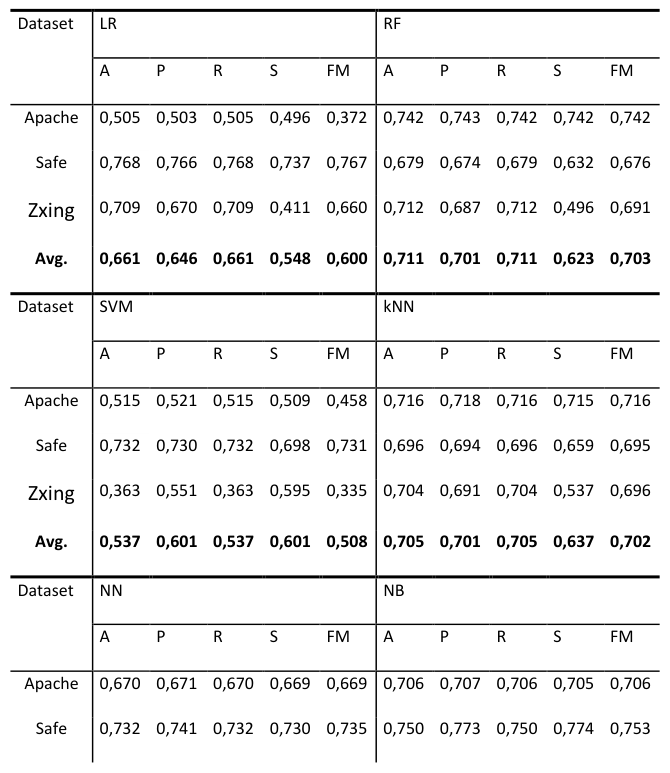
RESULTS: EVALUATION RESULTS From the cross-validation evaluation with the various performance evaluation met-rics to the machine learning classifier models, Table 2. shows the evaluation results of the LR, RF, SVM, kNN, NN, NB models. The performance scores of each dataset (Apache, Safe, Zxing) are averaged.
Table 2. Results of the evaluation Dataset LR RF
Intelligent Human Systems Integration (IHSI 2022): Integrating People and Intelligent Systems https://openaccess.cms-conferences.org/#/publications/book/978-1-7923-8988-7
At first glance, the RF, NN, NB and kNN models show high performance and are approximately similar. While the SVM and LR models show low performances compared to the other models.
ENTROPY AND TOPSIS RESULTS Based on the average of the results obtained in the cross-validation evaluation, the following input parameters are used to compare and select the best model using Entropy and TOPSIS. Table 3 shows the decision matrix that is formed by alternatives where LR is A1, RF is A2, SVM is A3, kNN is A4, NN is A5, NB is A6 that will be evaluated based on the criteria where A is C1, P is C2, R is C3, S is C4, FM is C5, with their respective individual weights (wi) associated to the criteria.
Table 3. Decision matrix D = [aij] C1 C2 C3 C4 C5 wi 0,219 0,093 0,219 0,127 0,341
Intelligent Human Systems Integration (IHSI 2022): Integrating People and Intelligent Systems https://openaccess.cms-conferences.org/#/publications/book/978-1-7923-8988-7
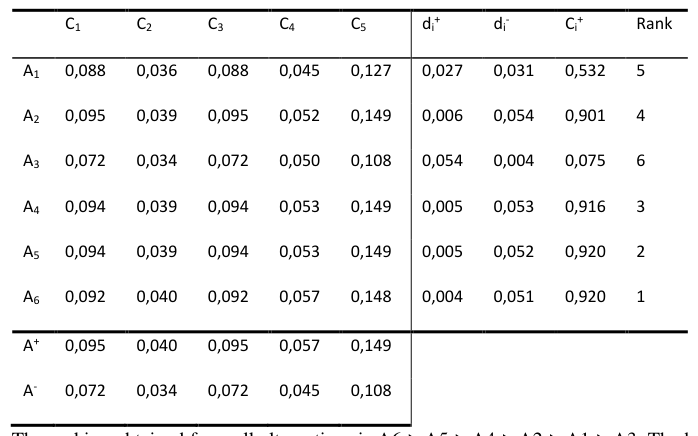
In order to obtain the weighted normalized decision matrix, the following is used (7). Using (8) and (9) we obtain the ideal solutions A+ and A-. From (10) and (11) the Euclidean distance di+ y di- is calculated. Then with (12) the relative closeness is calculated for each of the alternatives. Finally, the alternatives are ranked based on the Ci+ value, so the best alternative with the value closest to 1 is chosen. The results of the final evaluation and ranking of the alternatives are shown in Table 5
Table 5. Final evaluation and ranking of alternatives C1 C2 C3 C4 C5 di+ di- Ci+ Rank
The ranking obtained from all alternatives is A6 > A5 > A4 > A2 > A1 > A3. The best performing alternative is A6 i.e., NB.
Intelligent Human Systems Integration (IHSI 2022): Integrating People and Intelligent Systems https://openaccess.cms-conferences.org/#/publications/book/978-1-7923-8988-7
CONCLUSION AND FUTURE WORK In the present work, it was concluded that, in order to shorten testing cycles, reduce effort and increase efficiency in software defect detection, the use of Machine Learning classifier models is very necessary. There are several classifier models, however, there is no one classifier model better than another, because each one performs differently according to the volume and distribution of the data. To overcome this, a hybrid MCDM approach combining entropy and TOPSIS method was proposed to evaluate the performance of the classifier models in order to select the best one. The results obtained show that the hybrid approach is reliable as it is more objective in distributing the weights and more accurate in selecting an efficient alternative. It was determined that the best classifier model is Naïve Bayes compared to other models. For future studies, it is suggested to use other MCDM methods such as VIKOR, ELECTRE or PROMETHEE and combine it with entropy to verify and compare the results obtained by each of them.
ACKNOWLEDGMENTS
This work has been supported by the GIIAR research group and the Universidad Politécnica Salesiana
REFERENCES
C. L. Prabha and N. Shivakumar, “Software Defect Prediction Using Machine Learning Techniques,” Proc. 4th Int. Conf. Trends Electron. Informatics, ICOEI 2020, no. Icoei, pp. 728–733, 2020. [1] C. L. Prabha and N. Shivakumar, “Software Defect Prediction Using Machine Learning Techniques,” Proc. 4th Int. Conf. Trends Electron. Informatics, ICOEI 2020, no. Icoei, pp. 728–733, 2020. N. Kalaivani, R. Beena, and A. Professor, “Overview of Software Defect Prediction using
Machine Learning Algorithms” Int. J. Pure Appl. Math, vol.118, no.20, pp.3863, 2018. M. Á. Q. Martinez, B. A. M. Tayupanda, S. S. C. Paguay, and L. A. B. Peñafiel, “A Machine Learning Model Comparison and Selection Framework for Software Defect Prediction Using VIKOR,” pp. 890–898, Aug. 2021. C. Jin, “Software defect prediction model based on distance metric learning,” Soft Comput.,
vol. 25, no. 1, pp. 447–461, 2021, doi: 10.1007/s00500-020-05159-1. J. Sun, X. Jing, and X. Dong, “Manifold Learning for Cross-project Software Defect Prediction,” Proc. 2018 5th IEEE Int. Conf. Cloud Comput. Intell. Syst. CCIS 2018, pp. 567–571, 2019, doi: 10.1109/CCIS.2018.8691373. M. Y. L. Vazquezl, L. A. B. Peñafiel, S. X. S. Muñoz, and M. A. Q. Martinez, “A Framework
for Selecting Machine Learning Models Using TOPSIS,” in Advances in Intelligent Systems and Computing, Jul. 2021, vol. 1213 AISC, pp. 119–126.
Intelligent Human Systems Integration (IHSI 2022): Integrating People and Intelligent Systems https://openaccess.cms-conferences.org/#/publications/book/978-1-7923-8988-7
A. G. C. Pacheco and R. A. Krohling, “Ranking of Classification Algorithms in Terms of Mean–Standard Deviation Using A-TOPSIS,” Ann. Data Sci.,vol.5, no.1, pp.93–110, 2018. R. Wu, H. Zhang, S. Kim, and S. C. Cheung, “ReLink: Recovering links between bugs and
changes,” SIGSOFT/FSE 2011 - Proc. 19th ACM SIGSOFT Symp. Found. Softw. Eng., pp. 15–25, 2011, doi: 10.1145/2025113.2025120. C. Jin, “Cross-project software defect prediction based on domain adaptation learning and optimization,” Expert Syst. Appl., vol. 171, no. January, p. 114637, 2021. M. A. Q. Martinez, J. L. M. Redin, E. D. A. Castillo, and L. A. B. Peñafiel, “An Efficient
Approach for Selecting QoS-Based Web Service Machine Learning Models Using Topsis,” Lect. Notes Networks Syst., vol. 182, pp. 172–182, Aug. 2020. C. Pan, M. Lu, and B. Xu, “An empirical study on software defect prediction using codebert model,” Appl. Sci., vol. 11, no. 11, 2021, doi: 10.3390/app11114793. S. N. A. Saharudin, K. T. Wei, and K. S. Na, “Machine Learning Techniques for Software
Bug Prediction:A Systematic Review” J. Comput. Sci., vol.16, no.11, pp.1558–1569, 2020. E. A. Felix and S. P. Lee, “Predicting the number of defects in a new software version,” PLoS One, vol. 15, no. 3, pp. 1–30, 2020, doi: 10.1371/journal.pone.0229131. M. A. Q. Martinez, D. T. L. Rugel, C. J. E. Alcivar, and M. Y. L. Vazquez, “A Framework
for Selecting Classification Models in the Intruder Detection System Using TOPSIS,” Adv. Intell. Syst. Comput., vol. 1253 AISC, pp. 173–179, Aug. 2020. J. George, M. Sahu, and H. A. Naqvi, “An entropy-weight based TOPSIS approach for supplier selection,” Irjet, vol. 5, no. 6, pp. 2828–2832, 2018. R. Singh, D. Kumar, and B. B. Sagar, “Selection of Best Software Methodology Using
Entropy and TOPSIS,” ICRITO 2020 - IEEE 8th Int. Conf. Reliab. Infocom Technol. Optim. (Trends Futur. Dir., pp. 81–85, 2020. M. Nilashi, A. Mardani, H. Liao, H. Ahmadi, A. A. Manaf, and W. Almukadi, “A hybrid method with TOPSIS and machine learning techniques for sustainable development of green hotels considering online reviews,” Sustain., vol. 11, no. 21, 2019. E. M. Abdelkader, N. Elshaboury, and A. Al-sakkaf, “A Holistic Hybrid Entropy-TOPSIS-
based Method for the prioritization of Machine Learning Models in Energy Efficient buildings, 2020 , 7 ( 9 ): 61-75 A Holistic Hybrid Entropy-T,” no. September, 2020.
Intelligent Human Systems Integration (IHSI 2022): Integrating People and Intelligent Systems https://openaccess.cms-conferences.org/#/publications/book/978-1-7923-8988-7
LISTED IN THE AHFE DIGITAL BOOKSTORE CATALOGUE
Explore the complete digital volume
Intelligent Human Systems Integration (IHSI 2022): Integrating People and Intelligent Systems
Read this individual research paper free through the original publisher, or explore the full digital proceedings book.
ISBN 978-1-7923-8988-7
Explore this ISBN in the AHFE Bookstore ↗Listed in the July 2026 bookstore catalogue; search by ISBN to confirm current availability · Digital book purchase optional