Monica Daniela Gomez Rios, Bryan Acosta, Jos Rosales, Miguel Angel Quiroz Martinez (2024). Comparative analysis for the selection of a virtualization tool using the AHP Model. In: Intelligent Human Systems Integration (IHSI 2024): Integrating People and Intelligent Systems. AHFE Open Access, vol. 119, pp. 292–302. https://doi.org/10.54941/ahfe1004493
This paper presents a comprehensive comparative analysis of virtualization tools, grounding its study on applying the AHP model. Virtualization is introduced as an emerging technology, emphasizing its ability to enhance applications' portability, management, and compatibility by encapsulating them from the operating systems on which they run. Different approaches to virtualization are discussed, from desktop virtualization, highlighting its client-server-based computing model, to network virtualization, emphasizing its capability to combine software and hardware resources into a software-managed entity. An in-depth analysis of leading market virtualization tools, such as VMware and HYPER-V, is conducted throughout the article. VMware's operational advantages and efficiency are highlighted, along with the speed and versatility of HYPER-V's migration. To enrich the research, survey results conducted on professionals specialized in network infrastructure in Ecuadorian companies are incorporated, providing valuable insights into these tools' adoption and practical utility in corporate environments. Finally, the study presents a detailed comparative table to guide organizations in selecting the virtualization tool that best fits their requirements and operational contexts.
Most companies face challenges at the technological level, such as slow sys- tems with low resources and servers with low potential (Lima-Morales et al., 2018). They often have web and local environments that do not offer the nec- essary efficiency for their collaborators to perform their tasks optimally. One solution to this problem is the implementation of virtualization, a tool trans- forming the Information and Communication Technologies (ICT) domain. With it, creating multiple virtual environments on a single physical server is possible, efficiently managing resources, applications, and services. Given the numerous virtualization tools on the market, such as VMware, HYPER-V, Virtual Box, KVM, and XEN, it is essential to understand their characteris- tics, capabilities, and performance to determine which one is the most suitable for each organization (Jacome Et, 2018; Diaz and Garcia, 2020). For this reason, this research proposes to carry out a comparative analysis using the
Comparative Analysis for the Selection of a Virtualization Tool Using the AHP Model 293
AHP (Analytic Hierarchy Process) model, a method that has proven to be influential in production and logistics decision-making by guiding towards the achievement of goals and evaluations (Gómez et al., 2015; Espinoza and Sierra, 2018). Due to the diversity of options in the virtualization tool mar- ket, organizations require a methodology that allows them to make informed choices. The AHP model emerges as a valuable option.
Virtualization Key Concepts and Definitions Over the years, various experts and academics have offered definitions and perspectives on virtualization. One key defini- tion is that virtualization allows multiple operating systems and applications to run on a single physical machine, leveraging the underlying hardware. (Pacheco & D., 2019). However, according to Smith and Nair (2005) in their book “Virtual Machines: Versatile Platforms for Systems and Processes”, a virtual machine is essentially an efficient and isolated replica of a real machine. The importance of this definition lies in the word “isolated”, which means that any operation on a virtual machine does not affect other virtual machines or the host machine. (Garcia, 2010).
Types of Virtualization Since virtualization can be implemented using various methodologies, we examine categorizing the main types. Full virtualization using binary trans- lation: This approach is based on the translation of kernel code to replace instructions that are not virtualized. By introducing new instruction sequences, the desired result is achieved in hardware. It should be noted that the user-level code is executed directly on the processor in the framework of the user-level code is executed directly on the processor in the frame- work of the high-level virtualization context (Peliza et al., 2018). Principle of the form. Instead, this can lead to significant maintenance and support issues in a production environment, as it involves substantial modifications to the host operating system’s kernel. Virtualization supported by physical components: Hardware producers are rapidly incorporating virtualization, introducing new capabilities that simplify the methodologies linked to this procedure.
I/O Device Virtualization I/O device virtualization involves routing I/O requests between virtual devices and shared physical hardware through virtualization software. I/O process- ing, instead of direct communication with the hardware, opens up a wide range of opportunities and simplifies management. The hypervisor takes on the task of virtualizing physical hardware, assigning each virtual machine a uniform set of virtual devices. These virtual devices effectively manage to emulate hardware components (Rodriguez, 2017). The main goal of virtual- izing I/O devices is to create an abstraction layer that allows guest operating systems to access I/O resources. Virtual device drivers act as intermediaries between guest operating systems and physical resources. These drivers copy physical devices and translate I/O requests from guest operating systems into
understandable instructions for the underlying physical devices. Additionally, the hypervisor, the program managing the virtual machines and their inter- actions with the virtual devices, acts as an intermediary between the guest operating systems and the physical devices.
Application Virtualization Refers to a set of software technologies that improve applications’ portabil- ity, management, and compatibility by encapsulating them, creating isolation between these applications and the operating system of the machine on which they run. It is important to note that contemporary operating systems have limited resources. Desktop virtualization: Desktop virtualization follows the client-server computing model. It is defined as the process by which the user’s desktop environment is isolated from his physical machine and the operating system he uses. In this approach, the virtualized desktop is hosted on a cen- tral server, and all applications, programs, and data are available from this virtual desktop instance. The client must be networked to the central server to interact with it. In this way, when a client runs a program or accesses information from its virtual desktop, all operations are carried out on the server without the client’s operating system and hardware being aware of these processes. This virtualization mode employs virtual machines, ensuring each user has a virtual workstation. This technique facilitates users to inter- act with the desktops of these machines as if they were working on their local computers (Forero Rodriguez et al., 2016). Network virtualization: Network virtualization integrates software resources, hardware, and network func- tions into a unified software-managed entity known as a virtual network (Peliza et al., 2018). Implementing this strategy makes it possible to consol- idate multiple physical networks into a single virtual network (VPN), thus simplifying administration and giving administrators precise control over the network resources they manage. Through a VPN, a single network can encompass several geographically distributed networks. Within the virtual- ization framework, several essential elements work together to facilitate the generation and monitoring of virtual environments. Some of the most sig- nificant components are listed below: Hypervisor, also called VMM (Virtual Machine Monitor). There are two main categories of hypervisors: Hyper- visor Type1 (Digital Guide IONOS, 2019), and Hypervisor type 2 (Zablah et al., 2015). Virtual Machine (VM) (Rafa Morales, 2015), Guest OS. Virtual hosting (Oliver, 2019). Virtual network (Oliver, 2019). Administrator (Jane & Sanchez, 2018). Depending on the type of virtualization and the platform used, additional specific components may exist.
Virtualization Tools Virtualization tools have become essential for many organizations looking to improve the efficiency and flexibility of their systems. Several tools and tech- nologies offer different features depending on the needs of each company. For example, VMware is widely recognized for its versatility, offering solu- tions for servers and workstations, similar to Oracle’s VirtualBox, although the latter is open source. At the corporate level, organizations often gravitate
Comparative Analysis for the Selection of a Virtualization Tool Using the AHP Model 295
towards solutions such as Microsoft’s HYPER-V, especially if immersed in the Windows ecosystem. Alternatively, for Linux-based environments, KVM presents a robust and open solution. While Docker is not a virtualization tool in the traditional sense, its container-based approach has revolutionized the way applications are designed and deployed, offering greater flexibility and efficiency. Similarly, PROXMOX VE and OpenStack focus on container- based virtualization, while XEN offers a more versatile platform, supporting complete and paravirtualization (Jácome Segovia et al., 2018). These tools are not only valuable in technical terms; they can also boost productivity and improve administrative processes, as mentioned in Cuesta’s study, high- lighting the importance of adequately choosing these tools using selection models to achieve the maximum benefit for the corporation (Lima-Morales et al., 2018).
Related Work
Sushicorp S.A. faced a significant challenge when its technology infrastruc- ture weakened following its separation from the KFC group. To overcome this adversity, they chose to implement virtualization, thus strengthening their technology system. The results of this approach were remarkable, stream- lining work and improving operational efficiency in crucial areas such as customer service and administration (Vargas-Murillo, 2021). On the other hand, Gaval Soluciones S.A.C. also experienced problems related to techno- logical infrastructure as a result of its growth. The main challenge was the high energy consumption of its data center. The solution adopted was high- availability virtualization with the PROXMOX platform. This strategy led to a significant reduction in the data center’s energy consumption, benefiting both the company and the ecosystem. Similarly, Under Media, a company specializing in software development recognized the need to upgrade its tech- nological infrastructure due to its rapid expansion. They decided to centralize smaller sites on virtual servers, eliminating large servers. This strategy proved effective, guaranteeing 99.9% online service and optimizing server access and administration. Finally, Cineplanet in Peru adopted virtualization to address daily challenges its workers face, such as problems with software, hardware, and viruses. By implementing the Citrix platform, they sought to ensure the constant availability of tools for their employees. This initiative has provided robust tools available 24 hours a day, seven days a week, which is expected to reflect improved daily performance of the staff and, therefore, tangible benefits for the company.
Types of Selection Tools Topsis technique (Ideal Solution-Like Preference Sorting Technique) is a multifaceted decision-making approach that helps users choose the optimal option from several alternatives. Topsis operates by comparing each alterna- tive to an ideal solution, a combination of the most salient characteristics of all alternatives. The alternatives that are closest to the ideal solution which is a combination of the most salient features of all alternatives. The alternatives closest to the ideal solution are considered the superior options. Topsis can
be applied to make decisions in various fields, including supplier selection, project management, and investment (Chakraborty, 2022). It is an adaptable tool that can be tailored to the particular needs of each user.
Fuzzy Logic: The fuzzy logic technique is a decision-making approach that enables systems to model and regulate the behavior of dynamic sys- tems in contexts with imprecise or incomplete information. Fuzzy logic is based on the premise that values do not necessarily have to be binary (true or false) but can take intermediate values such as “very likely” or “unlikely” (Raheem et al., 2022). This fuzzy logic method consists of four essential elements: AHP: The Hierarchical Analysis Method (AHP) is a structured approach to organizing and analyzing complex decisions based on mathematical and psychological principles. It was developed by Thomas L. Saaty in the 1970s and has been refined since then (Leal, 2020). AHP is a multi- criteria decision-making method (MCDM) applicable in a variety of situ- ations. Each tool has its advantages, adapting to different environments and needs. For example, VMware is highly reliable and is an excellent choice for companies that require regular system backups (Abdulraheem, 2022).
METHODOLOGY
The AHP hierarchy is used to carry out this research, which defines common standards in selecting the best alternative based on different criteria Toskano Hurtado, 2022. The study is carried out according to a process consisting of the following steps:
Phase 1: Literature review: In this phase, a search is performed in the cen- tral databases such as Scopus, Web of Science, IEEE, and Google Scholar to investigate reliable sources such as academic articles, books, and spe- cialized websites to extract the criteria and alternatives for the selection of the best virtualization tool.
Phase 2: Comparison of tools using AHP method: This phase will be used as a decision-making method involving various criteria and alternatives. It will facilitate comparing and prioritizing different alternatives using a hierarchical structure with weighted criteria and alternatives.
Phase 3: Testing: In this phase, tests will be performed on the company’s server. We will identify which tools may be optimal for the operation, we will verify the connections through server load tests where the machines must be connected to a corresponding domain, the reliability of the net- work is essential for the tests to be performed within the organization, we will ensure that the test environment is within a stable and reliable net- work. The company’s system must be inside a server in the cloud, here it will be reviewed which of the tools are stable and durable, compatible that nowadays we use Windows in virtuality since it is hugely faster when installing and testing it. For greater security, an Active Directory controller and firewall are installed to ensure that the network is secure and that no malware leaks into these tests.
Comparative Analysis for the Selection of a Virtualization Tool Using the AHP Model 297
RESULTS
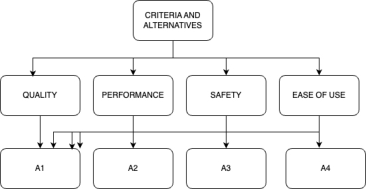
In phase 1 of the analysis of the tools, several were evaluated: VMware, SDN, MSC cloud, Exelearning, Stat fit, ESxi, Microsoft Hyper-V, Hypervisor, fsQCA, Virtual Box, Pronox 5.4, Serqual, Microsoft Azure, KVM, and Xen. All these named were considered through the criteria and alternatives for their performance, quality, security, and ease of use these essential tools are as follows: VMware, Virtual box, Hyper-v, KVM, and Xen. These tools are connected to the operating system and can work with many users within a server domain; these last four have similarities in their operation, are highly secure, and all can be run within the server. The most incredible thing is com- patibility with Windows. On the other hand, phase 2, Figure 1, illustrates a hierarchy to evaluate or compare certain alternatives based on specific crite- ria. The criteria are: “QUALITY”, “PERFORMANCE,” “SECURITY,” and “EASE OF USE.” These criteria are essential to evaluate different aspects or characteristics of the alternatives presented. Alternatives “A1”,” A2”,” A3”, AND “A4” are options or solutions that will be evaluated according to the above-mentioned criteria.
Figure 1: AHP model hierarchy creation.Table 1. Results of the weights of each tool.
Within the results of Table 1, a weight balance was obtained to identify an optimal tool with the necessary resources to operate and provide an excellent service to a corporate company with high scalability. All the criteria and alter- natives are analyzed by 1% effectiveness; that is to say, they were added and divided for the total number. They gave us those results shown in the table, that is to say, that the analysis of these four tools is balanced and gave 3.1175 to 5 %, which is of high impact for the organizations. With this result, we visualize that between them, they compete, but the most significant resource
is VMware. That was the one with more results, and close to 1% was against the others.
Table 2 we have as a result, the numbers within the matrix represent the evaluations or scores of each alternative according to each criterion. For example, tool Al has a score of 9 for criteria C1, C2, C3, and C4, indicating a high evaluation in all these criteria. It is verified within this matrix the results that alternative 1 has the highest score of the other tools. It has a score of 9 out of zero, i.e., the highest score in quality, performance, security, and ease of use.
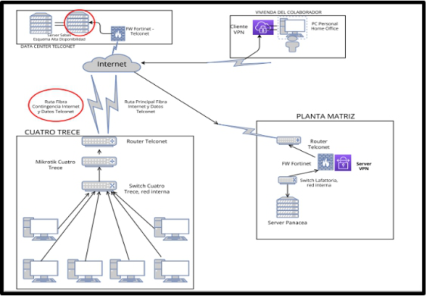
In phase 3, we have the tests performed using a server. In Figure 2 we have a network structure established at the web and local level by which, with the help of the VMware tool, a secure and stable connection is established via VPN so that employees can log in from home and access the systems established by the company.
Figure 2: Matrix server connections.
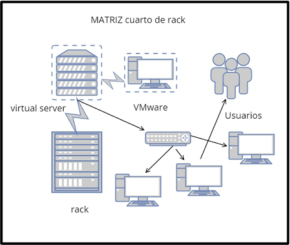
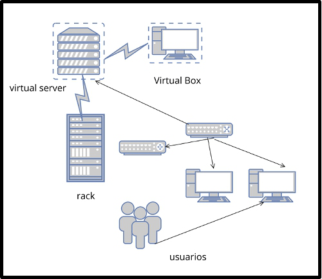
Next, you will notice in Figure 3 how stable it is to work with VMware. A secure and stable server that connects to many users. This tool presents stability, good performance, and quality more than all the security in the network. Therefore, security within the organization is very important so that there is no information leakage For phase 4, a comparison was made between tools. When working with the virtual box, we noticed it was incompatible with Windows, so we had to add another router to give it potential and enable it to start up optimally.
Comparative Analysis for the Selection of a Virtualization Tool Using the AHP Model 299
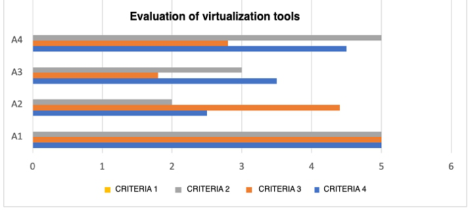
As part of these tests, a survey was carried out with IT network specialists in network security to determine what criteria are of greater weight when working with virtualization. This confirms the result that VMware is the best option.
Figure 5: Evaluation of virtualization tool.
This is for having better security, better performance when operating, and better guarantees; in turn, the VMware tool is the most used by all global companies for its high performance and energy savings; this tool can also be coupled in any server.
DISCUSSION
In exploring different virtualization modalities, the diversity of available solu- tions is evident. The tools analyzed, VMware and HYPER-V, reflect current trends and developments in virtualization. While VMware stands out for its operational efficiency and optimized resource management, HYPER-V excels in environments that require speed and adaptability in migration processes. Each tool presents a set of features that make it suitable for specific sce- narios, highlighting the importance of a detailed evaluation when deciding which tool to implement. The feedback obtained from network infrastruc- ture professionals in Ecuador has been enlightening. It reflects not only the technical perception of these tools but also the unique realities and chal- lenges of the local market. Therefore, it is crucial to adopt a continuous learning approach, where technological decisions are periodically reviewed and updated based on industry developments and changes in organizational needs, as the opinions obtained from the surveys of network infrastructure professionals obtained favourable results when implementing a tool or giving recommendations before buying it as a future investment to companies.
CONCLUSION
Virtualization, in its various forms, has established itself as an indispens- able tool in today’s technological landscape. Its ability to optimize resources, improve portability, and make the management of applications and systems more flexible places it at the center of modern technological strategies. This study provides an overview of the virtualization tools available on the mar- ket and emphasizes the need for a customized and contextualized approach to adopting virtualization technologies. While this study has provided valu- able insights into virtualization and its implementation in specific contexts, it opens the door for future research. It will be essential to explore in detail how organizations can combine different virtualization tools and approaches to create hybrid solutions and how these strategies can adapt to future challenges
ACKNOWLEDGMENT
This work has been supported by the GIIAR research group of the Universi- dad Politécnica Salesiana.
REFERENCES
Arias, M. (2008). PERCEPCIÓN GENERAL DE LA VIRTUALIZACIÓN DE LOS RECURSOS INFORMÁTICOS. Obtenido de https://acortar.link/cJ6xR Calenzani, M., & Salas, B. (2014). Modelo del proceso jerárquico análitico para
optimizar la localización. Obtenido de https://acortar.link/vzaFOP Cavada, J., & Egas, C. (2018). Virtualización de Redes y Servidores Emulando Infraestructuras Tecnológicas. Obtenido de https://acortar.link/HCecIF Cedeño, R. (2016). CONSOLIDACIÓN DE SERVIDORES MEDIANTE LA VIR-
TUALIZACIÓN. Obtenido de https://acortar.link/Sp4oQj
Comparative Analysis for the Selection of a Virtualization Tool Using the AHP Model 301
Chavarría Molina, J., & Fallas Monge, J. (2019). El algoritmo PSO aplicado al problema de particionamiento de datos cuantitativos. Matemática, Educación e Internet. Obtenido de https://acortar.link/Wk4LdW Congo Pastrana, M. (2014). implementar un servidor hosting linux compartido y
servidores dedicados. utilizando virtualización para la empresa UNDERMEDIA S. A. Obtenido de https://acortar.link/YUrUcc Cuesta, J., Reategui, L., Kevin, L., & Patiño, D. (2020). Control de inventario de una empresa de venta de aves de corral usando algoritmo AHP. usando algoritmo AHP. Obtenido de https://journals.gdeon.org/index.php/esj/article/view/46 Díaz García, A., & García MuñozAparicio, C. (2020). ANÁLISISCOMPARATIVO
DE LOS ESTÁNDARES DE CALIDAD DE UNA EMPRESANACIONAL CON LAS PRINCIPALES TEORÍAS DELA CALIDAD ENFOCADAS EN ELSERVICIO AL CLIENTE. Revista Hitos. Obtenido de https://acortar.link/2i62x1 Enzo, A. (2020). virtualizacion vmware. Obtenido de https://acortar.link/ej0Xam Espinoza Mina, M., & Sierra Cedeño, A. (2018). Análisis Comparativo entre ASP. NET y PHP. Obtenido de https://acortar.link/sfksfq Garcia Lopez, J. J., & Pascual, R. (2010). Virtualización de Servidores. solucion de
futuro. Obtenido de https://acortar.link/4j2uUr Gómez Montoya, R. A., Abdul Zuluaga, M., & Vásquez Noreña, G. L. (2015).
Método AHP utilizado para mejorar la recepción en el centro de distribución deuna empresa de alimentos. Obtenido de https://acortar.link/2dWrw6 Gomez, & Flores. (2020). Selección de un modelo para evaluar la sostenibilidad hidroeléctrica mediante el método AHP. hidroelectrica mediante el metodo AHP. Obtenido de https://www.upo.es/revistas/index.php/RevMetCuant/article/vi ew/3835 Gonzalez, M. (2014). tecnologias de virtualizacion. Obtenido de https://acortar.link
/G76Ei8 Guzman Gálvez, M., & Franck Charles, R. (2022). Virtualización de servidores para optimizar el data center de. empresa Gaval Soluciones S. A. C. Obtenido de https: //acortar.link/fqo578 Jacome Et. (2018). virtualizacion. Jácome Segovia, D., Núñez Núñez, J., Velasteguí López, E., Navas Moya, M., &
Vásquez Carrera, P. (2018). La virtualización de servidores como una herramienta para la optimización de recursos. Ciencia Digital. Obtenido de https://acortar.link /QMtEcE Jesé, B., & Condemarín, Z. (2020). Virtualización de escritorios basados en DaaS para la implementación de los puntos de venta en la empresa cineplanet. imple- mentación de los puntos de venta en la empresa cineplanet. Obtenido de https: //acortar.link/a8j9XX Lopez, F. (2014). Sistema distribuido. Obtenido de https://acortar.link/OeALwC Marzionni, E., & Formozo, O. (2012). virtualizacion con VMware. Obtenido de
https://acortar.link/qnFBfU Mendoza, A., & Garcia, D. (2018). Aplicación del proceso de jerarquía analítica (AHP) para la toma de decisión con juicios de expertos. decision con juicios de expertos. Obtenido de https://acortar.link/bR7uP8 Moyano Tipan, D. J. (2023). Análisis de herramientas de virtualización comosoporte
al modelo de negocio de las Pymes. Obtenido de https://acortar.link/Msw4TY Oliag, S. (2010). Herramientas de virtualización libres para. sistemas GNU/Linux.
Obtenido de https://acortar.link/zwptik
Ramírez Rodriguez, B. E., & Fiallos Zarate, A. F. (2020). Análisis de satisfacción de los servidores de la empresa pública Emapast con el modelo Servqual. Diletas Contemporáneos. Obtenido de https://acortar.link/kxLWkE Salazar, W. (2017). IMPLEMENTACIÓN DE ARQUITECTURA DE MICROSER-
VICIOS. Obtenido de https://acortar.link/SxLkTa Solaro Menéndez, S. (2015). “Utilización del modelo AHP y técnica de Mystery Shopping para evaluar calidad de servicio. Obtenido de https://acorta r.link/7YGFyS Toskano Hurtado, G. (2022). Además de AHP que otras herramientas existen.
decisiones de seleccion. Obtenido de https://acortar.link/Bd1ScF Urquizo, E., & Ruiz, J. (2012). CLOUD COMPUTING: DE LA VIRTUALIZACIÓN DE APLICACIONES Y DE ESCRITORIO, A LA. virtualizacion de servidores. Obtenido de https://acortar.link/tSPL2U Vega Guallpa, A., Andrade Cárdenas, D., & Pinos Castillo, L. (2022). Análisis com-
parativo de infraestructuras de redes SDN (Software Defined Networking) y redes tradicionales IP. Obtenido de https://acortar.link/mMHReG
LISTED IN THE AHFE DIGITAL BOOKSTORE CATALOGUE
Explore the complete digital volume
Intelligent Human Systems Integration (IHSI 2024): Integrating People and Intelligent Systems
Read this individual research paper free through the original publisher, or explore the full digital proceedings book.
ISBN 978-1-958651-95-7
Explore this ISBN in the AHFE Bookstore ↗Listed in the July 2026 bookstore catalogue; search by ISBN to confirm current availability · Digital book purchase optional