Leyi Wu, Jing Luo, Huihui Guo (2022). An interactive design solution for prenatal emotional nursing of pregnant women. In: Ergonomics In Design. AHFE Open Access, vol. 47, pp. 478–486. https://doi.org/10.54941/ahfe1001973
With the continuous development of interactive technology, informatization has begun to integrate into people's life[1].Having been neglected in history, postpartum depression reminds us that we need to pay attention to maternal emotional needs and prenatal care[2]. In the current situation, it is worth researching the interactive products for prenatal emotional care. According to the survey, it is not difficult to find that some speech emotion and facial expression recognition technologies in artificial intelligence are developing Which have large potential for extensive use.[3,4]. Therefore, it is necessary and feasible to design prenatal emotional diagnosis tools for pregnant women. This study has designed a product to care for pregnant women by identifying their emotional needs through AI recognition technologies. Appropriate prenatal intervention is conducive to the prevention of postpartum depression[5,6] . The use of artificial intelligence recognition technology can provide an appropriate emotional care plan. This can reduce the difficulty of training medical personnel and the difficulty of relatives caring for pregnant women. Therefore, the risk of postpartum depression can be reduced. QUESTIONCollecting opinions and information from previous studies is an important reference for this study. Therefore, this study needs to solve the following problems.1) How to design an artificial intelligence product that can accurately diagnose the emotion of pregnant women?2) How to integrate AI facial emotion recognition technology?3) How to help nurses and their families take care of users more professionally and easily through the information database?4) How to adapt the emotional care program provided by interactive products to different pregnant women? Methods:the research methods of this study are as follows:1) Observing the working process of artificial midwives and psychologists to find Which part can be assisted by machines[7].2) To understand the emotional needs of pregnant women through interview.3) To brainstorm according to the real data collected before and research findings, and then design interactive products that can practically solve the emotional care problems of pregnant women.4) Through the experiment of AI emotion recognition technologies, the feasibility of emotion recognition is verified. CONCLUSIONS:With the continuous development of artificial intelligence, more and more artificial intelligence products have entered our life [1]. This study is aimed to help pregnant women prevent prenatal and postpartum depression and maintain their health through artificial intelligence interaction technologies. This study is exploring the solution under the help of artificial intelligence after studying the problem that prenatal and postpartum emotion are neglected. This design is still in the conceptual design stage, but it seems only a matter of time before this design is applied in the future[8]. REFERENCES:[1]. Lee H S , Lee J . Applying Artificial Intelligence in Physical Education and Future Perspectives. 2021.[2]. Beck C T . Postpartum depression: it isn't just the blues.[J]. American Journal of Nursing, 2006, 106(5):40-50.[3].Ramakrishnan S , Emary I M M E . Speech emotion recognition approaches in human computer interaction[J]. Telecommunication Systems, 2013, 52(3):OnLine-First.[4]. Samara A , Galway L , Bond R , et al. Affective state detection via facial expression analysis within a human–computer interaction context[J]. Journal of Ambient Intelligence & Humanized Computing, 2017.[5]. Clatworthy J . The effectiveness of antenatal interventions to prevent postnatal depression in high-risk women[J]. Journal of Affective Disorders, 2012, 137(1-3):25-34.[6]. Ju C H , Hye K J , Jae L J . Antenatal Cognitive-behavioral Therapy for Prevention of Postpartum Depression: A Pilot Study[J]. Yonsei Medical Journal, 2008, 49(4):553-.[7]. Fletcher A , Murphy M , Leahy-Warren P . Midwives' experiences of caring for women's emotional and mental well-being during pregnancy[J]. Journal of Clinical Nursing, 2021.[8]. Jin X , Liu C , Xu T , et al. Artificial intelligence biosensors: Challenges and prospects[J]. Biosensors & Bioelectronics, 2020, 165:112412.
Perinatal depression damage women’s mental health, with estimates that 15- 20% of women develop mental health problems during this period. It can become newly ill or cause a relapse of an existing illness (National Institute for Health and Care Excellence (NICE)). Next, I will explore: what perina- tal depression is, developments such as mood recognition techniques; and approaches to care for the perinatal population.
(1) What is Perinatal Depression? Perinatal depression is a psychological disorder that occurs during the peri- natal period. This disorder is known as major depressive disorder and occurs mainly during pregnancy, after childbirth, and after miscarriage. Perina- tal mental health problems describe the range of psychological issues that women face during the perinatal period (Austin et al. 2008). If left untrea- ted, this can affect not only the intellectual state of the mother but also the condition and development of the baby (Hobfoll SE et al. 1999).
An Interactive Design Solution for Prenatal Emotional Nursing of Pregnant Women 479
(2) Development of Emotion Recognition Technology In recent years, synthetic intelligence cognitive technology has developed rapidly, and of course, the identification of mortal emotions is one of them. Currently, two AI technologies were selected: facial emotion recognition and the other is verbal emotion recognition.
Many excellent scholars have researched this area regarding facial emotion recognition. Research published by Kiavash Bahreini (2019) proposed a fuzzy logic approach to recognize facial expressions in real-time reliably. In this study, the software was developed for identifying facial expressions.
Ramakrishnan S’s study pointed out several ways to distinguish linguistic emotions. They point out that the mood of a language can be identified by its pitch and rhythm. In addition to this, the emotion of a language can be distinguished by keywords (Ramakrishnan S. 2013).
(3) Maintenance Methods for Perinatal People There are many methods for the maintenance of perinatal people. Most of these methods can be derived from medical research and clinical experience. The study published by Antoinette Fletcher MSc (2021) interviewed midwi- ves with clinical expertise. This study tells us that we need to use light-hearted language in our interactions when designing products.
QUESTION Collecting opinions and information from previous studies is an important reference for this study. Therefore, this study needs to solve the following problems.
1) How to Design an Artificial Intelligence Product That Can Accurately Diagnose the Emotion of Pregnant Women? These three points need to be noted:(1) Using scientific care methods.(2) Combining artificial intelligence recognition technology.(3) Using anthropo- morphic interactions for design.
Since PPD is a disease, it is reasonable to use scientific methods to prevent it. In this process, we combine artificial intelligence recognition technology to record maternal emotions and upload them to the cloud for analysis. These results can be transmitted to the family members, doctors, and nurses.
Observing a pregnant woman’s psychological problems firsthand is hard, and opening up to a doctor who is unfamiliar with her is even more difficult (Antoinette Fletcher MSc. 2021). We must use artificial intelligence emotion recognition technology. Both facial recognition and speech identification can recognize emotions with high accuracy.
We need to use an anthropomorphic design to improve the product’s affi- nity. For the design of the communication language, we wanted to mimic the infant’s voice intonation. This approach was designed to mimic the commu- nication between the pregnant woman and the baby. For the material design, we wanted to lessen the technicality and increase the softness and marbling to increase the intimacy.
2) How to Integrate AI Emotion Recognition Technology? AI emotion recognition technology is necessary because the emotional pro- blems of pregnant women are difficult to observe directly. Facial recognition technology needs to be used statically in the product design. We provide the stability of facial recognition by guiding the user face-to-face with the pro- duct to keep it static during the product design process. When using speech emotion recognition technology, choosing a database that corresponds to the user’s native language is essential.This practice is to ensure the stability and accuracy of the recognition technology.
In the interaction process, it is impossible to rely on these two AI recogni- tion technologies to replace the traditional interaction methods, which may degrade the user experience (Yoones A. Sekhavat. 2020). So we need to com- bine these two recognition technologies with the traditional interaction to achieve the desired effect.
3) How to Help Nurses and Their Families Take Care of Users More Professionally and Easily Through the Information Database? Preventing PPD requires more than just the efforts of the pregnant women themselves, but also the help of their families and doctors (Ju C H. 2008). We enable families and nurses to track pregnant women’s mental and physi- cal health through an interactive system. Our online application allows the nurse or family member to bind to the pregnant woman. Once the binding is complete, the nurse or family member can check the pregnant woman’s recent mental status through the online application. In addition, the app will provide family members and nurses with ways to help prevent depression. Along with the physician’s expertise, it can be used as a reference to help prevent PPD. It can also teach pregnant women to become more involved in online social activities to distract them from the negativity in their daily lives.
4) How to Adapt the Emotional Care Program Provided by Interactive Products to Different Pregnant Women? To adapt the products to different women’s personal, personalized services should be in the products. The product uses recognition technology to under- stand a woman’s emotional state and then provides her with personalized service. In addition to this, the product records a woman’s mental health status by having her fill out a questionnaire regularly. The most commonly used self-assessment questionnaires are the Edinburgh Postnatal Depression Scale (EPDS) and the Beck Depression Inventory (BDI) (Chutima Roomru- angwong. 2011). These records are saved in an online app for analysis by the system. The system combines the woman’s personal information and medical knowledge from the Internet. This is done in order to give the pre- gnant woman personalized recommendations for fetal education and physical therapy methods.
METHODS
(1) Interviews to understand the emotional needs of pregnant women.
An Interactive Design Solution for Prenatal Emotional Nursing of Pregnant Women 481
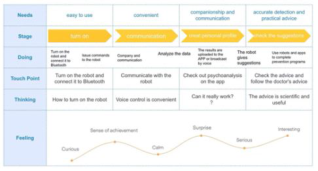
Figure 1: Survey of stressors for pregnant women.Figure 2: User journey map.
To demonstrate the usability of our product, we administered a question- naire to 31 randomly selected Asian women aged 25-35 who were pregnant or had been pregnant. We organized the main findings into a tree diagram (see Figure 1). In the questionnaire, we did not ask them directly whether they needed products to prevent depression but instead investigated the presence of stressors cited as sources of depression. The findings show that almost all modern Asian women experience these stressors during the perinatal period. During pregnancy, the fetus’s health, partner neglect, family stress, and lack of knowledge about childbirth may cause emotional stress to pregnant women (Chutima Roomruangwong. 2011). Therefore, to prevent depression, it is necessary to help pregnant women transform their negative emotions and increase the interest of their partners and families. However, such produ- cts are rare in the current market. This is why our practice innovation is necessary.
(2) To brainstorm according to the real data collected before and research findings, and then design interactive products that can practically solve the emotional care problems of pregnant women.
Through the previous research and survey, we clarified our design dire- ction. We researched the market for companionship products for vulnerable groups. The product we researched is a home robot focused on the health of the elderly. The primary function of this product is to monitor the health of the elderly. Regular monitoring can help prevent the onset of many diseases in the elderly. It prevents the occurrence of some elderly diseases by regular monitoring. After the research, we clarified that our design direction is to design a product to prevent perinatal depression. Figure 2 shows a user journey map based on our product development (see Figure 2).
Figure 3: The effect of MOMCARE show.
Figure available in the original PDF paper.
(3) The feasibility of emotion recognition is verified by experimenting with AI emotion recognition technology.
Based on the thinking in the QUESTION part, the AI technologies we chose are two kinds of facial recognition and voice recognition. We have made the following applications in the product, which can be seen in the user flow chart (see Figure 2): first, before using the product, the product remem- bers women’s faces and voices through face recognition technology and voice recognition technology; second, when conducting daily chats, the product analyzes the user’s verbal emotions and analyzes the user’s facial emotions, which requires the user to look at the camera as much as possible; third, in daily life Third, in everyday life, the robot records the voice information it can receive and performs emotion analysis. In this process, the application will record all the analysis results.
RESULT
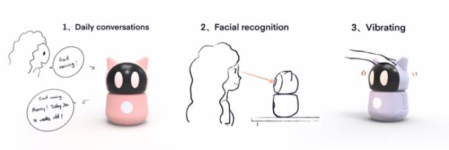
Introduction of the Physical Product MOMCARE is a home-use robot for preventing perinatal depression, which uses facial recognition technology, verbal emotion recognition technology, and traditional interaction to observe and record a woman’s emotional state. Figure 3 shows the effect of the product (see Figure 3). In this way, it can provide advice and methods to prevent depression to women, their fami- lies, and doctors. Its shape is mainly taken from a cat, which has a cute and warm visual effect and makes women feel friendly. Its material is also made of frosted material to reduce the industrial feeling. When communica- ting with MOMCARE, it imitates the way a toddler speaks, which allows the woman to feel that her child is with her. The most commonly used self-assessment questionnaires for perinatal depression are the Edinburgh Postpartum Depression Scale (EPDS) and the Beck Depression Inventory (BDI) (Chutima Roomruangwong, 2011), which MOMCARE asks users to complete periodically in the online app. MOMCARE also asks users to perform daily conversation tasks and then analyze the content of the conver- sations. The results are recorded in the app for the woman, her family, and her doctor to see. Based on the results, MOMCARE will recommend hea- ling and fetal education methods in the online app to help pregnant women
An Interactive Design Solution for Prenatal Emotional Nursing of Pregnant Women 483
transform their negative emotions and focus on the health of their fetuses. In addition, users can also share their experiences with other perinatal women in the online forum.
The CASIA Chinese Sentiment Corpus was recorded by the Institute of Automation, Chinese Academy of Sciences. Previous studies have shown that selecting a suitable corpus is necessary for the use of language recognition techniques. (Ramakrishnan S. 2013). So we applied this corpus to the emo- tional recognition of mom care, which can ensure recognition accuracy to some extent.
We arrange the facial recognition technology in face-to-face communica- tion between the user and the machine. Because the user is facing the camera at this stage, recognition accuracy can be ensured as much as possible. Before the voice recognition technology works, we need the user to record their voice on the application first to avoid recognizing other people’s voices.
In the experience of midwives and doctors, we have found that pregnant women rarely express their emotions with them, preferring to suffer alone or to talk to someone they trust. The benefit of using facial recognition and voice recognition technology in mom’s care is that we can identify emotional issues that doctors and family members don’t pick up on. These emotional issues may show up in their expressions or the tone of their speech. Since these two AI technologies alone cannot monitor 100% of pregnant women’s mood changes, we will also need pregnant women to fill out regular questionnaires and encourage them to communicate with the robot.
In the midwife’s experience, we learned that pregnant women need a fri- endly way to talk to each other (Fletcher A. 2021). In the survey of stress sources for pregnant women, we found that concern for the healthy growth of the fetus is one of the stress sources for pregnant women. The image of a baby will make a new mother feel close to her. Therefore, our robot simu- lates the cute speech and the appearance of a sharp and affectionate image of a small animal to achieve a visual and auditory approachable effect. Not only that, but we also divided the robot’s color into two colors, blue for male babies and pink for female babies, so that consumers can choose accor- ding to their preferences. To improve the product’s affinity, we did not use highly reflective material in the choice of material. Still, we decided to use fro- sted texture PVC material to the relationship of the product so that pregnant women from the tactile and visual feel warm.
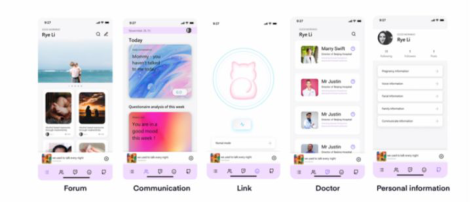
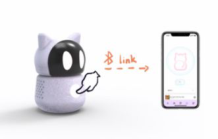
Interactive System Introduction The interaction system of momcare is mainly divided into these five parts: Connect, Forum, Find Doctor, My, and Communication (see Figure 4).
For the color design of the interaction system, we mainly use pink and blue, which corresponds to the color of our product. According to the principles of cognitive-behavioral therapy (Ju C H et al. 2008), we need to help pre- gnant women transform their negative emotions and guide their families and doctors to help them. Therefore, in the app, we record the pregnant woman’s emotional and health information and provide her with suggestions for tran- sforming her negative emotions in the system based on this information.
Family members and doctors can be paired with pregnant women to check their health status and thus increase their attention. Online psychological counseling is necessary because it is difficult for pregnant women to open up to real people. In the app, we provide online counseling services. In addition, pregnant women can also communicate in online forums and meet friends in similar situations. Figure 4 shows the framework of the whole interactive system (see Figure 5).
Display of Usage Effect There are three main parts to show the usage effect: daily usage (see Figure 6), daily task conversation (see Figure 7), and online app usage (see Figure 8).
An Interactive Design Solution for Prenatal Emotional Nursing of Pregnant Women 485
Figure 8: Online app usage.
DISCUSSION
MOMCARE can give emotional care to pregnant women. But MOMCARE still needs further improvement. How to ensure the accuracy of identification during the use of the product is an important issue. In addition, the pregna- ncy period is only a short year, so the sales model of the product needs to be considered in depth. We also need further experiments to verify whether MOMCARE is a practical product.
CONCLUSION
With the continuous development of artificial intelligence, more and more artificial intelligence products have entered our life (Lee H S. 2021). This study is aimed to help pregnant women prevent prenatal and postpartum depression and maintain their health through artificial intelligence intera- ction technologies. This study explores the solution with the help of artificial intelligence after studying the problem that prenatal and postpartum emoti- ons are neglected. As society develops, people are paying more attention to mental health issues. Although MOMCARE is a conceptual design, it is desi- rable to use emotion recognition technology to deal with mental health issues in the future. It seems only a matter of time before this design is applied in the future. There is still a long way to go for AI technology to be applied in reality.
REFERENCES
Austin, M.P., Priest, S.R. and Sullivan, E.A., 2008. Antenatal psychosocial assessment for reducing perinatal mental health morbidity. Cochrane Database of Systematic Reviews, (4). Bahreini, K., Van der Vegt, W. and Westera, W., 2019. A fuzzy logic approach to reli-
able real-time recognition of facial emotions. Multimedia Tools and Applications, 78(14), pp. 18943–18966. Beck, C.T., 2006. Postpartum Depression: It isn’t just the blues:. AJN The American Journal of Nursing, 106(5), pp. 40–50. Cho, H.J., Kwon, J.H. and Lee, J.J., 2008. Antenatal cognitive-behavioral therapy
for prevention of postpartum depression: a pilot study. Yonsei medical journal, 49(4), pp. 553–562. Fletcher, A., Murphy, M. and Leahy⣳Warren, P., 2021. Midwives’ experiences of caring for women’s emotional and mental well⣳being during pregnancy. Journal of Clinical Nursing, 30(9-10), pp. 1403–1416.
Hobfoll, S.E., Ritter, C., Lavin, J., Hulsizer, M.R. and Cameron, R.P., 1995. Depression prevalence and incidence among inner-city pregnant and postpartum women. Journal of consulting and clinical psychology, 63(3), p. 445. Jin, X., Liu, C., Xu, T., Su, L. and Zhang, X., 2020. Artificial intelligence biosensors:
Challenges and prospects. Biosensors and Bioelectronics, p. 112412. Lee, H.S. and Lee, J., 2021. Applying artificial intelligence in physical education and future perspectives. Sustainability, 13(1), p. 351. Ramakrishnan, S. and El Emary, I.M., 2013. Speech emotion recognition appro-
aches in human computer interaction. Telecommunication Systems, 52(3), pp. 1467–1478. Roomruangwong, C. and Epperson, C.N., 2011. Perinatal depression in Asian women: prevalence, associated factors, and cultural aspects. Asian Biomed, 5(2), p. 179. Samara, A., Galway, L., Bond, R. and Wang, H., 2019. Affective state detection via
facial expression analysis within a human–computer interaction context. Journal of Ambient Intelligence and Humanized Computing, 10(6), pp. 2175–2184. Sekhavat, Y.A., Sisi, M.J. and Roohi, S., 2021. Affective interaction: Using emotions as a user interface in games. Multimedia Tools and Applications, 80(4), pp. 5225–5253.
LISTED IN THE AHFE DIGITAL BOOKSTORE CATALOGUE
Explore the complete digital volume
Ergonomics In Design
Read this individual research paper free through the original publisher, or explore the full digital proceedings book.
ISBN 978-1-958651-23-0
Explore this ISBN in the AHFE Bookstore ↗Listed in the July 2026 bookstore catalogue; search by ISBN to confirm current availability · Digital book purchase optional