Catherine Neubauer, Kimberly Pollard, Kyle Benbow, Ashley Rabin, Daniel Forester (2024). Identification of Knowledge, Skills, Abilities and Other Behaviors to Predict Technological Fluency. In: Human Factors and Simulation. AHFE Open Access, vol. 139, pp. 35–45. https://doi.org/10.54941/ahfe1005022
In industry, academia, military, and the public sector, future operations will require humans to team with increasingly sophisticated and evolving technologies, including artificial intelligence (AI). Critically, these future intelligent technologies will be required to adapt in-field to keep pace with competition and other emerging needs. As such, operators and leaders in these domains will require increased technological aptitudes and skills to leverage their expertise and creativity to work with and adapt these intelligent technologies. We refer to this aptitude as technological fluency (TF), or the ability of operators to use and rapidly adapt new and intelligent technologies without formal training on these systems. Knowing an individual’s level of TF can assist in staffing or team composition decisions and can inform where training efforts are likely to be most needed or fruitful. Technological fluency is a complex concept, however, so it is crucial to understand what sorts of knowledge, skills, abilities, and other behaviors (KSBs) are required for individuals to become technologically fluent. Here, we outline five preliminary categories of KSBs that we believe underlie technological fluency within human-technology interaction domains. Future efforts will aim to develop refined practical measures of TF and to test which KSBs are most predictive of TF across contexts.
The digital revolution is progressing exponentially (e.g., Ghobakhloo, 2020). One of the most salient areas of growth in recent years, and perhaps the most impactful, has been in learning-capable artificial intelligence (AI). AI capa- bilities have demonstrated near-human, and sometimes superhuman, perfor- mance on highly complex tasks, thereby increasing productivity across almost every sector, especially for cognitive and computational tasks (Dwivedi et al., 2021). Although certain tasks currently performed by humans, and per- haps in some cases entire professions, may be delegated to AI (Huang and Rust, 2018; Webb, 2019), human-AI interactions will be critical for many,
perhaps most, future operations (O’Neill et al., 2022). This means that cor- porations, academia, military, and the public sector will increasingly need to make staffing and team-composition decisions based on the technological fluency of personnel. Furthermore, training of technological fluency (and/or of various skills that underpin it) will increasingly need to become a focus of onboarding and continuing education efforts. In this paper, we discuss the concept of technological fluency (TF) and discuss the relevance of knowl- edge, skills, abilities, and behaviors (KSBs) for TF that we believe may be most critical for technological fluency.
Problem Space One of the main challenges for human operators working with future AI technologies is that advances are poised to occur at increasingly faster rates, leaving little time for people to master novel functions and forcing people to confront a great deal of uncertainty. In this paper, we are interested in exam- ining whether some people are better equipped for navigating this rapidly advancing, and largely uncertain, technological landscape. Specifically, we seek to understand whether people differ in their abilities to instruct and operate these technologies to perform specific tasks, and, if so, how we can identify the attributes that facilitate better performance, what we are coining technological fluency (TF). We define TF as a competency wherein people’s knowledge, skills, and behaviors (KSBs) enable them to guide and operate novel, learning-capable systems toward near-optimal performance, with little-to-no formal training.
To begin laying the foundations for understanding TF, we conducted a vast literature review to understand the KSBs that contribute to people navigating similar challenges of the past, in addition to covering the burgeoning research in the domain of human-AI interactions (Neubauer et al., 2024). In the next section, we provide an explanation of how we are defining TF, followed by an overview of closely related concepts. Then, using our understanding of TF’s scope, we review KSBs that we believe are likely to facilitate TF, placing each KSB into one of five categories, which will be described forthwith. We then summarize our findings and discuss future research directions.
What Does It Mean to Be Technologically Fluent?
Because technology is changing so rapidly, and used in such a diverse range of domains, it is somewhat difficult to provide a one-size-fits-all definition for what an individual must have, understand, or convey to be considered tech- nologically fluent; however, the notion of adaptability seems to address key aspects of this question. This would include learning foundational material that would enable the acquisition of new skills, after the “formal” education is complete. In fact, Hatano and Inagaki (1986) describe adaptable experts as those who are able (by virtue of experience and depth of knowledge) to come up with solutions to unexpected or novel problems. They also differ- entiate between adaptable and routine experts who simply perform skills in a procedural manner, in situations that are relatively consistent. Adaptable experts can, in their opinion, apply conceptual knowledge to understand “the
Identification of Knowledge, Skills, Abilities and Other Behaviors 37
meaning and nature of their object” (Hatano and Inagaki, 1986, p. 263). We thus argue that the TF construct should be considered a multidimensional construct that encompasses both “crystalized” digital intelligence as well as a more “fluid”adaptable intelligence that can be observed as humans interact with technology.
This view of adaptability as a combination of expertise and the flexibility to transfer that expertise across contexts is the basis for TF. However, AI includes technologies that can themselves adapt and be adapted (modified) by human users. A TF individual therefore not only adapts their own behavior with evolving technologies, but they also drive and guide the technology to adapt its behavior to new situations and work goals. This human-guided adaptation of technology can be visualized as a sort of feedback loop in which the process of interacting with technology inherently calls for and changes the way we live and work.
Knowledge, Skills, Abilities, and Behaviors If TF is a desired outcome for individuals or organizations, it would be valuable to understand the fundamental human skills or tendencies that contribute to TF. Such underlying factors can include abilities, attitudes, tendencies, preferences, experience, competencies, or forms of knowledge. Together, we refer to these as knowledge, skills, abilities, and behaviors (KSBs). Understanding which KSBs are predictive of TF can facilitate recruit- ment efforts for technologically involved positions or inform individually focused teaching strategies. This understanding can also help guide technol- ogy developers in recognizing and meeting the needs of users with different KSBs.
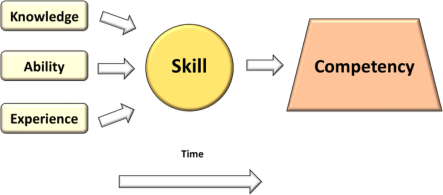
Basic KSBs, such as knowledge or certain experiences, are the building blocks on which a person’s competency in any skill domain develops over time. Developing and maturing knowledge through improved skill acquisi- tion over time generally results in what is known as competency acquisition (Eschenbrenner and Nah, 2014). In general, competencies are defined as a range of knowledge, abilities, and commitments required to accomplish a task well and efficiently, or to achieve professional goals (Teodorescu, 2006). These also include attitudes and beliefs that are driving factors for competent behaviors. According to Toth and Klein (2014), competencies are developed over time, as individuals gather knowledge and hone skills, and as the indi- vidual’s depth and knowledge of that skill increases through direct experience or on experience to related tasks (Eschenbrenner and Nah, 2014; Benilian, 2015). Figure 1 was inspired by the work of Carlton and Levy (2017) and illustrates how skill level increases through acquiring and developing abil- ities, knowledge, and experience. Practiced over time, these develop into competencies in those areas.
Modeling specific skills and competencies requires understanding how these are acquired and developed over time. Such competency models also outline the specific collection of KSBs and other characteristics that are required for effective performance in specific domains and job areas (e.g., Mansfield, 1996; Parry, 1996; Lucia and Lepsinger, 1999; Schippmann et al.,
2000; Rodriguez et al., 2002). In fact, certain predictors of TF (e.g., KSBs) may be critical components of skill acquisition and competency development in these areas. For example, Green (2005) measured self-reported informa- tion technology (IT) skill and found that factors such as younger age, greater education, openness, extraversion, positive constructions of the earliest tech- nological experience, and the belief in the flexibility of one’s computer skill significantly predicted digital fluency in a diverse sample. Here, having neg- ative beliefs about themselves (e.g., being unlucky or incapable), or about computers/digital technology (e.g., mysterious, or too complex), was a KSB that hindered development of digital fluency skills (Green, 2005). Therefore, to begin to understand TF, and various ways to measure, assess, and enhance this ability in individuals, it is crucial to first understand what those various KSBs might be and what evidence there is that they relate to TF.
Figure 1: Graphic representation of how skills are acquired over time to develop into competency.
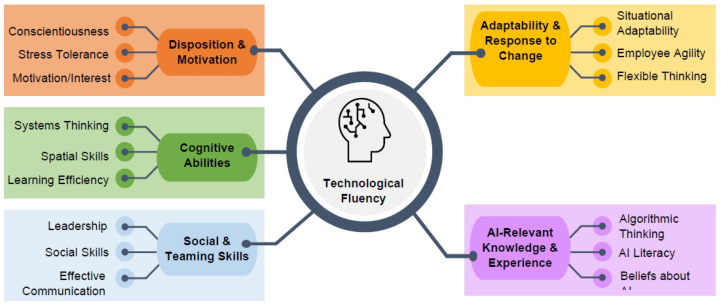
KSBs That Contribute to Technological Fluency For the purposes of this paper, we have decided to focus specifically on our definition of TF and the specific KSBs or predictors that we anticipate would enhance or augment an individual’s ability to use and adapt technology with- out the need for formal training. We group these KSBs into the following five categories: 1) Disposition and Motivation, 2) Cognitive Abilities, 3) Social and Teaming Skills, 4) Adaptability and Response to Change, and 5) AI- Relevant Knowledge and Experience. Figure 2 illustrates these five categories and a few examples of KSBs that fall within them. Below, we provide a brief description of each category of KSBs we considered and reviewed, along with a list of specific KSBs we included under each category. Detailed discussion of any specific KSB is beyond the scope of the current paper, but more detail can be found in Neubauer et al., (2024).
It should be noted that this is a preliminary list of what we consider to be promising predictors of TF, based on theory and current literature. We are not asserting that this list is exhaustive, nor that each KSB on the list is entirely free of overlap with other KSBs. Many of the KSBs discussed are related to one another. This list of KSBs will of course need to be empirically validated within experimental settings to determine whether they do indeed predict TF or whether the list needs to be adjusted. Further empirical test- ing and evaluation are needed to determine which of these KSBs are most
Identification of Knowledge, Skills, Abilities and Other Behaviors 39
predictive of TF with highly advanced technologies such as learning-enabled AI. Further empirical testing is also needed to uncover which of these KSBs are most broadly predictive of TF across domains. We anticipate that identifying, and perhaps even training, some of these KSBs can help ensure competency development in TF.
Figure 2: Infographic of five KSB categories and select examples of each as they relate to technological fluency.
Category 1: Disposition and Motivation Disposition and motivation refer to relatively stable patterns of thoughts, feelings, drives, and tendencies that define an individual’s unique character or viewpoint; however, they can also be influenced by situational fac- tors (some more than others). Relevant KSBs that fall within this category include extraversion, agreeableness, conscientiousness, neuroticism, openness to experience, stress tolerance, self-efficacy and self-confidence, motivation and (vocational) interest, and self-directed learning and proactive personal- ity. Some studies suggest that certain dispositions or motivational traits may be predictive of TF. For example, a study by Oksanen et al., (2020) found that individuals high in openness were more likely to trust AI robots, which may relate to adaptability and willingness to explore new methods and ideas, aiding in the incorporation of AI and future technologies by fostering innova- tive approaches and embracing change. Further, a general willingness to work with, perform, or drive change in technological usage and adaptation relates to motivation and (vocational) interest. According to Green (2005), motiva- tion to use Internet technologies appears to initiate as a developmental path starting first with extrinsic motivational factors (e.g., duty, need), which then shifts into an intrinsic/extrinsic mixture of factors for usage (e.g., diversion, entertainment, membership into a technological culture); however, intrinsic motivational factors may be a more prominent predictor of TF. Finally, self- directed learning (SDL) skills are also expected to be required when learning with technological systems (Azevedo et al., 2004), as users must search, vet, and integrate information from digital sources (Greene et al., 2014). Here,
TF individuals will need to learn technology and AI-related information and behaviors on the fly, be proactive, and not wait for someone to teach them.
Category 2: Cognitive Abilities Cognitive abilities refer to the mental processes that individuals use to acquire, process, and apply information and may can be crucial KSBs that enhance TF in individuals. Relevant KSBs that fall within this category include general and (logical) reasoning, probabilistic thinking and pattern recognition, spatial skills, graph literacy, numeracy, general cognitive ability, cognitive biases, systems thinking and strategic thinking, working mem- ory, theory of mind, learning efficiency, and metacognition. In this context, several researchers have developed frameworks that examine how reason- ing interacts with AI technologies including the Joint Cognitive Systems (JCS) framework (Woods et al., 2006). The JCS framework posits that the collaboration between both the human and AI systems is integrated and complementary where humans contribute reasoning capabilities and AI contributes to processing vast amounts of data, pattern recognition, and computation speed. Additionally, some work has demonstrated the efficacy of probabilistic reasoning (i.e., a skill that allows an individual to navigate uncertainty by using probabilities and identifying trends in regular or irreg- ular data) in optimizing resource allocation strategies, and interpretation of AI-generated insights (Silverman et al., 2019). Others have underscored the importance of accurate probabilistic interpretations in bolstering the relia- bility of AI systems, particularly in critical domains such as medical risk (Fagerlin et al., 2007) and financial forecasting (Chen and Zhu, 2020).
Category 3: Social and Teaming Skills As AI and advanced technologies continue to permeate industries and organizations, people will increasingly find themselves operating in mixed human-autonomy teams, where social skills vital to effective functioning in human-human teams are likely to continue to be valuable in human- machine teams (Lakhmani et al., 2022). KSBs we have placed in this category include cultural awareness, social skills and teamwork, leadership and project management, and effective communication. These types of skills generally facilitate effective collaboration and allow TF individuals to collaborate with others. Additionally, Techataweewan and Prasertsin (2018) specifically called out collaboration skills as one of four other factors that are vital for enhanc- ing digital and technological fluency. These authors further outlined that collaboration skills within digital domains consist of using digital technolo- gies in collaboration with others, either as the leader or a member of a team, by working together to achieve team goals.
Category 4: Adaptability and Response to Change Technology is advancing at a rapid and accelerating pace, with some advanced forms of AI even capable of updating their models and chang- ing their behavior in real time. This rapid change and unpredictability put
Identification of Knowledge, Skills, Abilities and Other Behaviors 41
tremendous pressure on the human to be flexible in their thinking and strate- gies, to adapt to new conditions, and to have enough comfort with change and uncertainty to remain focused and effective in their tasks. A person’s abil- ity to adapt not just themselves but also to adapt elements of the situation, including the AI, will be vital. Under this category, we place the KSBs of sit- uational (general) adaptability, employee agility, flexible thinking/cognitive flexibility, and comfort with uncertainty vs. need for cognitive closure. For example, individuals who are flexible in their ways of thinking (i.e., those with a propensity to adapt to new situations with less resistance; Barak and Levenberg, 2016) may be able to adapt to, as well as drive technological adaptation, and can effectively use new technologies faster than those with more rigid thinking (Barak and Levenberg, 2016). This KSB may allow indi- viduals to adapt, re-strategize, or restructure their plan of action to complete a task goal when faced with novel or unexpected situations, both of which may be readily apparent when working with new or evolving technology.
Category 5: AI-Relevant Knowledge and Experience In the context of AI, direct experience with AI or knowledge of it can be important in ensuring that individuals use AI technologies effectively and accurately. For example, individuals who have expertise in data analysis can ensure that the data input into the AI system is accurate and reliable. Sim- ilarly, individuals who have expertise in the field in which the AI system is being used can ensure that the output generated by the system is relevant and useful. KSBs that fall within this category include knowledge, general under- standing of AI, computational thinking, digital literacy, beliefs about AI, algorithmic thinking, AI literacy, propensity to trust in technology and trust calibration, and video gaming experience. Someone with these KSBs would have a general knowledge of how AI works, what the processes are, and how to best use those capabilities. Proficiency enables them to use AI correctly, as intended, and in the right situations. Conversely, a lack of understand- ing can result in unintentional misuse, whereas high proficiency may lead to creative and beneficial unintended uses and ensuring that users are able to identify where novel technologies break down. Moreover, beliefs about AI are linked to proficiency in technological tasks because individuals who believe in AI’s superiority are more motivated to adopt and effectively use AI-driven tools and advice (Von Walter et al., 2021). Moreover, AI literacy and computational thinking exhibit a positive association, wherein compu- tational thinking facilitates the understanding, recognition, and evaluation of AI-based technologies (Celik, 2023). This synergy between computational thinking and AI literacy underscores the interconnectedness of cognitive skills and AI proficiency.
CONCLUSION
In this paper, we introduced our definition of TF: the ability for individu- als and teams to rapidly use and adapt new technology without the need for formal training. Of great interest to our group is exploring which KSBs may be predictive of TF, especially in the context of operating with AI or
other advanced technologies. We summarized five categories of KSBs that we believe may be related to TF. A tremendous amount of work remains to be done in the study of these KSBs and in the realm of TF. Future work is needed to develop more refined models, improve measurement methods, and test KSBs against a variety of technological performance domains. Understand- ing these relationships will be critical for recruitment, team composition, and training efforts for ensuring a technologically fluent workforce of the future.
Furthermore, “technology” is a broad category, and different technologies may require different competencies. Thus, it may be a valuable exercise to develop a technology taxonomy wherein technologies are categorized based upon the characteristics required of the user. To undertake this task, descrip- tors that define the interaction between the technology and the user must be identified and defined. Developing a uniformed language to describe these interactions is necessary to clarify the relationship between specific KSBs and TF across the range of technologies. Characterizing the technologies that a specific assessment or KSB applies to may be a task that is as difficult as generating the list of KSBs or assessments in the first place. For example, spe- cific aspects of a technology may require different sorts of problem solving or attention abilities, and specific behaviors of a technological system may require different social skills and personality attributes.
Nonetheless, in domains where technologies or task needs are unpre- dictable or change rapidly, it may be prudent to select personnel based on KSBs that are found to be the most broadly predictive across different forms of technological performance. Many KSBs discussed in this document have been associated with technological performance across multiple technologies or technology domains, such as spatial ability, video gaming experience, and general adaptability. These and other KSBs may be prime candidates to con- sider when selecting personnel for rapidly changing or highly unpredictable technological environments (Pollard et al., 2022).
In addition to the development of a taxonomy of technology, there is a need to develop a model of how the individual characteristics defined by the KSBs influence TF performance. A good model developed from a solid theoretical base or empirical evidence will provide the necessary framework for further empirical testing of TF. Although it is often impractical to explore the rela- tionships of all KSBs with TF performance, a model will allow researchers to undertake smaller, more practical studies that explore individual paths or elements of the model, allowing the community to generate a body of evidence.
Although we expect that performance with virtually any digital technol- ogy (especially ones that were relatively cutting edge for their time) can be an informative proxy for TF, we acknowledge that we are on the cusp of another technological revolution. We also acknowledge that the ability to per- form with future AI may require substantially different skill sets than those that were required by earlier Internet, home computer, or early robotics tech- nologies. Empirical studies are needed to determine the extent to which the required KSBs are truly new or whether the KSBs that have always been asso- ciated with technological prowess will continue to be associated with TF in
Identification of Knowledge, Skills, Abilities and Other Behaviors 43
the future. In addition, few studies have examined KSBs in the context of mul- tiple types of advanced technologies. This is the information that we need to determine the generalizability of any KSB’s predictive power. Gathering these data will be a major thrust in our own future research.
ACKNOWLEDGMENT
The views and conclusions contained in this document are those of the authors and should not be interpreted as representing the official policies, either expressed or implied, of the Army Research Laboratory or the U.S. Government. The U.S. Government is authorized to reproduce and distribute reprints for Government purposes notwithstanding any copyright notation herein.
REFERENCES
Azevedo R, Cromley JG, Seibert D. Does adaptive scaffolding facilitate students’ ability to regulate their learning with hypermedia? Contemporary Educational Psy- chology. 2004;29(3):344–370. https://doi.org/10.1016/j.cedpsych.2003.09.002 Barak, M., Levenberg, A. (2016) Flexible thinking in learning: An individual differ-
ences measure for learning in technology-enhanced environments. Computers & Education, Volume 99, pp. 39–52. https://doi.org/10.1016/j.compedu.2016.04. 003 Benilian, A. (2015). IT feature use over time and its impact on individual task performance, Journal of the Association for Information Systems Volume 16, No. 3, pp. 144–173. Carlton, M., Levy, Y. (2017). Cybersecurity skills: Foundational theory and the
cornerstone of advanced persistent threats (APTs) mitigation, Online Journal of Applied Knowledge Management Volume 5, No. 2, pp. 16–28. Celik, I. (2023). Towards intelligent-TPACK: An empirical study on teachers’ professional knowledge to ethically integrate artificial intelligence (AI)-based tools into education. Computers in Human Behavior, Volume 138, pp. 107468. https: //doi.org/10.1016/j.chb.2022.107468 Chen, L., Zhu, Z. (2020). Probabilistic neural networks: Foundations and applica-
tions. IEEE Transactions on Neural Networks and Learning Systems, Volume 31, No. 8, pp. 2827–2841. Conway, A. R. A., Kane, M. J., Bunting, M. F., Hambrick, D. Z., Wilhelm, O., Engle, R. W. (2005). Working memory span tasks: A methodological review and user’s guide, Psychonomic Bulletin & Review, Volume 12, No. 5, pp. 769–786. https: //doi.org/10.3758/BF03196772 Costa, P. T., McCrae, R. R. (2008). The revised neo personality inventory (NEO-
PI-R). The SAGE handbook of personality theory and assessment (pp. 179–198). SAGE. Dwivedi, Y. K., Hughes, L., Ismagilova, E., Aarts, G., Coombs, C., Crick, T., Duan, Y., Dwivedi, R., Edwards, J., Eirug, A., et al. (2021). Artificial intelli- gence (AI): Multidisciplinary perspectives on emerging challenges, opportunities, and agenda for research, practice and policy, International Journal of Information Management, Volume 57, pp. 101994. Eschenbrenner, B., Nah, F. F.-H. (2014). Information systems user competency:
A conceptual foundation, Communications of the Association for Information Systems Volume 34, pp. 1363–1378.
Fagerlin, A., Zikmund-Fisher, B. J., Ubel, P. A., Jankovic, A., Derry, H. A., Smith, D. M. (2007). Measuring numeracy without a math test: Development of the subjective numeracy scale. Medical Decision Making, Volume 27, No. 5, pp. 672–680. Ghobakhloo, M. (2020). Industry 4.0, digitization, and opportunities for sustain-
ability, Journal of Cleaner Production Volume 252, p. 119869. Green, R. M. (2005). Predictors of digital fluency [Ph. D. Dissertation]. Dissertation Abstracts International Section A: Humanities and Social Sciences. Greene, J. A., Yu, S. B., Copeland, D. Z. (2014). Measuring critical components
of digital literacy and their relationships with learning. Computers & Education, Volume 76, pp. 55–69. https://doi.org/10.1016/j.compedu.2014.03.008 Hatano, G., Inagaki, K. (1986). Two courses of expertise. In: Stevenson, H., Azuma, H., & Hakuta, K., (Eds), Child development and education in Japan (pp. 262–272). W. H. Freeman and Company. Huang, M. H., Rust, R. T. (1997). Artificial intelligence in service, Journal of Service
Research Volume 21, No. 2, pp. 155–172. Lakhmani, S., Neubauer, C., Forster, D. E., Wright, J., Krausman, A., Berg, S., Schaefer, K. E. (2022). Cohesion in human-autonomy teams: An approach for future research, Theoretical Issues in Ergonomic Science. https://doi.org/10.1080/ 1463922X.2022.2033876 Lewin, K. (1935). A Dynamic theory of personality. McGraw-Hill. Lucia A, Lepsinger R. (1999). The art and science of competency models: Pinpointing
critical success factors in organizations. San Francisco, CA: Jossey-Bass/Pfeiffer. Mansfield RS. (1996). Building competency models: Approaches for HR professionals, Human Resource Management Volume 35, pp. 7–18. Neubauer, C., Pollard, K. A., Benbow, K., Rabin, A. H., Forster, D. E., Nguyen,
R., Kochert, J., Bonsignore, E., Campbell, S. (in press). Measuring and Predicting Technical Fluency: How Knowledge, Skills, Abilities, and Other Behaviors Can Contribute to Technological Savviness (Report No. ARL-TR-XXXX). Aberdeen Proving Ground, MD; DEVCOM Army Research Laboratory. Oksanen, A., Savela, N., Latikka, R., Koivula, A. (2020). Trust toward robots and artificial intelligence: An experimental approach to human–technology interac- tions online. Frontiers in Psychology, Volume 11, pp. 568256. O’Neill, T., McNeese, N., Barron, A., Schelble, B. (2022). Human–autonomy team-
ing: A review and analysis of the empirical literature, Human Factors Volume 64, No. 5, pp. 904–938. Parry, S. B. (1996). The quest for competencies, Training, Volume 33, No. 48–54. Pollard, K. A., Files, B. T., Oiknine, A. H., Dalangin, B. (2022). How to prepare for rapidly evolving technology: Focus on adaptability (Report No. ARL-TR-9432). U. S. DEVCOM Army Research Laboratory. Rodriguez, D., Patel, R., Bright, A., Gregory, D., Gowing, M. K. (2002). Develop-
ing competency models to promote integrated human resource practices, Human Resource Management Volume 41, pp. 309–324. Schmit, M. J., Ryan, A. M. (1993). The big five in personnel selection: Factor structure in applicant and nonapplicant populations, Journal of Applied Psychology Volume 78, No. 6, pp. 966–974. https://doi.org/10.1037/0021-9010.78.6.966. Schippmann, J. S., Ash, R. A., Battista, M., Carr, L., Eyde, L. D., Hesketh, B.,...
Sanchez, I. (2000). The practice of competency modeling, Personnel Psychology, Volume 53, pp. 703–740.
Identification of Knowledge, Skills, Abilities and Other Behaviors 45
Silverman, J., Purshouse, R. C., Fleming, P. J. (2019). Probabilistic model predictive control: theory and applications. IEEE Transactions on Automatic Control, Volume 64, No. 10, pp. 4129–4151. Stark, S., Chernyshenko, O. S., Drasgow, F., Nye, C. D., White, L. A., Heffner, T.,
Farmer, W. L. (2014). From ABLE to TAPAS: A new generation of personality tests to support military selection and classification decisions, Military Psychology, Volume 26, No. 3, pp. 153–164. https://doi.org/10.1037/mil0000044. Techataweewan, W., Prasertsin, U. (2018). Development of digital literacy indicators for Thai undergraduate students using mixed method research, Kasetsart Journal of Social Sciences, Volume 39, No. 2, pp. 215–221. Teodorescu, T. (2006). Competence versus competency: what is the difference? Per-
formance Improvement Volume 45, No. 10, pp. 27e30. https://doi.org/10.1002/ pfi.027 Toth, P., Klein, P. (March 2014). A role-based model for federal information technology/cyber security training. National Institute of Standards and Technology. https: //csrc.nist.gov/publications/drafts/800-16-rev1/sp800_16_rev1_3rd-draft.pdf Von Walter, B., Kremmel, D., Jäger, B. (2021). The impact of lay beliefs about
AI on adoption of algorithmic advice. Marketing Letters, Volume 33, No. 1, pp. 143–155. https://doi.org/10.1007/s11002-021-09589-1. Webb, M. (2019) The impact of artificial intelligence on the labor market (No.
3482150). SSRN. Woods, D. D., Hollnagel, E. (2006) Joint cognitive systems: Patterns in cognitive systems engineering. CRC Press.
LISTED IN THE AHFE DIGITAL BOOKSTORE CATALOGUE
Explore the complete digital volume
Human Factors and Simulation
Read this individual research paper free through the original publisher, or explore the full digital proceedings book.
ISBN 978-1-964867-15-1
Explore this ISBN in the AHFE Bookstore ↗Listed in the July 2026 bookstore catalogue; search by ISBN to confirm current availability · Digital book purchase optional