Susan Campbell, Rosalind Nguyen, Elizabeth Bonsignore, Breana Carter, Catherine Neubauer (2023). Defining and Modeling AI Technical Fluency for Effective Human Machine Interaction. In: Human Factors in Robots, Drones and Unmanned Systems. AHFE Open Access, vol. 93, pp. 19–28. https://doi.org/10.54941/ahfe1003743
1 College of Information Studies, University of Maryland, College Park, MD 20742 USA; Applied Research Laboratory for Intelligence and Security, University of Maryland College Park, MD 20740 USA ↗↗
2 Department of Psychology, University of Maryland, College Park, MD 20742, USA ↗
3 College of Information Studies, University of Maryland, College Park, MD 20742 USA ↗
4 DEVCOM Army Research Laboratory, Aberdeen Proving Ground, MD, USA ↗
Working and interacting with artificial intelligence (AI) and autonomous systems is becoming an integral part of many jobs both in civilian and military settings. However, AI fluency skills, which we define as competencies that allow one to effectively evaluate and successfully work with AI, and the training that supports them have not kept pace with the development of AI technology. Specific subgroups of individuals who work in these areas, such as cyber and emerging technologies professions, are going to be required to team with increasingly sophisticated software and technological components, while also ensuring their skills are equivalent and not ‘overmatched’ by those of the AI. If not addressed, short term consequences of this gap may include degraded performance of sociotechnical systems using AI technologies and mismatches between humans’ trust in AI and the AI’s actual capabilities. In the long term, such gaps can lead to problems with appropriately steering, regulating, and auditing AI capabilities. We propose that assessing and supporting AI fluency is an integral part of promoting future appropriate use of AI and autonomous systems. The impact of AI fluency on the successful use of AI may differ depending on the role that the human has with the agent. For example, agents built on machine learning may update their behavior based on changes in the environment, changes in the task, or changes in input from humans. When an agent changes its behavior, humans must detect and adapt to the change. Furthermore, future agents may require human input to learn new behaviors or shape existing practices. These examples, where further intervention is needed from the human, emphasize the cyclic relationship between the agent and the human. However, humans vary in their ability to detect and respond to such changes based on their skills and experience. This example is just one potential aspect of the impact of one’s AI fluency on future human-AI interactions. To increment towards optimal performance, it is crucial to understand how and where differences in various aspects of AI fluency may help or hinder successful use of AI. The impact of AI fluency will be even stronger in the domain of interaction with autonomous systems built on AI technology, where agents may exhibit physical and information behaviors that affect human teammates’ safety. In this paper, we present a working definition and initial model of AI Technical Fluency (ATF) that relates predictors of ATF to potential outcome measures that would reflect one’s degree of ATF, including having accurate mental models of agents and the ability to interact with or use agents successfully. Additionally, we propose a preliminary set of assessments that might establish an individual’s ATF and discuss how (and the degree to which) different aspects of ATF may impact the various outcome measures. By gaining a better understanding of what factors contribute to one’s ATF and the impacts and limitations of ATF on the successful use of AI, we hope to contribute towards the ongoing research and development of new methods of interactions between humans and agents.
As artificial intelligence (AI) and autonomous systems become ubiquitous in our everyday lives, it is becoming increasingly important for one to under- stand their impact and limitations in our society. From civilian to military settings, AI is being used in various contexts and age groups to achieve a wide array of goals. For example, AI systems underpin the social media platforms that people use, chatbots that can help them with daily tasks, the increasingly procedurally-generated video games they play, streaming services that recom- mend what they should watch next, or voice assistants they use at home. Moreover, AI has impacted almost every field, from healthcare to agricul- ture and gaming to education (Balakrishnan et al., 2020), with AI-related job postings increasing internationally since 2013 (Zhang et al., 2021). Yet, while the use of technology has exponentially increased, research has shown that
the conceptual knowledge behind its use is lacking (Sardone, 2011). The lag of technical fluency behind the rapid development of AI technology has seve- ral consequences. On an individual level, people may over or under trust AI assistants and algorithms. On a societal level, AI systems may create power imbalances between groups that understand systems and groups that do not have such access or understanding. Thus, research and support in develo- ping and assessing technical fluency is not only fundamentally beneficial at all levels, but is critical to increasing the benefits of these systems that have become part of the infrastructure of daily life. Our overarching goal is to begin to operationalize the working construct of AI fluency and, from that construct, develop a working model to help guide and inform future research.
OVERVIEW OF RELATED WORK AND APPROACH TO ANALYSIS To frame our process, we first provide a synopsis of salient literature that we analyzed to arrive at our model of ATF. We then outline the analytic approach we followed to survey the broader expanse of established literature related to information and technology literacy frameworks as well as emerging work on AI education and AI literacy. Last, we outline the iterative analysis process we followed to develop and shape the components of the initial ATF model.
Related Work
While there is a consensus around the importance of technical fluency, a review of the relevant literature demonstrates that fluency has been hard to define and distinguish from the related concept of literacy. Within the langu- age domain, literacy is generally seen as being able to write and understand a language. On the other end, fluency goes beyond literacy and allows one to create something new from the language to express themselves. In other words, literacy is being able to use a tool while fluency is having a deep enough understanding to create something new with the tool. This metaphor can be extended into the context of AI and technology. Several definitions of AI technical literacy and fluency have been proposed. For example, Long and Magerko (2020) defined AI literacy as a set of competencies that enables individuals to critically evaluate AI technologies; communicate and collabo- rate effectively with AI; and use AI as a tool online, at home, and in the workplace. In a report from the National Research Council (1999), flue- ncy with information technology is characterized as being able to express oneself creatively, reformulate knowledge, and synthesize new information. Finally, Barak (2017) conceptualized Information and Communication Tech- nology (ICT) literacy as the ability to use digital technologies, computers, communication tools, and related devices and applications to access, manage, create, and communicate information to meet individual and social goals. While there is no clear line that distinguishes literacy from fluency, there are commonalities among the definitions proposed.
Once one defines technical fluency, the question remains of whether and how it can be trained. In a review by Ng et al. (2021), the authors introduced a coding framework which identifies four aspects of promoting AI literacy: 1) know and understand AI, 2) use and apply AI, 3) evaluate and create AI and
Defining and Modeling AI Technical Fluency 21
4) AI ethics. We focused mostly on literature that falls into aspects 1 & 2 and found some guidelines and frameworks centering around the development of technical fluency. For example, a discussion paper of key issues around edu- cating, teaching, and learning AI identified five pillars or elements necessary to support teachers and learners’ capacity development for the use of AI : 1) Uncertainty & Randomness, 2) Coding and Computational Thinking Skills, 3) Data Awareness, 4) Critical Thinking, and 5) Post AI Humanism (Higu- era, 2019; Eguchi, Okada and Muto, 2021). Similarly, AI4K12, an initiative that is developing guidelines for AI education, proposed five big ideas in AI education: 1) Perception, 2) Representation & Reasoning, 3) Learning, 4) Natural Interaction, and 5) Societal Impact (Association for the Advancement of Artificial Intelligence/AAAI and Computer Science Teachers’ Associatio- n/CSTA, 2020). With regards to particular pedagogical methods, Dwivedi et al. (2021) explored the machine teaching aspects of participatory machine learning (ML) (Vartiainen et al., 2020) with children in order to guide future interfaces and early educational experiences. They found that certain infor- mation and activities such as revealing confidence scores, allowing for model swapping, and enabling quick data inspection facilitated basic learning of AI concepts. Thus, existing research, guidelines, and methods indicate that tech- nology fluency is amenable to several different approaches to training and education.
Assessing these training and education methods requires a reasonable method of assessing technical fluency. Because there is no strong consensus on the operationalization of ATF, standardized measures are currently not possible. However, researchers have attempted to measure AI fluency related outcomes both qualitatively and quantitatively.
Qualitative measures are usually administered after some sort of instru- ctional intervention to gauge whether the intervention was effective. For example, Kaspersen, Bilstrup and Petersen (2021) developed their Mach- ine Learning Machine (MLM), a tangible user interface designed to allow students to iteratively build their own ML models. To gauge students’ know- ledge and experience with learning basic concepts of ML, they used pre- and post-interviews, including questions around ML use and design (Kaspersen, Bilstrup and Petersen, 2021).
Quantitative measures include context/content specific exams (e.g., class exam, work agency test) or a subset(s) of existing standardized measures that are deemed reflective of AI and/or technical fluency. For example, the aforementioned study by Sardone (2011) examining the effect of learning sty- les on teaching technology fluency used a Dantes Subject Standardized Test (2004; 2023) as a dependent variable. Finally, while there are few standardi- zed outcome measures for technical fluency, some researchers have begun to develop their own or have subsetted items from other standardized measu- res. For example, in an effort to promote AI literacy through ethics framing, exposure to AI-enhanced careers, and relating AI to the students’ daily lives, Zhang et al. (2022) conducted a Developing AI Literacy (DAILy) workshop. Learning outcomes were measured before and after the workshop with three instruments: a content specific measure, a scale measuring AI attitudes, and a career interest questionnaire. In sum, prior work has attempted to capture
outcomes related to AI and technology fluency, but there are no standard measures. As the field comes to uncover more aspects of fluency, we hope to develop measures to assess ATF.
Methodology: Analytic Approach To arrive at the related work synthesis described above, we began with a sco- ping overview of the expansive literature on technology and digital literacies as well as the emerging literature on AI literacy. Given that the concept of AI literacy and AI fluency are both offshoots of existing literacy frameworks based on the rapid development of AI technologies, platforms, and tools, we opted to follow a combined scoping and state-of-the-art review process (Grant and Booth, 2009). A scoping review was an effective sensitizing appro- ach, given that AI has been established as a field of interest across multiple disciplines for decades. In addition, all the authors of this paper are experie- nced in distinct, but interrelated fields (cognitive science, human-computer interaction, psychology, learning sciences, digital/computing literacies), so each could offer starting points for scoping. As a complement to the sco- ping review, a state-of-the-art review provides a snapshot of the current state of knowledge and affords a means for identifying potential opportunities for new and emerging work (Grant and Booth, 2009). This approach yielded articles ranging from more traditional information and technology literacies (National Research Council, 1999) and technical skills/training overviews (Pollard et al., 2022) to emerging frameworks from human-computer inte- raction design (Long and Magerko, 2020) and education and computing research (Ng et al., 2021). In addition to general terms such as “digi- tal literacy,” “information literacy,” “technology literacy”, authors scanned papers on systems thinking, cognitive models (e.g., procedural flexibility), computational thinking, adaptive expertise, and future of work/workforce development. To organize and structure our review, we maintained annota- ted bibliography notes with brief summaries and notes related to knowledge, skills, behaviors, dispositions, and mental models that we were uncovering in our search.
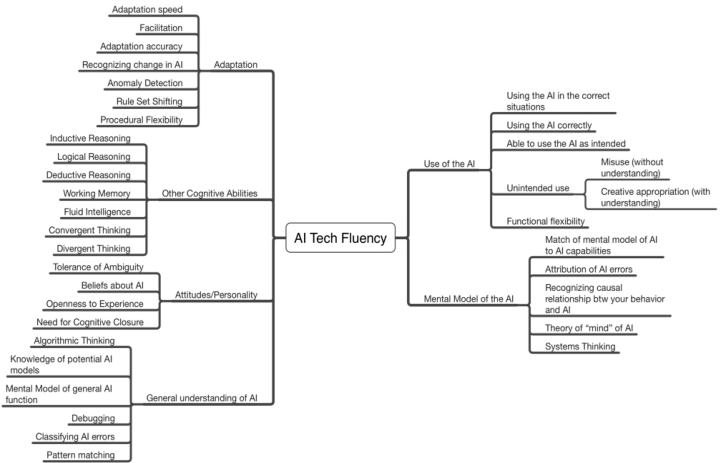
Simultaneous with this review process, the authors engaged in several rounds of thematic coding (Onwuegbuzie, Frels and Hwang, 2016) to iden- tify specific aspects of knowledge, skills, behaviors, and abilities that may contribute to a comprehensive understanding of AI tools and technologies on the one hand and effective or reflective use of AI systems on the other (which gradually evolved into Figure 1). After reviewing an initial set of arti- cles, we used a digital whiteboard tool, Google’s JamboardTM (Google LLC, 2016), to begin open coding. Initial open coding followed a frequency analy- sis approach, wherein we added terms and phrases that appeared frequently across various literacy definitions and competencies. Some examples of these commonalities are the “ability to use”, “be able to adapt to rapidly changing technologies”, and “ability to create new technologies”. We iteratively com- bined some concepts while adding more details to others, following several rounds of thematic coding and discussion to arrive at the main categories of our initial model.
Defining and Modeling AI Technical Fluency 23
Figure 1: Model of AI Technical Fluency (ATF). The left side of the model focuses on factors that contribute to the development of ATF; the right side of the model focuses on outcomes or emergent states that reflect one’s degree of ATF.
To provide workforce-related framing to our analysis, we applied a priori coding categories that loosely combined the knowledge, skills, and attitudes, or KSAO job attributes model (American Psychological Association, 2023) and the US Army’s knowledge, skills, and behaviors (KSB) framework (Koch et al., 2018; Lockhart, 2020). Although the KSAO/KSB framework guided the process of arriving at the initial ATF model, we remained open to adding new concepts and terms (e.g., having a sense of AI ethics, engaging creati- vely and collaboratively with AI systems). To add another dimension to our analysis that could allow for how ATF can be demonstrated by an individual’s effective and creative use of AI, we conceived of a spectrum of AI use, from a “functional” aspect (i.e., the use of a tool, or in this case, technology) to “expressive”aspect (i.e., having a deep enough understanding to create some- thing new with the tool, or in this case being able to reformulate, express, and create technology). We propose that both the functional and expressive com- ponents represent critical aspects in thinking about how a technically fluent individual can engage with, and respond to AI systems and tools. That is, to go beyond AI literacy, we argue that performance should go beyond functio- nal use (e.g., rote memorization) and encompass expressive use (e.g., creating new technology).
PROPOSED DEFINITION, FRAMEWORK, AND MODEL Our analysis resulted in a working definition of AI Technical Fluency as a set of competencies and attributes that allow people to learn and use AI- based systems effectively and creatively. We propose a model that maps
out pathways between predictors to ATF (KSABs) and potential outcome measures that reflect an individual’s degree of ATF. Effectively, the model also affords educators and trainers with a means for designing AI learning activities as well as a means for assessing ATF outcomes and actions.
Overview of the ATF Model To structure, inform, and guide subsequent work on ATF, we propose a wor- king conceptual model of ATF as shown in Figure 1. ATF is represented as a box that sits at the center and contains a set of to-be-defined and evolving components (knowledge, skills, abilities, and behaviors). To the left side of ATF are factors and their sub-components that may contribute to the overall development of ATF, and to the right side are outcomes or emergent states and their sub-components that reflect one’s degree of ATF. The left and right side of the model allow us to conceptualize the progression of research in understanding and assessing ATF to be of two sorts: 1) those that focus on the factors that lead to the development of AI technical fluency, and 2) those that focus on the processes and outcomes that come into play when AI tech fluency is “at work” or “in use”. Categorical components and their sub- components should not be viewed as discrete or separate from each other, either within or across categories. For example, working memory may play a role in anomaly detection and rule set shifting and beliefs about AI may place a role in adaptation.
As we iterate through and test the model, clusters of factors and their individual sub-components on either side of the model may become core factors in ATF. The multidimensionality and continuous nature of ATF have implications for its conceptualization and measurement, however. First, one’s demonstrated successful use of AI may reflect literacy but not be sufficient for fluency. For example, an individual who uses Google Maps may be able to get to their destinations most of the time, but then fail on a particular route and be unable to troubleshoot because they lack the understanding of the ways that Google Maps gathers data from the environment. Secondly, one’s degree of ATF is constantly tested against the rapid changes and adaptati- ons of a particular technology or class of technologies. That is, one’s degree of ATF may change as the technology adapts and evolves. To demonstrate a high degree of ATF continually, one must be in step with these changes and adaptations.
The measurement of ATF is necessarily contextual – one’s performance with and understanding of a particular system reflects practice with that system as well as underlying competencies that allow development of per- formance. The contextual nature of measurement means that a variety of measurement situations may be required to identify ATF as distinct from extensive practice with a specific system.
Factors Contributing to the Development of ATF In the initial model, we distinguished between factors that contribute to the development of ATF and outcomes that flow from ATF, though we expect that developing ATF may also improve the cognitive abilities and other
Defining and Modeling AI Technical Fluency 25
characteristics that enable ATF. We clustered these factors into four broad categories: understanding of AI, attitudes and personality, adaptation, and other cognitive abilities.
A general understanding of AI can contribute to ATF by enabling the con- struction of better mental models and a calibration of expectations for AI performance. In addition, people who have a higher awareness of algori- thms are more likely to have higher engagement with technology than those who have lower algorithm awareness, potentially leading to a self-reinforcing loop (Siles, Valerio-Alfaro and Meléndez-Moran, 2022). In general, a better understanding of how AI gathers, stores, and processes data can improve interaction effectiveness (Pollard et al., 2022).
Attitudes and personality, such as tolerance of ambiguity and openness to experience, also should contribute to ATF by increasing willingness to adapt and use new technologies as well as boosting willingness to trust AI systems (Oprins, Bosch and Venrooij, 2018; Schmidt and Biessmann, 2020; Roberts et al., 2021). In addition, there are complicated relationships between the traits of a user and their responses to interpretability and explainability, two characteristics of AI which will be important in the future (Gleaves, Schwartz and Broniatowski, 2020).
Adaptability, defined as “an individual’s ability, skill, disposition, wil- lingness, and/or motivation, to change or fit different task, social, and environmental features” (Ployhart and Bliese, 2006), should allow people to change their approaches and understanding of technology to adapt to the rapid pace of technical change in the AI space. Previous work at the Army Research Laboratory has identified adaptive behaviors that could be used to predict ATF (Pollard et al., 2022).
Besides the factors that affect adaptability, other cognitive abilities may also contribute to successful performance with AI systems, including both basic cognitive abilities like working memory or inductive reasoning and more specific abilities like probabilistic reasoning (How and Hung, 2019). Another potential factor contributing to algorithmic awareness and thus engagement with AI is temporal processing (Siles, Valerio-Alfaro and Meléndez-Moran, 2022).
Outcomes That Reflect a Person or Team’s Level of ATF Measuring ATF depends on having a model of how a person or team’s ATF is reflected in their performance using an AI and adapting to new AI systems. Though we expect that ATF will continue to develop across a person’s inte- raction with AI systems, we also expect that there will be some indicators of current level of ATF that arise from that interaction.
We posit two categories of outcome that will reflect a person’s degree of ATF: their use of a specific AI system, and their expressed mental model of that system. Effective use is necessary but does not necessarily mean that the person understands the system and can generalize their actions to new situa- tions – they may have memorized a set of actions or may be using a mental model that applies only to the current task This mental model is related to algorithm awareness, which Siles et al. (2022) claim includes expectations
for model performance, personalization, and training. By accurately under- standing the systems that they are using, people are more able to shape the outcomes of their interactions. This definition matches with the coding scheme for AI literacy from Ng et al. (2021) by including an aspect of AI understanding and an aspect of AI use.
CONCLUSION
AI Technical Fluency describes the human components of successful human- AI interaction. Understanding and operationalizing this concept will provide a starting point for research into selection for AI-intensive jobs and into trai- ning people to effectively work with new AI-enabled technologies. We posit that ATF flows from attributes that individuals have before encountering a specific technology and manifest through accurate use and understanding of AI systems in context.
ACKNOWLEDGMENT
This work was sponsored under U.S. Army Cooperative Agreement W911NF2120076.
REFERENCES
American Psychological Association (2023) ‘Knowledge, Skills, Abilities, and other characteristics (KSAOs)’, APA Dictionary of Psychology. online: American Psych- ological Association. Available at: https://dictionary.apa.org/knowledge-skills-ab ilities-and-other-characteristics. Association for the Advancement of Artificial Intelligence/AAAI and Computer
Science Teachers’ Association/CSTA (2020) ‘AI4K-12 Guidelines’, K-12 AI Gui- delines. Available at: https://ai4k12.org/. Balakrishnan, T. et al. (2020) The state of AI in 2020. McKinsey and Company. Available at: https://www.mckinsey.com/business-functions/mckinsey-analytics/our- insights/global-survey-the-state-of-ai-in-2020#. Barak, M. (2017) ‘Reflective Drawings as Means for Depicting ICTS Roles in Science
and Engineering Learning in the 21st Century’, in P. Katz (ed.) Drawing for Science Education. Rotterdam: SensePublishers, pp. 31–40. Available at: https://doi.org/ 10.1007/978-94-6300-875-4_3. Dwivedi, U. et al. (2021) ‘Exploring Machine Teaching with Children’, in 2021 IEEE Symposium on Visual Languages and Human-Centric Computing (VL/HCC). 2021 IEEE Symposium on Visual Languages and Human-Centric Computing (VL/HCC), St Louis, MO, USA: IEEE, pp. 1–11. Available at: https://doi.org/10. 1109/VL/HCC51201.2021.9576171. Eguchi, A., Okada, H. and Muto, Y. (2021) ‘Contextualizing AI Education for K-12
Students to Enhance Their Learning of AI Literacy Through Culturally Responsive Approaches’, KI - Künstliche Intelligenz, 35(2), pp. 153–161. Available at: https: //doi.org/10.1007/s13218-021-00737-3. Gleaves, L. P., Schwartz, R. and Broniatowski, D. A. (2020) ‘The Role of Individual User Differences in Interpretable and Explainable Machine Learning Systems’. Google LLC (2016) ‘Jamboard’. Mountain View, CA: Google. Available at: https:
//jamboard.google.com/.
Defining and Modeling AI Technical Fluency 27
Grant, M. J. and Booth, A. (2009) ‘A typology of reviews: an analysis of 14 review types and associated methodologies’, Health Information & Libraries Jour- nal, 26(2), pp. 91–108. Available at: https://doi.org/10.1111/j.1471-1842.2009. 00848.x. Higuera, C. (2019) A report about Education, Training Teachers and Learning Arti-
ficial Intelligence: Overview of key issues, Workshop on Teaching and Learning Competencies for AI from an Information Access Perspective, pp. 1–11. Available at: https://cdlh7.free.fr/UNESCO/Teaching_AI-preliminary_report.pdf. How, M.-L. and Hung, W. L. D. (2019) ‘Educing AI-Thinking in Science, Technology, Engineering, Arts, and Mathematics (STEAM) Education’, Education Sciences, 9(3), p. 184. Available at: https://doi.org/10.3390/educsci9030184. Kaspersen, M. H., Bilstrup, K.-E. K. and Petersen, M. G. (2021) ‘The Machine Lear-
ning Machine: A Tangible User Interface for Teaching Machine Learning’, in Proceedings of the Fifteenth International Conference on Tangible, Embedded, and Embodied Interaction. TEI ‘21: Fifteenth International Conference on Tan- gible, Embedded, and Embodied Interaction, Salzburg Austria: ACM, pp. 1–12. Available at: https://doi.org/10.1145/3430524.3440638. Koch, A. J. et al. (2018) Cyber Test Development. Interim: Training and Assessment AFRL-RH-WB-TR-2018-0120. Alexandria, VA: Human Resources Organization (HumRRO), pp. 1–23. Available at: https://apps.dtic.mil/sti/pdfs/AD1083243.pdf Lockhart, L. G. (2020) ‘The “So What”Behind KSBs’, US Army Articles, 8 December.
Available at: https://www.army.mil/article/241467/the_so_what_behind_ksbs. Long, D. and Magerko, B. (2020) ‘What is AI Literacy? Competencies and Design Considerations’, in Proceedings of the 2020 CHI Conference on Human Factors in Computing Systems. CHI ‘20: CHI Conference on Human Factors in Compu- ting Systems, Honolulu HI USA: ACM, pp. 1–16. Available at: https://doi.org/10. 1145/3313831.3376727. National Research Council (1999) Being Fluent with Information Technology. Wash-
ington, D. C.: The National Academies Press, p. 6482. Available at: https: //doi.org/10.17226/6482. Ng, D. T. K. et al. (2021) ‘Conceptualizing AI literacy: An exploratory review’, Computers and Education: Artificial Intelligence, 2, p. 100041. Available at: https://doi.org/10.1016/j.caeai.2021.100041. Onwuegbuzie, A. J., Frels, R. K. and Hwang, E. (2016) ‘Mapping Saldaˇna’s Coding
Methods onto the Literature Review Process’, Journal of Educational Issues, 2(1), p. 130. Available at: https://doi.org/10.5296/jei.v2i1.8931. Oprins, E. A. P. B., Bosch, K. van den and Venrooij, W. (2018) ‘Measuring adaptability demands of jobs and the adaptability of military and civilians’, Military Psychology, 30(6), pp. 576–589. Available at: https://doi.org/10.1080/08995605. 2018.1521689. Ployhart, R. and Bliese, P. (2006) ‘Individual Adaptability (I-ADAPT) Theory: Conce-
ptualizing the Antecedents, Consequences, and Measurement of Individual Diffe- rences in Adaptability’, in Advances in Human Performance and Cognitive Engi- neering Research. Elsevier, pp. 3–39. Available at: https://doi.org/10.1016/S1479- 3601(05)06001-7. Pollard, K. A. et al. (2022) How to prepare for rapidly evolving technology: Focus on adaptability. Technical report ARL-TR-9432. DEVCOM Army Research Laboratory. Prometric (2023) ‘DSST test taker’, About DSST (formerly DANTES Subject Stan-
dardized Tests). Available at: https://getcollegecredit.com/about-dsst/.
Roberts, R. et al. (2021) ‘Psychological factors influencing technology adoption: A case study from the oil and gas industry’, Technovation, 102, p. 102219. Available at: https://doi.org/10.1016/j.technovation.2020.102219. Sardone, N. B. (2011) ‘Developing Information Technology Fluency in College Stu-
dents: An Investigation of Learning Environments and Learner Characteristics’, Journal of Information Technology Education, 10, pp. 101–122. Available at: https://doi.org/10.28945/1381. Schmidt, P. and Biessmann, F. (2020) ‘Calibrating Human-AI Collaboration: Impact of Risk, Ambiguity and Transparency on Algorithmic Bias’, in A. Holzinger et al. (eds) Machine Learning and Knowledge Extraction. Cham: Springer International Publishing (Lecture Notes in Computer Science), pp. 431–449. Available at: https: //doi.org/10.1007/978-3-030-57321-8_24. Siles, I., Valerio-Alfaro, L. and Meléndez-Moran, A. (2022) ‘Learning to like TikTok... and not: Algorithm awareness as process’, New Media & Society, p. 146144482211389. Available at: https://doi.org/10.1177/ 14614448221138973. US DOD Defense Activity for Non-Traditional Education Support (DANTES) (2004)
‘College Credit By Examination (CLEP & DSST)’, College Credit By Examination (CLEP & DSST). Available at: https://www.dantes.doded.mil/EducationPrograms /get-credit/creditexam.html. Vartiainen, H. et al. (2020) ‘Tensions and trade-offs of participatory learning in the age of machine learning’, Educational Media International, 57(4), pp. 285–298. Available at: https://doi.org/10.1080/09523987.2020.1848512. Zhang, D. et al. (2021) The AI Index 2021 Annual Report. Stanford, CA,
USA: AI Index Steering Committee, Human Centered AI Institute. Availa- ble at: https://aiindex.stanford.edu/wp-content/uploads/2021/03/2021-AI-Index -Report_Master.pdf. Zhang, H. et al. (2022) ‘Integrating Ethics and Career Futures with Technical Learning to Promote AI Literacy for Middle School Students: An Exploratory Study’, International Journal of Artificial Intelligence in Education [Preprint]. Available at: https://doi.org/10.1007/s40593-022-00293-3.
LISTED IN THE AHFE DIGITAL BOOKSTORE CATALOGUE
Explore the complete digital volume
Human Factors in Robots, Drones and Unmanned Systems
Read this individual research paper free through the original publisher, or explore the full digital proceedings book.
ISBN 978-1-958651-69-8
Explore this ISBN in the AHFE Bookstore ↗Listed in the July 2026 bookstore catalogue; search by ISBN to confirm current availability · Digital book purchase optional