Zhilin Hu, Yang Xing, Karl Proctor, Andrew Owens, Yifan Zhao (2023). Trust evaluation of automated vehicles: A systematic review. In: Human Aspects of Advanced Manufacturing. AHFE Open Access, vol. 80, pp. 159–170. https://doi.org/10.54941/ahfe1003518
The rapid development of automated vehicles offers the promising development of driver-vehicle interaction and cooperation. Trust is an important concept to consider for the future implementation of autonomous driving. An inappropriate level of trust can lead drivers to under-trust and reject the system's potential benefits or allow drivers to over-trust and abuse it. Therefore, autonomous vehicles need an appropriate level of trust for drivers to experience the full benefits of autonomous driving. This paper reports a systematic review of the literature to analyse the critical role of trust and also discusses various methods of evaluating the trust between drivers and automated vehicles to promote the use of autonomous driving on the ground.The review surveyed the trust in automated vehicles and followed the Preferred Reporting Items for Systematic Reviews and Meta-Analyses (PRISMA) guidelines. First, the importance of trust in increasing the acceptance of autonomous driving is investigated. Second, the factors influencing drivers' trust in autonomous driving are grouped and presented. The analysis focuses on individual driver characteristics, automated vehicles and the driving environment, such as driver preference, driving automation system and driving scenarios. Finally, the methodologies to measure trust in autonomous driving are reviewed and analysed. The key measurement indicators include questionnaires, physiological signals such as eye gaze, head and body postures, etc. and psychological signals such as electroencephalogram (EEG).This study is expected to summarise the factors that influence trust and to find reliable and replicable methods to measure trust. The results show that the influence of different factors on trust varies considerably. Currently, questionnaires are the most commonly used subjective measurement method, while psychophysiological measures are a promising objective complement and attract increasing investigations.
The rapid development of automated driving will transform the future of transport, with important implications for the future of the urban economy, safety, and the environment. Level 3–5 autonomous vehicles defined by SAE (SAE International, 2021) become increasingly common. At SAE Level 3, dri- vers need to cooperate with autonomous vehicles to complete driving tasks,
which means consumer attitudes towards autonomous driving will influence the eventual results of its implementation. Trust is a particularly important psychological factor in people’s interaction with automated systems (Lee & See, 2004). More importantly, trust affects how drivers use self-driving cars, and it becomes the most important factor in promoting the full use of auto- nomous driving (Man et al., 2020). On the one hand, when people over-trust the automated system, consumers rely on the system to handle tasks beyond its capacity, which could lead to disasters. On the other hand, when people under-trust the system, they will not be able to take full advantage of the superiority of automated driving, leading to the abandonment of the system (Azevedo-Sa et al., 2020). Therefore, an accurate assessment of driver trust can help make the most of the benefits of autonomous driving and facilitate its flourishing.
Increasing studies have been reported on trust in autonomous driving. In 2016 and 2017, (J. D. Lee & Kolodge, 2020) questioned over 8,000 drivers to reveal the reasons behind the influence of drivers’ trust in automation through text analysis, investigating attitudes towards self-driving cars and the factors that drive these attitudes. Manchon et al., (2021) studied the impact of initial trust levels and driving style on trust calibration over time and found that the effect of initial trust in driver trust change was critical, while driver trust increased over time regardless of driving style. In asses- sing trust, most scholars have used questionnaires to measure it. In recent years, new methods have been proposed to objectively measure trust using an eye-tracker (Manchon et al., 2022), functional near-infrared spectroscopy (fNIRS) (Perello-March et al., 2022) and electroencephalography (EEG) (Seet et al., 2022). Research shows that the relationships between the factors that influence consumer trust are numerous and complex. Different scholars have studied specific factors, leading to a lack of macro understanding of these influences. In addition, most studies use subjective measures, but in recent years scholars have been using objective quantitative approaches to evaluate trust, so there is a necessity to review the different methods of calibrating trust assessment. Hence, the review of current research on trust in automated vehicles needs to categorise and summarise the different factors that influence trust and provide different ways to measure trust effectively. The realisation of trust in autonomous driving requires not only the manufacturers but also relies on the cooperation of the multiple parties involved, such as the car, the driver, and the road environment (Kuru, 2022). However, in terms of factor analysis, previous relevant literature reviews have not analysed the influe- ncing factors from a multi-subject perspective. In terms of assessment, there is not enough detail on the use of quantitative research methods in recent years.
The review conducted in this paper aims to evaluate trust in automated vehicles, focusing on the drivers’ trust in Level 3–5 autonomous vehicles. Fir- stly, the different impact of trust on self-driving vehicles is compared, and the applications of trust in autonomous driving are presented. Secondly, the factors influencing trust in autonomous vehicles are analysed from a multi- subject perspective of the vehicle, the driver and the environment. After that, recent collection methods for assessing trust in autonomous driving are
Trust Evaluation of Automated Vehicles: A Systematic Review 161
reviewed and summarised. Finally, the paper concludes and suggests future research directions. The following research questions are addressed in this review: RQ1: What is the relationship between trust and acceptance of autono- mous driving?
RQ2: What are the factors that influence trust in autonomous driving? RQ3: What are the main evaluation methods for trust in autonomous driving?
METHODOLOGY
Search Strategy and Eligibility Criteria This systematic review was conducted by using articles from Scopus and PsycINFO (EBSCO), selecting keywords, titles, and abstracts. The keywords that were used across all databases were “(trust OR confidence) AND (dri- ver) AND ((automated OR autonomous OR driverless) AND (driving OR vehicles OR cars))”. The search field is restricted to the year of publication and to articles in English, i.e., where only articles from 2000 to 2023 are included.
The criteria for exclusion or inclusion are as follows.
1. The article should be longer than two pages. 2. The article should be on the topic of both trust and automated vehicles, which must be the main focus. 3. The article should only discuss trust in self-driving cars or trust in automation. 4. The article includes an assessment of trust in autonomous driving.
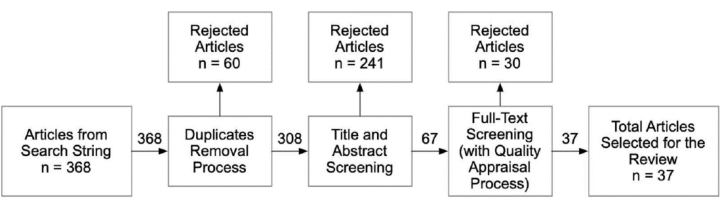
Screening and Quality Assessment The whole literature selection and screening process are presented in Figure 1. The search mentioned above yielded a total of 368 articles, from which 60 duplicates were removed manually. The subsequent screening process consisted of two stages: title and abstract screening, and full-text screening. The first part of the process implies reading the title and abstract of these articles to assess their relevance whilst at the same time discarding articles from journals that do not meet quality standards. A series of inclusion and exclusion criteria were used in screening titles and abstracts. The first part of the process meant reading the titles and abstracts of these articles to assess their relevance while discarding journal articles that did not meet the qua- lity criteria. A total of 241 papers were rejected during the title and abstract screening.
The quality appraisal process is part of the full-text screening. At this stage, the criteria in Table 1 were applied to obtain a score for each of the 67 selected sources. Full-text screening rejected 30 additional articles due to the terms of quality appraisal, resulting in a total of 37 articles.
1 Theoretical basis for assessing the contribution of trust
Does not provide enough information to assess this criterion
Weak Partial Strong This item does not apply to this publication 2 Clear and logical description of Factors/Problems. Practical value
Poor description. Inadequate Value
Clear and logical description. Some value Inadequate description. Lack of experiments Only key parts. Reasonable experiments Clear description. Complete experiments
Very clear and logical description. Practical value 3 Clear description of the experiment process.Evaluate trust through experiments
Fails to inform
Limited Critically informs
4 Informs of implications for practice
5 Level of citations Missing citations
Some degree of citations
Comprehensive and complete citations
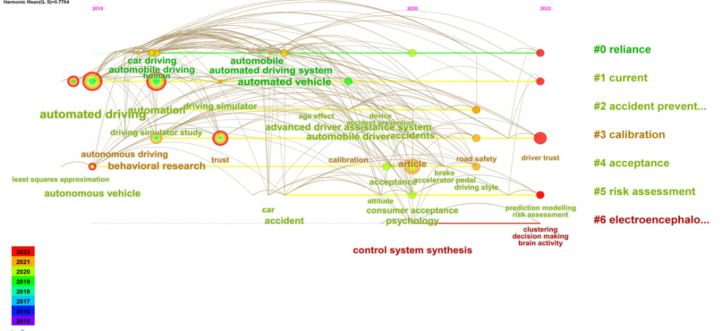
Citation Analysis In order to better sort and analyse the selected papers, a graphical timeline analysis of the selected references was carried out using CiteSpace software. The timeline diagram spreads out the paper’s keywords chronologically through clustering. The left-hand side in Figure 2 contains six keywords, and the right-hand side on the way shows the chronological development of the keywords. As seen from this figure, papers related to autonomous driving started to appear and become a research hotspot around 2015. Research on trust in autonomous driving emerged in abundance in 2017, and from the size of the red nodes, keywords on calibration in trust became popu- lar around 2022. In addition, autonomous driving acceptance was getting more attention around 2020. In particular, research on autonomous driving using devices such as EEG to study drivers’ psychological states appeared for the first time in 2020 and is a relatively new research direction in recent years.
Trust Evaluation of Automated Vehicles: A Systematic Review 163
Figure 2: Timeline view from CiteSpace.
RESULTS
Trust in the Acceptance of Autonomous Driving With automated vehicles revolutionising the transport industry and their technology becoming increasingly mature, it is essential to understand driver acceptance of self-driving vehicles. Trust plays a very important role in drivers’ intentions to use self-driving cars.
The Technology Acceptance Model (TAM) was used as a theoretical basis to investigate the factors that influence the acceptance of automated vehicles (Choi & Ji, 2015; Man et al., 2020). Researchers have studied how psycholo- gical determinants, such as trust, perceived usefulness, perceived ease of use, and risk perception, interact to shape the acceptance of automated vehicles. It was found that trust is directly influenced by perceived usefulness, risk perce- ption and other factors, which is the most important factor in shaping positive attitudes towards the acceptance of automated vehicles. Extending TAM to social and personal factors, Zhang et al., (2020) proposed a new acceptance model for autonomous vehicles, and the results show that initial trust makes the greatest contribution to explaining whether drivers will accept automated vehicles. Furthermore, Adnan et al., (2018) concluded that consumer trust in cars is a potential factor in the acceptance of self-driving vehicles through a systematic literature review, and one of the biggest challenges in increasing driver acceptance is building trust in the technology. It has been proposed that successful adoptions of autonomous vehicles also require that travellers must accept shared ride sharing (SAV) with others they are unfamiliar with (Paddeu et al., 2020). Comfort and trust have been identified as factors that positively influence acceptance and a strong correlation was found between comfort and trust, suggesting that trust in SAV is a significant predictor of perceived comfort.
Based on the above literature, the answer to Question 1 is that trust affects acceptance indirectly by influencing such as perceived usefulness, comfort by influencing perceived usefulness, comfort and other factors. Trust itself
also directly affects acceptance. Therefore, trust is one of the most important factors influencing driver acceptance of autonomous vehicles.
Impact Factors Currently, some research on trust in automated driving has focused on the impact factors. By studying the factors, the concept of trust could be further calibrated. The three-layer trust model proposed by Hoff and Bashir, (2015) provided a framework to describe the potential factors in autonomous dri- ving trust. The framework includes the person who trusts the automated vehicles, the system to be trusted and situational trust. Kalayci et al. (2021) proposed that a triangulation study of the driver, the vehicle and the envi- ronment is required to gain a deeper understanding of trust in autonomous driving. Therefore, in order to understand how different factors impact trust, the following section explores the trust influencing factors in terms of the driver, the autonomous vehicle and the external environment, respectively.
Driver The factors affecting trust, analysed from the driver’s perspective, were mainly related to the driver’s age, gender, driving style, personality, and initial trust.
The result shows that the age of the driver does not appear to be an accu- rate predictor of trust. Some researchers (Alsghan et al., 2021) believed that young people were more likely to find autonomous vehicles trustworthy and acceptable, but others (Gold et al., 2015) had come to the opposite conclu- sion. Some papers have studied the effect of driving style on trust. Driving styles were divided into aggressive and defensive situations. The results of the experiments show that driving style initially has a greater effect on trust, but over time the trust of the driver still increases regardless of different dri- ving styles (Manchon et al., 2021). In recent years, driver personality has been used to study the impact on trust. Personality reflects an individual’s stable cognitive, behavioural and emotional patterns (Kraus et al., 2021). Among the five personalities - extraversion, agreeableness, conscientiousness, neu- roticism and openness - there is a significant negative correlation between openness and trust (Li et al., 2020). This may be because autonomous dri- ving systems reduce the driver’s workload, and for openness driver, who likes challenges, reduces the enjoyment of manual driving.
Initial trust has a clear impact on early driver trust construction, which means the first experience with automated driving may have a greater impact on drivers’ short-term trust calibration and can help improve trust calibra- tion for under-trust drivers (Hartwich et al., 2019). Therefore, adjusting the driver’s initial phase of training experience can help the driver calibrate the appropriate level of trust in the future.
Automated Vehicles The factors affecting trust, analysed from the automated vehicle’s perspective, were mainly related to the automation failure, driver Interface and automated driving systems reliability.
Trust Evaluation of Automated Vehicles: A Systematic Review 165
The results show that unexpected automation failures negatively affect dri- vers’ trust. This trust recovery has different patterns, depending on the type of failure. If failures are predictable, their trust can be rebuilt over time. In addition, failures in driving automation have a substantial drop in trust for drivers with low levels of knowledge, drivers thus should be fully briefed in advance to prevent this from happening (Azevedo-Sa et al., 2021; Kraft et al., 2020; J. Lee et al., 2021) On the contrary, trust will increase if the system is reliable. The design of driver interfaces for automated vehicles is particularly important, where speech features are crucial in moderating trust. They inve- stigated the effect of speech strategies on driver trust and showed that drivers perceive polite, submissive voice communication to be more likely to increase trust (J. Lee & Lee, 2022; Yoo et al., 2022).
Environment Factors affecting trust have been relatively less analysed from an environmen- tal perspective. Regarding the factors that influence trust, researchers have looked at different driving environments. For example, driver trust in the short term during overtaking environments may be influenced by parame- ters such as speed and lateral distance to objects. In foggy weather, the effect of visibility on trust is less noticeable (Abe et al., 2018; Azevedo-Sa et al., 2021). In conclusion, the answer to Question 2 is trust can be influenced by the driver, the automated vehicle and the environment. In the beginning phase, initial trust is more likely to be influenced by the personal characteristics of the driver. During the interaction with the automation, the driver’s experie- nce of the performance of the self-driving vehicle facilitates the development of trust. The external environment, on the other hand, can also influence dri- vers’ risk perceptions and affect changes in trust. Hence, trust is constantly evolving throughout the process. Only a better understanding of how these factors evolve and interact with each other will allow a more appropriate calibration of trust levels.
Estimation Methods The previous research has analysed the influencing factors of trust, and some have looked at the methods used to estimate trust, emphasising how to improve and innovate the way to assess trust levels. This paper categorises methods of evaluating trust into four groups including questionnaires, visual behaviour, driving behaviour and physiological activity. The following explo- res the relationship between these four aspects and proposes more accurate trust evaluation methods.
Questionnaire In order to understand the changes in drivers’ trust levels in autonomous vehicles and to better calibrate trust, it is necessary to measure trust effecti- vely. Trust measurements have been mainly based on questionnaires derived from the trust scale proposed by Jian et al. (2000), which has been widely used in other research (Hoff & Bashir, 2015; Walker et al., 2019). However,
driver trust is constantly changing with the driving process. Even when que- stionnaires are administered at different stages of the experiment to obtain trust values, these reports still struggle to capture real-time changes in trust, such as those associated with specific driving situations. In addition, questi- onnaires are challenging to be used in many application environments, such as real-world driving situations.
Visual Behaviour Questionnaires cannot capture real-time changes in trust. In contrast, analysis of driver gaze behaviour has the potential to provide an objective, real-time measure of trust. When drivers with higher trust, they will pay more attention to non-driving related tasks (NDRT). During this time driver’s eye move- ments, such as pupil changes, duration of gaze at non-driving activities, and frequency of monitoring of the road or dashboard will change(He et al., 2022; Hergeth et al., 2016; Körber et al., 2018; Y. Zhang et al., 2021). The results show that as the driver’s trust level increases, their pupil diameter decrea- ses; they gaze at the NDRT for a more extended period; and the automated driving system is monitored less frequently. It shows that gaze behaviour provides a more direct measure of trust in automation than the questionnaire.
Driving Behaviour As well as the driver’s visual behaviour, their driving action behaviour could also respond to changes in trust. For example, participants with high levels of trust spent more time keeping their feet away from the pedal. However, there was no temporal relationship between trust and the foot’s position on the pedal(He et al., 2022; Stapel et al., 2022). Their hand position during driving could also be correlated with trust; for example, the lower trust group is more likely to keep their hands on top of the steering wheel (Yu et al., 2021). In addition, high-trust drivers also had longer reaction times in emergencies (Payre et al., 2016). Using drivers’ body language to identify changes in their trust offers a promising application. This area is more investigated based on feet or brakes behaviour, as pedal inputs can be finely measured in time and are less likely to require additional devices (Lee et al., 2021).
Physiological Activity Analysis of the driver’s physiological and psychological signals provides a more direct characterisation of the driver’s mental state as well as trust, including measurement of the driver’s functional near-infrared spectroscopy (Perello-March et al., 2022), cardiovascular activity (He et al., 2022), skin conductance (Mühl et al., 2020) and electroencephalography (Seet et al., 2022). Comparing the observations with the driver’s trust shows that trust is associated with a reduction in monitoring and working memory. Thus, there is a close relationship between subjective trust, skin conductivity, and brain activity. When trust increases in humans, the level of skin arousal decrea- ses. Furthermore, frontal alpha EEG is a neural correlate of trust, and using EEG analysis may be more helpful in analysing the principles of physiological and psychological changes in humans. However, human neurophysiological
Trust Evaluation of Automated Vehicles: A Systematic Review 167
data can also receive interference from other factors such as driving style and driving environment.
In conclusion, the answer to Question 3 is that the measurement of trust in automated driving is assessed by mainly questionnaire measures due to the nature of the study, which involves examining people’s subjective fee- lings. Therefore, more objective, real-time measures of trust can be provided regarding changes in people’s visual behaviour, driving action behaviour, and physiological and psychological signals, which is a powerful complement to questionnaire measures. The three measures can be used independently, but the combination of the gaze behaviour and electrodermal activity provides a better indication of drivers’ trust in automation (Ajenaghughrure et al., 2021; Walker et al., 2019). Overall, these studies represent progress towards deve- loping reliable, continuous and objective methods for assessing driver trust in automated vehicles.
CONCLUSION
With increasing vehicle automation, the study of trust in automation has attracted more and more attention. This paper reports a systematic litera- ture review, analyses the importance of trust in automated driving, discusses the multiple factors influencing trust, and the various estimated methods to assess trust between drivers and automated vehicles.
Studies found that trust is one of the most critical factors influencing dri- ver acceptance of autonomous vehicles. Moreover, trust is related to other factors affecting acceptance, such as perceived usefulness, risk perception, and comfort.
Trust can be influenced by operator characteristics (driver), system chara- cteristics (automated vehicle system), and situational environment (environ- ment). From the driver’s point of view, age and gender are less significant for trust; risky driving styles (i.e. speeding and lane drifting) reduce trust, but the driving style has less impact on trust in the long term. The ini- tial trust of the driver has a positive effect on the calibration of trust, and driving simulator practice, as well as driver training, and also helps better calibrate trust. From an autonomous vehicle perspective, a reliable, non- failure-prone driving system that uses a polite voice strategy increases driver trust, which is helpful for car manufacturers to design autonomous veh- icles. From an environmental perspective, different driving environments, such as overtaking and foggy weather, affect trust in the short term. How- ever, only a few papers have described the mechanisms of influence of the factors and the impact of different factors on trust in a systematic way. As trust constantly changes, few studies have introduced and studied the long- and short-term effects of different factors in combination with feedback.
For trust evaluations, questionnaires are considered to be the most common way. In practical scenarios, it is imperative to assess changes in trust in real time, and questionnaires are often challenging to imple- ment. Changes in driver eye behaviour and driving movements, such as gaze duration, gaze monitoring frequency, foot pedal position, and hand
position, as well as the driver’s physiological and psychological changes, such as functional near-infrared spectroscopy, skin conductivity and brain waves, which can be used to measure changes in trust in real-time. In addition, EEG analysis allows us to describe these mental states more dire- ctly than other physiologies. However, there are obstacles to the practical application of related measurement devices such as eye-tracker and EEG devices.
ACKNOWLEDGMENT
The authors thank Dr Yifan Zhao for his assistance in producing this paper. The authors are grateful to Dr Yang Xing and Jaguar Land Rover Research specialists -Dr Karl Proctor and Dr Andrew Owens’ support and advice.
REFERENCES
Abe, G., Sato, K., & Itoh, M. (2018). Driver trust in automated driving systems: The case of overtaking and passing. IEEE Transactions on Human-Machine Systems, 48(1), 85–94. Adnan, N., Md Nordin, S., bin Bahruddin, M. A., & Ali, M. (2018). How trust can
drive forward the user acceptance to the technology? In-vehicle technology for autonomous vehicle. Transportation Research Part A: Policy and Practice, 118, 819–836. Alsghan, I., Gazder, U., Assi, K., Hakem, G. H., Sulail, M. A., & Alsuhaibani, O.
A. (2021). The determinants of consumer acceptance of autonomous vehicles: A case study in riyadh, saudi arabia. International Journal of Human-Computer Interaction. Azevedo-Sa, H., Jayaraman, S. K., Yang, X. J., Robert, L. P., & Tilbury, D. M. (2020).
Context-Adaptive Management of Drivers’ Trust in Automated Vehicles. IEEE Robotics and Automation Letters, 5(4), 6908–6915. Azevedo-Sa, H., Zhao, H., Esterwood, C., Yang, X. J., Tilbury, D. M., & Robert, L. P., Jr. (2021). How internal and external risks affect the relationships between trust and driver behavior in automated driving systems. Transportation Research Part C: Emerging Technologies, 123. Ben Ajenaghughrure, I., Sousa, S., & Lamas, D. (2021). Psychophysiological Model-
ling of Trust in Technology: Comparative Analysis of Psychophysiological Signals: Proceedings of the 16th International Joint Conference on Computer Vision, Imaging and Computer Graphics Theory and Applications, 161–173. Choi, J. K., & Ji, Y. G. (2015). Investigating the importance of trust on adopting an autonomous vehicle. International Journal of Human-Computer Interaction, 31(10), 692–702. Gold, C., Körber, M., Hohenberger, C., Lechner, D., & Bengler, K. (2015). Trust in
Automation – Before and After the Experience of Take-over Scenarios in a Highly Automated Vehicle. Procedia Manufacturing, 3, 3025–3032. Hartwich, F., Witzlack, C., Beggiato, M., & Krems, J. F. (2019). The first impression counts—A combined driving simulator and test track study on the development of trust and acceptance of highly automated driving. Transportation Research Part F: Traffic Psychology and Behaviour, 65, 522–535. He, X., Stapel, J., Wang, M., & Happee, R. (2022). Modelling perceived risk and trust
in driving automation reacting to merging and braking vehicles. Transportation Research Part F: Traffic Psychology and Behaviour, 86, 178–195.
Trust Evaluation of Automated Vehicles: A Systematic Review 169
Hergeth, S., Lorenz, L., Vilimek, R., & Krems, J. F. (2016). Keep your scanners peeled: Gaze behavior as a measure of automation trust during highly automated driving. Human Factors, 58(3), 509–519. Hoff, K. A., & Bashir, M. (2015). Trust in Automation: Integrating Empirical
Evidence on Factors That Influence Trust. Human Factors, 57(3), 407–434. J3016_202104: Taxonomy and Definitions for Terms Related to Driving Automation Systems for On-Road Motor Vehicles. SAE International: https://www.sae.or g/standards/content/j3016_202104/. Jiun-Yin Jian, Bisantz, A. M., & Drury, C. G. (2000). Foundations for an Empiri-
cally Determined Scale of Trust in Automated System. International Journal of Cognitive Ergonomics, 4(1), 53. Kalayci, T. E., Güzel Kalayci, E., Lechner, G., Neuhuber, N., Spitzer, M., Westermeier, E., & Stocker, A. (2021). Triangulated investigation of trust in automated driving: Challenges and solution approaches for data integration. Journal of Industrial Information Integration, 21. Körber, M., Baseler, E., & Bengler, K. (2018). Introduction matters: Manipulating
trust in automation and reliance in automated driving. Applied Ergonomics, 66, 18–31. Kraft, A.-K., Maag, C., Cruz, M. I., Baumann, M., & Neukum, A. (2020). Effects of explaining system failures during maneuver coordination while driving manual or automated. Accident Analysis and Prevention, 148. Kraus, J., Scholz, D., & Baumann, M. (2021). What’s driving me? Exploration
and validation of a hierarchical personality model for trust in automated driving. Human Factors, 63(6), 1076–1105. Kuru, K. (2022). TrustFSDV: Framework for Building and Maintaining Trust in Self- Driving Vehicles. IEEE Access, 10, 82814–82833. Lee, J., Abe, G., Sato, K., & Itoh, M. (2021). Developing human-machine trust:
Impacts of prior instruction and automation failure on driver trust in parti- ally automated vehicles. Transportation Research Part F: Traffic Psychology and Behaviour, 81, 384–395. Lee, J. D., & Kolodge, K. (2020). Exploring Trust in Self-Driving Vehicles Through Text Analysis. Human Factors, 62(2), 260–277. Lee, J. D., Liu, S.-Y., Domeyer, J., & DinparastDjadid, A. (2021). Assessing Dri-
vers’ Trust of Automated Vehicle Driving Styles With a Two-Part Mixed Model of Intervention Tendency and Magnitude. Human Factors, 63(2), 197–209. Lee, J. D., & See, K. A. (2004). Trust in Automation: Designing for Appropriate Reliance. Human Factors, 46(1), 50–80. Lee, J., & Lee, K. M. (2022). Polite speech strategies and their impact on drivers’
trust in autonomous vehicles. Computers in Human Behavior, 127. Li, W., Yao, N., Shi, Y., Nie, W., Zhang, Y., Li, X., Liang, J., Chen, F., & Gao, Z. (2020). Personality Openness Predicts Driver Trust in Automated Driving. Automotive Innovation, 3(1), 3–13. Man, S. S., Xiong, W., Chang, F., & Chan, A. H. S. (2020). Critical Factors Influe-
ncing Acceptance of Automated Vehicles by Hong Kong Drivers. IEEE Access, 8, 109845–109856. Manchon, J. B., Bueno, M., & Navarro, J. (2021). Automation, Expert Systems Calibration of Trust in Automated Driving: A Matter of Initial Level of Trust and Automated Driving Style? Human Factors. Manchon, J.-B., Bueno, M., & Navarro, J. (2022). How the initial level of trust
in automated driving impacts drivers’ behaviour and early trust construction. Transportation Research Part F: Traffic Psychology and Behaviour, 86, 281–295.
Mühl, K., Strauch, C., Grabmaier, C., Reithinger, S., Huckauf, A., & Baumann, M.
(2020). Get Ready for Being Chauffeured: Passenger’s Preferences and Trust While Being Driven by Human and Automation. Human Factors, 62(8), 1322–1338. Paddeu, D., Parkhurst, G., & Shergold, I. (2020). Passenger comfort and trust on first-time use of a shared autonomous shuttle vehicle. Transportation Research Part C: Emerging Technologies, 115. Payre, W., Cestac, J., & Delhomme, P. (2016). Fully automated driving: Impact of
trust and practice on manual control recovery. Human Factors, 58(2), 229–241. Perello-March, J. R., Burns, C. G., Woodman, R., Elliott, M. T., & Birrell, S.
A. (2022). Using fNIRS to Verify Trust in Highly Automated Driving. IEEE Transactions on Intelligent Transportation Systems, 1–0. Seet, M., Harvy, J., Bose, R., Dragomir, A., Bezerianos, A., & Thakor, N. (2022).
Differential Impact of Autonomous Vehicle Malfunctions on Human Trust. IEEE Transactions on Intelligent Transportation Systems, 23(1), 548–557. Stapel, J., Gentner, A., & Happee, R. (2022). On-road trust and perceived risk in Level 2 automation. Transportation Research Part F: Traffic Psychology and Behaviour, 89, 355–370. Walker, F., Wang, J., Martens, M. H., & Verwey, W. B. (2019). Gaze behaviour and
electrodermal activity: Objective measures of drivers’ trust in automated vehicles. Transportation Research Part F: Traffic Psychology and Behaviour, 64, 401–412. Yoo, Y., Yang, M.-Y., Lee, S., Baek, H., & Kim, J. (2022). The effect of the dominance of an in-vehicle agent’s voice on driver situation awareness, emotion regulation, and trust: A simulated lab study of manual and automated driving. Transportation Research Part F: Traffic Psychology and Behaviour, 86, 33–47. Yu, B., Bao, S., Zhang, Y., Sullivan, J., & Flannagan, M. (2021). Measurement
and prediction of driver trust in automated vehicle technologies: An application of hand position transition probability matrix. Transportation Research Part C: Emerging Technologies, 124. Zhang, T., Tao, D., Qu, X., Zhang, X., Zeng, J., Zhu, H., & Zhu, H. (2020).
Automated vehicle acceptance in China: Social influence and initial trust are key determinants. Transportation Research Part C: Emerging Technologies, 112, 220–233. Zhang, Y., Ma, J., Pan, C., & Chang, R. (2021). Effects of automation trust in drivers’ visual distraction during automation. PLoS ONE, 16(9).
LISTED IN THE AHFE DIGITAL BOOKSTORE CATALOGUE
Explore the complete digital volume
Human Aspects of Advanced Manufacturing
Read this individual research paper free through the original publisher, or explore the full digital proceedings book.
ISBN 978-1-958651-56-8
Explore this ISBN in the AHFE Bookstore ↗Listed in the July 2026 bookstore catalogue; search by ISBN to confirm current availability · Digital book purchase optional