Janne Heilala, Pawel Krolas (2023). Locating A Smart Manufacturing based on Supply Chain Segregation. In: Human Factors, Business Management and Society. AHFE Open Access, vol. 97, pp. 230–240. https://doi.org/10.54941/ahfe1003899
The recent EMS 2021 small-scale pilot assessment in Finland covered a perspective for evaluating corporations' relocation activities, key enabling technologies, and organizational concepts. Relocation activities were reflected in off- or backshoring manufacturing or R&D. Depthness was taken by withdrawals from knowledge boundaries from the database content, which was combined with additive manufacturing and energy management systems. This is a representative study on the relocation factors, and what is outside scope is considered from the management human systems integrative angle of entry. The main research problem was can relocation activities be explained by the corporation's manufacturing key technologies and organizational concepts with cross-sectional indices of growth, manpower, and capital utilization. The response method was mixed in reviewing the EMS structural connections. The empirical finding content variables were bound with standardization and explaining scientific philosophy. As a result, the framework for relocation activities can explain firms' intentions over additive manufacturing and sustainable business. Conventionally selected literature sampling was used to identify likely supporting factors for the relocating activities. In conclusion, in terms of empirical findings, good politics, financing opportunities, and cooperation enable business growth and development.
There is much information about merging companies moving their opera- tions from Finland in local media (e.g., Varpula 2019). This presentation background is a case study based on empirical evidence from European Manufacturing Survey (EMS) to which research questions were founded, how Finnish manufacturers’ and R&D operations are reflected in the sample, interest in which firms utilize in this context by manufacturing efficiency tech- nologies (ET), simulation, data-analysis and additive manufacturing (SDA), energy and efficiency management systems (PMC5-6). The applicability of the links from the material by comparing the associative functions to the previous researchers’ methods and observations to which founding linkages between companies point out sustainable elements that are applicable for Finnish manufacturing and R&D, which is then taken to the level of inter- national trading classification to adopt the economic perspective of multiple
Locating a Smart Manufacturing Based on Supply Chain Segregation 231
market areas explicitly. Because sustainable and competitive firms’ mana- gement basis is on information communication systems and integration of internationally recognized quality standards.
RESEARCH QUESTIONS To cover the objectives of the study, the following research questions (RQs) were defined by selecting a case company:
1. What are the sustainability development areas of the offshoring manu- facturers and research and development operations? 2. What are the sustainable practices and requirements for domestic and foreign integrated operations? 3. What are the requirements from the system integration side reflected in enterprises’ quality decisive requirements?
Justifying the selection of outsourcing locations, the good manufacturing practices included for operating the enterprise aspects are important from the humans’ behalf in a generative and innovative sense. The first resea- rch question responds to where the optimized offshoring location for infant manufacturing and research and development operations is while it sup- ports the given area of sustainability by considering sustainable technologies and organization practices. The research question also responds to where the most optimized location for manufacturing, research, and development from the sustainment requirements is operating at the selected locations. The second research question elaborates on the idealized followable path to run multinational operations from the perspectives of multinational enterprises from the timely perspectives by conducting a dense literature review. The third research question is then supplemented: What are the large corporati- ons’ requirements that apply to the corresponding integrative hypothesized quality formation?
Research is carried out by conducting a literature review to extend the empirical research on relevant sustainability research to explore the fictive lifecycle of a modern smart manufacturing factory and research and develo- pment sides concerning RQs objectives. To respond to the abovementioned research statements, the empirical firm selection had a basis in manufacturing industries’ volunteering players and was selected with convenience sampling. The following section discusses the empirically selected firms and proceeds to respond to each research question.
SCIENTIFIC PHILOSOPHY Experimenting and establishing knowledge over domains of existing know- ledge verifies reality by the rationalistic view over the curse of dimensionality, wherein the components of reality are reduced so that they give fixed obse- rvation points based on deduction and help in decision-making; thus, the science of philosophy relies upon natural sciences, in mathematics factori- zing the environment where academist experiences the phenomenon, and it is specifically content and time-dependent because time passes silently, which
232 Heilala and Królas
on the other hand requires guidelines for repeatability of the research, where the results are not any more repeatable as is, but based on physical content under multi-criteria sets their conditionality and enables carrying out and justifying the research, best justified by existing theories. Now, the scientific experiment can be considered as a response to the experiment with New- ton’s laws to confirm the second law of thermodynamics and lawfulness of the material in the state, to which the repeatability of the state of the rese- arch and its response domain solution space depends on the situationally constructed functional domain. Before Newton’s process, cross-existed out- put from an Italian astronomist-physicist-engineer existed for justifying the masses independency of the velocity dropping the similar height corresponds, and the drag effect of the surface pattern was discriminated by the behavior the surfaces resists on the medium of air opposing the linearity. (Thompson 2011.) Testing axioms based on data withdrawn from the captured database for developing a hard grounding for a scientific theory enables the statistical testing taken from theory but also empirically driven approach to explore the data empirically based on hypothesis selection considering the syntax, semantics, and pragmatism through data labeling and characterization (e.g., Heilala et al. 2023). Hypothesis testing on found challenges is based on rea- soning and deducing logical operations to verify observed variables. Thus, the validation of truth through data for repeatability is important to form new operational models for several functional design domains. The objecti- vity of the research is getting support from the information axiom domain for success in predetermined {P} -
Q
mirroring patterns (Kellen et al. 2018). One way of presenting each information criteria’s success is by quantum probability. Attached to the basics of Poppers to support the transient proba- bility of a modulus dollens ((p→q), where p is true, and q is the complement of either. (adapted Thompson 2011.) Where contemporary (∼ep →∼p(1)) can be based on connection classic probability theorem, expressed as truth table, modus ponens n2n, starting in this context by total of 2x4 matrix is enough. In contrast, each unit present forms truth table, for instance.
The measure forming the scientific foregrounding can be denoted by each decision measured from the survey. The response function is based on back- ground factors (age, cognitive development, among others) (Kellen et al. 2018). More the values, larger the matrice, here it is double, 2n, twice and Nth as exponential wherein n is holding singularity for (1, . . . , N). The litera- ture review shares similar researching viability but focuses on practical axiom testing.
EMPIRICAL PERSPECTIVE ON MANUFACTURING Finnish EMS offers manufacturing and R&D depthness twofold: offsho- ring and backshoring. The analysis part numbers are first withdrawed for a representative sample, and the refined results from the tables are elaborated. Similarly, as Newton found strength when the apple falls, the apple of this study is in the companies’ market behavior with the additive manufacturing that is growing from the seeds of sustainability.
Locating a Smart Manufacturing Based on Supply Chain Segregation 233
Analysis Descriptives and Variable Interconnections The respective sample characteristics withdrawn from the study are repre- sented in Table 1, minimum, maximum, mean, median, mode, standard deviation, skewness, kurtosis, sum, and validity of the sample respondees on given measure indices. Respectively connection structure is presented in Table 2. The variables in the tables takes following arguments based abbre- viations. Annual turnover (AT), number of employees (NE), manufacturing capacity utilization (MCU) for 2019 and 2021 respective years, as well as return on sales (ROS), offshoring manufacturing performance (OMP), offshoring R&D (ORD), backshoring foreign manufacturing (BFM), efficie- ncy technologies (ET), simulation, data analysis and additive manufacturing (SDA), energy and efficiency management systems (PMC5-6).
Off- and Backshoring Manufacturing or R&D Offshoring manufacturing outside Finland does not require efficiency tech- nologies, certified energy, or environmental management systems. However, the firm has to be able to simulate, analyze data, and prototype using additive manufacturing and have core Headquarters for research and development in Finland expected from the backshoring research and development side that the certifications are expected to be left out for smaller companies. For smal- ler, growing, interests based design offices, the Capability to function is within Finland, when again, offshoring manufacturing as foreign operations appears as a selectable opportunity that growth companies with a smaller turnover often pick up out of liberty.
For older factories, the more likely the company to be an old operator and the more likely it must have more employees and a certified energy manage- ment system in use, meaning solvent operations in the home country (Heilala et al. 2022a). Considering this research business perspective, it is financially
Table 1. Descriptives emphasized for HSI from offshoring or backshoring manufacturing and companies’ competitiveness arithmetic means (M) to respondees’ validity (source: own study).
Locating a Smart Manufacturing Based on Supply Chain Segregation 235
more sustainable to outsource the activity to countries where energy manage- ment and the environment are politically rewarded. On the other hand, when taxation benefits large corporations, smaller ones are outside of the benefits. In light of the latest research, these countries are, for example, in Central Europe (CE), on the edge of offshoring manufacturing performance. There are others, such as the Baltics, Southwestern Europe, CE, East Asia, South Asia, The US, and Canada.
On the other hand, from the point of view of R&D, the preferred conne- ctions for outsourcing are in North-western and CE, Baltics, South Asia, and Nordic countries. R&D South Asia emphasizes results seesaws and careful consideration. (adapted to Heilala et al. 2022a.) Given the narrowness of the results, moving manufacturing from Finland, the closest for sustainable logistics point of view are Nordics, Baltics, and CE.
The spectrum of relocation is broad; formulating a proposal from manu- facturers’ and R&D operations’ perspectives requires reflecting the market environment to position these results.
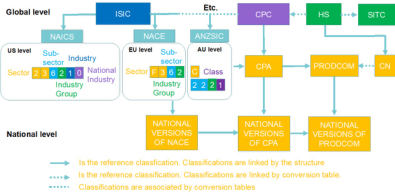
Classifying International Trading Human systems integration compatibility between industrial systems from legislative and economic perspectives is presented in Figure 1. Representa- tion is the so-called Nomenclature Générale. The economic activities can be viewed from the globalized perspective and domestic control. The United Nations’ International Standard Industrial Classification (ISIC) of all Euro- pean Economic Area (EEA) Activities is equivalent to the North American (NAICS) and EU (NACE) states’ levels, Australian and New Zealand Stan- dard (ANZSIC) is nearly identical to the EU design level. Other relevant are China (CSIC) and Japanese (JSIC), and so forth, which differ slightly from the data form and categorization. Hence, the economics have differences between states but also between markings to be able to read the contextual industry classifications. The required integrations can be fetched from different data- bases, for example, when the supply chain management considers different foreign sites. The Eurostat standard is important for the united states because Europe has uniformly surpassed many usable standards from the perspective of the NAICS. The United Nations Central Product Classification (CPC) is associated with augmentation by compliance in terms of product characters. Parallelly the indices of production of manufactured goods carried out by enterprises on the national territory of the reporting countries (PRODCOM) references the classification of goods used for statistics on industrial produ- ction in the EU that its level includes all variations in the division of, e.g., manufacturing of mobility equipment in the degree of class, and dimensio- ning the manufacturing activity extension: is it assembly or is it extending to reach other areas as an additive or subtractive manufacturing, or software, or are the activities outsourced. Going straight to down associating link to the CPA, which is the EU Classification of Products by Activity (CPA), brings the variation in products really handy to keep on track to manufacture spe- cific structures on emerging products or another variant on identifying the design environments from the reverse engineering perspective or service level
236 Heilala and Królas
Figure 1: Domains of human systems integration on economic activities selectively represented in block diagram at the global level (adapted own study to SICCODE 2023; Europa 2023).
competencies. From the HSI perspective, the system combines by Harmoni- zed Commodity Description and coding system (HCDC), managed by the World Customs Organization (WCO), which is an umbrella term for Combi- ned Nomenclature (CN), that is an EU classification of goods used for foreign trade statistics between enterprises. There is a parallel connection to the ISIC for international trade statistics (SITC). What is needed to know about this pattern is that there is a correspondence between harmonious human systems. (Improved adaptation from SICCODE 2023; Europa 2023.)
DEVELOPING HSI ON QUALITY STANDARDS The idea of sustainable manufacturing emanates from the management of the environment. Accelerated labor hours to upbringing technological innovati- ons fire up competitive situations and challenges to operate in the markets recommending integrating human systems for information management that facilitates operations leader-learnship knowledge-based. (adapted Madonsela 2020.) Technology-based management systems’ purpose for integration is to enable the recognition of environmental changes in real-time. For example, for the manufacturing and service sector, energy audits are primarily for large companies following the Energy Efficiency Act (1429/2014), which planning engineering firms carry out. Act, on the other hand, based on this consti- tution, is unequal for tinier organizations from human factors perspective. Findings of scarcely monetized corporations need to catch up to innovate for green environmental management aspects, which appears as negative prospects (EIBIS 2022, 8). This appears as operations out of social bene- fits. European, The Law, defines a large company as one with more than 250 employees, a turnover of more than 50 million, and a balance sheet of 43 million. The tax can be exempted if the company has an ISO 14001 and certified energy management systems; Enabler for environmental systems investments is thus perceptually perceived transformative investments with a significant return (EIBIS 2022, 8). It has generally been observed that suppliers have responded with measures extending beyond the manufactu- ring systems, including plans for maintaining infrastructure with renewable energy sources. This can be seen in energy efficiency for climate commi- tments by using artificial intelligence to identify energy saving, waste heat
Locating a Smart Manufacturing Based on Supply Chain Segregation 237
recovery from manufacturing, or supplying infrastructures providing virtual power plants for manufacturing business models more sustainability. (Ada- pted from MOTIVA 2021). Closing down manufacturing areas not in use supports energy efficiencies for technologies interfering with challenges and sustainability (e.g., Elovaara 2019). It has emphasized that follow-up inve- stment studies have shown that powerful investments lean more from the personnel side of getting used to environmental management, innovating sustainable solutions, pays-off in non-incremental digitalized environmental solutions, and after this manpower is integrated, no need for further training (EIBIS 2022, 8).
Finnish systems and software engineering requirements for managers of information for users of systems, software, and services are defined by the Finnish Standards Association (SFS) and Polish Committee for Standardi- zation (PKN) confirmed ISO/IEC/IEEE 26511:2020:en, to where standards consist of organizational environment definition from the perspective of operations, stakeholders, the applicability of the quality management (ISO 9001:2015; 10002:2018) and processes; leadership and commitment, quality politics, organizational roles (ISO/IEC 19778:2015) among accountability and privileges. Generally, the customer or any stakeholder requirements are derived and steered by environmental laws constraining the operations for designing the product or service. The conforming and managing strategy for information development, creating user needs, planning, and managing information development, staffing and teaming, managing technical reviews, managing the translation processes to the final production and delivery, and following content quality and user satisfaction are integratable for business. Measuring productivity, efficiency, and cost and evaluating process maturity. (SFS 2020; PKS 2018.) The scope covers organizational and systemic asses- sment, to which extension of additive manufacturing for purchases general principles are within this study scope. The requirement for AM is to label order-specific part data, process the product manufacturability, describe its characteristics and functionality within the expectation threshold, accept the work order, and deliver the product. (SFS 2018.)
DISCUSSION
Companies that move their production abroad use SDA to a statistically signi- ficant extent. Companies that transfer their product development abroad do not transfer product development and do not implement quality systems for energy certification, and there is also no concern about environmental cer- tification. (Source: Own study; adapted to Heilala et al. 2022b). Moving production is not a good thing for information leakage and loss of intelli- gence because the manufacturing decline in terms of jobs and opportunities related to this would decrease in domestic markets. From the planning perspe- ctive of domestic operations establishes foregrounding for sustainable R&D and functional prototyping. For operations transiting phase to geographi- cally various locations have great uncertainty because the companies need to use ICT management systems infrastructure and policies that keep the com- panies awareness top-notch and the company’s growth more certain. The
238 Heilala and Królas
results indicated that CE aerial is beneficial for manufacturing; for exam- ple, in terms of population and parameters, CE would be an opportunist location to offshore, but because of its sustainability challenges, such as coal dependency (e.g., Brauers & Oei 2020) recommends sustainable design it is considerable to plan decarbonization led operations to improve sustainable energy operated manufacturing from an R&D perspective.
CONCLUSION
The Human Systems Integration perspective advanced in the behavior of ran- dom representative sample provides guidelines for businesses to adapt to sustainable manufacturing and R&D goal-setting on the relocation activi- ties based on financial indices from growth to manpower. Research suggests profitability-based designing to the firm size and scalability accordingly to the minimum 250 employees. The success of domestic trade is likely from the management systems perspective results in starting the design from energy, environment, simulation, data analysis, and additive manufacturing for real sustainability as EU Sustainable Development Goals (SDGs) have to be fol- lowed, weighted in the destinations (RQ1), as generally, the sample showed no correspondence in the domestic quality-compliance. Cooperation betw- een foreign authorities depends on the policies compatibility (RQ2): design offices for the contribution of design, manufacturers to manufacture within house standards to which ISIC and integration of economic systems offer soothing but a slightly laborious requirement for operating in multiple mar- kets. Sustainable practices include simulation, data analysis, and additive manufacturing. This requires a range of reflections from the enterprises’ management systems for quality (RQ3). Validating and planning certifica- tes; what are the customer requirements for manufacturing equipment, what is available; because funding is always available for patent-seeking innovative applications when operations are standardized and managed.
ACKNOWLEDGMENT
The authors would like to acknowledge that this view is made by academic- in-confidence. The views represented in this paper are of its primary author. The advisor takes no liability for commercial decisions taken based on kno- wledge in this notice. As far as the advisor is aware, the information is accurate; however, it is recommended that no commercial decisions be made based on national regulations or decrees, and anyone should take no admini- strative decision without the authority of the government agency concerned having given them written advice and checking the context applicability in the national context.
REFERENCES
Boy, G. & Kennedy, G. (2021). Human Systems Integration - A Contemporary Discipline. Boy, G. A., Narkevicius, J. M. (2014). Unifying Human Centered Design and Systems
Engineering for Human Systems Integration. In: Aiguier, M., Boulanger, F., Krob,
Locating a Smart Manufacturing Based on Supply Chain Segregation 239
D., Marchal, C. (eds) Complex Systems Design & Management. Springer, Cham. https://doi.org/10.1007/978-3-319-02812-5_12 Brauers, & Oei, P.-Y. (2020). The political economy of coal in Poland: Drivers and barriers for a shift away from fossil fuels. Energy Policy, 144, 111621–. https: //doi.org/10.1016/j.enpol.2020.111621 Brzezinski, Ł.; Wyrwicka, M. K. Fundamental Directions of the Development of the
Smart Cities Concept and Solutions in Poland. Energies 2022, 15, 8213. https:// doi.org/10.3390/en15218213 Business Finland. (2022). Digitalisation and Electrification in Symbi- osis, RAPORTIT JA TUTKIMUKSET. Referenced in 18.11.2022. businessfinland.fi/julkaisut/future-watch-digitalization-and-electrification-in- symbiosis-white-paper doi: 10.54941/ahfeXXXXX EIBIS. (2022). European Investment Bank Investment Survey (EIBIS). https://www.ei b.org/attachments/publications/economic_investment_report_2021_2022_en.pdf Elovaara, J. (2019). Electromagnetic Interference (EMI) in Substations. In: Krieg, T.,
Finn, J. (eds) Substations. CIGRE Green Books. Springer, Cham. https://doi.org/ 10.1007/978-3-319-49574-3_41 Energy Efficiency Act, 1429/2014. https://www.finlex.fi/fi/laki/alkup/2014/ 20141429 Europa. (2023). The international system of economic classificatai- ons. Referenced in 1.1.2023. https://ec.europa.eu/eurostat/statistics- explained/index.php?title=NACE_background European Commission. (2019). The European Parliament declares climate emergency Referenced in 18.11.2022. https://www.europarl.europa.eu/news/en/press-r oom/20191121IPR67110/the-european-parliament-declares-climate-emergency Finnish Standards Association, SFS. (2015). SFS-ISO/IEC/IEEE 9001:2015: en
Additive manufacturing. General principles. Requirements for purchased AM parts. Requirements. https://sfs.fi/ Finnish Standards Association, SFS. (2020). SFS-ISO/IEC/IEEE 26511:2020: en Systems and software engineering -- Requirements for managers of information for users of systems, software, and services. https://sfs.fi/ Finnish Standards Association, SFS. (2020). SFS-ISO/IEC/IEEE 26511:2020: en
Systems and software engineering -- Requirements for managers of information for users of systems, software, and services. https://sfs.fi/ Fitrios, R., Nur, E. & Zakya, I. (2022). How Information Technology and User Competence Affect the Quality of Accounting Information Through the Quality of AIS. Quality - Access to Success. 23. 109–118. 10.47750/QAS/23.187.13. Habibzadeh T., Shad, E., Molinas, M., & Ytterdal, T. (2020). Impedance and Noise
of Passive and Active Dry EEG Electrodes: A Review. IEEE Sensors Journal. PP. 1–1. 10.1109/JSEN.2020.3012394. Heilala, J., Kantola, J., Salminen, A. & Wallace, B. (2022a). Developing competitiveness and employment situations based on relocation activities. 1st Australian IEOM Conference 2022. Australia, Sydney 16-18.12.2022. Heilala, J., Kantola, J., Salminen, A. & Wallace, B. (2022b). Supply Chain Segre-
gation of Human Resources that Supports the Development of Competitive Employment Situations from Efficiency, Simulation, Data Analysis, and Additive Manufacturing Technologies.
240 Heilala and Królas
Heilala, J., Nevalainen, P. & Toivonen, K. (2023). AI-based sentiment analysis approaches for large-scale data domains of public and security interests. Human Factors in Management and Leadership. Jaqua, T. (2020). Recruiting and human resources in a post-pandemic environ-
ment. The International Journal of Human Resource Management. 2. 35-36. 10.33545/26633213.2020.v2.i2a.45. Kellen, D., Singmann, H., & Batchelder, W. H. (2018). Classic-Probability Accounts of Mirrored (Quantum-Like) Order Effects in Human Judgments. Decision (Washington, D. C.), 5(4), 323–338. https://doi.org/10.1037/dec0000080 Kwegyir-Afful, E. (2022). Tämä koskettaa laajasti kaikkea teollisuutta. Simulation-
Based Countermeasures Towards Accident Prevention: Virtual Reality Utilization in Industrial Processes and Activities. Madonsela. (2020). Integration of the Management Information System for Competitive Positioning. Procedia Manufacturing, 43, 375–382. https://doi.org/10.1016/ j.promfg.2020.02.176 MOTIVA 2021. Energy Efficiency of the Commerce Sector in Finland. motiva.fi/files/19504/Energy_Efficiency_of_the_Commerce_Sector_in_Finland.pdf Nazir, S., Ahram, T. Z., & Karwowski, W. (2021). Advances in human factors in
training, education, and learning sciences : proceedings of the AHFE 2021 Virtual Conference on Human Factors in Training, Education, and Learning Sciences, July 25-29, 2021, USA (S. Nazir, T. Z. Ahram, & W. Karwowski, Eds.). Springer. Pérez-López, Rubén Jesús & Olguín Tiznado, Jesús & García-Alcaraz, Jorge & Mojarro, Maria & Camargo-Wilson, Claudia & Lopez-Barreras, Juan. (2021). Integrating and Controlling ICT Implementation in the Supply Chain: The SME Experience from Baja California. Mathematics. 9. 1234. 10.3390/math9111234. Palmas, F. (2022). Using Artificial Intelligence to Improve Human Performance: A
Predictive Management Strategy. 10.54941/ahfe1001441. Polish Committee for Standardization, PKS. (2018). SFS-ISO/IEC/IEEE 26511:2020: en Energy management systems - Requirements and application guidelines. https: //www.pkn.pl/ SICCODE. (2023). About Statistical Classification of Economic Activities in the
European Community. Referenced in 1.1.2023. https://siccode.com/page/what-is -a-classification-system Simulation-Based Countermeasures Towards Accident Prevention: Virtual Reality Utilization in Industrial Processes and Activities Thompson, M. K. (Ed.) (2011). Proceedings of the 6th International Conference on
Axiomatic Design, Korea 2011 : ICAD 2011. KAIST. http://books.google.dk/bo oks?printsec=frontcover&id=Jlqst3jfh4sC&redir_esc=y#v=onepage&q&f=false. Ulewicz, R., Novy, F., & Sethanan, K. (2019). The Challenges of Industry 4.0 for Small and Medium Enterprises in Poland and Slovakia. Quality Production Improvement - QPI. 1. 147–154. 10.2478/cqpi-2019-0020. Varpula, S. (2019). Oras aikoo siirtää tuotantoaan Suomesta Puolaan, Rauman teh-
taan työntekijät menevät lakkoon. https://www.hs.fi/talous/art-2000006258651. html Wawer, M.; Grzesiuk, K.; Jegorow, D. (2022). Smart Mobility in a Smart City in the Context of Generation Z Sustainability, Use of ICT, and Participation. Energies 2022, 15, 4651. https://doi.org/10.3390/en15134651 Xometry. (2022). Manufacturing on Demand. Referenced in 4.12.2022. https://xo
metry.eu/
LISTED IN THE AHFE DIGITAL BOOKSTORE CATALOGUE
Explore the complete digital volume
Human Factors, Business Management and Society
Read this individual research paper free through the original publisher, or explore the full digital proceedings book.
ISBN 978-1-958651-73-5
Explore this ISBN in the AHFE Bookstore ↗Listed in the July 2026 bookstore catalogue; search by ISBN to confirm current availability · Digital book purchase optional