Janne Heilala, Saeid Parchegani, Aezeden Mohamed, Adriano Gomes De Freitas (2023). A sustainable system of systems in space. In: Human-Centered Aerospace Systems and Sustainability Applications. AHFE Open Access, vol. 98, pp. 94–100. https://doi.org/10.54941/ahfe1003923
Additive manufacturing (AM) positions as a system in systems (SoS) to which ecosystem is often difficult to assess in cost curve in bulk, peculiarly in challenging mediums. This paper presents an AM-related solution in the aerospace domain of recent sources forming a review of future space manufacturing. The paper presents an example of a sustainable circular economy based on AM through systematic product lifecycle management (PLM) design domain implementation methodology. Developing an agile business sustainable human system integration (HSI) model, human factors, and ergonomics (HFEs) based on the surrounding medium and structure with fine-designed system fidelity require reciprocal signal communication. A turbulent market environment shaped future communication space between domains of human systems stakeholders sets challenges on communication. HSI applies the ecosystem design to comply with various sectors' companies' stakeholders. The HSI design ensures that the design can simplify by the systems engineering method utilizing axiomatic design (AD). The mathematical AD analysis results as a design matrix (DM) that qualitatively represents the internal design parameters as SoS for energy capture, reuse with dynamic motion innovation on thermal power propulsion, and THz-controlled semi-autonomous operations. Future studies in virtualizing models in the metaverse are proposed for the design solution of the system.
SPACE ENERGY MANUFACTURING We present an opportunistic design avenue innovation process for “North American Industry Classification System (NAICS) code 3364—manufactures aircraft, spacecraft, and missiles, and rebuilds and overhauls aircraft and pro- pulsion systems based on Environmental Protection Agency (EPA) guidelines tracked to recent trends on sustainability” (adapted EPA 2023). Since outer space debris has cumulated in orbit, it requires a special form of energy remo- val architectural design (e.g., Carlson et al., 1990). This was because the transformation of telecommunications was initially the governmental deci- sion to let companies commercialize satellites which led to an increase in the number of vehicles in space, according to Boeke (2016), that are sustainably
in orbit. The number of redundant malfunctions satellites (debris) become a threat from a spacefaring perspective. The investments cost millions of dol- lars. The dangerous debris left in orbit due to the space race support launcher leftovers. Active dead satellite removal from circling from the sky increases the existing and new satellites’ lifecycles (Kim, 2021). Collecting the human- made debris product in the Earth’s orbit has become a business. For products that do not serve any meaningful purpose brought back to Earth compared to expenses (adapted Cooney 2022). Since some large parts crash on Earth, it is wanted to control the collection. Missions for space exploration business have become interested in AM since the first decade (Redwire 2023). Instead of bringing debris to Earth, alternative decisive manufacturing applications for AM in process steps are brought up in this study. Recent research on space debris and AM have optimistic views on distance manufacturing.
Moreover, the view mitigated the risk by designing recyclable in-orbit (Becedas & Caparrós 2019). To research whether manufacturing and deli- very platform in space is sustainable, ecosystem research becomes relevant. The core research question is how the HSI and AM will in the distance, inte- grate. The sector for the program is next navigated non-linearly, guided by different works to respond to problematized areas on conventionally selected literature review.
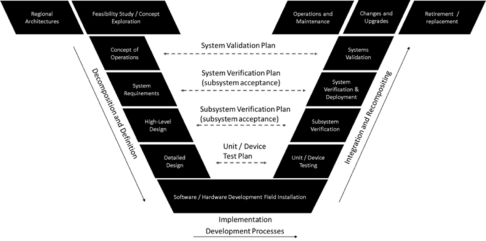
V-Matrix on DFAM We need to consider who launches the debris collection and manufactu- ring facility. Human systems integration emphasizes safe un/crewed missions. Which aspects are systems engineering preliminaries? Collecting the debris for space-platform artificial object recognition requires long-range and close- range radar and spectrometry basics and longer knowledge, while debris from the size of buses to small sand circles around 17’000 mph. Design for additive manufacturing (DFAM) for the system’s vehicular system on captu- ring space debris design principles can be followed on the V-matrix (FHWA 2023). Digital design aspects interconnect at the System of System (SoS) level. The lifecycle is often modeled in conceptual, preliminary, detail, constru- ction, fabrication, installation, commissioning, operations, and retirement. The V-matrix extends the scale of scope in Figure 1.
Figure 1: Domains of human systems integration. (Adapted from FHWA 2023).
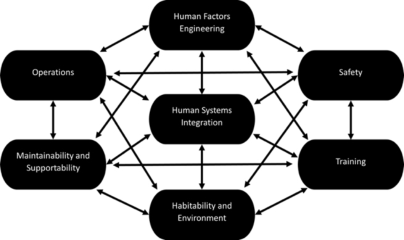
V-Matrix DFAM on HSI The HSI in aerial context considers AM over systems engineering (SE) to product design (PD) in Figure 2. model and human factors and ergono- mics (HFEs) are interconnected and deliver a comprehensive approach to systems engineering that incorporates human, organizational, and technolo- gical factors throughout a system’s life cycle. Human factors and ergonomics play a vital role in the HSI model, ensuring that systems are designed to adapt to humans according to their capabilities, limitations, and prefere- nces and minimize human error and risks (adaptation Boy 2021; Ahram & Karwowski 2009). It considers the product’s function domain. It invo- lves human factors such as engineering, manpower, personnel, training, and safety. Engineering narrows the system on the human, robot, and environ- mental observations (HF, RF, and EF) and factors integration in to the safety of PDl. Advancing performance from unmanned to autonomous operations requires manpower from the DFAM designers (in distance work) to remote operators. The cognitive domain of the team is constantly aware of the DFAM to operations management. SoS training processes traceability on the HE on the system advances constructive error management to improve human per- formance. The logical limits ensure a safety net on SoS (Adapted McCormick & Sanders 1981). The hub of HSI on the SoS angle is Human compatibility (Karwowski & Zhang 2021).
AD on V-Matrix DFAM Axiomatic design (AD) functional requirements for collective design minimi- zation are derived from the SoS HSI HFEs domain. The method has also been used successfully in studies by Salonitis (2016) in AD and AM context.
The SE requires metric evaluation at the design stage. For example Col- lective capacity can vary per operational intervals before returning to orbit (Carlson et al., 1990). What, if not returned, but refined and delivered, would produce some unwanted energy to the Outerspace instead to the orbit ground as an adaption to Sacco & Ki Moon (2019) or refined only for aerospace stations’ use. Such as a case, assessing the elements over manufacturing helps generate systems’ performance (Realyvásquez et al., 2015).
Figure 2: Domains of human systems integration. (Applied from Laarni & Ylönen 2020; Folds 2019).
A Sustainable System of Systems in Space 97
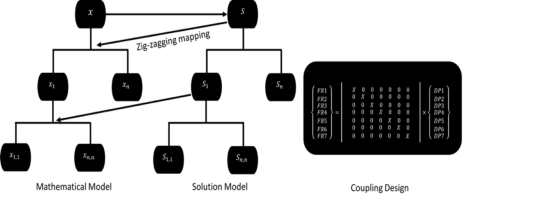
The hub herein is simplifying axioms, whatever the design requirements are, on the SoS domains. Similarly, technological and organizational design. Management of macroergonomics design level becomes compatibility of the organization (adapted Karwowski & Zhang 2021). The design becomes poly- tope shaped, producing a prototype whose faces are not defined as we saw in previous Figure 2. To form a resultant to the sparse design domain, the com- binations of the mathematical subdivisions is classified in the system upper dimension system, where functions become shared and form multi/pairwise cardinalities between complex systems resulting in a low-dimensional possi- ble next section. In Figure 3, the domain of the mathematical model variable function X presents the corresponding (any) system. The domain of the model solution becomes a variant of the model variable S = F(x); the corresponding roots are zig-zag mapped, to which the overall solution becomes the designed coupling.
The axioms supporting the distance smart manufacturing are presented minimized in previous Figure 3. F(x1 , xn): function to collect and store on the container; F(y1, yn): function to be recognized by the geographical posi- tioning satellites; F(z1, zn): function to observe the environment; F(i1, in): function to contract externally; F(j1, jn): function to provide usable energy as independently as possible; F(k1, kn): function to observe near surroun- dings; F(l1, ln) function to minimize the container energy form; and F(m1, mn): function to offer manufacturing features.
Figure 3: Domains of human systems integration on axiomatic design. (Improved from Bi 2018).Table 1. prototype for hybrid systems distance control maximizing function F for the operation.
Table available in the original PDF paper.
The following 1F(X, Y, Z, I, J, K, L, M) determine the axiom correspon- ding congruent sides of the design: universal body design requirement, grip, docking,… etc. reviewed as conclusion and solutions in the full paper.
DISCUSSION
Design for energy-forming projects is limited by the use of methods and approaches developed for conventional manufacturing (Adapted to Saloni- tis 2016). For this reason, manufacturing guidelines and constraints were captured from additive manufacturing practitioners to support an example case design in space.
The Axiomatic design theory is a systematic approach to design that provides a set of principles for creating designs that meet specified requi- rements while minimizing complexity and maximizing efficiency. One of the key features of this theory is the concept of decomposition, which involves breaking down a complex design problem into smaller, more manageable sub-problems.
The zigzagging decomposition technique is an extension of this appro- ach that considers manufacturing limitations and capabilities from the early design phases. This method can be particularly useful in the case of addi- tive manufacturing, where the designer must consider the capabilities and limitations of the manufacturing process when designing a component.
CONCLUSION
The future system design domain operation efficiency requires adaptation to aerospace. The human system integration of aerospace manufacturing sector provides opportunists a way into part of the circular economy, and part of pollution prevention by preventing another dead energy from colliding with a healthy satellite in orbit, and by collecting this threatening energy. The system of systems (SoS) level agile design raises expectations for prototyping and modelling a sustainable manufacturing base. A preliminary investiga- tion was presented here on the topic of advanced design principles applied to sustainability in space. This design base can also be extended to different fields for different requirements. Capturing the international space energy business by adapting it into a circular economy for regeneratively processing the products for customers’ contracts requires developing a recycling and reusable platform in an efficient cycle.
For future research, metaverse integration for simulating digital twins supports in-/tangible prototype creation. Moreover, the view of simulation presents the aims and helps to sell projects to manufacture the systems. The prototypes bring added value for learning and researching interesting topics on AM.
ACKNOWLEDGMENT
The authors have no conflicts of interest to disclose. Author correspondence Janne Heilala. The inspiration for Janne’s passion for spacecraft design stems from his youth when he avidly was following full of curiosity space agencies’
A Sustainable System of Systems in Space 99
achievements and advancements. Practical experience in astronomy, infor- mally and through education, further nurtured his dream of contributing to space exploration and innovative spacecraft structural design. He brought together researchers interested in research and design to review the process suggestions on systems engineering and commit to future design through reviewing contributions. Preliminarily, chapter crew co-authorships involve opportunists for future design guidelines and design directions on the per- spectives of Saeid Parchegani, Aezeden Mohamed, and Adriano de Freitas, specializing in optical manufacturing, materials, and automation techno- logies, respectively. More research for complex surface engineering with mechanical technologies with details is needed, particularly for new techno- logies. The authors are grateful for the contributions of various institutions’ support. Future research is a collaborative process of several continuously developing domains.
REFERENCES
Ahram, Tareq & Karwowski, Waldemar. (2009). Human Systems Inte- gration Modeling Using Systems Modeling Language. Human Factors and Ergonomics Society Annual Meeting Proceedings. 53. 1849–1853. 10.1518/107118109X12524444082754. Becedas, Jonathan & Caparrós, Andrés. (2019). Additive Manufacturing Applied to the Design of Small Satellite Structure for Space Debris Reduction. 10.5772/inte- chopen.78762. FHWA 2023. Bi Zhuming. Finite Element Analysis Applications: A Systematic and Practi-
cal Approach. Academic Press 2018. INSERT-MISSING-DATABASE-NAME https://www.sciencedirect.com/science/book/9780128099520. Accessed 30 Jan. 2023. Boeke, Cindy. (2016). Via Satellite at 30: The 1990s and Early 2000s. Referenced in 29.1.2023. https://interactive.satellitetoday.com/via-satellite-at-30-the-1990s -and-early-2000s/ Boy, Guy. (2021). Human Systems Integration and Design. Preprint Chapter for
the Handbook of Human Factors and Ergonomics, 5th edition, Wiley, USA, 2021. Carlson, Erika & Casali, Steve & Chambers, Don & Geissler, Garner & Lalich, Andrew & Leipold, Manfred & Mach, Richard & Parry, John & Weems, Foley. (1990). Final design of a space debris removal system. NASA STI/Recon Technical Report N. 92. 25382. Carlson, Erika & Casali, Steve & Chambers, Don & Geissler, Garner & Lalich,
Andrew & Leipold, Manfred & Mach, Richard & Parry, John & Weems, Foley. (1990). Final design of a space debris removal system. NASA STI/Recon Technical Report N. 92. 25382. Cooney, Ralph. (2022). Harpoons, robots and lasers: how to capture defunct satellites and other space junk and bring it back to Earth, September 13, 2022, referenced in 29.1.2023. https://theconversation.com/harpoons-robots-and- lasers-how-to-capture-defunct-satellites-and-other-space-junk-and-bring-it-back- to-earth-189698. Redwire 2023 Karwowski, Waldemar. and Zhang, Wei. (2021). THE DISCIPLINE OF HUMAN
FACTORS AND ERGONOMICS. In Handbook of Human Factors and Ergono- mics (eds G. Salvendy and W. Karwowski).
Kim, Shi. (2021). Can the World’s First Space Sweeper Make a Dent in Orbiting Debris?Article in Smihsonian Magazine in August 25, 2021. Referenced in 29.1.2023. smithsonianmag.com/science-nature/can-worlds-first-space-sweeper- make-dent-orbiting-debris-180978515/. Laarni, J., & Ylönen, M. (2020). Development of a Human System Integra-
tion Program in Military Context. Intelligent Human Systems Integration 2020, 1057–1062. https://doi.org/10.1007/978-3-030-39512-4_160Folds 2019 McCormick, E. J., & Sanders, M. S. (1981). Human factors in engineering and design (5. ed.). Tata McGraw-Hill. Realyvásquez, Arturo, Maldonado-Macías, Aidé Aracely, García-Alcaraz, Jorge Luis,
& Blanco-Fernández, Julio. (2015). Effects of Organizational Macro-ergonomic Compatibility Elements over Manufacturing Systems’ Performance, Procedia Manufacturing, Volume 3, 2015, 5715–5722. Sacco, Enea & Ki Moon, Seung. Additive manufacturing for space: sta- tus and promises. Int J Adv Manuf Technol 105, 4123–4146 (2019). https://doi.org/10.1007/s00170-019-03786-zRealyvásquez et al., 2015. United States Environmental Protection Agency (EPA). Aerospace Manufacturing Sector – Pollution Prevention (P2) Opportunities. Referenced in 1.2.2023. epa.gov/toxics-release-inventory-tri-program/aerospace-manufacturing-sector- pollution-prevention-p2., Carlson et al., 1990).
LISTED IN THE AHFE DIGITAL BOOKSTORE CATALOGUE
Explore the complete digital volume
Human-Centered Aerospace Systems and Sustainability Applications
Read this individual research paper free through the original publisher, or explore the full digital proceedings book.
ISBN 978-1-958651-74-2
Explore this ISBN in the AHFE Bookstore ↗Listed in the July 2026 bookstore catalogue; search by ISBN to confirm current availability · Digital book purchase optional