Janne Heilala (2023). Sustainable operation system for space debris management. In: Application of Emerging Technologies. AHFE Open Access, vol. 115, pp. 444–448. https://doi.org/10.54941/ahfe1004342
Space debris poses an escalating threat to sustainable space operations due to the accumulation of junk from decades of exploration and engineering. The orbital debris management system is explored, utilizing autonomous lasers, robotics, and AI techniques for integrated debris mitigation. Emphasis is placed on the critical need for international standards for sustainable space stewardship. Repurposing commonly observed debris as an in-situ renewable energy source is suggested by collecting and reusing existing junk. A case study is explored, evaluating the potential to reduce Earth resource launches. While promising technologies are emerging, international cooperation remains imperative to ensure the longevity of the space environment through coordinated and responsible debris prevention and mitigation practices. This paper examines the proposed integrated space debris management design for renewable energy generation. It highlights the importance of dual technology and policy efforts for sustainable space operations.
Managing space debris correctly has become increasingly important as the space industry has experienced unprecedented growth. An attempt to resolve the problem using laser techniques has shown considerable promise. Although laser technology offers promise, it is important to consider several aspects of space interactions, including electrostatics, gravity, and physio- chemistry (Rusu, 2012). Considering this, AI and machine learning become increasingly important in debris management, offering advanced wired com- munications to pioneer the future of debris management (Huang et al., 2022). Moreover, examining existing techniques and innovations is increasingly important as the space industry evolves. Retrofitting and equipping current space stations as orbital space debris recycling stations demonstrate the inno- vative transition of energy (Laino & Vasile, 2023). During the increasing knowledge about the Earth’s vulnerability, exemplified by the symbolic “blue dot,” it has become evident that debris management has become increas- ingly important in light of increasing space activities providing solutions (Dalal 2021; UNESCO MGIEP 2023). Determining whether emerging ways to clean debris are long-term important from increasing pollutants in rains is inevitable. Introducing laser cleaning into spacecraft designs raises questions
Sustainable Operation System for Space Debris Management 445
about risk management and appropriate control mechanisms (Dalal 2021; Fang et al., 2031).
These guidelines offer essential principles for space debris autonomous operations to ensure effective cleansing as space operations in interna- tional space comply with the lexicon. The preventive standardization could include factors such as environmental impacts (F3218), navigation proto- cols (F3244), and obstacle evaluations (F3265, F3327, F3381). Safety and efficiency in in-orbit operations depend on adapting these guidelines to space-specific criteria. This framework helps space debris managers design their operations based on these standards. (ASTM International Technical Committee F45 on Robotics, Automation, and Autonomous Systems 2021.)
LITERATURE REVIEW
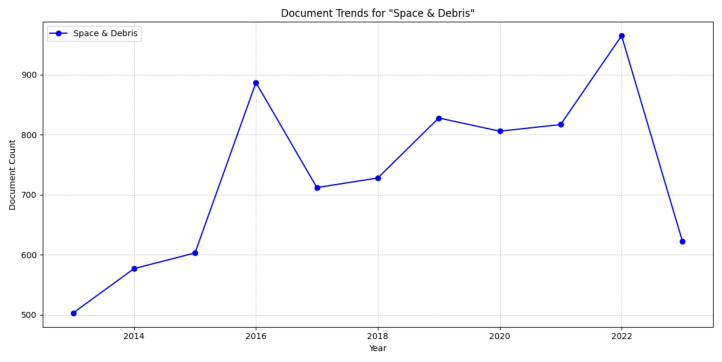
With the help of a scoping review, the study explores how to design a debris remover suitable for this operational example when debris removal is fol- lowed by the design. For the design study, PRISMA-ScR (Preferred Reporting Items for Systematic Reviews and Meta-Analyses Scoping Review) guide- lines for review are suggested (Munn et al., 2018). By comparing findings, technology principles could be solidified. Thus, the study incorporated the PRISMA-ScR method for accurate reporting with PRISMA-P with SCR qual- itative assessments (Tricco et al., 2018; Moher et al., 2015; Page et al., 2021). Queries utilized the TITLE-ABS-KEY function, targeting the domain using terms space debris-related topics, incorporating terms of “space debris”, fur- ther benefiting exploring “debris removal”. These searches were aimed at understanding designs optimized for collecting space obstacles. A visual rep- resentation spanning a decade (2013-2023) is depicted in Figure 1, detailing the academic trajectory of aerospace (Scopus, 2023).
Figure 1: A The decreased surge for controlling space debris management in this study scope fills the gap well (Scopus, 2023).
446 Heilala
Axiomatic design for space is used to assess further extension to the design parameters encompassed by the requirements to solve space debris with intelligent metasurfaces, algorithms, protocols, navigation, and col- lection methods. New space designs require specific functionalities such as tracking, coordination, and reliable communication in space. Exploring the technological adoption could steer the dimensionless values in physics modeling.
A SYSTEM FOR COLLECTING DEBRIS IN ORBIT A space debris management systems engineer should have clear functional requirements (FRs) and design parameters (DPs) with sample N. FRs/FPs follow the axiomatic design theory (Suh 2007). A comprehensive approach addressing the dynamic nature of space objects is essential.
The space debris management design encompasses various functions: FR1 focuses on attaching to orbital debris safely, FR2 on maintaining a consistent towpath, FR3 on safe transit and collision avoidance in multiagent systems, and FR4 on returning debris to a predetermined function (adapted from Heilala, 2018). Design parameters (DPs) underpin functional requirements, providing the essential tools for their realization. DP1 involves mechanisms like robotic arms and magnetic latches for attachment. DP2 encompasses sta- bilization and thrust systems for transport. Advanced navigation tools, such as high-frequency sensors and radars, are key components of DP3, ensuring effective towing in unpredictable space conditions where angles can exceed normal (adapted from Heilala 2018). Exploring energy reuse in a circular economy is crucial for protecting electronics, with features from shifting to responsive communication(s) integration for autonomous control for safe re-entry promoted in DP4. The FR above/DPs are shown in Table 1.
Table 1. This table shows simply the functions and design related to the standardization requirement arranged by a case study (N = 4).
Table available in the original PDF paper.
N Functional Requirements (FRs) Design Parameters (DPs) 1 Attach safely to in-orbit automotive Robotic arms, magnetic latches 2 Maintain a stable tow with minimal deviations Thrust and stabilization systems 3 Return debris safely to the Earth’s surface Advanced navigation; electronics’ protection 4 Energy electronic protection for re-entry Steering metasurface(s) for total control
Additionally, exploring sensing control during re-entry ensures debris safety (Lindner et al., 2022); otherwise, risks like energy loss or commu- nication breakdown can occur as hazards. In decoupling, the effect becomes equilibrium with the DP4 feature.
Furthermore, FR5/DP5 would cover the design of robust thrust and navi- gation systems, with feedback and control features that contribute to making missions reliable and precise. Towing space debris, however, has its limita- tions and inefficiencies. By integrating advanced machine learning and fluid dynamics, this mechanism entails complex processes, including heat transfer and particle flow analysis with proper material syntheses in a proper design, which would correspond to design automation of a self-processing debris
Sustainable Operation System for Space Debris Management 447
machine design. The space debris manager’s algorithms, communication automation, and assemblies must be developed and innovated to converge these processes.
Table 2. This table explores the development results for parametric space debris management. The axiomatic design matrix for the one operation of the space debris management becomes functional requirement (FR) and design parameter (DP). As a synthesis, FRs include attaching safely to in-orbit debris (FR1), maintaining a stable tow with minimal deviations (FR2), and returning debris safely to the Earth’s surface (FR3). It incorporates DPs such as robotic arms or magnetic latches to meet these FRs, thrust and stabilization systems to meet FPs, and advanced navigation tools to meet FPs. It features care electronics with care (like shieldings) to meet FPs.
Table available in the original PDF paper.
DP1 DP2 DP3 DP4 FR1 X FR2 X FR3 X FR4 X
Thrust Dynamics Axiomatic Usefulness for Space Management Exploring the fusion of data-driven methodologies in the space operations field could demonstrate remarkable progress. Combining these methods with AI capabilities, such as neural networks, can revolutionize practices in managing space debris. As the study of dynamics advances from cou- pling, these data-driven strategies are incorporated, namely, the integration of aerodynamic forces and propulsions and using real-world data to refine multi-propulsion performance. Whichever number determines the coupling dynamics allows the downshifting of thrusts and the revmatching of upshift- ing the thrust propulsions. Additionally, simulations indicate that static magnetic fields are highly effective in distinguishing space debris. The inte- gration of AI capabilities, especially in simulation training, could result the development of superior design. The additional understanding of the com- plex forces operation in space can be used to optimize space operations. A clear indication of this progress can be seen in the emergence of neu- ral network-centric methods that allow the tracking and reconstruction of unknown objects, which can be critical in managing space debris rotational dynamics.
CONCLUSION
Several factors were explored in managing space debris, including using advanced technologies, international collaborations, and developing holistic best practices. With the ongoing growth of space exploration, it is imperative to address the challenge of space debris with proper lifecycle management.
448 Heilala
The exploration must be paired with standardized procedures to ensure long- term sustainability. This requires technical competence and creative vision. It is essential to ensure the sustainability of space operations with realistic design by combining innovation with international cooperation and respect for the unique aspects of the space environment to become possible.
ACKNOWLEDGMENT
There are no conflicts of interest to disclose.
REFERENCES
Dalal, P. (2021). Pulsed laser cleaning of debris accumulated on glass articles in vehicles and photovoltaic assemblies. U. S. Patent No. 11110896. United States Patent and Trademark Office. Heilala, J. (2018). Electric Vehicle Conversion from the View of Modern Technology,
Motor Sizing, and Legislation. Oulu University of Applied Sciences. https://urn.fi /URN: NBN: fi: amk-201803012927 Huang, Q., Wang, P., Wang, Y., Xia, X., & Li, S. (2022). Kinematic Analysis of Bionic Elephant Trunk Robot Based on Flexible Series-Parallel Structure. Biomimetics, 7(4), 228. https://doi.org/10.3390/biomimetics7040228 Laino, Maria & Vasile, Massimiliano. (2023). Optimal Orbits for a Recycling Station
Supporting In-Orbit Recycling. Lindner, Claudia & Kraft, Nico & Happe, Darius & Ortwein, Annette & Staar, Kilian & Rienow, Andreas. (2022). Augmented Reality Applications for Remote Sensing in Secondary Education using Radar, Lidar, and Imaging Spectrometer Data. Munn, M. D. J. Peters, C. Stern, C. Tufanaru, A. McArthur, and E. Aromataris, “Sys-
tematic review or scoping review? Guidance for authors when choosing between a systematic or scoping review approach,” BMC Medical Research Methodology, vol. 18, no. 1, 2018. Rusu, Ioan. (2012). The Electrostatic Model of Gravity. Conference: XII International Symposium on Nuclei in the Cosmos August 5–12, 2012 Cairns, AustraliaAt: Cairns, Australia. Scopus, Elsevier B V, Available: https://wwwscopuscom/, Accessed on: October 10
2023. Suh. N. Ergonomics, AD, and complexity theory. https://doi.org/10.1080/ 14639220601092509, last accessed 2022/12/13 (2007). Tricco, A. C., Lillie, E., Zarin, W., O’Brien, K. K., Colquhoun, H., Levac, D.,... & Garritty, C.... & others. (2018). PRISMA extension for scoping reviews (PRISMA- ScR): checklist and explanation. Annals of internal medicine, 169(7), 467–473. UNESCO MGIEP. (2023). The Blue DOT. https://mgiep.unesco.org/the-bluedot.
Referenced in 18.9.2023.
LISTED IN THE AHFE DIGITAL BOOKSTORE CATALOGUE
Explore the complete digital volume
Application of Emerging Technologies
Read this individual research paper free through the original publisher, or explore the full digital proceedings book.
ISBN 978-1-958651-91-9
Explore this ISBN in the AHFE Bookstore ↗Listed in the July 2026 bookstore catalogue; search by ISBN to confirm current availability · Digital book purchase optional