Janne heilala, Khushboo Singh (2023). Evaluation Planning for Artificial Intelligence-based Industry 6.0 Metaverse Integration. In: Intelligent Human Systems Integration (IHSI 2023): Integrating People and Intelligent Systems. AHFE Open Access, vol. 69, pp. 692–703. https://doi.org/10.54941/ahfe1002892
The article presents an image of Industry 6.0 (I6.0) metaverse integration based on an extensive study of selective literature. The Key Enabling Technologies (KETs) developed from industry 1.0, which showcased steam engines, to the information age 4.0, which includes Automation and Robotics (AR) and Additive Manufacturing (AM), are briefly discussed. The aim is to know how manufacturing practically links to the connection between business partners' core competence, the Global Supply Chain (GSC) pattern, and how Human Systems Integrate (HSI). The level of I5.0 requires highly developed systems, and manufacturing robots must consider Human Factors (HFs) for safety reasons. In addition, the design office must also consider human health and safety. HSI requires these Robot Factors (RFs) for humans to work in the manufacturing environment without being restricted. This work investigates how Artificial Intelligence (AI) can be transferred to a robot in practice by creating a test setup for sharing human behavior with high sampling frequency devices. Developing models that can promote the future of cognitive Augmented Reality (AR) will increase the immersion of initial steps of the metaverse in the new generation internet. In the proposed clinical test setup program, we deal with the procedures related to the model's production from a meta-level with a futuristic vision to long-term progress in this field of research. The relevance and promising potential of the recent research conducted in this area suggest that the proposed approach is highly significant in enabling future studies.
The industrial revolution from Industry 1.0 (I1.0) to Industry 4.0 (I4.0) has seen world industries using machines and taking advantage of global internet-driven economic evolution by relocating manufacturing and serving customers in real-time. The enterprises’ site management and operations gained strength, spreading production across the globe. The remote manage- ment operations advancements require digital duality and global connectivity between machines and humans, technologies and organizations. (Heilala 2022a adaptation.) The metaverse, a new internet generation, is on its way (Anderson & Rainie 2022). An intense multinational race on competitive- ness and productivity is driving industries to move from I5.0 to I6.0 for new
Evaluation Planning for Artificial Intelligence-Based Industry 6.0 Metaverse Integration 693
fortune, sustainability, and well-being: towards universal, customer-centric, virtualized, and resilient manufacturing, emphasizing the global industrial revolution (Business Finland 2021). The roadmap towards I6.0 requires the I5.0 basis for robotic assistance of human labor to consider humans as the center of the Universum perspective. I5.0 Artificial Intelligence pipelines define computerized field communication that can autonomously use vari- ous production sources to adapt to the demand of customers (Duggal et al. 2021). To respond to the requirements of the I6.0, the stylistic set of text was selected to form canonical fiction simulation to program innovations for human systems. Because the literature varies from surrealism to living harmo- niously with nature, the realism emphasizing sustainability from European Commission is respected. The I6.0 requires full I4.0 technology integra- tion with I5.0 value decomposition to find the industries through human system integration. Managing the supply chain requires inception, conce- ption, and perception of a successful Manufacturing-As-a-Service (MAAS) concept, where customized, flexible and decentralized production technolo- gies are initiated. Factory/site level quantum corporations repositories form a certain irony for deep integration of corporations from their current state and data regulations, emphasizing platform development challenges on the Horizon (Heilala 2022c). The I4.0 managed digital plant between work- flow employees to communicate and produce products is digitalized, whereas the I5.0 anatomical dimensions go above for advanced robotics, bioen- gineering, intelligent manufacturing, and society (Chourasia et al. 2022; Duggal et al. 2021).
The paper provides a detailed overview of the human systems integra- tion program preliminaries to organizational requirements. The study covers the perception that Cognitive Automation and Robotics Collaboration with humans are dependent on Human Factors (HFs) that must adjust Robot Factors (RFs) to which end robot cognition technologies raise communi- cation immersion for industry 6.0 metaverse for communication and safety issues (Hopko et al. 2022; Chourasia et al. 2022 adopted to Business Finland 2021). The requirements are based on the pre-registration criteria for fur- ther Human/Hardware-in-the-Loop (HIL) simulations for Computer-Aided- designer frameworks and manufacturers/ suppliers. The major research requirements are weighted in BCT-the management side, requiring a piloting project that establishes the usable environment to support Human-Centered Design (HCD) from the perspective of the aforementioned industrialized project from the HFs side.
We propose electroencephalography (EEG) for its simplicity and popu- larity among other health device applications, which is backed by market analysis showing rising sales and extensive usage. (The Insight Partners 2021). Market data suggests that in 2019 alone, the professional AR sector grew by a whopping 32%, from the US $8.5 billion to $11.2 billion (Cassioli et al. 2021).
To strategically manage these innovative KETs through application archi- tecture layers’ to HSI practice, we consider and address the challenges in the exported cases using Integrated Systems Engineering (ISE) & Processes Pipe- lines in Object Oriented Architectures (PPOOA) Model-Based SE (MBSE).
694 Heilala and Singh
The degree of understanding of the occupational and safety error-prone semantics and syntax helps to formulate efficiency-enhancing testing proto- cols and inspires HFs to respond to the industry requirements that could be generalized from unique systemic mechanisms (adapted to INCOSE 2017). An attempt to explicate the spanning of neuroscience, which bridges the politics-led I6.0 with cognitive neuroscience, is made in (adapted to the Fleur et al. 2021 context to Business Finland 2021).
AM and Simulation and Data Analysis (SDA) integration research are rele- vant because the area is new and developing and holds promising potential in the MAAS from platform development aspects. BCT parallel sending of internal communication has been a subject of research for a long time, and creating a test setup is challenging but possible for piloting experiments, such as SDA and AM, through the design processes to bring ergonomics to the design work. Let us refine this further with research questions in the next chapter, which will be answered chapter by chapter, and finally, a synthesis will be made of the risks and advantages of the plan.
Research Questions To cover the objectives of the study, the following research questions (RQs) were defined prior to industry 6.0 engineering:
1. What is a compact integration platform model for Manufacturing? 2. What are the considerable Human Factors for collaborative and safety design for Robot Factors? 3. What are the compact Machine Learning preliminaries for neuroergo- nomic communication modeling?
To respond to the abovementioned research questions, Metacognitive Learning Strategies (MSL) mapping is carried out by exploring the objectives of this study by relying on the database findings in the literature (e.g., Ismail & Karwowski 2020). The following section discusses the PPOOA perspective to consolidate the necessary considerations to perform HSI for redundancy and effectiveness of manufacturing. It explains reciprocity between humans and robots via neural models.
IMMERSING IN TO THE INDUSTRIALIZED METAVERSE Testing Protocol Skeleton for Integrating Stakeholders
We begin with an attempt to address the following question, “In what respect the use of software causes problems?” and try to find solutions to verify the quality of the chosen comparative classifier from the literature. When consi- dering SDAs’ downstream applications, the classic errors in creating drawings for manufacturable products are typical for complex design intentions. For instance, Computer-Aided Engineering/Manufacturing (CAE/CAM), where the healing structures are impossible and require direct modification on the primary native modeler in Computer-Aided Design (CAD). The native desi- gner’s design choices are driven by subconscious learning and creativeness through aware cognitive actions with strategies to achieve desired outcomes that have a pace for frame rate processing from the system point of view.
Evaluation Planning for Artificial Intelligence-Based Industry 6.0 Metaverse Integration 695
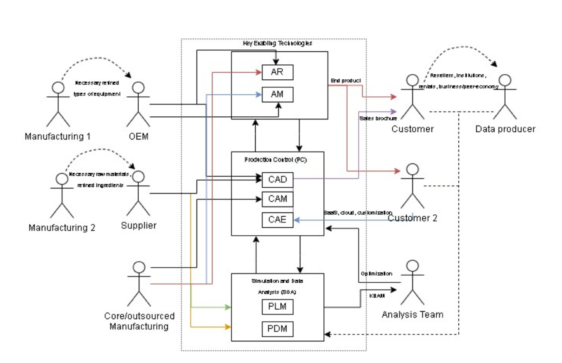
Figure 1: Compact model for bridging the gap between the SE architectures using ISE & PPOOA MBSE methodology for stakeholders’ program (Fernández 2022). It shows the Key Enabling Technologies (KETs) digital platform’s Automation and Robo- tics (AR); Additive Manufacturing (AM); Production Control (PC): Computer-Aided Design (CAD), Computer-Aided Manufacturing (CAM), Computer-Aided-Engineering (CAE); Simulation and Data Analysis (SDA): Product Lifecycle Management (PLM), Product Data Management (PDM); application components interaction with Manufa- cturer’s, Original Equipment Manufacturers (OEM) and Supplier’s viewpoint to the core or outsourced corporation Manufacturing to which infrastructure management and engineering model evaluated MBSE the responses of the business integration and simplified the HFs individual capabilities.
Drawing one line per two seconds without errors is a heavy process that requires attention control and motivation to get the vectors properly in place, aided by the aim of shape and interface communication.
The innovative ways to enhance performance efficiency in designing with- out propagating changes await a global network of designers (adapted to context solution González-Lluch et al. 2017). The designer’s communication is prone to semantic and syntax errors. To propose a solution for MBSE, pre- processing for ISE looks at HSI-aspects as shown in Figure 1, from which reproducibility and reliability of the overall trial can be assured via standar- dization of the workflow using Unified Modeling Language (UML) (model example from de Carvalho et al. 2010). KETs architecture provides a more concrete view of how components will be realized and deployed: networking and forming a manufacturing supply chain simulation. Its components are generally acquired from the marketplace and can be assembled and configu- red to constitute the industry’s KETs infrastructure. Assigning components to KETs represents the symbiotic relationship between the architecture set of software (SW) and hardware (HW) components (Desfray & Raymond 2014).
The Human Factors for Safety Design and Collaboration for Robotic Factors Communication inefficiencies between humans and GSC on an IE aspect, focusing on occupational health issues and injuries caused by working environments and situations, pose a research challenge. Take a moment to
696 Heilala and Singh
consider engineering ethics: why did the Boeing 737 MAX new flight control system-based aircraft fail and end up crashing in 2018-2019? Simply because of fatal HF design errors (Herkert et al., 2020). This incident emphasizes the necessity of occupational certification.
Whether we consider occupational safety or designing responsibilities – particular culprits are best shown on Human-In-the-Loop (HIL) side, where accident prevention in VR applications risk assessment and preventiveness, for instance, immersive applications (e.g., Kwegyir-Afful 2022) and safety monitoring (e.g., Kim et al. 2021) justifies that they are critical for an effi- cient system design. From the programmers’ and designers’ perspective, the systematic and random type of Human Errors (HEs) in model construction view possibilities to launch the manufacturing process “on the fly” when requested. Human pace sorties in connection to the mouse or keyboard inte- raction failure while checking drawing for errors show that purging does not recover. This results in incorrect solutions and, in turn, produces unwan- ted geometry’s kernel biases shape characteristics. (adapted AutoCAD 2022; González-Lluch et al 2017.)
The MAAS technique mentioned earlier in automation and robotics may decrease safety, performance, and efficiency. The lack of a Human Systems Integration perspective that incorporates emergent Human Factors with Robot Factors, such as “trust, anxiety, increased mental strain or workload,” is a major concern (Hopko et al. 2022 cited Lee and Seppelt 2009; Fujita et al. 2010; Charalambous et al. 2016). From a Human System Integration (HSI) perspective, projects on system design polarize into SE fidelity compo- nents. The components culminate in total HFs in the SE model. HFs are based on performance: how the problem is identified and transformed into a chal- lenge by defining a goal, and what information has been used to elaborate and make predictions? The strategy for formulating long-term planning with timely decision-making will deliver outcomes and learn from them. Thus, HFs safety correspondence on MSLs among a collaboration of the stakehol- ders is crucial. Biosignals’ complexity emphasizes the networking biases, to which end recently established taxonomy on HEs distinguishes 24 types of bias and a problem-solving theory (adapted Dörner & Güss 2022).
From a safety point of view, learning is always there, and from the MSL point of view, it would be quite interesting to see mechanical solutions to the safety of design work and manufacturing.
Suitable MBSE Program for BCT-Based Clinical Trials and Studies In answer to the requirements, human cognitive performance measures using the EEG has excellent temporal resolution and indices highly sensitive to human brain activity fluctuations (Ismail & Karwowski 2020). Hence, the BCT study is EEG-based. Receptive-active feedback on the capabilities of a human is obtained concerning Metacognitive Learning Strategies (MSL), electrical tracts mapping results, and tasks that the method topic considers.
Problem identification essentially refers to posing the right problem for preventing fatal design work HEs. The goal is to formulate research questions on aligning failures’ complex spheres to the response. For the correct failure
Evaluation Planning for Artificial Intelligence-Based Industry 6.0 Metaverse Integration 697
disposition, the selective literature review is captured to lead Brain Com- munication Technologies (BCT) perspective for solving errors and increasing efficiency to the PCs/SDAs based on AR/AM expertise KETs framework (Hei- lala 2022ac). The extensive knowledge study justifies that the BCT is suitable for improving neuroergonomic interaction and the learning environment. BCT management is suitable for monitoring human operations on controlling machines that operate through computers or microcontrollers. Its acquisi- tion potential is to collect a database of information for solvable artifacts of operator communication based on the technological side to give numeric estimations of electrical tracts of brain signals on the operation. Research findings suggest that a metacognitive decision results from integrating sen- sory data and information acquired through interactions with the external environment, so action information contributes to metacognitive decision- making (Wokke et al. 2020). Another study proposes an applicable testing protocol for the failure disposition to decision-making and evaluation of action-based outcomes (Dörner & Güss 2022). The intention of measurement is important because its acquisition and developable algorithm give an appro- aching pattern for establishing a communication channel between activated humans and the interactable object, depending on the HIL test setup.
Here, we present a standardized procedure for visual network-based extra- ction. We first need to build a test protocol that is applicable to respond to the I6.0-driven education requirements and then arrange a clinical trial test pro- tocol. We open applications to the trial, select participants for the study using surveying, invite approved applicants to the neuroergonomic base-setting, and start collecting data sets cumulatively by arranging and capturing data from each participant. Participant selection emphasizes freedom of choice because it weighs innovative testing. However, incentives are considered if turnout is expected to be low. The participants are asked to sign contracts for permission the study to bind the approach and perform follow-up studies legally.
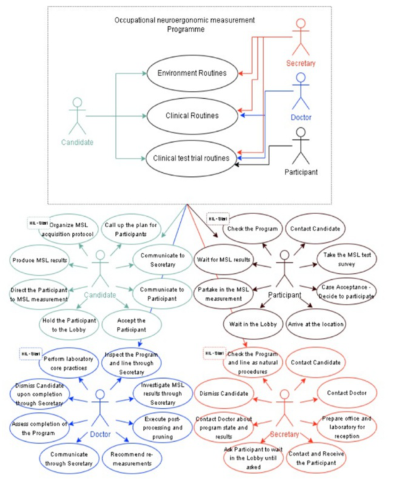
Figure 2 shows the MSL abilities integration to the researching syntax and semantics. The candidate sees the formalities of the measurement laboratory from the perspective of the environment, clinical procedures, and tests. The secretary also knows less about practice than the candidate. From the doctor’s point of view, it is essential that the protocol works and that the test results are delivered to him. At the center of the testing is the participant, who can be a student under different circumstances than a patient, whose learning is studied from the point of view requested by the test setup, and the participant does not have to see through the systematic planning, because they participate in the program.
These program actors are seen as preliminary examples of a neuroergo- nomic measurement event. The candidate prepares a testing protocol and conveys information about this to the secretary and the doctor, who can check it. Finally, the person applying for the measurements can join the measurement as advised by the secretary or otherwise based on the time given. When checking, the secretary also forwards the information to the doctor, as it is unlikely that the candidate’s processing will be interrupted by a pre-prepared program. The measurement event begins when the participant’s
698 Heilala and Singh
Figure 2: MSL abilities integration to the researching syntax and semantics of how HIL are performing ISE & PPOOA MBSE-based UML setting on nearest stakeholders for building the I6.0 manufacturing platform (Siemens 2022 applied to Fernández 2022 design study framework).
pre-measurement questionnaire is accepted, and the candidate invites the per- son to be measured for the study. At times a separate registration may not be required after an accepted invitation. After the test, the doctor checks the data and, by virtue of professional skills and experience, declares the proce- dure a success or a failure. The secretary is informed if the candidate needs to repeat the measurement in case of invalid test outcomes. The program’s main point is to organize the fundamentals of a systematic interpersonal function.
For the trial setting, selecting a suitable sample size of participants for systematic testing depends on the mathematical framework and the precision of the composition. The clinical use and research of the neuroergonomic stu- dies have varied in case of studies from 20 to 80 participants (Alasim 2020). Some BCT studies’ electrode-specific models claim that even 10 participants can account for sufficient saturation with nearly 99% accuracy (Lun et al. 2020). However, the test situation for a wider spectrum of users requires broader sampling to saturate. However, the test situation for a wider spe- ctrum of users requires broader sampling to saturate. In this situation (ibid.), the advantage is in the empirical measurement and signals that the product is nearly at the clinical phase but quite likely still in its infancy (Panacha- kel & Angarai 2021). Commonly, researchers have conducted small studies with large spectral data-capturing acquisition methods that fail to meet qua- lity control (QC). Having a sample under 100 participants and a detached measurement protocol cannot account for the phenomenon of interest from the perspective of QC standards. When the model is trainable, the dataset must be larger than 100, preferably over 5000, for effective generalization to
Evaluation Planning for Artificial Intelligence-Based Industry 6.0 Metaverse Integration 699
a problem to increase accuracy prediction expectations from 20% to 90% (D’souza et al. 2020). Additionally, the design study must be well-received and relatable (Kim et al. 2021).
On I6.0 metaverse requirements, communication and safety testing, and comprehending the failure disposition, the massive data supports only highly innovative models, where sample size and trainable model are justified. Concerning the technical and managerial matters, HF/HR- integration data modeling requires massive data acquisition. To this end, the HFs networ- king for manufacturing enables smart sensors measured via a computing platform for which the sample set must be minimized to optimize the labor hours.
Procedural Neuroergonomic Machine Learning Modeling The academic-industry demonstration for recording human brain activities is subject to Bioelectric Resonance Frequency (BRF) understanding of what the human processing captures the sensory experience and rearranged to new meaningful memory in the HIL domain-specific setting (Heilala 2022c cited Mongan et al. 2015). To map the spectrum, Multichannel BCTs from 124–256 channels are used in high-level cognitive processing acquisition (Ismael & Karwowski (2020). HFs connection clinically is critical, and the world is more complex because individuals have different Craniofacial Vari- ability Index (CVI); for instance, in a standardized set of z-core, variability in the reference population is shown by (N = 1312) (Ward et al. 1998). The CVI variations appear in the readiness fiducial landmarks to the model mea- surement requiring anatomical brain scanning to reproduce a digital twin to localize signals entirely. (Gallego et al. 2021).
The prefrontal regions of the human brain oscillate at theta frequencies (5-7 Hz) for working memory and alpha frequencies (9-12 Hz) for shif- ting memory. Human attention states during working memory tasks can be quantified using these wavelengths because parietal and frontal regi- ons show lower amplitudes during high working memory loads (Ismail & Karwoski 2020). Human-selected objects maintain chronological order infor- mation differently with theta and alpha oscillations. (Hsieh et al. 2011.) Higher domains relate to higher level MSL processes: reading, speaking, and forming intrinsic thoughts on the cognitive domain by 70 Hz (Ala- sim 2020, 53–54); corresponding to MSL HIL, the requirement is to build a large cloud storageable database for novel deep convolutional Neural Network (CNN) considering network markup, sharing, task assignment with desktop synchronization and build the clinical trial in supervised lear- ning as (model example from de Carvalho et al. 2010). CVI and the range of cognitive measurement domain imply that the machine learning mode- ling needs to estimate the cerebral area’s diversity of an Nth user that challenges following hemispheric sensory processing (Heilala 2022c cited Hsieh et al. 2011).
The pre-recording and postprocessing for acquired high-resolution wave- lengths take much space to supervise pattern recognition, and prediction takes enormous time, depending on the processing capabilities of the
700 Heilala and Singh
quantum technology. Here we present a more reductionist approach for a hypothetical BCT.
. . .
For instance, the axon tracing ex vivo representation appoints I for input and K for output with the given hypothetical vector space S =
xH, yH
x1, y1
formulating training couples xN, yN ∈I × K, where H = (1, . . . , N) denotes iterations of data- acquisition cycle-time inte- rvals forming readable beziers from the training inputs xN and marking outputs yN. The Bezier curves are then compared with the numerical qua- litative outcome space probabilistic compositions to predict the number Nth of system Bth behaviors. The optimal practice is a Sequential Backward Sele- ction (SBS) defining the subset for performing classification on Conformal Kernel. The typical spatial pattern linear discriminant analysis of long short- term memory and singular value decomposition deep neural network are reasoned for primary demonstration (Panachakel 2022). Both compositions and behaviors for safety measures require dual clustering. The approach used for the emotion prediction method is graph-based semi-supervised learning. (Dan et al. 2021).
The integrative approach to problem-solving has been related to ability and intelligence. MSL is the outcome of adapting to new environments requiring concepts like perceptual, conceptual, analytic, social, motor, control, flex, extroversion/introversion, and general and differential activity to define the impulse for individual innovation generation. A solver for measurement is essentially an environment that requires Lingual, Numerical, and Spatial con- straining, simplified models to solve one application at a time for a specific purpose (adaptation to DeNovellis 2017).
The perceptual data is based on the Gaussian decision process to fit linear/non-linear data since the training from stochastic Monte Carlo resam- pled can be used when limited sampling is available. Model-fitting to a deterministic model in practice can adapt to operator state assessment and be deployed as a HIL model following and approximating human integration (Borghetti et al. 2017).
The complexity of BCTs in interactive HCD-level ensures that the sof- tware (SW) and hardware (HW)-based design HFs stay connected. Future HSI-assessment-based incremental innovation sets R&D requirements to rely on BCTs to prevent polarizing HFs. The SW side emphasizes the HSI per- spective on HFs fluidic program creation method and maintenance plan to correspond from its integrability to HW. As the counterpart, deriving SW functions to the digitally designed physical, the ergonomic surface purchased by humans defines its additive manufacturability and functional characteri- stics. The HSI plan interchangeably works best on sound SysML defining the world characteristics from the OOSEM perspective (Heilala et al. 2022; Hei- lala 2023). The BCT mapping through the PPOOA supports selecting HFs for organizational goals to be highly beneficial.
CONCLUSION
The study provides a vivid picture from the perspective of core and outsou- rced manufacturing, design, product development, and the customer, which corresponds to reality from innovating manufacturers-enterprises at the I6.0
Evaluation Planning for Artificial Intelligence-Based Industry 6.0 Metaverse Integration 701
level (yet) without delving into the metaverse. From the digital platform eco- nomy standpoint, which is precisely the perspective of the supply chain, i.e., the stakeholders, it is essential to integrate the company’s everyday life with various solutions so that the unnecessary work steps of the employees are reduced. The production of various end products (invoicing, work order, order of parts, CAD drawing) will practically run without interruption if we consider individual companies. If, on the other hand, everything works under the same roof, it loses the efficiency of the global supply chain because I5.0 customized, flexible and decentralized production gives the customer the freedom to influence the requirement for outsourced companies. Hence, it can mean more diverse, virtual, customized, and sustainable products in I6.0 (RQ1).
However, between the customer and the outsourced designer, manufa- cturer, or another stakeholder, there is usually nothing but challenges in coordinating the collaboration. The more complex the system, the more human factors can cause work accidents. Accidents happen all the time, not all of which are necessarily brought to the employer’s attention, but we learn from them, and some incidents cannot be avoided. When viewing manufa- cturing from level I4.0-I5.0, in terms of production control and robotics, it is emphasized that it would be important to consider and measure HF and plan the contribution in terms of RFs so that the operation would be sustainable. Our research suggests that this can be measured and based on manufacturing niche monitoring that would collect a certain quality of data about emplo- yees that would help employees rather than having someone monitor their data for them. From the communication viewpoint, our research trusts that the immersive internet of the future has aspects for collecting such data about people and conveying it in the necessary form to the user, or when sufficiently developed, for communication (RQ2).
Finally, the study encapsulates a meta-level description of needs and goals and the existing methods for analyzing and using brain computers for artifi- cial intelligence. It appears to be one of the most exciting avenues for research professionals and entrepreneurs and holds potential for further development, typically focusing on features that increase safety. The study proposes a possibility and suggests guidelines for developing artificial intelligence in conjunction with a Monte Carlo simulation, especially when the available samples are insufficient. The research takes a critical approach to the sources used because the development of communication technology or the utili- zation of scientific models, i.e., the creation of practice, do not necessarily follow this fictitious functional integration. However, it creates the basis for developing a pre-registering program for EEG studies and further motivates to do open science by licensing and treating the sources used, leaving a lot to learn for the subsequent follow-up studies.
REFERENCES
Alasim, F. (2020). Human Performance In Virtual Reality Environments and Its Exploration with Engineering Analytics, doctoral dissertation, University of Central Florida. https://stars.library.ucf.edu/etd2020/322/
702 Heilala and Singh
Anderson, J. & Rainie, L. (2022). The Metaverse in 2040. Pew Research Center, June 30, 2022. AutoCAD. (2022). Optimizing drawing files in AutoCAD with Purge. https://knowledge.autodesk.com/support/autocad/troubleshooting Borghetti, B. et al. (2017). Assessing Continuous Operator Workload. Human
Factors. 59, 134–146. Business Finland, BF. (2021). From Industry X to Industry 6.0 Antifra- gile Manufacturing. alliedict.fi/wp-content/uploads/2021/08/Industry-X-White- Paper-3.5.2021_Final.pdf Cassioli, F. et al. (2021). Human–Co-Bot Interaction and Neuroergonomics. Frontiers in Robotics and AI. Chourasia S. et al. Sustainability of Industry 6.0 in Global Perspective. MAPAN.
2022;37(2):443–52. Dörner, D. & Güss, C.D. (2022). Human Error in Complex Problem Solving and Dynamic Decision Making: A Taxonomy of 24 Errors and a Theory. Computers in human behavior reports 7. Dan, Y. et al. (2021). Possibilistic Clustering-Promoting Semi-Supervised Learning
for EEG-Based Emotion Recognition. Frontiers in neuroscience 15. de Carvalho E. et al. (2010) Standardizing clinical trials workflow representation in UML. PLoS, Nov 9;5(11). DeNovellis, R. (2017). Problem Solving: The Integration of Personality, Cognition,
and Interest Subgroups around Verbal, Numerical, and Spatial Problems. Desfray, P. & Raymond, G. 2014. Modeling Enterprise Architecture with TOGAF: A Practical Guide Using UML and BPMN. Morgan Kaufmann Publishers Inc., San Francisco, CA, USA. D’souza, R. et al. (2020). Structural Analysis and Optimization of Convolutional
Neural Networks, Sci 10, 834. Duggal, A.S. et al. (2022). A sequential roadmap to industry 6.0. IET Commun. 16, 521– 531 Fernández, J. (2022). The system and software architectures using ISE&PPOOA
MBSE. INCOSE. 21.9.2022. Fleur, D. et al. (2021). Metacognition. npj Science of Learning Journal, 6, 13. Gallego, M. et al. Automatic Detection of Fiducial Landmarks. Occipital Structure Sensor-Based Work. González-Lluch, C. et al. (2017). A Survey on 3D CAD model quality assurance and
testing tools. Computer-Aided Design, 83, 64–79. Heilala, J. (2022a). Deployment Of Competitive Techno-organizational Global Supply Chain Management. XXXIII ISPIM Innovation Conference. 5-8.6.2022 Copenhagen. Heilala, J. (2022b). Horizon Europe Proposal Preparation. Kaunas University of
Technology, Economics and Management University Conference 21-23.9.2022. Heilala, J. (2022c). Quantum Based Brain-Computer Interface Performance Analysis for Next Generation Metaverse. Intelligent Human Systems Integration (IHSI 2022): Integrating People and Intelligent Systems. Heilala, J. et al. (2022). Human System Integration for Additive Manufacturing.
Jubilee Conference Managing Enterprise of the Future 13-14.10. in Poznan, Poland Herkert, J. et al. The Boeing 737 MAX: Lessons for Engineering Ethics, 2957–2974. Hopko, S. et al. (2022). Human Factors Considerations and Metrics in Shared Space Human-Robot Collaboration: A Systematic Review. Frontiers in Robotics and AI. 9.
Evaluation Planning for Artificial Intelligence-Based Industry 6.0 Metaverse Integration 703
Hsieh, L-T., et al. (2011). Neural Oscillations Associated with Item and Temporal Order Maintenance in Working Memory. The Journal of neuroscience, 31. Ismail L. & Karwowski W. (2020) Applications of EEG indices for the quantification
of human cognitive performance: A systematic review and bibliometric analysis. Kim, J. et al. (2021). EEG-Based Intention Monitoring to Support Nuclear Operators’ Communications for Safety-Relevant Tasks, Nuclear Technology, 207:11, 1753– 1767. Kwegyir-Afful, E. (2022). Simulation-Based Countermeasures Towards Accident
Prevention: Virtual Reality Utilization in Industrial Processes and Activities. Academic dissertation, University of Vaasa. Lun, X. et al. (2020). A Simplified CNN Classification Method for MI-EEG via the Electrode Pairs Signals. Frontiers in Human Neuroscience. Panachakel, T. & Angarai, G. 2021. Decoding Covert Speech From EEG-A. Frontiers
in Neuroscience 15. Siemens. (2022). Cloud based Collaborations: Ad-hoc collaboration using Flow Simulation Engineering Fluid Dynamics with Xcelerator Share. Tareq A. et al. (2009). Human Systems Integration: Development Based on SysML
and the Rational Systems Platform. IIE Annual Conference Proceedings. Ward, R., et al. Craniofacial Variability Index: A Simple Measure of Normal and Abnormal Variation in the Head and Face. American journal of medical genetics 80.3 (1998): 232–240. Wokke, M. et al. (2021). Action information contributes to metacognitive decision-
making.
LISTED IN THE AHFE DIGITAL BOOKSTORE CATALOGUE
Explore the complete digital volume
Intelligent Human Systems Integration (IHSI 2023): Integrating People and Intelligent Systems
Read this individual research paper free through the original publisher, or explore the full digital proceedings book.
ISBN 978-1-958651-45-2
Explore this ISBN in the AHFE Bookstore ↗Listed in the July 2026 bookstore catalogue; search by ISBN to confirm current availability · Digital book purchase optional