Jarno Einolander, Jussi Kantola, Hannu Vanharanta (2024). Mentoring for Transition: Optimizing Mentorship Through Competency Assessment among Young People. In: Human Factors, Business Management and Society. AHFE Open Access, vol. 135, pp. 313–322. https://doi.org/10.54941/ahfe1004958
Mentorship provides targeted support for career and personal development, and is crucial for guiding emerging professionals through the transition from academia into the workforce. This paper explores the significance of assessing mentee competencies to optimize mentor-mentee interactions and enhance outcomes. It introduces an innovative competency ontology integrated with the Career 4.0 platform, enabling international mentoring connections. The framework categorizes skills, characteristics, and engagement attributes, facilitating comprehensive assessment using the Evolute system. Grounded in fuzzy logic, Evolute offers nuanced analysis of self-evaluations, capturing subtleties in competency levels. A case study validates the approach, highlighting its practicality and effectiveness in identifying strengths and growth areas. Integration within Career 4.0 enables personalized development planning and regular reassessments to track progress and maximize outcomes, enhancing the impact of mentoring in supporting adolescents in career planning.
The transition from education to the professional world brings new chal- lenges and uncertainties for emerging professionals. As individuals embark on establishing their career identities and pathways, they face multifaceted tasks related to self-development, networking, and navigating the demands of their chosen occupations. During this pivotal early career stage, mentor- ship emerges as a catalyst for enhancing early-career development by helping people navigate the complexities of this transitioning.
and Wright, 1987; Hunt and Michael, 1983). Mentors assume varied roles as guides, supporters, and advisors to help mentees tackle significant devel- opmental tasks (Kram, 1983). In traditional scenarios, mentors such as university professors or career professionals with accumulated experience and status provide junior employees or students with knowledge, skills, and career guidance to facilitate their growth (Mullen and Klimaitis, 2021; Eby et al., 2008).
Over time, there has been a great expansion in research interest in examining mentoring dynamics and outcomes. This includes deep explo- ration of the nuances of mentoring across various domains, highlighting its multifaceted importance (Mullen and Klimaitis, 2021). Newer concep- tualizations emphasize the mentee’s active engagement in their learning process through critical reflection on their experiences, supported via a col- laborative partnership with their mentor to accomplish mutually defined goals (Zachary and Fischler, 2012). At its core, mentoring revolves around providing career development assistance and psychosocial support such as confidence-boosting and counselling (Mullen and Klimaitis, 2021; Kram, 1985; Ragins, 1989). Ragins (2005) defines mentoring as a process rooted in mutual interdepen- dence, empathy, and empowerment, fostering personal growth, development, and enrichment for both parties. This definition underscores its relational nature as a developmental connection characterized by mutual growth, learning, and progress across personal, professional, and career domains (Ragins and Verbos, 2007). Successful mentoring relies not only on the mentor’s expertise but also on the mentee’s aptitude and preparedness to maximize learning opportunities (Ragins and Verbos, 2007). Accordingly, understanding mentee competencies has emerged as pivotal for enhancing the effectiveness and outcomes of guidance initiatives.
Previous research has highlighted numerous beneficial impacts of men- toring, including enhanced career progression, strengthened networks, and personal development gains, including increased competence and higher self- esteem (Wright and Wright, 1987). Positive effects stem from fulfilling the fundamental human need for belongingness, aligning with theories empha- sizing the importance of social connections for personal and professional development (Allen and Eby, 2007). Fulfilling this core need not only fos- ters a sense of belonging but also catalyzes the development of self-esteem and a heightened sense of personal competence (Allen and Eby, 2007).
In summary, the transition from education to the professional world intro- duces challenges for emerging professionals as they establish career identities and navigate multifaceted tasks related to self-development, networking, and occupational demands. Mentorship is a crucial catalyst during this essential early-career stage. The present paper explores the pivotal role of mentoring relationships and competence assessment models in shaping the capabili- ties of emerging professionals, addressing the demands of the contemporary business landscape. This may be facilitated by strategic approaches and the integration of innovative tools such as the Evolute competence evalua- tion system (Kantola, 2015) and the Career 4.0 Learning Platform, which effectively employs technology to bridge the gap between theoretical knowl- edge and practical application, fostering mentorship connections that extend
Mentoring for Transition: Optimizing Mentorship Through Competency Assessment 315
beyond geographical boundaries (Kröll and Burova-Keßler, 2021a; Kröll and Burova-Keßler, 2021b). The goal is to effectively develop the human cap- ital of emerging professionals for success in today’s dynamic professional environment.
ASSESSING MENTEE COMPETENCIES: THE EVOLUTE SYSTEM Competency-based approaches have gained widespread recognition in edu- cation, training, and human resource management (Hoffmann, 1999). Def- initions for competence vary, but they often involve the consistent, observ- able, and measurable ability to perform defined tasks or elements of tasks (Zachary and Fischler, 2012; Clutterbuck, 2005; Spencer and Spencer, 1993). Competencies are commonly categorized into five domains: motives, traits, affective (related to personality or self-concept), knowledge-based (cognitive), and skill-based (Spencer and Spencer, 1993). Their significance varies based on the specific objectives of the mentoring relationship. The classification into distinct domains offers a framework for understanding mentee capabilities and their contributions to the outcomes of the mentoring relationship.
Understanding both mentor and mentee competencies is vital for build- ing effective mentoring relationships (Clutterbuck, 2005). Mentors leverage their accumulated experience and status to contribute valuable insights and guidance to the mentee. Mentee competencies encompass a spectrum of skills and attributes that facilitate active engagement, learning, and value derivation from the mentoring relationship (Clutterbuck, 2005; Knowl Social Enterprise, 2015; Knowles, 1980). These competencies span various dimen- sions, such as goal setting, motivation, resilience, learning orientation, and the ability to seek external support, collectively enhancing the effectiveness of mentoring interactions (Clutterbuck, 2005). Successful communication, learning, and collaboration between mentors and mentees hinge on these competencies, emphasizing their pivotal role in the mentor-mentee dynamic (Clutterbuck, 2005).
To enhance the outcomes of mentor-mentee relationships, it is cru- cial to have an effective system for assessing mentee competencies. The Evolute system, an advanced competence assessment tool, is designed to evaluate individual competencies and qualifications through self-evaluation (Kantola, 2015). Using fuzzy logic, it provides a nuanced analysis of exam- ined object ontologies by utilizing self-evaluated statements to capture sub- jective, abstract, and imprecise aspects of both current reality and envisioned future for respondents (Kantola, 2015; Einolander, 2018). In the context of the present study, the Evolute system provides an in-depth analysis of a mentee’s knowledge, skills, and abilities, offering valuable insights to both mentors and mentees. This analysis serves as a catalyst for discussions between mentors and mentees, significantly enhancing the understanding of individual competencies and fostering personal growth. In the following sec- tion, we present the newly developed mentee competence ontology utilizing the Evolute system.
DEVELOPING THE COMPETENCE ONTOLOGY Effective mentorship requires understanding a mentee’s skills, attributes, and mindset. The present research utilizes a competence ontology framework created to comprehensively evaluate mentees’ capabilities, readiness, and engagement. The framework aims to maximize the impact of mentorship programs by conducting a multidimensional assessment of emerging profes- sionals. It was designed to complement the Career 4.0 Learning Platform, a European Union (EU) initiative transforming education and mentorship through modern technologies to support young individuals in their career planning. This platform integrates elements like talent diagnosis, employment analysis, mentor workshops, and personalized development planning (Kröll and Burova-Keßler, 2021a; Kröll and Burova-Keßler, 2021b). A key evo- lution is incorporating competence assessments to enhance talent diagnosis accuracy and learning effectiveness. Drawing from literature (e.g., Zachary & Fischler, 2012; Clutterbuck, 2004, 2005; Fleming et al., 2013; Knowl Social Enterprise, 2015) and expert input, the framework categorizes compe- tencies into three domains covering 11 subcategories exploring factors such as Achievement Motivation. It examines traditional competencies, motiva- tions, engagement levels, and learning styles to provide nuanced insight into a mentee’s preparedness, enthusiasm, and capacity to engage effectively in a mentorship program.
Overview of Subcategories The framework’s competencies have been organized in such a way to offer clarity for evaluation and to provide a thorough exploration of abilities. In the present study, we aim to holistically develop mentees within the context of mentorship by separating their capabilities through the competence ontol- ogy. The subcategories are briefly described in Table 1, which includes the number of statements within each subcategory (total statements/mini version statements), a brief description, and a sample statement.
Table 1. Subcategories of the framework.
Table available in the original PDF paper.
Description Sample Statement
Subcategory No. of Statements
1. Personal Characteristics Achievement Motivation
“I have a strong desire to succeed in the things I set out to do.”
28/17 The driving force behind individuals who set and attain goals, achievement motivation fuels a desire to win, compete, and achieve.
“I keep my promises, e.g., agreed deadlines and commitments.”
Conscientiousness, Diligence, and Accuracy
33/19 Individuals embodying conscientiousness exhibit ambition, reliability, and a commitment to delivering their best work.
(Continued)
Mentoring for Transition: Optimizing Mentorship Through Competency Assessment 317
Table 1. Continued
Table available in the original PDF paper.
Description Sample Statement
Subcategory No. of Statements
“I enjoy engaging in lively debates and discussions.”
Extraversion 21/14 Highly extraverted individuals thrive on social interactions, express cordiality, and easily adapt to new situations.
“I am able to stay motivated even when faced with setbacks.”
Resilience 16/12 Resilient individuals display adaptability, maintain a positive outlook, and stay focused on goals.
Openness to New Experiences
“I like to try out new things.”
16/10 Individuals with high openness exhibit intellectual curiosity, creativity, and flexibility.
“I enjoy working collaboratively with others.”
Agreeableness 16/10 Highly agreeable individuals are characterized by empathy, compassion, and a cooperative nature.
Confidence in One’s Own Ability to Perform
“I believe I can succeed in almost anything I set my mind to.”
16/9 Confident individuals approach challenges with ingenuity, generating unique solutions by breaking down complex problems.
Time Management
11/6 Individuals skilled in time management excel in prioritization, ensuring tasks are addressed based on urgency.
“I can identify tasks that require my immediate attention and those that can wait.” 2. Social/ Communication Competencies Communication 17/12 Proficient communicators showcase versatile skills, articulating thoughts clearly in writing and speech.
“I am able to communicate my thoughts verbally and effectively.” 3.Mentorship Engagement Mentorship Program Motivation
“I have specific goals for being in this program.”
47/29 Proactive goal-setting, commitment to transparent learning, and appreciation for constructive feedback define motivation in the mentorship program.
Learning Preferences
“I prefer to learn by doing than just reading.”
19/13 Encompassing various learning styles, this category ensures adaptability across visual, auditory, kinesthetic, and reading/writing learning preferences.
The framework meticulously assesses competencies across 11 subcate- gories, further divided into 51 smaller features, such as adaptability, problem- solving skills, self-discipline, self-efficacy, perseverance and resilience, goal
setting and achievement orientation, effective communication skills, learning orientation, creativity, intellectual curiosity, and motivation. Approximately 230 self-evaluation statements are employed for this comprehensive evalua- tion, capturing mentees’ capabilities holistically. This diverse set of statements explores skills, attributes, and engagement factors critical for mentees’ holis- tic development, fostering a supportive and growth-oriented mentorship environment.
To balance the advantages of a thorough evaluation with concerns about feasibility, we developed a condensed version of the assessment instrument. While the initial version delved deeply into various competence facets, its extensive length could potentially hinder responses if participants lacked the willingness or ability to stay focused. The condensed format aims to miti- gate this limitation by presenting a more concise yet still rigorous evaluation. This balanced approach captures essential skills and attributes in a format designed for easier completion, encouraging thoughtful responses within a more manageable time frame. The condensed version evaluates the cate- gories through approximately 140 self-evaluation statements, capturing the most crucial aspects of mentees’ capabilities. This condensed set of state- ments focuses on key skills, attributes, and engagement factors, providing a streamlined yet comprehensive assessment of mentees’ holistic development.
The chapter provided insight into the content of the assessment instrument within the mentee’s competence model, offering a nuanced understanding of the factors influencing the evaluation. This approach ensures a comprehen- sive and tailored assessment, enriching the mentorship experience for mentees and enhancing their growth potential.
CASE STUDY AND RESULTS In this case study, the effectiveness of the mentee competence assessment instrument utilizing the Evolute system was tested via a single evaluation run involving university students from the University of Turku. The main aim was to assess the Evolute competence assessment system using university students acting as participants in a mentoring program. Specifically, the study sought to validate the usability of the assessment instrument in capturing the com- petencies of university students, with a focus on identifying their strengths and areas for development.
The participants were 10 undergraduate students (6 females, 4 males) from engineering programs at the University of Turku, Finland, who volunteered to take part in a single test evaluation run through the online Evolute plat- form at the end of 2023. The 6 female participants ranged in age from 21–26 years old, with an average age of 24.6 years. The 4 male participants ranged in age from 23–28 years old, with an average age of 25 years. Prior to partic- ipation, they were informed of the study purpose, procedures, and that their anonymous data may be analysed for research purposes.
Participants were asked to self-assess their current competence levels and express their aspirations for the future within the respective competence cate- gories using the Evolute system. This self-assessment involved the evaluation
Mentoring for Transition: Optimizing Mentorship Through Competency Assessment 319
of the competence statements using a graphical scale, where participants rated both their current state and their desired target state (Figure 1).
Figure 1: Sample of statement evaluation.
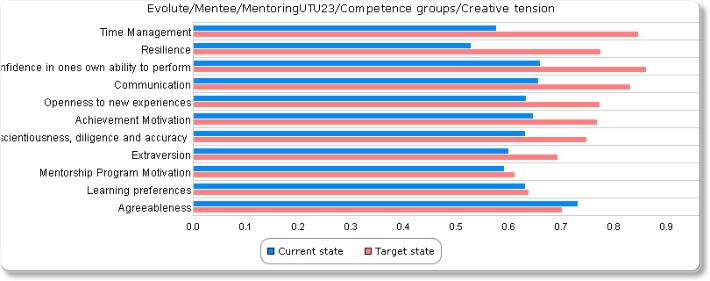
The system then visualized individual profiles depicting current versus tar- get competence levels within each subdomain and included them in group analysis. The gap between current reality and envisioned future is referred to as creative tension, generating emotional and energetic stress that fosters creativity and change. It signifies the difference between current and desired status, thereby indicating the direction and extent of development required across various domains highlighted by the statements. Figures 2 to 4 show examples of group-level results.
Figure 2: Group level results of current and target state of the competence groups based on creative tension.
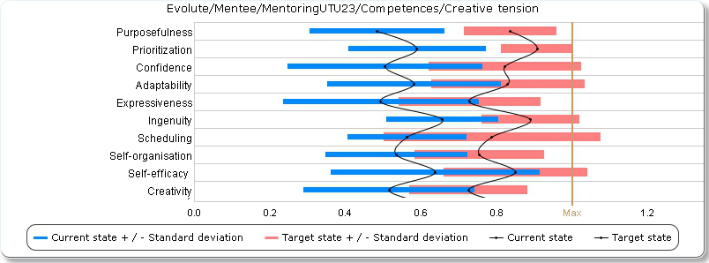
Figure 2 shows the group-level results according to the subcategories/com- petence groups. The results are sorted based on creative tension. The highest collective creative tension is in Time Management, followed by Resilience and Confidence in one’s own ability to perform. Figure 3 presents the results on a more detailed competence level. It displays the 10 competences with the highest creative tension, along with the standard deviations from the participants.
Figure 3: Group level results of current and target state results, including standard deviations of the 10 competences with the highest creative tension.
The results from the three highest collective creative tensions could be interpreted as follows. The Purposefulness scores indicate that on average, participants feel less purposeful in their current state than their target state. The statements suggest a need to enhance focus, goal clarity, and motiva- tion, particularly in challenging situations. The notable gap suggests that mentees may benefit from interventions focused on maintaining focus dur- ing difficulties, setting clear goals, and fostering motivation, especially in the face of setbacks. There is also a noticeable gap in Prioritization skills. Improvement is needed in time management, project focus, and setting spe- cific objectives for mentoring relationships. Mentees acknowledge a need for improvement in managing time effectively, setting learning objectives, and maintaining focus on overarching project goals. These data highlights opportunities for mentorship in project management and goal-setting. The substantial gap in confidence levels points towards a need for mentees to build belief in their abilities, handle failures positively, and maintain optimism about the future. Mentorship programs could include confidence-building activities and positive reinforcement.
CONCLUSION
The present research provides a notable advancement in our understanding of how the assessment of mentee competences can enrich mentoring experiences for students. We conducted a real-life test of the Evolute mentee competence assessment instrument to validate its usability in capturing the competen- cies of university students, focusing on identifying strengths and areas for
Mentoring for Transition: Optimizing Mentorship Through Competency Assessment 321
development. The findings, particularly in categories with significant cre- ative tension, offer valuable insights for refining mentoring programs and tailoring interventions to foster targeted growth in specific competencies. The work underscores the efficacy of the Evolute system in providing actionable insights into mentees’ developmental needs, positioning it as a valuable tool for enhancing mentoring experiences across various contexts.
By integrating these profiles within Career 4.0’s talent diagnosis and personalized development planning, mentoring programs can be designed to holistically support personalized learning recommendations and career preparation. Regular reassessments enable mentors and mentees to track progress, ensuring continuous improvement and maximizing outcomes throughout the mentoring relationship. Through the implementation of structured yet flexible tools like Evolute, mentoring can assume an even more impactful role in cultivating the human capital essential for success in today’s dynamic work environments.
The case study conducted as part of this research further validates the effectiveness and practicality of the competency assessment approach, affirm- ing its ability to provide a comprehensive view of skills and attributes while identifying areas for growth. These preliminary findings highlight the usability, clarity, and relevance of the assessment instrument for mentee eval- uation, offering valuable insights into participants’ competency strengths and developmental needs.
ACKNOWLEDGMENT
This research paper is a part of the European Union (EU)-supported project “Career Intelligence” (2021-2-DE02-KA220-VET-000050347), led by the Institute of Work Science at Ruhr-Universität Bochum (RUB).
REFERENCES
Allen, T. D., & Eby, L. T. (2007). Common bonds: An integrative view of mentoring relationships. In T. D. Allen & L. T. Eby (Eds.), The Blackwell handbook of mentoring: A multiple perspectives approach (pp. 397–419). Wiley-Blackwell. Clutterbuck D. (2004). What about mentee competencies? In The situational men-
tor: An international review of competencies and capabilities in mentoring, David Clutterbuck and Gill Lane (Eds.). pp. 72–82. Aldershot: Gower Publishing Ltd. Clutterbuck, D. (2005). Establishing and maintaining mentoring relationships: An overview of mentor and mentee competencies. Journal of Human and Resource Management, 3(3), pp. 2–9. Eby, L. T., Allen, T. D., Evans, S. C., Ng, T., & DuBois, D. L. (2008). Does
mentoring matter? A multidisciplinary meta-analysis comparing mentored and non-mentored individuals. Journal of Vocational Behavior, 72(2), pp. 254–267. Einolander, J. (2018). Strategic assessment of organizational commitment. Acta Wasaensia, 406. 282p. Hoffmann, T. (1999). The meanings of competency. Journal of European Industrial
Training, 23(6), pp. 275–286. doi: 10.1108/03090599910284650. Hunt, D. M., & Michael, C. (1983). Mentorship: A career training and development tool. Academy of Management Review, 8, pp. 475–485.
Kantola, J. (2015). Organizational Resource Management: Theories, Methodologies, and Applications. CRC Press. Knowles, M. S. (1980). The modern practice of adult education: From pedagogy to
andragogy (2nd ed.). Cambridge Adult Education. Kröll, M., & Burova-Keßler, K. (2021a). AI and learning in the context of digital transformation. In S. Nazir, T. Z. Ahram, & W. Karwowski (Eds.), Advances in human factors in training, education, and learning sciences. AHFE 2021, Lecture Notes in Networks and Systems, vol. 269. Springer, Cham. doi: 10.1007/978-3- 030-80000-0_5. Kröll, M., & Burova-Keßler, K. (2021b). The Learning Concept Career 4.0 – An
introduction and overview. Research Paper No. 1, 2021, EU-Project “Career 4.0”. Institute of Work Science (IAW), Ruhr-University Bochum, Germany. Kram, K. (1983). Phases of the mentor relationship. Academy of Management Journal, 26(4), pp. 608–625. doi: 10.2307/255910. Kram, K. E. (1985). Mentoring at work: Developmental relationships in organiza-
tional life. University Press. Knowl Social Enterprise. (2015). Competence framework for key mentoring competences (44p.). MENTEE – Mentoring, Networking and Training for Euro- pean Entrepreneurs. Proj.no: 2014-1-PL01-KA202-003383. MENTEE project Consortium. Mullen, C. A., & Klimaitis, C. C. (2021). Defining mentoring: A literature review
of issues, types, and applications. Annals of the New York Academy of Sciences, 1483(1), pp. 19–35. doi: 10.1111/nyas.14176. Ragins, B. R. (1989). Barriers to mentoring: The female manager’s dilemma. Human Relations, 42(1), pp. 1–22. Ragins, B. R. (2005). Towards a theory of relational mentoring. Unpublished
manuscript, University of Wisconsin–Milwaukee, Milwaukee. Ragins, B. R., & Kram, K. E. (Eds.) (2007). The handbook of mentoring at work: Theory, research, and practice. Thousand Oaks, CA: SAGE Publications, Inc. Ragins, B. R., & Verbos, A. K. (2007). Positive relationships in action: Relational
mentoring and mentoring schemas in the workplace. In K. E. Kram & L. L. Portnoy (Eds.), Advancing relationships in the workplace: Theory and practice (pp.159–188). Information Age Publishing. Shapiro, E. C., Haseltine, F. P., & Rowe, M. P. (1913). Moving up: Role models, mentors, and the “patron system.” Sloan Management Review, 19, pp. 51–58. Spencer, L. M., & Spencer, S. M. (1993). Competence at work: Models for superior
performance. John Wiley & Sons. Wright, C. A., & Wright, S. D. (1987). The role of mentors in the career development of young professionals. Family Relations, 36(2), pp. 204–208. Zachary, L. J., & Fischler, L. A. (2012). The mentee’s guide: Making mentoring work
for you. John Wiley & Sons.
LISTED IN THE AHFE DIGITAL BOOKSTORE CATALOGUE
Explore the complete digital volume
Human Factors, Business Management and Society
Read this individual research paper free through the original publisher, or explore the full digital proceedings book.
ISBN 978-1-964867-11-3
Explore this ISBN in the AHFE Bookstore ↗Listed in the July 2026 bookstore catalogue; search by ISBN to confirm current availability · Digital book purchase optional