Pengcheng Ni, Jussi Kantola (2024). Taxonomy of knowledge management systems in a complex environment. In: Human Factors, Business Management and Society. AHFE Open Access, vol. 135, pp. 84–92. https://doi.org/10.54941/ahfe1004933
This paper is aimed at exploring the knowledge management system architecture in a complex environment by taxonomy. Knowledge management, an interdisciplinary study, is being developed widely in different research fields. Knowledge management system which is considered as the effective and comprehensive way of enhancing the organizational knowledge. Finally, contribute to the success of running of projects, especially in the complex environment. The current global market enhance communication and contribute to the prosperity of economy, whereas it also increases the competition. Knowledge management system, as the output of knowledge management, plays an indispensable role in a complex environment. Furthermore, the current literature do not offer us the wide viewpoint of the knowledge management in a complex environment from a holistic perspective. The first step of conducting the research in this topic is knowing the background of complex environment and knowledge management system. There are different expressions of definition of complex environment. However, these parameters are vital for complex environment, which are stakeholders, interfaces, approach, disciplines, resources, project environment, strategy. In the meantime, we can also narrow the parameters by axiomatic design theory. They are strategy, political conditions, environmental dimensions, stakeholders. Furthermore, we have to realize that complexity exists in the projects. Not only complex environment but also other complex factors can lead to varying degrees of complexity. By summing up the aforesaid analysis, the complex environment in the project can be defined as a project which has multiple unpredictable stakeholders, high importance, a plenty of disagreement and demand of decision-making process and dimension of change imposed on environment. The complex environment, the environment which is full of uncertainties, is value being studied. Knowledge management system, a systemic solution of knowledge management, is the core competency of an organization. And it makes a great significance on the success of the project. However, we have to realize that knowledge is complex, which is factual, conceptual and procedural. That is why this paper introduces the taxonomy to help us to create the knowledge management system. The second step is building the taxonomy based on knowledge management system in a complex environment. Taxonomy, which comes from the biological field, as a significant method, has been used in many other research fields. The initial conception of taxonomy is referred to classification of living organisms. However, the taxonomy has been broadly used in many other fields for classifications. This paper focuses on the taxonomy application in knowledge management system in a complex environment, which finds the common characteristics of knowledge management system in a complex environment. In terms of the knowledge management system, it shows its high importance in organizations which are in the complex and international market. This paper is to present a taxonomy of knowledge management system in a complex environment to provide a depict of this phenomenon. Then, we use taxonomy to figure out the phenomenon from a holistic perspective, which can reduce the complexity and lower the difficulty of understanding. The taxonomy provides us the useful tool for creating the knowledge management system for the projects in a complex environment. The paper is based on the extensive literature review. The final discussion will contribute to the architecture of knowledge management system in a complex environment. This work is done in a ship-building context. The related project is SEUS , which belongs to EU Horizon.
A knowledge management system (KMS) is a system based on knowledge management (KM) theory. There is no common definition of a KMS (Salis- bury, 2003), but KM has the clear goal of achieving an increase or output of desired knowledge. Salisbury (2003) stated that successful organizations manage the ongoing cycle of creating, preserving and disseminating knowl- edge. KM is thus a comprehensive way of managing these ongoing cycles in order to achieve and increase or outputs of desired knowledge. ‘KM is the concept of standardizing the creation, dissemination and application of informational asset in business’ (Abu-AlSondos, 2023), corresponding with the view proposed by Salisbury.
In terms of organizational competitiveness, knowledge is the most valuable asset because it is hard for rivals to duplicate (Renzl, 2008) and is there- fore of great significance to projects and organizations. A KMS is the most important asset in industrial projects and takes the form of a technically or non-technically group of interconnected functions to support the discovery, capture, integration, sharing, or delivery of the knowledge needed by an orga- nization to achieve its goals (McDonald & Williams, 2011). It ‘gives solutions in a central location; therefore, all employees may safely exchange knowl- edge and information, enhancing the efficiency of the flow of information throughout the company’ (Gunjal, 2019). Therefore, an effective KMS can lead to great improvements in an organization’s competitiveness.
Taxonomy of Knowledge Management Systems in a Complex Environment 85
A KMS plays a pivotal role in the complex international market environ- ment in which modern organizations operate. KM, as an interdisciplinary study, is being developed widely in different research fields. A KMS is con- sidered to be an effective and comprehensive way of enhancing organizational knowledge and contributes to the success of running of projects, especially in complex environments. KM can help organizations to achieve their strategic objectives (Nova et al., 2023).
The present paper explores KMS architecture via a taxonomy to iden- tify common characteristics of a KMS in a complex environment. The original conception of a taxonomy is a classification of living organisms. However, the general approach has been broadly used to provide classifi- cations in many other fields. A taxonomy creates a holistic view of a given phenomenon, decreasing complexity and facilitating comprehension (Haa- palainen & Kantola, 2015). It is therefore a valid approach to take in the present paper. The work in our paper is based on an extensive literature review. We present a taxonomy of a KMS in a complex environment, the Smart European Shipbuilding project (SEUS) funded by the Horizon Europe programme, to provide a depiction of the phenomenon. Then, we use the taxonomy to view the phenomenon from a holistic perspective, which can reduce its complexity and help us to understand it better. The taxonomy pro- vides a useful way to create a KMS for projects in complex environments. The final discussion will contribute to knowledge about the architecture of a KMS in a complex environment.
The paper is organized as follows: the first section outlines the theoretical background of complex environments and KMS; the second section describes the construction of the taxonomy of a KMS in a specific complex envi- ronment; the third section provides a discussion; the final section offers a conclusion.
THEORETICAL BACKGROUND A large body of work has sought to explain the complexity inherent to projects and organizations. Project complexity contains structural com- plexity and uncertainties (Williams, 1999). Widforss and Rosqvist (2015) proposed that complexity is the aggregation of intricate structure and a high degree of complication, difficulty and entanglement. Geraldi and Adl- brecht (2007) categorized complexity into three types, fact, faith and inter- action; faith is required in uncertain situations (Geraldi and Adlbrecht, 2007). According to Locatelli et al. (2014), there are various parameters that contribute to a complex environment, including stakeholders, inter- faces, approach, disciplines, resources, project environment and strategy. We can also narrow these parameters according to the information axiom, which derives from the axiomatic design principle (Suh et al., 2021). The International Project Management Association (IPMA) holds that the key parameters are strategy, political conditions, environmental dimensions and stakeholders. In summary, a complex project environment can be defined as one containing multiple unpredictable stakeholders, of high importance, characterized by disagreement and demanding decision-making processes, and containing dimensions of change imposed on the environment.
86 Ni and Kantola
Complexity also exists within projects and, therefore, in addition to a com- plex environment, other factors can lead to varying degrees of complexity. The management of complexity within projects can be split into five dimen- sions captured by the ‘MODeST’ acronym (Mission, Organization, Delivery, Stakeholders, Team) (Maylor et al., 2008). These dimensions correspond with the key working components of a KMS. A complex environment full of uncertainties warrants further study. The design of a KMS in a complex environment needs to consider all the above factors so that it contains a decision-making support system to improve the performance of the KMS and use effective communication and instructions to reduce the uncertainties in tacit knowledge delivery. As a systemic solution of KM, a well-functioning KMS is the core competency of any organization and has great influence on the success of a project. In particular, its application can improve project and organization performance in complex environments.
Complex environments can also be viewed from the system engineering perspective, as this discipline is typically connected with projects in such envi- ronments (Walden et al., 2015). Historically, the quality of a project is defined by the ‘iron triangle’ of project management, consisting of cost, time and scope: a good quality project is one delivered within budget and on time that meets the customer’s specifications (Locatelli et al., 2014). It may no longer be a sufficient guarantee of effectiveness. Davies at al. (2009) cited the exam- ple of Terminal 5 at London Heathrow airport, which finished on time and within budget, and also fulfilled project specifications. However, a project can collapse once it has started, as a result of imperfect commissioning, lack of integration and an untrained workforce (Davies et al., 2009), which serves as a reminder that there are other factors can affect a project in a complex environment.
The current global market enhances communication and economic devel- opment, which also increases competition. KMS and KM are indispensable in complex environments. Current literature does not offer a sufficiently holis- tic view KM in complex environments. There is a need to create a general KMS for projects and organizations, hence the aim of the present paper is to introduce a taxonomy to support this creation.
THE TAXONOMY The phases of building a taxonomy of a KMS in a complex environment are based on a literature review and previous experience. The first version of the taxonomy is based on an ongoing KM cycle proposed by Salisbury (2003) and the taxonomy of KM in open innovations (Haapalainen & Kantola, 2015). The second version draws on Bloom’s taxonomy (Bloom, 1956), developed by Anderson et al. (1998) and the cognition model pro- posed by Salisbury (2003). The final version is combined with real-world project experience from the SEUS project.
There are eight phases in the construction of the taxonomy:
1. Identifying the main components of the KMS. 2. Confirming the domains for the initial version of taxonomy.
Taxonomy of Knowledge Management Systems in a Complex Environment 87
3. Selecting the literature database sources. 4. Identifying keywords for the articles. 5. Reviewing the literature and collecting related conceptions. 6. Creating the new version of taxonomy. 7. Considering potential deficiencies and improvements to the taxonomy. 8. Creating the final version of the taxonomy.
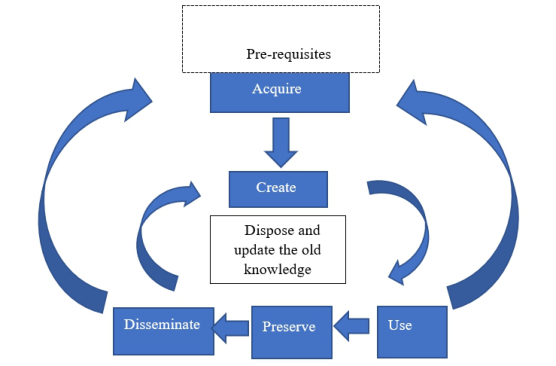
Figure 1 shows the general workflow of a KMS in a complex environ- ment. Seven procedures are included, with their relationships identified by the arrows, forming a closed loop. The complete knowledge process always starts from the pre-requisites zone, which is the preparation stage of acquiring knowledge. Knowledge can also be acquired when we use and disseminate it, which means that we can get and use knowledge directly from the final knowledge delivery process. A successful KMS involves all the components shown below, but does not always need the involvement of every component. KM is an iterative process in which new knowledge always replaces obsolete knowledge to drive forward both the specific project and the organization as a whole.
Figure 1: Workflow of a KMS in a complex environment.
Identifying the Main Components The main components are derived from the literature and from real-world experience in the SEUS project. The key word in the literature is ‘KMS’. The first version of the taxonomy is based on two articles, Salisbury (2003) and Nonaka et al. (2000).
Confirming the Domains for the Initial Version The KM consists of six components—acquiring, creating, using, preserv- ing, disseminating and disposing—which can be considered as six domains in our taxonomy (Table 1). Disposing knowledge runs through the whole KMS process, because KM is an ongoing, iterative process in which obsolete
88 Ni and Kantola
knowledge is deleted and the knowledge database updated. Although dispos- ing can take place at any phase, we need to identify the specific phases which focus on disposing in order to avoid chaos in the KMS. The KMS starts from acquiring existing knowledge, moves into creating new knowledge, which is then used. Finally, we need preserve and disseminate knowledge. New knowledge can be used for acquiring knowledge in the next iteration of the process.
Table 1. KMS components.
Table available in the original PDF paper.
Pre-requisites The preparation stage of acquiring knowledge (e.g., collecting information). Acquire Manage all the related information, convert it into knowledge (akin to ‘raw materials’ in production processes). Create Use old knowledge to create new knowledge. Dispose & Update The iteration of knowledge requires deleting obsolete knowledge and updating knowledge. Disseminate The KMS is a spiral process in which knowledge can be used and renewed by dissemination. Preserve Preserving the current knowledge maintains the key asset of organization, which can be extracted for future activities. Use Using the knowledge is the fundamental value of knowledge.
Selecting the Literature Database Sources We used the Web of Science and Scopus databases, which cover almost all the related literature in this field.
Identifying Keywords for the Articles We use title retrieval function by inputting the keywords, applying Boolean operators and truncation in order to retrieve more highly related articles. We set the field limit to title, for precise results. The initial search was conducted in both databases, using the terms ‘Knowledge management’ AND ‘Complex environment’ AND ‘Taxonomy’, but returned zero results. The second search was conducted in Web of Science, using the terms ‘Knowledge management’ AND ‘Complex environment’ OR ‘Knowledge management’ AND ‘Taxon- omy’, yielding 31 results. Running the second search in Scopus produced 39 results. To expand the search, we applied truncation, using the terms ‘Knowledge management’ AND ‘Complex* environment’ OR ‘Knowledge management’ AND ‘Taxonomy’. Unfortunately, this third search produced the same results as before.
Table 2. Retrieval of related articles on KM. XXXXXXXXXX Source
Table available in the original PDF paper.
Key Words Keywords in First Search
Keywords in Second Search
Keywords in Third Search Web of Science 0 31 31 Scopus 0 39 39
Taxonomy of Knowledge Management Systems in a Complex Environment 89
Reviewing the Literature and Collecting Related Conceptions From our analysis of the retrieved articles,we generated the following four characteristics of the KMS:
1. Knowledge is an invisible asset in the project. It can be treated as a separate dimension, which could be visible and textual. 2. Tacit knowledge plays a very important role in a KMS. This is the most difficult form of knowledge for Artificial Intelligence (AI) to replace. 3. Creating new knowledge in projects always starts from the conversion of tacit knowledge, relying on the interaction between tacit and explicit knowledge. 4. Processing information passively may cause the failure of projects. Creat- ing new knowledge is vital for project success.
Creating the Second Version of the Taxonomy The second version of taxonomy is created by adding the new findings from the literature to give a more comprehensive framework. It starts with the three domains of creating, preserving and disseminating. Each domain has several branches, which shows the process of KM.
Considering Potential Deficiencies and Improvements to the Taxonomy The final version of the taxonomy includes real-world experience from the SEUS project. A new element is added to the preserving phase. This is due to the development of software engineering, which increases the importance of cyber security.
Creating the Final Version of the Taxonomy of KMS in a Complex Environment The final version of taxonomy of KMS contains all of the above content. It is illustrated by a matrix showing how the two variants of knowledge dimension and process dimension are influenced by one element.
RESULTS
The KMS is developed by combining the theories of Nonaka et al. (2000), Salisbury (2003) and Anderson and Krathwohl (2001). Nonaka et al. (2000) depict the process of creating new knowledge as an ongoing, spiral process. They emphasize that old knowledge can be a good asset for creating new knowledge. Salisbury (2003) shows the ongoing cycle of KM, expands the phases from creating knowledge to disseminating knowledge.
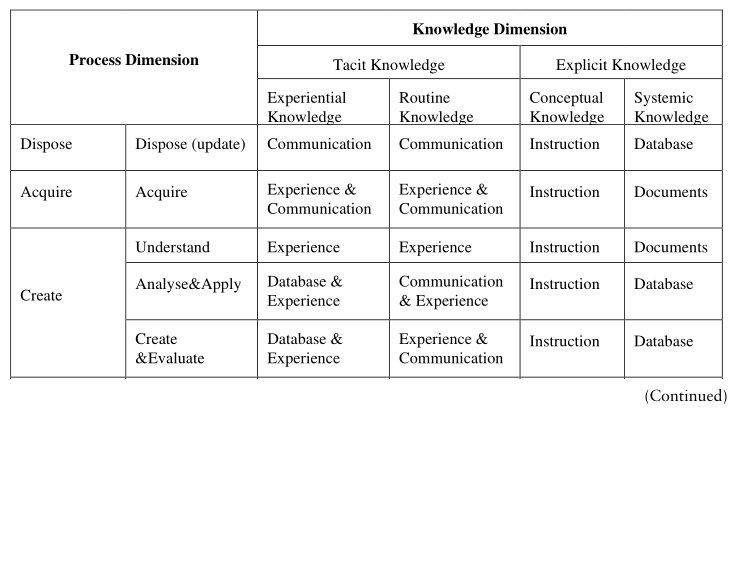
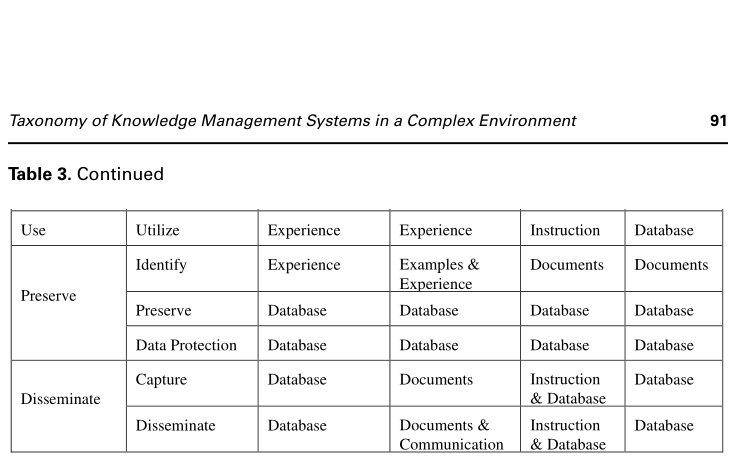
The above theories contribute to our findings shown in Table 3, which highlights 44 dimensions of a KMS, each of which represents the differ- ent stages and varieties of knowledge. According to Nonaka et al. (2000), conceptual knowledge, which comes from stakeholders and other distinct concepts, is easier to grasp than experiential knowledge, which is shared through common experience. Systemic knowledge is more explicit than
90 Ni and Kantola
other varieties of knowledge, because it is about systematized and packaged knowledge (Nonaka et al., 2000).
Table 3 also shows that the format of documents can be paper or elec- tronic. The development of software engineering provides more tools for dealing with KM issues, such as databases for electronic documents. How- ever, in terms of the KMS in a complex environment, electronic documents and paper documents need to be separated. The definition of ‘database’ in this table is broad, but in the field of software engineering, a database can be used for representing related applications (e.g., simulations, decision-making support applications, etc.). A database can support KM in a complex envi- ronment effectively and cybersecurity can be enhanced to protect important knowledge. In a complex environment, the involvement of multiple stake- holders contributes to complex relationships. Use of a database can speed up the delivery of knowledge between these multiple and unpredicted stakehold- ers. Tacit knowledge depends on experience and communication in order to allow progress through the KMS domains.
Limitations of space in the present paper mean that we can only discuss routine knowledge. This is often ignored, but it is very important in a complex environment and may be referred to as organizational culture and routine (Nonaka et al., 2000). Routine knowledge is part of tacit knowledge, it can be learned and reinforced by day-to-day experience and sometimes may be hidden in everyday business (Nonaka et al., 2000). A complex environ- ment always contains more routine knowledge. At the dissemination stage, it is always important to use documents and communication to enhance its impact. Future research exploring how this process works would be valuable.
Table 3 illustrates the general taxonomy of a KMS in a complex environ- ment. Following this taxonomy should increase the possibilities of handling the dimension of change imposed on an environment. The taxonomy also provides a foundation for future research into KMS within organizations.
Table 3. General KMS taxonomy.Table 3. Continued Use Utilize
CONCLUSION
Projects in complex environments contain multiple stakeholders, knowledge overlap and complex KM processes that can be learned and reinforced by day-to-day experience. A KMS is essential for project success. The absence of a KMS, or a vague and poorly specified KMS, will lead to project failure. In the present paper, we have shown the essential components of a KMS and have used a taxonomic approach to collect and classify these components. Our KMS reveals the essential components of KMS and their relationships via matrix. Our general framework provides a foundation for future research focusing on the architecture of KMS in complex environments.
ACKNOWLEDGEMENTS
We would like to thank Horizon Europe for funding the SEUS project, which in turn generously supported our research: https://cordis.europa.eu/project/id/101096224. We are grateful for the support from all consortium members.
REFERENCES
Abu-AlSondos, I. A. (2023). An empirical study of critical success factors in implementing knowledge management systems (KMS): The moderating role of culture. Uncertain Supply Chain Manag. 11, 1527–1538. https://doi.org/10.5267/j.uscm .2023.7.016 Anderson, L. W., & Krathwohl, D. R. (Eds.). (2001). A taxonomy for learning,
teaching, and assessing: A revision of Bloom’s taxonomy of educational objectives (Complete ed.). Longman. Davies, A., Gann, D., & Douglas, T. (2009). Innovation in Megaprojects: Systems Integration at London Heathrow Terminal 5. California Management Review, 51(2), 101–125. https://doi.org/10.2307/41166482 Geraldi, J. G., & Adlbrecht, G. (2007). On Faith, Fact, and Interaction in Projects.
Proj. Manag. J. 38, 32–43. https://doi.org/10.1177/875697280703800104 Gunjal, B. (2019). Knowledge Management: Why Do We Need it for Corporates.
SSRN Electron. J. https://doi.org/10.2139/ssrn.3375572
92 Ni and Kantola
Haapalainen, P., & Kantola, J. (2015). Taxonomy of Knowledge Management in Open Innovations. Procedia Manufacturing, 3, 688–695. https://doi.org/10.1016/ j.promfg.2015.07.307 Locatelli, G., Mancini, M., & Romano, E. (2014). Systems engineering to improve
the governance in complex project environments. International Journal of Project Management, 32(8), 1395–1410. https://doi.org/10.1016/j.ijproman.2013.10. 007 Maylor, H., Vidgen, R., & Carver, S.(2008). Managerial Complexity in Project-Based Operations: A Grounded Model and Its Implications for Practice. Proj. Manag. J. 39, S15–S26. https://doi.org/10.1002/pmj.20057 McDonald, C., & Williams, D. (2011), “Designing a KMS”, University of Canberra,
available at: www.slide_nder.net/d/designing_a_kmsv2/32955764, (accessed 23 September 2014). Nonaka, I., Toyama, R., & Konno, N. (2000). SECI, Ba and Leadership: A Unified Model of Dynamic Knowledge Creation. Long Range Planning, 33. Nova, N. A., González, R. A., Beltrán, L. C., & Nieto, C. E. (2023). A knowl-
edge management system for sharing knowledge about cultural heritage projects. Journal of Cultural Heritage, 63, 61–70. https://doi.org/10.1016/j.culher.2023. 07.013 Renzl, B. (2008). Trust in management and knowledge sharing: The mediating effects of fear and knowledge documentation. Omega 36, 206–220. https://doi.org/10. 1016/j.omega.2006.06.005 Salisbury, M. W. (2003). Putting theory into practice to build knowledge management
systems. Journal of Knowledge Management, 7(2), 128–141. https://doi.org/10. 1108/13673270310477333 Suh, N. P., Cavique, M., Foley, J. T. (Eds.), 2021. Design Engineering and Science. Springer International Publishing, Cham. https://doi.org/10.1007/978-3- 030-49232-8 Walden, D. D., Roedler, G. J., & Forsberg, K. (2015). INCOSE Systems Engineering
Handbook Version 4: Updating the Reference for Practitioners. INCOSE Inter- national Symposium, 25(1), 678–686. https://doi.org/10.1002/j.2334-5837.2015. 00089.x Widforss, G., & Rosqvist, M. (2015). The Project Office as Project Management Support in Complex Environments. Procedia Computer Science, 64, 764–770. https://doi.org/10.1016/j.procs.2015.08.626 Williams, T. M., 1999. The need for new paradigms for complex projects. Int. J. Proj.
Read this individual research paper free through the original publisher, or explore the full digital proceedings book.
ISBN 978-1-964867-11-3
Explore this ISBN in the AHFE Bookstore ↗Listed in the July 2026 bookstore catalogue; search by ISBN to confirm current availability · Digital book purchase optional