Jussi Kantola, Hannu Vanharanta, Waldemar Karwowski (2020). Designing and Producing Services in Knowledge Enterprises. In: Advances in The Ergonomics in Manufacturing: Managing the Enterprise of the Future. AHFE Open Access, vol. 12. https://doi.org/10.54941/ahfe100431
This paper describes the challenges of designing and producing services in knowledge enterprises, and presents approaches and methods that can be used for these purposes. There are cognitive as well as conceptual challenges in designing and producing services due to increasing complexity and dynamics in the work and business environment. Services should be able to meet these challenges. Therefore it is not possible to operate only in technical domains using technological modules when designing and producing services. Knowledge enterprises are really based on knowledge in human minds and therefore cognitive and conceptual domains and modules must also be taken into account in service design and production. Principles of design and Axiomatic Design theory by Nam Suh in design and production of services enable us to create productive, profitable, adaptive and dynamic services. The challenge is also to develop and maintain human and other organizational resources that are capable of designing and producing services in knowledge enterprises. Sustainability of such services is also crucial. This paper proceeds from theory to practice. The paper starts with theoretical considerations of design and its implications and then shows methods and tools that can be used to develop and maintain organizational resources to provide services in knowledge enterprises in a sustainable manner. Finally, a case of service design resources development is presented.
Modern societies produce investment products for internal as well as external markets. Traditionally services have not been considered as products. Instead, they have been considered as trade giveaways. The concept of the Service Society demands services and the general climate is becoming more favorable for the service industry. Clearly, different kinds of consumer goods and capital goods are being designed accompanied by a variety of service content. In particular, industrial products require a combination of product and service. Development in the service sector has concentrated mostly on specialization and different pricing schemes. In general, product and service design has become an important part of our society, our organizations, and our companies in terms of new product and service development, productization, commercialization, and trade practices.
Elevators are sold with multiannual maintenance services; paper machines are sold together with a wide variety of maintenance and process control services, even with a commitment to maintain a certain production level over a given period of time. It is important to note that special expertise in the form of human work is tied in with products. Likewise, some services require certain products, automation, etc., so that the customers get what they need at any given time. It is necessary to pay attention to the success of product and service development especially so that all the necessary resources for development pursue the same goal. It is particularly important to coordinate between the various resources: human capital, physical capital, organizations, processes, methods, external stakeholders, etc. Systems encounter a variety of other systems and how they interact together should always be demand-based.
When we examine what product and service development really covers, we find that physical products are easy to understand. In contrast, the abstract nature of services makes it more difficult to perceive, understand and conceptualize the needs for services and service content. We can buy consumer products, such as mobile phones, without any services or continuous maintenance. However, the demand for services concerning capital investment products is more difficult due to the complex systemic nature of such products. Services are therefore needed, in particular maintenance, to keep equipment or complex systems up and running. This requires a lot of human skills, capabilities and competence concerning maintenance services, which in turn creates demand for knowledge creation and learning in these specific production situations.
Robust products, services that have high uptime, satisfied clients, well-managed project schedules and costs all indicate that the products and services in question are well-designed. Successful service development is therefore the base for operational success. Failure, on the other hand, has the opposite effect. Competition today is fierce locally, regionally, nationally, and globally. Development of services must therefore be systematically enhanced and managed. In the face of this competition we need the co-evolution of different management and leadership sciences, theories, methodologies as well as technologies. It is evident that we have to meet the requirements of the demand and see the real challenges as well opportunities of the supply on a continuous basis.
NATURE OF SERVICES Service may exist in addition to a product or alone without a physical product. We can no longer manage by only considering technical parts; we also have to start thinking about people, the product and service consumers. Services are always to some degree inter-human. As we move away from the technical field towards "human space," we find that complexity is increasing. In this case, we are unable to measure and analyze the objects precisely – these kinds of objects are indistinct. The uncertainty that is typical for humans comes into the picture in addition to imprecision. People, however, constitute different roles, processes and functions in services as both providers and users.
It is hard to imagine services without people behind them. If we try to ignore this issue in some way, we will not succeed in product and service development. In place of technical variables, we have to take concepts that are in the human mind as shared perceptions and thoughts regarding some objects. It is known that perceptions of objects are vague and linguistic in nature. According to Professor Zadeh, our ability and understanding of a system deteriorates with increasing complexity (Zadeh, 1973). Is there something we can do about it in this context? Can we clarify such conceptual elements and use them in some form?
The more complex and abstract the issues we focus on, the less we can find workable solutions. We can quickly see that humans are quite often integral parts of problems that do not yet have good solutions. Why is this so? In the technical field, we can reach the required levels of precision through measuring. On the other hand, we can neither measure nor manage well the imprecision and uncertainty associated with people. Exact mathematical modeling of a human is not and will never be possible. At the same time, however, we know that when designing services and their usage the imprecise and uncertain nature of people and human behavior cannot be ignored. We have to work with imprecision and uncertainty in the context of services in order to fulfill the supply and demand through the requirements of the markets.
PRINCIPLES OF SERVICE DESIGN The role of product and service development is wide and very varied: ranging from simple to complex. This activity should be efficient and effective in precise technical areas as well as in abstract human areas. Fortunately, however, there are technologies and methods that can handle uncertainty, imprecision, and abstraction. Can such a variety of objects and concepts in the technical and human domains be designed and developed according to a similar approach?
The process of product and service design and development involves first a profound analysis and then a comprehensive synthesis (Suh, 2001). Everything starts with the perceived and observed needs or problems, which in turn open up the possibility of developing and designing solutions for said problems and needs. The problems and needs turn easily into opportunities. The only logical direction is always to analyze the perceived demands and needs and to design and develop services for them. Any other type of logic leads to a developed product or service that will not be recognized and perceived according to the needs and demands. The push style of design and development of products and services is aimless and does not usually lead to anything other than wasted resources.
Professor Nam Pyo Suh has developed and defined the Principles of Design (PD) (Suh, 1990) and Axiomatic Design Theory (ADT) (Suh, 2001). ADT is based on the principles of design and has its origins in mechanical engineering. According to Suh, design can simply be defined as "What do we want to achieve? and “How do we achieve it?". Suh’s two design axioms are: Axiom #1: The Independence Axiom > Maintain the independence of the Functional Requirements (FRs).
Axiom #2: The Information Axiom > Minimize the information content of the design.
According to Suh, ADT always 1) Seeks for creative solutions 2) Gets rid of trial and error based design work that results in random future solutions and 3) Determines the best solution in the set of proposed solutions. The Axiomatic Design Process (ADP) systematically maps four different domains to each other: 1) Customer, 2) Functional requirements, 3) Design parameters, and 4) Process domains. Thus, design work proceeds from the goal to alternative and realistic optional solutions.
The key is to specify independent functional requirements for the design and develop parameters for achieving them. Nam Suh’s classic textbook example is the freezer door (Suh, 1990). The functional requirements of the freezer door are: a) keep food cold b) provide access to food. If an insulated vertical door on the side of the freezer is used, the above requirements do not stay independent. When the door is opened, the cold gets out. If an insulated horizontal door on top of the freezer is used, the requirements remain separate. When the horizontal door is opened, the cold stays inside the freezer. It is important to aim for designs where functional requirements remain independent. In an ideal situation, one WHAT corresponds with one HOW aspect in the design. Thus changes in one part of the design do not require the redesign of other parts. These principles also apply to aspects besides mechanics: software, systems, manufacturing systems, organizations, and services.
The consequences of bad design are not generally understood. Poorly designed products and services are difficult to implement, and they are difficult to update. As a result, the allocation of resources to projects is difficult or even impossible. Resource requirements, timetables, and costs are very difficult to manage. If the design is done right the first time, changes can be managed in the future. However, if the design is poor, it will be difficult and expensive to manage changes in the future. Product and service design determines the basis for life-time costs and added value creation.
The world is dynamic. New demands and needs are connected to this dynamic. This clearly creates new challenges and opportunities for services. There are two dimensions to consider: newness on the market and newness for the designers. Due to the fact that the world is dynamic and changing, existing services must change too. In other words, the WHAT and HOW aspects of services will change. Then again it is necessary to explore new solutions using the Axiomatic Design approach. Often the whole has been built piece by piece without considering the whole system according to Axiomatic Design principles. This leads to all kinds of problems. The whole has to be designed as a system that is a collection of independent modules, i.e. as a system of systems. ADT leads to solutions that are understandable and as simple as possible, which can be updated when necessary module by module. At the same time, project management becomes easier. Trial and error based service development becomes costly. When we look at the services all around us, we can recognize poorly and well-designed products and services. We can say with certainty that Axiomatic Design principles should be fundamental to companies, universities, colleges, and other organizations that develop services. Axiomatic Design gives a solid foundation for the modularity of products, production systems, and services. Furthermore, it serves as a good platform for distributing product and service development in different locations. Many other areas are well based on Axiomatic Design: quality assurance, Design for Six Sigma, project management, etc. Currently, the Axiomatic Design approach has not been widely adopted in companies and in universities. In this aspect, there is a lot to be done to promote the right design of services in different kinds of organizations on theoretical as well as methodological levels.
SERVICE DESIGN RESOURCES The conceptual world is a major challenge for us humans. We are able to talk easily about difficult and different concepts. However, when we have to show what their structures, terms, and interactions really are, we cannot explain them easily. We must first reveal the essential content and construct structure of concepts that impacts our world in real life. After that, the essential can be revealed with the help of conceptual models. Resources are needed for designing and developing new services which can be perceived, understood and defined with the help of ontologies.
It is not enough that we can create successful service once. The goal is to be successful continuously. In order to achieve this, we have to develop superior resources, skills, capabilities and competences that sustain advantages and increase added value, i.e. “do the job”. These resources include: firstly, committed people in different occupational roles; secondly, a strong innovation and service culture; thirdly, well-designed innovation processes; followed by successful management and leadership, continuously maintained knowledge creation and learning processes; and finally, a highly motivating responsive environment. All these leveraging resources have an important role in service design and development. The company or organization has to educate, develop, manage, and lead these resources systematically. Once again we encounter factors that are not tangible. Many of these resources are abstract and conceptual, and therefore they must be articulated, defined, applied, and implemented. Concepts should be expanded and specified so that they can be used for product and service development, support, and management. Without this, our understanding of these crucial resources and their management will not increase.
We need to present these resources using the natural language and terminology that is familiar to people in a variety of occupational roles. If we do this, we can provide tools to support people in their work. Also, we can start to develop and manage these resources towards continuous success. Indicators presented in natural language form a semantic layer between people and concepts, i.e. between the Conceptual World and the Real World. Such semantic layers may be multiple and they may be different and overlapping. We also need a kind of interpreter. In other words, clarification is needed on three levels before the conceptual aspects of these resources can be included in the tools:
1. Concepts must be described using natural language that is familiar to the people and stakeholders in different occupational roles.
2. Concepts and their interrelationships form an ontology (Gruber, 1993), which is the explicit specification of the concepts of the resources.
3. Ontologies are perceived and evaluated in dynamic situations. This refers to adaptive products and services that behave and manifest themselves differently in different situations for different users.
In the next section, we present the Evolute approach, which can be used for the development and management of the resources needed to design and develop successful services now and in the future.
THE EVOLUTE APPROACH Evolute is a system that supports fuzzy logic (Zadeh, 1965; Zadeh, 1973) applications to be used on the Internet (J. Kantola, Vanharanta, and Karwowski, 2006). The Evolute system allows researchers to develop domain ontologies and present them to target groups using natural language, for example, in the form of statements. Evolute computes and visualizes how the current reality and future vision of the resources are perceived by stakeholders. For a single person, this “answer” is defined as an Instance (Kantola, 2005). Instances from all the stakeholders form the collective view of the organization’s/company’s resources. A collection of instances is called an Instance Matrix (Kantola, 2009). A dynamic instance matrix charts the organization’s resources over time, see Table 1. The Instance Matrix is of great use to managers since it represents the collective mind of the target group.
Table 1: Instance matrices provide a collective view of service design and development resources Instance matrix Dynamic instance matrix
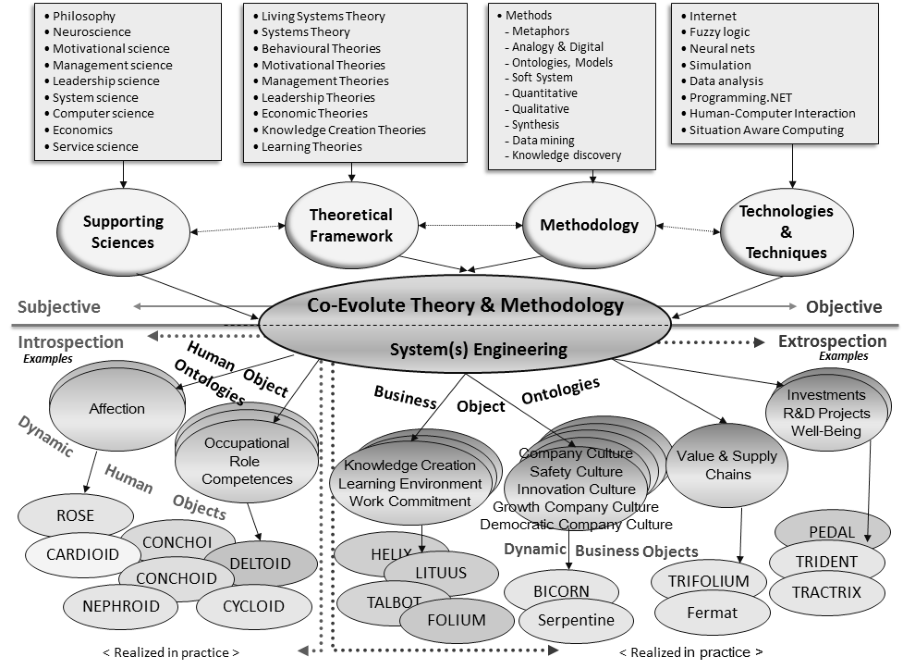
The Evolute system (Kantola, Vanharanta, and Karwowski, 2014) captures the subjective and abstract nature of the resources that are used for designing and developing services in the organization/company. The goal is to capture a true bottom-up view of the current reality and envisioned future. Figure 1 presents the Co-Evolute theory and methodology (Vanharanta, Kantola, and Karwowski, 2008). The upper part of the framework describes the scientific side and the lower part describes the practical side. In the lower part, different application areas are shown including work role based competences, knowledge creation and organizational learning, company cultures, investments, and supply and value chains. The lowest level shows the tools with their names. Many of these tools can be applied in developing and managing the resources used for service design and development.
Figure 1: Co-Evolute Theory and Methodology Framework has both scientific and practical aspects (Vanharanta,
Kantola, and Karwowski. 2008).
The tools we have developed have been used in dozens of companies in many different countries. The Co-Evolute theory and methodology framework has been verified and validated with millions of data points. Now the plan is to apply this framework also to service design and development resources and strive to develop and manage these resources in organizations in such a way that the service design and development activity leads to organizational success.
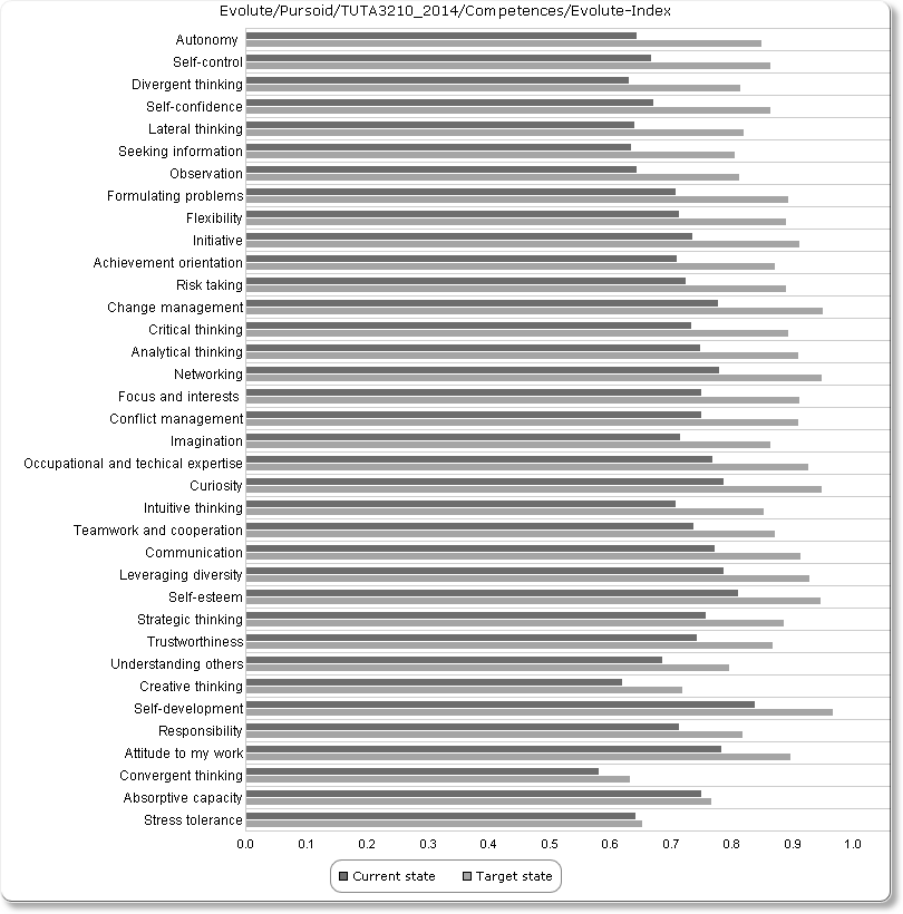
CASE: A PRODUCT DEVELOPMENT COURSE A product development course arranged by the Department of Production at the University of Vaasa, Finland, during the spring semester of 2014 had about 30 participants. Almost all of them, 24 to be precise, conducted a self- evaluation with the Pursoid 2.0 Innovativeness tool using the Evolute system. During the course the participants took different kinds of roles in product and service development. In other words, they acted as product and service development resources. Therefore, the self-evaluation with the Pursoid 2.0 Innovativeness tool is seen as an effort to develop product and service development resources, namely the innovativeness of those people who are acting in different roles in product and service development. As described earlier in this paper, development of these resources is an investment for the future (and the current reality as well). The following Figures 2-7 show the summary results of this self-evaluation effort. On the left side of these figures, we can see the concepts related to Innovativeness according to Pursoid 2.0. On the right side, we can see the current reality and future vision of these innovativeness concepts as perceived by the 24 participants. The darker bars at the top represent the current reality and the lighter bars below represent the future vision according to the respondents. In Figure 2, the concepts are listed according to the greatest (top) relative creative tension, i.e. Target/Current levels. The top five concepts are: Autonomy, Self-control, Divergent thinking, Self-confidence, and Lateral thinking. The lowest relative creative tension is in: Stress tolerance, Absorptive capacity, Convergent thinking, Attitude to my work, and Responsibility. The general observation is that there is quite a large degree of creative tension throughout the whole concept space.
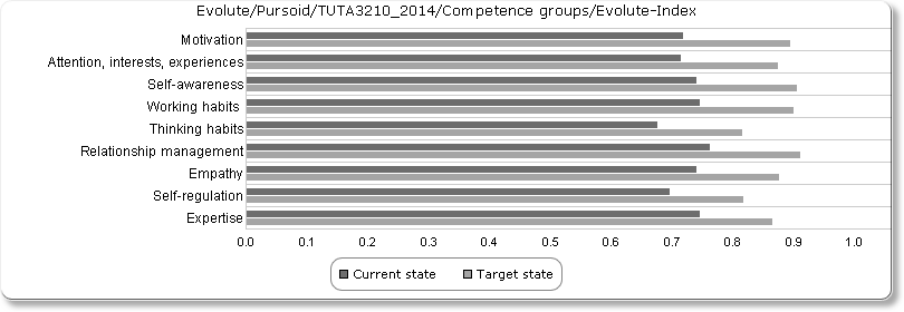
Figure 2: Relative creative tension in the case study of a product development course When the results are grouped in competence groups according to Pursoid 2.0, it can be observed that the highest relative creative tension is in the Motivation group, and the lowest is in the Expertise group, see Figure 3. A general observation is that both current reality and future vision are at quite high levels and the participants did not perceive there to be any major weaknesses in their Innovativeness. Still, there is a clear perceived need to strengthen all the areas of Innovativeness.Figure 3: All competence groups show clear creative tension.
When the results are grouped in competence main groups according to Pursoid 2.0, it can be observed that personal and social competences have very similar levels of creative tension. The current and target levels are slightly higher in social competences, shown in Figure 4.
Figure 4: Values in Social competences are bit higher than in Personal competences.
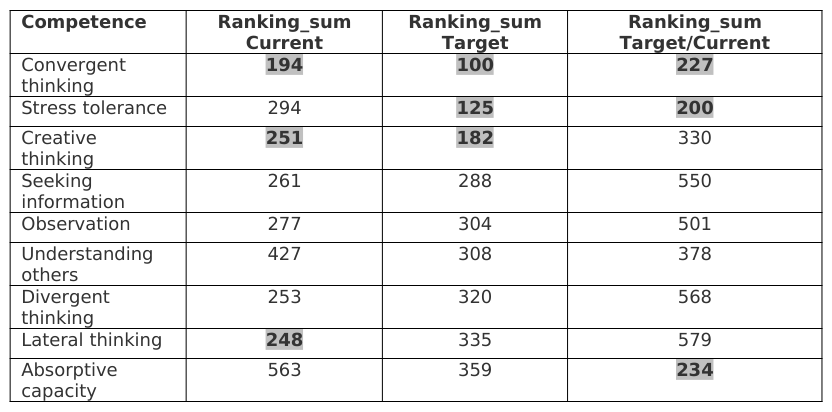
Table 2 below shows another aspect of the results. It shows the ranking sum according to Current, Target, and Relative creative tension. It indicates which competences had the highest value in each three categories for many people. The smaller the sum, the more often that competence was top in the individuals' results. Convergent thinking, Creative thinking and Lateral thinking were "the most popular" high current values. Convergent thinking, Stress tolerance, and Creative thinking were the most popular high target values. Stress tolerance, Convergent thinking, and Absorptive capacity were the most popular in the relative creative tension category.
Table 2: The most popular values in the group according to three different categories are highlighted.
The results as shown above would help a company to place its training effort in the right direction. This means that target training and support can be given to service design and development teams and even individuals in the company according to their perceived need, i.e. creative tension.
CONCLUSIONS
Companies and organizations need new ways and tools to succeed in the design and development of services for future knowledge enterprises. It is likely that simple solutions to boost service production will fall short due to the complex and conceptual nature of services and those company resources that produce services. Firstly, the Axiomatic Design theory by Suh should be applied when new services are being designed or existing services are being updated. Secondly, service design and development resources should be developed. This paper described the Evolute approach and system to tackle this second challenge. The case presented in this paper demonstrated how target training and support for the resources that produce services can be planned. Target training and support for service design resources save time and money in the company and affect the success of a company success in the service business.
The short-term goal of this research is to create more domain ontologies for service design and development. The research-based work is being carried out jointly in many universities – mostly in the European Union. These research results can quickly be put into practical use as online tools in organizations and companies with the Evolute system. We would like to invite any interested party to join the global Evolute research community.
REFERENCES
Gruber, T.R. 1993, “A Translation Approach to Portable Ontologies.” Knowledge Acquisition 5 (2) (April): 199–220. Vanharanta, H., Kantola, J. and Karwowski, W. 2008, “Capturing Change Intelligence Through Internet Applications.” In Karwowski, W. & Salvendy, G. (eds.) 2008 AHFE International Conference. Las Vegas, USA. Kantola, J. 2005, “Ingenious Management”. Doctoral thesis, Pori, Finland: Tampere University of Technology. Kantola, J, Vanharanta, H. and Karwowski, W. 2006, “The Evolute System: A Co-Evolutionary Human Resource Development
Methodology”, In International Encyclopedia of Ergonomics and Human Factors, 2nd Edition. Boca Raton: 2nd Edition. Kantola, J, Vanharanta, H. and Karwowski, W. 2014, “Evolute Website”. www.evolutellc.com. Kantola, J. 2009, “Ontology-based Resource Management”, Human Factors and Ergonomics in Manufacturing & Service Industries 19 (6): 515–527. Suh, N.P. 1990, The Principles of Design. Oxford University Press, USA. Suh, N.P. 2001, Axiomatic Design: Advances and Applications. Oxford University Press, USA. Zadeh, L. 1965, “Fuzzy Sets.” Information and Control 8 (3): 338–353. Zadeh, L. 1973, “Outline of a New Approach to the Analysis of Complex Systems and Decision Processes.” IEEE Transactions
on Systems, Man, and Cybernetics 1 (1): 28–44.
LISTED IN THE AHFE DIGITAL BOOKSTORE CATALOGUE
Explore the complete digital volume
Advances in The Ergonomics in Manufacturing: Managing the Enterprise of the Future
Read this individual research paper free through the original publisher, or explore the full digital proceedings book.
ISBN 978-1-4951-2103-6
Explore this ISBN in the AHFE Bookstore ↗Listed in the July 2026 bookstore catalogue; search by ISBN to confirm current availability · Digital book purchase optional