Agata Branowska (2020). Methods of Staffing Process in Agile Enterprises. In: Advances in The Ergonomics in Manufacturing: Managing the Enterprise of the Future. AHFE Open Access, vol. 12. https://doi.org/10.54941/ahfe100428
Management theorists and practitioners search for new methods which enable to establish competitive advantage for international and domestic enterprises by reacting rapidly and flexibly to changes occurring in the business environment of the company; by being agile. Agility is an ability to continuously monitor changes in customer needs and creating and delivering products and services that satisfy those needs better and faster than the competition does (Takla et al., 1999). One of the necessary conditions of enterprise agility is the implementation of new human resource management methods. The article is about one of a key phases of HRM - staffing process. The aim of the paper is to present newest perspective in employees selection in agile organization, which bases on multilevel fit and includes factors, that haven’t been taken into consideration so far. In the article selected results of empirical, statistical research on factors influencing agility will be presented. The research was conducted among R&D teams members in one of the Polish, manufacturing enterprises. Respondents shared opinions on hierarchization of factors which HR workers need to take into consideration during staffing process.
The manuscript aims at presenting new method of modeling the selection process in agile companies. Selection is a key phase of human resource management in agile organizations - implementation of this function is essential to achieve and maintain business agility. The sine qua non for agile reacting to market chances is disposing human resources in appropriate quantity, qualifications, structure, time and place (Branowska,2011). The aim of the paper is to present method of selection process based on the concept of multilevel fit. In times of economic hardship, when employers seek to maintain their market share by attracting and retaining the most qualified personnel, fit is an important consideration (James, 2003).
This manuscript reviews recent advancement of the research on Person-Environment fit (P-E) which can be defined as the extent to which a person is compatible with the environment in which he or she is working (Edwards, et al.,1998). The concept of PE fit has been differentiated into separate aspects (Sekiguchi, 2006). These include:
1. fit with job: person-job (PJ fit), 2. fit with workgroup: person-group (PG fit), 3. fit with organization: person-organization (PO fit), and 4. fit with vocation: person-vocation (PV fit), (Judge, Ferris, 1992). The paper concerns first three types of fit. Selection plays a critical role in establishing any type of PE fit (Schneider, 1987). It should be designed to hire people with desired skills and behaviors needed to match a work context (Werbel, DeMarie, 2005). In order to achieve organizational agility, there must first be an agile workforce. The individual employee capacities (f.ex. openness to change and the ability to function in highly ambiguous situations) are critical to deal with unexpected and uncertain situations. In agile organizations which structure is based on small teams of varying composition taking into account only the individual characteristics of the candidate is not enough. It’s impossible to think about building adaptive capacity without targeting group level of analysis. Adaptive capacity of an organization is more than the sum of its individual and team capacities (Jamrog et al., 2006). Capacity building must also target the organization as a whole, with managers influencing policies, processes, systems, technologies (Jamrog et al., 2006). Job requisites are determined by performing an environmental analysis such as a job analysis, group analysis, or organizational analysis (Jamrog et al., 2006). Different PE fit paradigms are likely to be associated with different selection criteria (Werbel, Gilliland, 1999).
The work includes the following topics. The first chapter contains the concept of agile enterprise. It presents the definition of an organization of such type and its features. The next chapter is devoted to most extensively studied type of fit - Person - Job fit in agile organizations. Chapter two and three review Person-Group fit and Person - Organization fit. Last chapter summarizes and presents final conclusions.
THE CONCEPT OF AGILE ENTERPRISE Nowadays most organizations operate in a dynamic environment, with frequent unpredictable events which have an impact on the organization. There are many factors that affect enterprises, among which the most important ones are related to the expectations of customers and vendors, new products and services, and technological and process changes (Jamrog et al., 2006). In turbulent conditions, where change is both continuous and disruptive, it is increasingly recognized for organizations to become more agile (McCann, 2004). Over the past decade, the intense interest in organizational agility has come from the assumption that the best-performing organization is one that moves the fastest and most effectively in identifying opportunities and avoiding major collisions in an increasingly fast-paced environment (Jamrog et al., 2006).
Agility is an ability to continuously monitor changes in customer needs and creating and delivering products and services that satisfy those needs better and faster than the competition does (Takla et al., 1999). Agility seems best suited for managing rapid change by supporting early, fast, and effective recognition of opportunities and threats in the organization’s environment. Agile organizations are good at inducing and taking advantage of opportunities through fast, flexible, and decisive action (Jamrog et al., 2006).
Definitions of the "agility" emphasize few factors: the speed and flexibility (Gunasekaran, 1999;), effective response to change and uncertainty (Goldman et al., 1995), high quality and highly customized product (Gunasekaran, 1999; Kidd, 1994).
Characteristically an agile manufacturing facility has six attributes (Ganguly, et al., 2009): 1. produces to order; whereas traditional mass production produces to stock; 2. meets the customer's specific needs; whereas traditional mass production produces a “good, average'' product; 3. achieves a speed and flexibility in its functioning that is matched to the speed and flexibility of the technologies it manages (Goldman, Nagel, 1993); 4. mobilizes and manages all forms of knowledge intelligently to support an agile strategy; 5. adopts new ways of working when these facilitate agility (i.e. moving from functional to team working and from arms-length to interdependent relationships with other companies); 6. creates “virtual'' project and ad hoc organizations to add capabilities as and when they are needed. The literature concerning agile enterprises focuses mainly on technologies in the context of agile manufacturing, drawing relatively little attention to human resources and creating human resource strategy which would support enterprise agility (Shafer et al., 2001).
Actions in the field of human resources management should provide important support for processes adjusting the company to requirements of the market. One of the necessary conditions of enterprise agility is the implementation of new human resource management methods, which would enable an efficient adaptation of the organization to requirements presented by the competitive environment (Urbaniak, 2000). Choosing the right people during selection and taking into consideration different levels of fit is essential to achieve organizational agility.
PERSON - JOB FIT (P-J FIT) Person - Job fit is defined as compatibility that exists between an individual personal attributes and the job characteristics and is of two types (Hassan et al., 2012): 1. Demand-Abilities (D-A) fit and 2. Need-Supply (N-S) fit (Cable, DeRue, 2002).
D-A fit is defined as matching employees’ skills, knowledge, and abilities, to performing specific job- related tasks in the work environment (Edwards, 1994). It is assessed by determining the demand of the job through a job analysis which identifies the essential job tasks that an incumbent performs, and the requisite skills, knowledge and abilities to perform the job tasks (Sekiguchi, 2004). This approach breaks work into domains, tasks, and sub- tasks. The more refined the job analysis, the easier it is to determine the human attributes that are needed to perform a job (Werbel, DeMarie, 2004).
N-S fit can be referred as the degree to which employees needs, aspirations and preferences are fulfilled by the jobs they perform and by the rewards associated with that jobs (Cable, DeRue, 2002). These two parts of P-J fit are combined into an overall concept of P-J fit (Cable, DeRue, 2002). A good fit exists when an individual have right skills and abilities to perform his job and the job can fulfill the individual’s needs (Edwards, 1991).
P - J fit is positively related to individual performance and adjustment at work and significantly predicts attitudes toward the organization (Caldwell, O’Reilly, 1990).
There are several factors that at P-J level HR workers should take into consideration. Appropriately designed selection process in agile organization should allow the identification of the person who is able to adapt to dynamically changing conditions and is able to rapidly deepen and broaden his/her competences. Thus, during selection process HR workers need do examine candidate’s potential – intelligence (general mental ability - GMA or “g”) and personality.
Intelligence can be defined as an ability to become familiar with particular task or skill in a fast and precise manner. The shorter the time and the bigger the precision (accuracy) the higher the intelligence (Chorągwicka – Majstrowicz, 2013). People with demonstrated high levels of GMA seem to acquire job knowledge with greater speed and depth, and this boosts job performance (Scroggins et al., 2009). Tests of cognitive ability have been found to be highly valid predictors of job performance (Salgado, Anderson, 2002). GMA has been found to correlate strongly with divergent thinking abilities, for instance, allowing individuals to cope better with a changing work role and also to be more adaptive and innovative, so measurement of “g” factor is likely to remain at least as important in selecting new employees, if not even more so (Neil et al.,2004).
Personality is a set of relatively stable characteristics that lead to consistent patterns of behavior; most often it’s described in terms of measurable traits that a person exhibits, such as shy, aggressive, lazy, ambitious, loyal and timid (Robbins, 2005). Personality attributes have been found to be powerful predictors of behavior in organizations. The first attribute is related to locus of control - the degree to which people believe they are in control of their own fate; others are Machiavellianism, self-esteem, self-monitoring, risk-taking, and Type A and B personalities. Personality attributes give a framework for predicting behavior. Personality affects how people react to others, and the types of jobs that they may desire (Robbins, 2005).
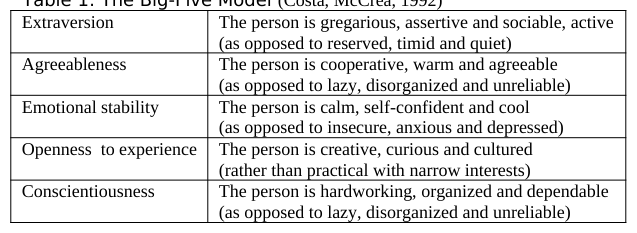
Nowadays, a well – accepted framework with which to describe personality is the Five-Factor Model of Personality, also known as the Big-Five. This is the most often used method of evaluating personality in organizations. Within this framework a person’s personality is described by the five factors: extraversion, agreeableness, conscientiousness, emotional stability and openness to experience. Each of these factors predisposes a person to behave in certain way (Peeters, 2006).
Table 1: The Big-Five Model (Costa, McCrea, 1992) Extraversion The person is gregarious, assertive and sociable, active (as opposed to reserved, timid and quiet) Agreeableness The person is cooperative, warm and agreeable (as opposed to lazy, disorganized and unreliable) Emotional stability The person is calm, self-confident and cool (as opposed to insecure, anxious and depressed) Openness to experience The person is creative, curious and cultured (rather than practical with narrow interests) Conscientiousness The person is hardworking, organized and dependable (as opposed to lazy, disorganized and unreliable) Conscientiousness is the most consistent predictor of individual performance (Salago, 2003) Highly conscientious individuals are hardworking, responsible, organized, self-disciplined, self-motivated, achievement and task- oriented.
In case of employee selection for a job which doesn’t require self development, fast acquisition of new knowledge and skills and which conditions are unchangeable it is not important to evaluate intelligence and personality of the candidate. The probability of hiring such a candidate depends more on his or her competences, rather than IQ and personality (Smółka, 2011).
In agile organizations, in which employees need easily adapt to changeable roles and tasks, continuously develop their competencies it is essential to measure both candidates’ potential and occupational competences. By implementing two-way approach it is possible to evaluate candidates’ current usefulness to perform a job, as well as potential for further development and adaptation to new, changeable job conditions (Smółka, 2011).
Competencies are aptitude, skills and knowledge used to effectively perform tasks in given work conditions (Spychała, 2011). Occupational competencies can be defined as behavior determined by: knowledge, skills and motivation, leading to completion of tasks according to expectations (Jurek, 2008).
According to Behavioral Model of Occupational Competencies in order to demonstrate a desired behavior leading toward achieving a defined results a person must know how to behave (KNOWS), must be able to take adequate actions (CAN) and must want to behave in a given way (WANTS). Jurek (2008) believes that competencies are neither knowledge nor skills, nor even motivation analyzed separately. All the above mentioned components must coexist and they lead toward occurrence of certain behavior.
Overall competencies of an employee can be divided into two categories: occupational competencies of a worker in particular enterprise and excessive competencies. Technical and social competencies compose occupational competencies. Technical competencies are related to a specific work process and consist of: knowledge of the process (means of labor, subjects of labor, technology), practical ability to perform task and motivation to perform the task according to defined patterns (Spychała, 2011).
Competencies connected with agility are both of technical and social nature. They are going to be discussed in chapter concerning Personal-Group Fit (P-G fit).
PERSON-GROUP FIT Employee selection processes of most organizations have traditionally focused on achieving P-J fit. Practitioners and academicians have suggested that P-J fit is becoming less important than other types of fit (Sekiguchi, 2004). Performance should embrace the domain of behaviors including more than just task activities.
Agile organizations make widespread use of teams, so individuals need to interact with others during the workday. The behavior of people in a group is more than the sum total of all the individuals acting in their own way. People’s behavior when they are in a group differs from their behavior when they are alone (Robbins, 2005). The agile workplace is often made up of people from different backgrounds, requiring a greater ability to understand and easily cooperate with them.
Given an increased emphasis on work teams in organizations, it is important to select applicants based on their ability to make contributions to a given work team. Person-group (PG) fit becomes an increasingly relevant construct. It is defined as the compability between individuals and their work groups (Kristof,1996).
Person-group fit is one of the most under-researched areas of PE fit (Kristof-Brown et al., 2005b).The literature most closely related to P-G fit is that of team composition.
PG fit can be based on many different types of characteristics. PG fit identifies both supplementary and complementary aspects of fit necessary for successfully working with co-workers in a workgroup or a team (Werbel, Gilliland, 1999). Supplementary fit involves employees sharing similar attributes (values) among their group members. Value congruence should positively affect individuals’ attitudes because people define themselves by being members in a group of similar others (Seong, Kristof-Brown, 2012). Byrne’s (1971) similarity-attraction paradigm proposes that similarity leads to attraction and higher degrees of interpersonal liking. Thus, when individuals believe that their values are congruent with team members, they should be more attracted to the team and committed to it’s success. Studies of composition have shown that goal (Weldon, Weingart, 1993), value (Klimoski, Jones, 1995) and sometimes personality homogeneity influence behavioral and attitudinal outcomes for groups and their members (for example it’s beneficial that all team members have got high level of consciousness and agreeableness - those attributes refer to the extent the person is self-disciplined, organized and hard-working, as well as cooperative, friendly and flexible; in case of extraversion it’s favorable that team members have got different ratings, too many or too few can depress performance (Smółka, 2010). Another factor connected with PG fit is team members demographic characteristics, such as age, tenure, sex, race, and education. Demographic heterogeneity typically has negative effects on work attitudes and performance (Chatman, Flynn, 2001; Chatman, Polzer, Barsade,). The researches have shown that team members who are dissimilar from others have poorer communication, experience higher levels of conflict and are less integrated into the group (Mayo, 2000; Pelled et al., 1999). In contrast, increased demographic similarity generally has positive effects on liking, satisfaction, commitment, tenure, performance, and decreased turnover. The effects of demographic differences may diminish after time and the effects of deeper characteristics, such as value similarity may increase (Harrison et al., 2002; Martins et al., 2003). As individuals come to know more about others’ values and goals they rely less on preliminary categorizations and initial cognitions (O’Reilly, Elfenbein, 2007).Values are by definition relatively stable, it is likely that these will be more predictive of long-term attitudes and behaviors than ascriptive demographic characteristics (O’Reilly, Elfenbein, 2007).
Complementary fit is concerned with providing the abilities that are not widely shared by other group members (Muchinsky, Monahan, 1987). Abilities-based fit refers to “the match between the environmental demands and a person’s abilities” (Edwards, 1996). Abilities subsume the skills, knowledge, time and energy that one employs to cope with environmental demands (Seong, Kristof-Brown, 2012). Teams composed of members with heterogeneous knowledge, skills and abilities (KSAs) are more effective than those with homogenous KSAs (Shaw, 1981).
According to Belbin (2009), teams, in which members had heterogeneous intellectual abilities worked together better than more homogeneous teams. In his researches the worst results received teams composed with very intelligent, smart people with high analytical abilities (this is called “Apollo Syndrome").
The same situation occurred when composing a team with very creative members. Creativity is a highly desirable feature in a rapidly changing world. According to Belbin (2009) each team should have a creator to be effective, and to deal with complex problems. Teams with more creators work however not better than those without, because of incubation of too many ideas and lack of their evaluation, verification and implementation.
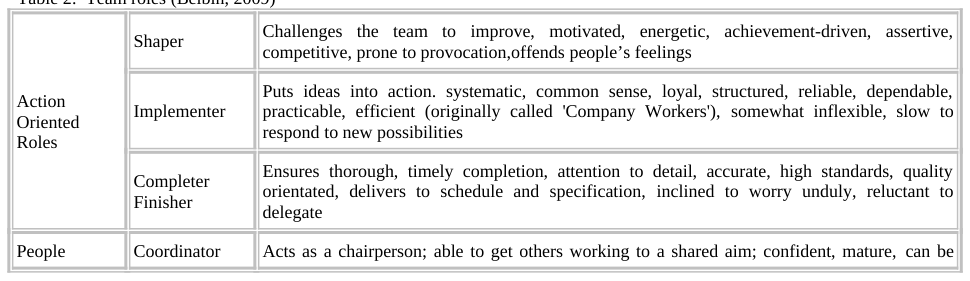
Creator is one of the team role distinguished by Belbin. During selection it is important to take into consideration the tendency of an individual to play specific team roles, which is defined as a tendency to behave, contribute and interrelate with others in a particular way (Belbin, 2009). Belbin named nine team roles that underlie team success and categorized these roles into three categories: action oriented, people oriented, thought oriented. Belbin’s team roles are described in table 2.
Table 2: Team roles (Belbin, 2009) Shaper Challenges the team to improve, motivated, energetic, achievement-driven, assertive, competitive, prone to provocation,offends people’s feelings
The concept of PG fit focuses on having a composite set of skills and behaviors that support both the group task dimension (for example skill diversity) and the group maintenance dimension (value similarity) within any given work team (Werbel, DeMarie, 2005). For organizations emphasizing PG fit, both supplementary and complementary fit dimensions are important for selection (Werbel, Gilliland, 1999).
Group analysis provides the basis for determining the requisite skills and behaviors to achieve PG fit (Werbel, Johnson, 2001). The characteristics of agile teams determines the competencies it’s members should have. Agile teams are self – organizing. Their members are empowered, they decide what to do but stay accountable for the final results. They are composed of individuals who manage their workload, shift work among themselves based on need and best fit. Agile teams are meant to be democratic teams, without a strict hierarchy, however they are not leaderless (Hoda et al., 2011). Leadership is transferred accordingly to the key knowledge, skills and abilities necessary for a particular issue at a moment in time (Georgieva et al., 2008; Glaser 1992; Hoda et al., 2011). Instead of command and control management style, it is meant to be more facilitative and coordinating, light-touch and adaptive, providing feedback and subtle direction. Informality in organizational structure promotes openness. In such organizations, team members are free to voice opinions, raise concerns, seek management support in resolving their concerns, make collaborative decisions (Hoda et al., 2011). Team members are with cross – functional skills, which allows members to substitute each other. Multilevel and multifunctional learning allow team members to acquire broad knowledge outside their direct product scope, allowing the team to respond quickly and to solve problems fast (Takeuchi et al.,1986). One of the main characteristics of self-organizing agile teams is high levels of cohesion and collaboration within the team (Hoda et al., 2011). The way the agile teams are functioning defines skills and behaviors their members should demonstrate. Agile employees are open to change, have a high tolerance for ambiguity and uncertainty and are good at making sense of ambiguous, uncertain situations. They can quickly change roles and responsibilities, are good multi-taskers – they are able to do many things at once and function well during pressure and stress. Team members are action- oriented - quickly take advantage of situations, think outside the box - are inventive and creative. They are optimistic - have strong, positive self-concepts and great persistence - can demonstrate moral and physical courage. Agile workforce know and use technology effectively, have deep experience, are good mentors and coaches and are active learners - quickly acquire and apply new skills and knowledge (Jamrog et al., 2006). Team members should consist of a flexible, adaptable and highly knowledgeable workforce. There are several factors of workforce agility, namely: dealing with unpredictable and uncertain situations, creative problem solving, professional flexibility, learning work tasks and procedures, interpersonal adaptability and coping with work stress (Sherehiy, 2008). Team members are multi-skilled and flexible, able to make rapid decisions, as speed of response is one of the main characteristics of the agile organizations, as well as continuous learning (Ganguly et al., 2009). Agile organization should seek for individuals who are team players, are able to work together, cooperate, and demonstrate interpersonal skills. To take advantage of opportunities quickly they should actively and widely scan for information to have the right knowledge at the right time and be willing to share the knowledge among other employees.
To verify which factors are important during selection process, the research among R&D teams members in one of the Polish, manufacturing enterprises was conducted. The company is employing over 360 workers and it produces a wide range of products for passengers cars, street cars, rail buses, metro, buses and coaches. The company’s assortment are mainly: various types of windows, buses door systems, compartment doors and walls, luggage shelves, luggage racks, toilets, aluminum panels, other aluminum components of interior and exterior parts of the vehicles, ramps for people with disabilities, fireproof single-door and fireproof driver wall. The Company applies its own construction-technological solutions and provides services in various areas of production. Respondents (in quantitative and qualitative questionnaires) shared opinions on hierarchization of factors which HR workers need to take into consideration during staffing process.
According to respondents the most important are following competencies: 1. ability to use the delegation of powers and independence in decision-making 2. fast response to changing customer needs 3. ease of transition from working on one project to another 4. effective cooperation with other functional divisions 5. ability of rapid development of skills and competencies 6. speed of acquisition of new skills related to IT and software 7. speed of acquisition innovation management skills 8. speed of acquisition of skills required for changing business processes 9. fast response to changes of market conditions.
Group analysis provides a foundation to develop HRM practices and procedures to ensure highly effective work teams.
PERSON-ORGANIZATION FIT Agile organizations are facing a dynamic and changing environment. This requires hiring employees who are able to readily change tasks and move easily between teams (Robbins and Judge 2009). Just as groups are not just the sum of individuals, organizations are not the sum of individuals and groups (Robbins, 2005), so HR workers during selection process should take into consideration the third type of environmental fit: Person-Organization Fit (PO). The PO fit argues that people are attracted, selected and retained by organizations that are similar to them (Schneider, 1987).
PO fit is related to a number of positive outcomes. It’s correlated with individual work attitudes such as job satisfaction and organizational commitment (Vancouver, Schmitt, 1991; Witt, Voss, 1995). PO fit was found to predict intention to quit and turnover (Chatman 1991, O’Reilly et al., 1991).
Person-Organization fit is defined as the compatibility between people and organizations (Kristof, 1996), as the match between an applicant and broader organizational attributes (Judge, Ferris,1992). PO fit can be conceptualized as matching between distinctive characteristics of the employee and the organization in which that employee is working (Hassan, et al., 2012). Individual characteristics include ideas, principles, interests and dispositional characteristics while organizational characteristics are made of organizational doctrine, norms, traditions and the overall organizational climate (Hassan, et al., 2012). Person’s fit with the organization associates a person’s personality, goals and values with those of the organization (Sutarjo, 2007). PO fit is most often measured in terms of the congruence between a set of work-related values held by a candidate and the culture of an organization (Handler, 2004). Since PO fit emphasizes fit to the organizational culture, it addresses PE fit from a macro-level of analysis (Werbel, DeMarie, 2005).
PO fit is a construct that has multiple conceptualizations. Kristof’s (1996) review of PO literature identified four operationalizations of P-O fit: 1. congruence between individual and organizational values, 2. congruence with organizational leader or peers, 3. match between individual preferences or needs and organizational systems and structures, 4. match between the personality and organizational climate.
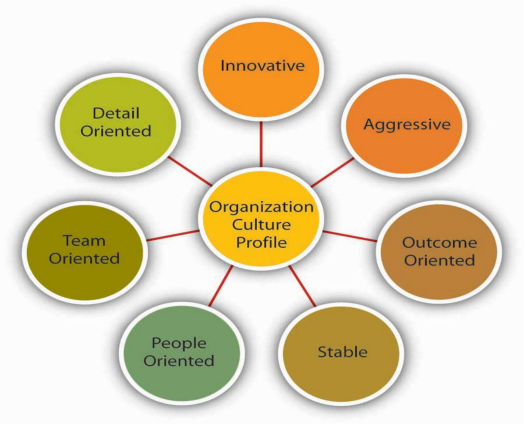
PO fit can be broken down into some dimensions (Handler, 2004).
Figure 2. Dimensions of the PO fit (Handler, 2004).
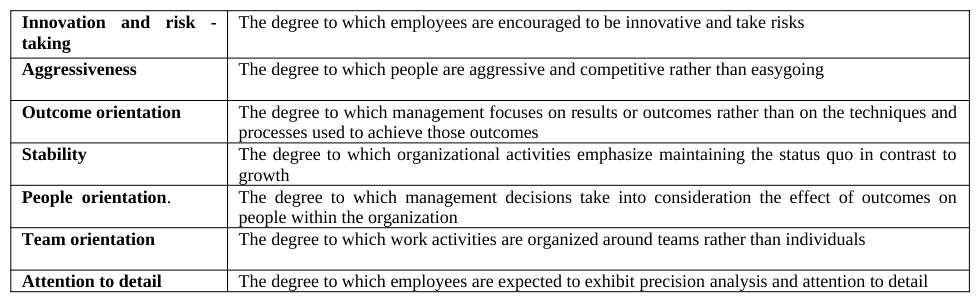
Table 3 presents characteristics of PO fit dimensions.
Table 3: Characteristics of PO fit dimensions (Robbins, 2005)
Chatman developed the Organizational Culture Profile (OCP) – a tool that can be used in a selection setting to assess the compatibility between applicants’ values and the organization’s values (O’Reilly, Chatman, Caldwell, 1991). The OCP uses above mentioned dimensions to measure fit via the following process:
Figure 3: Main steps of Organizational Culture Profile development (Handler, 2004).
Figure available in the original PDF paper.
The PO fit argues that people are attracted to and selected by organizations that match their values, and they leave organizations that are not compatible with their personalities (Robbins and Judge, 2009). When employees do not value the same things as the organization they work for, negative outcomes can result. Conversely, good fit between the values of an employee and organization can lead to positive outcomes, like higher levels of organizational commitment. Values are important attributes on which to establish employees fit. Within the work context, values have been labeled as work values. Instrumental work values relate to obtaining desired ends, and refer to work benefits, work security, and success at work (Van Vianen et al., 2007). Cognitive work values relate to a belief system about appropriate behaviors and refer to broadening one‟s horizons, contributing to society, and having meaningful work (Van Vianen et al., 2007). Affective work values are related to feelings and emotions, and refer to happiness, good human relationships, and friendships at work (Van Vianen et al., 2007).
There are several values characteristics that could create misfit between a person and an agile organization. Among them the most important are: security, tradition, recognition and power (Smith, Dickson, 2003). Security: People who value security have a high need for stability and predictability. Given the lack of constancy in agile organization, security values represent a key dimension of misalignment (Smith, Dickson 2003). The characteristics of agile enterprises indicates that it’s members should be open to change, be able to experiment and take risk. They should be flexible, function well without strict rules, procedures and hierarchy. Tradition: People who value tradition have a dedication to ritual and history. It is unlikely that agile organization would be focused on en-trenched rituals and institutional history (it would be constantly rewritten). Consequently, a person who values ritual and history is unlikely to fit a dynamic organization (Smith, Dickson 2003). Power: People who focus on power enjoy control over others. However, agile organization requires individuals who are simultaneously comfortable being a leader and a follower. People with high power motives have difficulty in subordinate positions and are unlikely to function effectively in agile organizations (Smith, Dickson 2003).Agile organization are less formal, less hierarchical then traditional ones. They are flat, with minimal formal authority (Ashkenas, Ulrich, Jick, Kerr, 1995; Dove, 2001). By having a minimal level of formalization, routinization and standardization, the organizational infrastructure becomes more adaptable. Recognition: People who value recognition desire attention, approval, praise, and public signs of status. In agile organization, given changing job and project assignments and loose reporting relationships, status boundaries are unlikely to be clearly visible, and recognition is likely to be difficult to achieve (Smith, Dickson 2003).
Having values that are shared among all organizational members can strengthen an organization’s identity, and become a key element in shaping an organization’s culture (Werbel, DeMarie, 2005). Organizations striving to achieve PO fit conduct an organization analysis that assesses the organization culture, and then make efforts to select employees who demonstrate the key values necessary to achieve a competitive advantage (Werbel, DeMarie, 2005).
CONCLUSIONS
Organization effectiveness can be achieved by fitting characteristics of the organization to environmental demands. Agile organizations are functioning in unstable and unpredictable environment with continuous change. They have authority tied to tasks rather than positions, open and informal communication, distributed decision making, low levels of formal regulation in respect to job description, work schedules, and overall organizational policies (Sherehiy et al., 2007). Agile enterprises rely on teams to perform tasks. The specific of agile organization place higher demands on the workforce and HR specialist that need to select them. The concept of multilevel fit may be helpful in recruiting a candidate to those organizations. In the past applicants were recruited to fill a single, well defined role. In agile organizations candidates are recruited to fulfill a variety of roles in a broad variety of interpersonal and organizational contexts, so HR practitioners beside the assessment of traditional P-J fit need to take into consideration other types of fit. They should move away from individual to team and organizational level of analysis. Selection should focus not only on fit for the requirements of a particular job, but the whole coworkers group and values of organization as well. Person – job fit, person – group fit and person – organization fit are constructs, which are often considered separately, they haven’t been integrated yet. The challenge for HR practitioners is to examine the relationship between three types of fit and selection decisions, make decision how to combine and balance them and create an integrated model which could be applicable in agile enterprises.
REFERENCES
Ashkenas, R., Ulrich, D., Jick, T., Kerr, S. (1995). “The boundaryless organization”, SanFrancisco: Jossey-Bass. Belbin, M. (2010a), “Management teams. Why they succeed or fail”, 3rd. Edition. Elsevier Butterworth-Heinemann, Oxford. Belbin, M., (2009), “Zespoły zarządzające. Sekrety ich sukcesów i porażek”, Oficyna a Wolters Kluwer business, Kraków. Branowska, A., (2011), “Modeling of competencies of workers in modern – agile enterprises”, in: Workers’ occupational competencies in a modern enterprise, Branowska, A., Siemieniak, P., Spychała, M., Politechnika Poznańska, Poznań Byrne, D., (1971), “The Attraction Paradigm”, Academic Press, New York, NY. Cable, D. M., DeRue, D. S., (2002),“The convergent and discriminant validity of subjective fit perceptions”, Journal of Applied
Psychology, 87(5), 875-884. Caldwell, D., O’Reilly, C., (1990), “Measuring person - job fit with a profile -comparison process”, Journal of Applied Psychology, 75 (6), 648-657. Chatman, J., Flynn, F., (2001), “The influence of demographic heterogeneity on the emergence and consequences of cooperative
norms in work teams”, Academy of Management Journal,44, 956-974. Chatman, J., Polzer, J., Barsade, S., Neale, M., (1998), “Being different yet feeling similar: The influence of demographic composition and organizational culture on work processes and outcomes”, Administrative Science Quarterly, 43, 749- 780. Chatman, J.A., (1991),“Matching people and organizations: Selection and socialization in public accounting firms,.
Administrative Science Quarterly, 36, 459-484. Chorągwicka - Majstrowicz B., (2013), „Czy IQ prawdę Ci powie? Stosowanie testów na inteligencję w doborze personelu”, Personel i Zarządzanie. Costa, P.T., McCrea R., (1992), Revised NEO Personality Inventory (NEO-PI-R) and NEO Five-Factor Inventory (NEO-
FFI) manual. Odessa, FL: Psychological Assessment Resources. Dove, R. (2001), “Response Ability: The language, structure, and culture of agile enterprise”, New York: Wiley. Edwards, J. R., (1996), “An examination of competing versions of the person – environment fit approach to stress”, Academy of Management Journal, 39, 292 - 339. Edwards, J. R., Caplan, R. D., Harrison, R. V. (1998), “Person-environment fit theory: Conceptual foundations, empirical
evidence, and directions for future research”, in C. L. Cooper (Ed.), Theories of organizational stress. Oxford: Oxford University Press. Edwards, J. R., (1991), “Person–job fit: A conceptual integration, literature review, and methodological critique”, Vol. 6, New York: Wiley. Edwards, J. R., (1994), “The study of congruence in organizational behavior research: Critique and a proposed alternative”.
Organizational Behavior and Human Decision Processes”, 58, 51–100. Ganguly, A., Nilchiani, R., Farr J.V.,(2009), “Evaluating agility in corporate enterprises”, International Journal of Production Economics, Volume 118, Issue 2, Pages 410–423. Georgieva, S., Allan, G., ( 2008), “Best practices in project management through a grounded theory lens”, Electronic Journal of
Business Research Methods. Glaser, B., (1992), “Basics of Grounded Theory Analysis: Emergence vs Forcing”. Sociology Press, Mill Valley, CA. Goldman, S.L., Nagel, R.N., Preiss, K., (1995), “Agile Competitors and Virtual Organizations: Strategies for Enriching the Customer”, Van Nostrand Reinhold, New York. Gunasekaran, A., (1999), “Agile manufacturing: a framework for research and development”, International Journal of Production Economics 62, 87–105.
Handler, C., (2004), “The value of person – organizational fit”, ere.net, ERE.net Recruiting Intelligence. Recruiting Community Hassan, M., Akram A., Naz S., (2012), “The Relationship between Person Organization Fit, Person-Job-Fit and Turnover Intention in Banking Sector of Pakistan: The MediatingRole of Psychological Climate”, International Journal of Human Resource Studies ISSN 2162-3058, Vol. 2, No. 3. Harrison, D. A., Price, K. H., Gavin, J. H., Florey, A. T., (2002), Time, teams, and task performance: Changing effects of
surface- and deep-level diversity on group functioning. Academy of Management Journal,45, 1029-1046. Hoda, R., Noble, J., Marshall, S., (2011), “Supporting Self-Organizing Agile Teams What’s Senior Management Got To Do With It?”, Agile processes in software engineering and extreme programming, Springer-Verlag Berlin. 77: 73-87. Jamrog, J.J., McCann, J.E., Lee, J.M., Morrison, C.L., Selsky, J.W., Vickers M., (2006), “Agility and resilience in the Face of
Continuous Change. A Global Study of Current Trends and Future Possibilities 2006-2016”, American Management Association. James, I.L., (2003), “Employees as stakeholders: an examination of person - organization fit and corporate social performance”, working paper, Claremont Graduate University. Judge, T. A., Ferris, G. R., (1992), “The elusive criterion of fit in human resource staffing decisions”, Human Resource
Planning, 15 (4), 47 - 67. Jurek, P., (2008), „Analiza wybranych metod oceny kompetencji zawodowych”, in: Kompetencje a sukces zarządzania organizacją (red.) A. Witkowski, T. Listwan, Wydawnictwo Difin, Warszawa. Kidd, P.T., (1994), “Agile Manufacturing: Forging New Frontiers”, Addison-Wesley, Reading, MA. Klimoski, R., Jones, R. G., (1995), “Staffing for effective decision making: Key issues in matching people and teams”, in Team
effectiveness and decision making in organizations, Eds. Guzzo R. A., Salas,E., Jossey Bass, San Francisco. Kristof, A.L.,(1996), “Person – organizational fit: An integrative review of its conceptualizations, measurement and implications”, Personnel Psychology, 49 (1), 1 – 49. Kristof-Brown, A.L., Zimmerman, R.D., Johnson, D.J. (2005b),“Consequences of individuals’ fit at work: a meta-analysis of person-job, person-organization, person-group and person-supervisor fit”, Personnel Psychology, Vol. 58 No. 2, pp. 2 81-342. Loosemore , M., (2014), “ Innovation, Strategy and Risk in Construction. Turning serendipity into capability”, Routledge, London, ISBN 978-0-415-67599-4. Martins, L., Milliken, F., Wiesenfeld, B., Salgado, S., (2003). “Racioethnic diversity and group members’ experiences: The
role of the racioethnic diversity of organizational context”, Group & Organization Management, 28, 75-106. Mayo, M., (2000), “Looking into the black box: A social network approach to diversity, communication, and work team effectiveness”, Paper presented at the annual meeting of the Academy of Management, Toronto, Canada. McCann, J.E., (2004), “Organizational Effectiveness: Changing Concepts for Changing Environments.”, Human Resource
Planning Journal, 42-50. Muchinsky, P. M., Monahan, C. J. (1987), “What is person-environment congruence? Supplementary versus complementary models of fit”, Journal of Vocational Behavior, 31, 268-277. Neil, A., Lievens F., Dam K., Ryan A.M., (2004), “Future Perspectives on Employee Selection: Key Directions for Future
Research and Practice”, APPLIED PSYCHOLOGY: AN INTERNATIONAL REVIEW, 53 (4), 487–501. O’Reilly, C.A., Chatman, J., Caldwell, D. F., (1991), “People and organizational culture: A profile comparison approach to assessing person-organization fit”. Academy of Management Journal, 34, 487-516. O’Reilly, C.A., Elfenbein, H.A., (2007), “Fitting In The Effects of Relational Demography and Person-Culture Fit on Group Process and Performance”, Group & Organization Management, Volume 32 Number 1, 109-142. Pelled, L., Eisenhardt, K., Xin, K., (1999), “Demographic diversity in work groups: An empirical assessment of linkages to
intragroup conflict and performance”. Administrative Science Quarterly, 44, 1-28. Peeters, M. A., (2006), “Design teams and personality, Effects of team composition onprocesses and effectiveness”, Doctoral dissertation, Eindhoven University of Technology, Eindhoven, Netherlands. Pisani, M., (2012), “The Impact of Team Composition and Interpersonal Communication on PerceivedTeam Performance
– A Case Study”, European Journal of Social Sciences ISSN 1450-2267 Vol. 35 No 3, pp.411-430. Robbins, S.P., (2005), “Essentials of Organizational Behavior”, Upper Saddle River, N.J. : Pearson/Prentice Hall. Robbins, S.P., Judge, T.A. (2009), “Organizational Behavior”, 13 Th Ed. Pearson Prentice Hall. Upper Saddle River, New Jersey. 750ps. Salgado, J.F., Anderson, N., (2002), “Cognitive and GMA testing in the European Community: Issues and evidence”, Human
Performance, 15, 75-96. Schneider, B., (1987), “People make the place”, Personnel Psychology,40, 437–454. Scroggins, W. A., Thomas, S. L., Morris, J. A., (2009),“Psychological testing in personnel selection, Part III: The resurgence of personality testing”, Public Personnel Management 38 (1), 67-77. Sekiguchi, T., (2006), “How organizations promote person-environment fit: using the case of japanese firms to illustrate
institutional and cultural influences”, Asia Pacific Journal of Management, vol. 23, issue 1, pages 47-69. Sekiguchi, T., (2004), “Person – Organization fit and Person – Job fit in employee selection: a review of the literature”, Osaka Keidai Ronshu, Vol. 54 No. 6. Seong, J.Y., Kristof-Brown A.L, (2012), “Testing multidimensional models of person-group fit”, JOURNAL OF
MANAGERIAL PSYCHOLOGY; 27, 6; 536-556. Shafer, R., Dyer, L., Kilty, J., Amos, J., Ericksen, J., (2001), “Crafting a human resource strategy to foster organizational agility: a case study”, Human Resource Management, Vol.40, No. 3, Pp. 197 – 211. Sherehiy, B., (2008), “Relationships between agility strategy, work organization and workforce agility”, UNIVERSITY OF
LOUISVILLE152 pages; 3308333.
Sherehiy, B., Karwowski, W., Layer, J.K., (2007), “A review of enterprise agility: Concepts, frameworks, and attributes”, International Journal of Industrial Ergonomics 37, 445-460. Smith, B., Dickson M.W., (2003), “Staffing the Dynamic Organization: Rethinking Selection and Motivation in the Context
of Continuous Change”, in: Peterson, R.S, Mannix, E.A., Leading and managing people in dynamic organization LAWRENCE ERLBAUM ASSOCIATES, PUBLISHERS, Mahwah, New Jersey. Smółka, P., (2010), „Wirtuozerski dobór czyli jak dobrze skomponować zespół”, Personel i Zarządzanie. Smółka, P., (2011), „Możliwości i preferencje. Ocena potencjału kandydata z perspektywy różnic indywidualnych”, Personel i Zarządzanie, nr 1. Spychała, M., (2011), „Analiza metod badania i oceny kompetencji zawodowych pracowników w nowoczesnym
przedsiębiorstwie”, in: Kompetencje zawodowe pracowników w nowoczesnym przedsiębiorstwie, Branowska, A., Siemieniak, P.,Spychała, M., Politechnika Poznańska, Poznań. Sutarjo, (2007), “Ten Ways of Managing Person – Organization Fit (P - O Fit) Effectively: A Literature Study”, International Journal of Business and Social Science Vol. 2 No. 21 [Special Issue – November 2011] 226. Takeuchi, H., Nonaka, I., (1986),“The new new product development game”, Harvard Business Review. Takla, M.G., Dyer, L., Wright, P.M., (1999), “Execution: The Critical "What's Next?" in Strategic Human Resource Management”, CAHRS, Cornell University ILR School Year. Urbaniak, P., (2000), „Standardy zarządzania pracownikami”, Zarządzanie zasobami ludzkimi. Teraźniejszość i przyszłość.,
pod red. S. Borkowskiej, IPiSS, Warszawa. Van Vianen, A. E. M., De Pater, I. E., Van Dijk, F. (2007), “Work value fit and turnover intention: Same-source or differentsource fit”, Journal of Managerial Psychology, 22, 188-202. Vancouver, J. B., Schmitt, N. W., (1991), “An exploratory examination of person organization fit: Organizational goal
congruence”. Personal Psychology, 44, 333-352. Weldon, E., Weingart L.R., (1993),”Group goals and group performance”, British Journal of Social Psychology, 32, 307 –
334. Werbel, J.D., DeMarie, S.M, (2005), “Aligning strategic human resource management and person–environment fit”, Human Resource Management Review 15, 247 – 262. Werbel, J. D., Gilliland, S. W., (1999), “The use of person–environment fit in the selection process”, in: G. Ferris (Ed.),
Research in personnel and human resources management, vol. 17, (pp. 209–243). Greenwich, CT JAI Press. Werbel, J. D., Johnson, D. J., (2001), “The use of person–group fit for employment selection: A missing link in person– environment fit”, Human Resource Management, 40 , 227- 240. Witt, L. A., Voss, E., (1995), “Person-organization fit, customer focus and commitment”, Paper presented at the Tenth Annual
meeting of the Society for Industrial and Organizational Psychology, Orlando, FL.
LISTED IN THE AHFE DIGITAL BOOKSTORE CATALOGUE
Explore the complete digital volume
Advances in The Ergonomics in Manufacturing: Managing the Enterprise of the Future
Read this individual research paper free through the original publisher, or explore the full digital proceedings book.
ISBN 978-1-4951-2103-6
Explore this ISBN in the AHFE Bookstore ↗Listed in the July 2026 bookstore catalogue; search by ISBN to confirm current availability · Digital book purchase optional