Stefan Gerlach, Nika Perevalova (2023). Agile Organization of Shift Work without Shift Models. In: Application of Emerging Technologies. AHFE Open Access, vol. 115, pp. 185–194. https://doi.org/10.54941/ahfe1004315
Whereas agility of white-collar work is a common and successful concept, blue-collar work is in many cases still organized in shifts following long-term plans. Shift models are very uncomfortable to humans in two ways: first, working hours are spread over the whole day, in many cases over the whole week as “24/7 operations”, and second, the start and end times of the shifts are fixed. The concept of flextime is very uncommon on the shop floor, unimaginable to white collars. Therefore, blue collars ask more and more for flexible labour hours also to achieve a better work-life balance.An approach to a more agile organization of shift work is to substitute the shift model by self-assignment of shifts through the workers. Instead of working along fixed plans, employees may self-assign to different working hours and shifts from day to day, according to their individual preferences and availability. Smart devices seem to be an enabler for the agile organization of shift work. Several commercial apps with self-services for the planning of shifts and working hours are still offered, which may be appropriate for this reason.Agile shift work without predefined shift models may increase the flexibility of the company as well as the work-life balance of the workers. The concept promises to be useful. In practice, a lot of questions arise: What if different workers apply for the same shift? Who gets the shift, first come, first serve? Are there rules to calculate priorities? Is the team responsible to solve the situation or the supervisor? What if no one takes over a shift? Obviously, agile organization of shift work needs a thoroughly defined organization, and obviously too, the workers themselves must be involved in the process of defining this organization, to gain acceptance by them.Developing an organizational framework for agile shift work without shift models is one of the main topics of the German research project “agileASSEMBLY”, which comprises twelve industrial and scientific partners. The framework consists of a target image about the expected achievements, a process blueprint that guides the employees step by step in balancing and synchronizing their individual working applications, and a concise set of rules to solve conflicts in the self-assignment of working hours. The approach of the project is to involve employees in the development of the new framework for the agile organization of assembly processes by means of a role play. Within this paper, the framework for the self-assignment of working hours will be presented. It displays the first step and result of “agileASSEMBLY”. Subsequently, a pilot implementation, operation, and evaluation of the achievements and human factors in a team with round about 45 employees are planned to prove the success expectations of the concept.
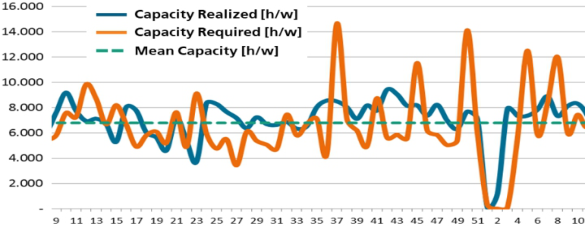
Manufacturing companies must meet customer demands for high quality products faster and more reliably than their competitors [Spath, 2008], with short delivery times, low inventories and at competitive costs [Salvendy, 2001, Hopp, 2008], even in globalised markets. There are many influences on the fluctuations in order intake and workload of manufacturing companies such as marketing campaigns, large single orders, or customised products. Com- bined with the globalisation of markets and the emergence of international competitors, it is difficult to estimate the actual workload for a given period [Tolio, 2009]. Figure 1 shows an example of the workload of a production unit in a machine building company. The workload is calculated in terms of the working hours needed to assemble the customer orders with delivery due date in each week.
Figure 1: Workload machine building company [Gerlach, 2019].
This short-term flexibility is superimposed by long-term effects such as seasonal demand, product life cycles or the global economic activity [Spath, 2011]. In particular, it seems impossible to reliably predict the global eco- nomic activity [Bullinger, 2009]. Centralised planning and scheduling of production demands and orders [Artiba, 1996] doesn’t meet the needs of dynamic and volatile markets. Therefore, companies are forced to use flexible and agile forms of production activities and labour [Oechsler, 2011] as well as for all activities regarding product development and production planning. (Bosse, 2019, Dregger, 2003, Dombrowski, 2017).
The following paper introduces the concepts of flexible labour utilisation. Afterwards an approach for agile organization of shift work without shift models will be introduced and the necessary framework is explained.
HUMAN RESOURCE FLEXIBILITY AND SHIFT MODELS The flexibility of the workforces in a company depends on specific measures for the utilization of working hours, often referred to in this paper as flex- ibility instruments. A comprehensive discussion of the common flexibility instruments can be found, for example, in [Reilly, 2001]. A brief overview is given below.
Agile Organization of Shift Work Without Shift Models 187
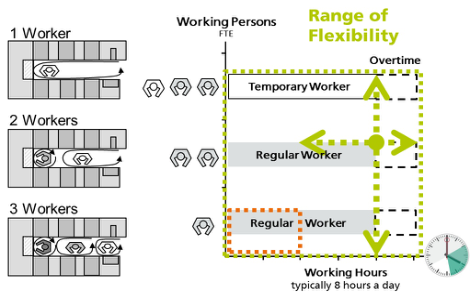
In general, there are two ways for flexible labour utilisation. First, the working time of a group of employees can be reduced or increased, perhaps on a daily basis. Second, the group of employees can be reduced or increased [Bauer, 2014]. Figure 4 gives an idea of the two ways using the example of a so-called “U-shaped assembly system”. In this system one worker can assem- ble an entire product by walking around all the workstations in one walking circle. According to German law can work a maximum of ten hours a day. There is no law on minimum working hours. However, for economic rea- sons, there is usually a minimum daily working time. If a higher workload is needed, an additional worker can be added to the assembly system. The two workers share the assembly tasks between them. Obviously, the maximum number of workers within the assembly system is given by the number of workstations.
Figure 2: Workload machine building company [Gerlach, 2019].
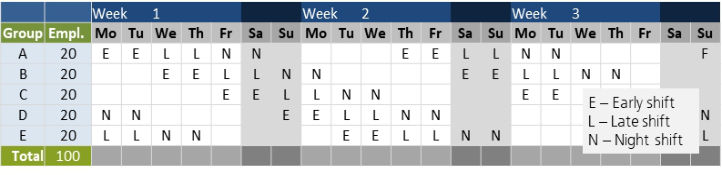
The example shows that a flexible labour utilisation can be achieved by working with more or fewer workers, or by working longer or shorter hours, or by both measures. In most production companies a flexible labour utili- sation is organised in shifts with models that follow defined sequences. An example of a common shift model for a 24/7 labour utilisation is shown in Figure 3. In this model employees are organised in 5 groups of equal size. The employees in group A work 2 days early shift (abbreviated as “E”), 2 days late shift (“L) and 2 days night shift (“N”) in the first week, then they have 4 days off (“f”). Then they again work 2 days early shift, 2 days late shift, 2 days night shift and so on. Obviously, the shift model is based on a sequence of shifts that we can abbreviate as “E-E-L-L-N-N-f-f-f-f”. The shifts of the other groups follow the same sequence with an offset of every 2 days. There are many possible sequences and principles for building shift models for versatile purposes and demands of workloads. A detailed description can be found e.g., in (Gärtner, 2008).
While shift models can follow a known and periodic fluctuation of work- load demands and can also regulate extra days off for employees, each model is in any way based on a more or less complex sequence. Therefore, the fluctu- ations and the extra days off must in some way follow a sequence and a rule.
188 Gerlach and Perevalova
Figure 3: Example of a widespread shift model for 24/7-utilization.
As explained in the introduction, it is difficult to find these rules. Agility and self-organization are approaches to overrule centralised planning and fixed sequences, in particular, self-organization increases the ability of companies to react and to adapt to unpredictable situations and demands (Glasl 2016, Laloux 2014).
AGILE ORGANIZATION OF SHIFT WORK In the German research project “agileASSEMBLY” an agile organization of shift work without a shift model, a so-called “sequence less shift work”, is being developed and tested in a pilot study.
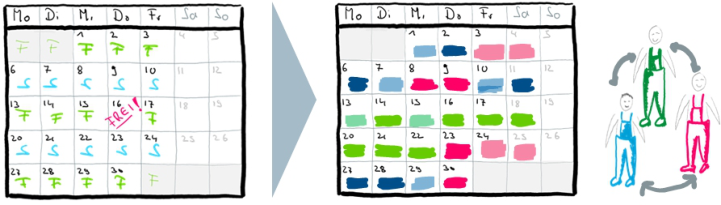
In a sequence less organization of shift work the work assignments of the individual workers don’t follow a fixed sequence or any other rule. Instead of working along fixed plans, employees will be able to assign themselves to different working hours and shifts from day to day, according to their individual preferences and availability, as depicted in Figure 4.
Figure 4: The idea of sequence less shift work.
The rationale behind the agile approach is, that self-organized shift work can follow the unpredictable fluctuating workload demands more quickly and reliably as in any centralized planning of shift sequences. A second ratio- nale is, that the employees can now plan and organize their work assignments more suitable to their private activities and preferences, in other words, they can achieve a better work-life-balance. More and more companies are try- ing to implement flexible working hours in order to offer more attractive working conditions, especially to blue collars workers, as they recognize the increasing difficulties in recruiting well-qualified employees. It is there- fore expected that sequence less shift work will be a useful concept for all stakeholders.
Agile Organization of Shift Work Without Shift Models 189
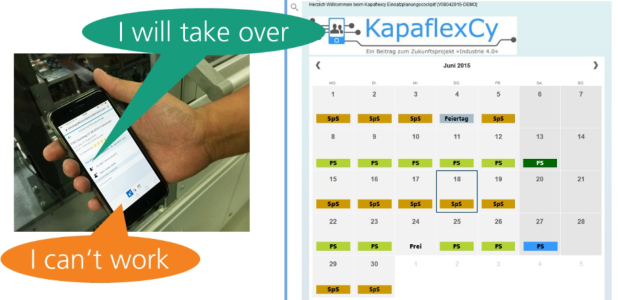
Implementation appears to be straightforward. Obviously, employees need a planning board to organize and plan their individual work assignments. Today’s state of the art are apps for mobile devices that offer distributed time schedules or similar. In Figure 5 a brief impression of the look and feel of such tools is illustrated by the example of the app “KapaflexCy”, which was prototypically implemented within the corresponding research project during the years 2021 till 2015 (Gerlach, 2015). Several cloud-based products are now commercially available which are easy to use and do not require any specific installation. Any of these may be suitable for the task.
Figure 5: Example of a cloud-based app for shift planning (Gerlach XXXX).
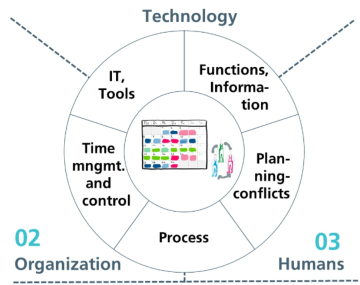
While the technical requirements are easy to meet, many organizational questions arise. To disclose those questions, to find possible measures and answers to them and to test the acceptance by the employees is the task of the research project “agileASSEMBLY” which started January 2023 and will run until December 2025. As a result, an organizational framework will be developed, tested, and evaluated that covers the views and aspects of the involved technology, organization, and humans and consists of five building blocks, see Figure 6.
Figure 6: Aspects and building blocks of the organizational framework.
190 Gerlach and Perevalova
The building blocks are the IT tools, their functions, and the demand of information to run an agile process of sequence less shift work and to control and manage the time records, salaries, and shift bonuses. The human aspect directly addresses the planning conflicts that can arise during the agile process of self-assignment of shifts by the individual workers. For example, what happens, if several workers apply for the same shift or no one takes over an unpopular shift? Is it acceptable that more than one worker takes over the same shift or that an unpopular shift with no assignment will be cancelled?
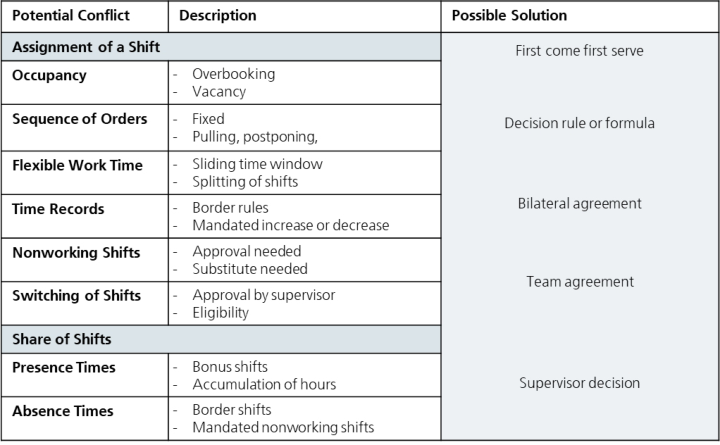
During the project agileASSEMBLY a catalogue of the planning conflicts was gathered together with possible solutions and answers for the employees to solve these situations, see Figure 7. Within the rest of this paper, a brief overview of the catalogue will be given.
Figure 7: Catalogue of planning conflicts.
One category of planning conflicts may arise during the assignment of shifts.
The first conflict “occupancy” has already been explained in the intro- duction to this section: two or more workers apply for the same shift, or no worker applies for a particular shift, we call this overbooking respectively vacancy.
If the sequence of orders is fixed, they must be processed exactly according to the production programme, so the allocation of shifts must follow the demand of workload exactly. To offer a higher degree of self-organization the workers can be allowed to pull or postpone the orders within defined time zones together with the according shifts. There is also a close relation with “occupancy”: Instead of overbooking a shift the employees can pull orders to have enough workload for more than the originally estimated workload and workers within the shift. The same rationale applies to postponing of
Agile Organization of Shift Work Without Shift Models 191
orders in case of vacant shifts. Pulling or postponing of orders may usually affect more than one worker so an agreement between them is needed.
Flexible work times can also increase the degree of self-organization. Whereas the concept of shifts is usually combined with fixed working hours it may be possible to offer flex times where the workers themselves decide on the start and end times of her shifts. Depending on the process and equip- ment, many workplaces need to be manned continuously. The workers of consecutive shifts at the same workplaces have to agree upon their start and end times. With one of the mentioned apps for planning of shifts the work- ers may agree quick, easy, and reliable by means of a smartphone nowadays. Even splitting of shifts with several small work assignments within a day is possible with such easy-to-use tools, if the workers involved agree.
When planning their shifts, employees need to pay attention to their time records. They must observe the limits of the time records and there may also be defined rules about mandatory increases or decreases in the records. All these constraints can affect the number of shifts that employees within a group assign to. So they have to agree on how many shifts each of them take over with respect to the individual constraints.
Usually there are considerably fewer nonworking shifts than working shifts. Nevertheless, they are very valuable for the workers since they give them an extra “day off”. Like holidays they are carefully planned. Conflicts can arise over the amount of nonworking shifts required by an employee, the time he announced them, and the organization of a substituting worker who takes over the shift.
Even if some workers already have agreed on a switching of shifts, several conflicts may arise during this action. Normally, a supervisor is in charge of the processes, the orders, the equipment, the stuffing etc. He is responsi- ble that everything runs smoothly, that the workers are properly trained or qualified for their jobs and the equipment and so on. Therefore, it is appro- priate to at least inform him about the switch or that he wants to approve a self-organized switch of shifts.
The conflicts introduced so far, can arise during the self-assigning of a spe- cific shift, i.e., a single point in time. A second category of planning conflicts arises from the share of shifts over a longer period of time and is a result of the popularity of certain shifts. For example, many workers like to work in night shifts on Sundays. They usually have an attractive extra pay and the social activities of the weekend are finished. On the other side, late shifts on Fridays or Saturdays are very unpopular since they conflict with social activ- ities. Therefore, a conflict can arise, if some of the workers take the popular shifts more than others or avoid the unpopular shifts more than others. This can only occur over a period of time, not a single point in time. Planning conflicts regarding the share of shifts arise through accumulating presence times at popular shifts or through avoiding of unpopular shifts at absence times. Which shifts are popular depends on specific reasons, usually they are extra paid or offering more comfortable tasks or environmental conditions. This can also vary from person to person, some people get up early and like to work in the morning hours, others prefer to sleep long and work later etc. In many cases the border shifts are unpopular, these are the first or the last
192 Gerlach and Perevalova
shift in a block of shifts. Especially the last shift in a block, usually the late or night shift on Fridays is very unpopular since it is the last work assignment before the “free weekend”. Understandably many employees try to schedule border shifts as nonworking shifts.
The planning conflicts introduced so far, are solvable, no doubt about that. Also, there is no fundamental problem in finding solutions. The problem is, in fact, that a group of employees, i.e., humans, with distinct prefer- ences, interests and behaviour must solve these regularly arising conflicts. It seems to be highly advisable, to agree on mandatory rules, which must be observed by every self-organized work assignment, and on possible solutions for every of the conflicts before starting an agile organization of shift work. Five principles for possible solutions can be offered.
Possible, but not really recommended is the principle of “first come first served”. It is not a gentle agreement between employees, but rather a “sur- vival of the quickest”, and long-term acceptance seems difficult to achieve. Nevertheless, it is a principle and is therefore mentioned here.
In any case it is strongly recommended to have rules and formulas for calculating figures about the share of shifts and work assignments. Who has occupied how many times which specific shifts, whose time records are close to the limits, which orders must be processed until a due date, and so on. For some of the planning conflicts a “hard calculated” solution based on the figures may be possible. For example, in case of overbooking, the worker with the higher time record must resign the shift. But this principle is very close to an algorithmic planning, which is already realised in many of the available planning tools.
The rationale behind agile organization is, that self-organization produces better plans than algorithms. The figures mentioned above may give impor- tant hints on how to solve planning conflicts. However, employees may come up with better solutions with respect to more constraints, aspects, and back- ground information. Therefore, a third principle is “bilateral agreement”. To solve a conflict the employees directly involved in the conflict must agree on a solution for it. They can use the figures mentioned, but they are not strictly bound to them. They are free to overrule them and to solve the problem according to their individual preferences but within the rules of the organizational framework.
Some of the conflicts seem to be better solved by a team agreement, espe- cially the share of the shifts concern the whole team or group members, therefore, they can be responsible in solving these conflicts.
If neither a bilateral nor a team agreement seems to be possible, a super- visor decision is needed. According to the agile principle of self-organization this should only be used as a last possible solution, if for some reason no other principle is appropriate. Bilateral or team agreements should be the dominant principles of an agile organizational framework.
The catalogue of plannings conflicts and possible solutions presented so far offers no relationship between them. According to the agile principle of self-organization, it is the blue-collar employees themselves who should agree on the solutions to the planning conflicts. This may also reflect the indi- vidual preferences of the employees and must be determined specifically for
Agile Organization of Shift Work Without Shift Models 193
each company and implementation. There is no rationale to give a general relationship.
CONCLUSION
The concept of sequence less shift work is expected to meet both the com- pany’s need for flexible workloads as well as the employees demands for attractive working conditions, flexible working hours, and a better work- life-balance. Centralised planning and fixed shift models will be substituted through a self-assignment of shifts and working hours by the workers itself and by means of a distributed and mobile planning board.
This paper stresses the need for an organizational framework, in particular a set of rules to resolve planning conflicts that may arise between the workers during the self-assignment of shifts. A catalogue of expected planning con- flicts was presented together with possible solutions to resolve the conflicts. The catalogue displays one of the first results result of the ongoing research project “agileASSEMBLY”. The next step is the development of a role play, to prove the catalogue together with the workers and to agree with them on the solutions to solve the planning conflicts. After this a pilot operation in a team with round about 45 employees is planned for one year, to test and refine further the concept and to evaluate its achievements.
ACKNOWLEDGMENT
The research and development project ‘agileASSEMBLY” is funded by the German Federal Ministry of Education and Research (BMBF) within the Framework Concept “Innovation for Tomorrow’s Production, Service and Labour” and managed by the Project Management Agency Karlsruhe (PTKA). More information about the ongoing research project is provided via (Perevalova, 2023). Please apologize, that the website is in German language.
REFERENCES
Artiba A, Elmaghraby S., (1996): The Planning and Scheduling of Production Systems: Methodologies and Applications, Springer. Bauer, W., Gerlach, S., Hämmerle, M., (2014): Rule Base for Operative Planning and
Control of Flexible Labour Hours. Proceedings of the19th IFAC World Congress, Cape Town. Bosse, Christian; Zink, Klaus (2019): Arbeit 4.0 im Mittelstand. Springer, Berlin und Heidelberg. Bullinger H.-J., Spath D., Warnecke H.-J., Westkämper E., (2009): Handbuch
Unterneh-mensorganisation – Strategien, Planung, Umsetzung, Springer, Berlin. Dombrowski, U.; Richter, T.; Krenkel, P. (2017): Interdependencies of Industrie 4.0 & Lean Production Systems: A Use Cases Analysis. In: 27th International Conference on Flexible Automation and Intelligent Manufacturing, Volume 11. Dregger, J.; Niehaus, J.; Ittermann, P.; Hirsch-Kreinsen, H.; Hompel, M. (2018):
Challenges for the future of industrial labor in manufacturing and logistics using the example of order picking systems. In: 11th CIRP Conference on Intelligent Computation in Manufacturing Engineering, Volume 67.
194 Gerlach and Perevalova
Gärtner, J; Kundi, M. et al. (2008): Handbuch Schichtpläne – Planungstechnik, Entwicklung, Ergonomie, Umfeld. Vdf Hochschulverlag, Zürich. Gerlach, S.; Bauer, W. (edts) (2015): Selbstorganisierte Kapazitätsflexibilität in
Cyber-Physical Sytems. Fraunhofer Verlag Stuttgart. Gerlach, S., Hämmerle, M. (2019): Patterns for Analysis of Human Resource Flexibility in Manufacturing. Proceedings of the 25th ICPR, August 9–14, 2019, Chicago, Elsevier. Glasl, F.: Dynamische Unternehmensentwicklung. Grundlagen für nachhaltiges
Change Management. 5. Auflage. Freies Geistesleben, Stuttgart, 2016. Hopp, W. J., Spearman M. L., (2008): Factory physics, 3. ed. McGraw-Hill, Boston. Laloux, Frederic: Reinventing Organizations (2014). Nelson Parker. Oechsler W. A., (2011): Personal und Arbeit – Grundlagen des Human Resource Manage-ment und der Arbeitgeber – Arbeitnehmer-Beziehungen, Verlag Olden- bourg, Munich. Perevalova, N. (2023): Homepage of Project “agileASSEMBLY”. Stuttgart: Fraun-
hofer IAO.: https://www.agileassembl.de/. Reilly P., (2001): Balancing Flexibility – Meeting the Interests of Employer and Employee, Burlington, Gower. Salvendy G., (2001): Handbook of Industrial Engineering: Technology and Opera-
tions Management, Wiley, NewYork. Spath, D. (2008): Global Challenges and the Need for Enhanced Performance.
Presentation, Professional Training Facts, Stuttgart. Spath, D., Hämmerle, M. (2011): Analysis of sales rhythm as a basis for human resource capacity planning in manual assembly systems. Proceedings of the 21th ICPR. Fraunhofer Verlag, Stuttgart. Tolio T., (2009): Design of Flexible Production Systems: Methodologies and Tools,
Springer.
LISTED IN THE AHFE DIGITAL BOOKSTORE CATALOGUE
Explore the complete digital volume
Application of Emerging Technologies
Read this individual research paper free through the original publisher, or explore the full digital proceedings book.
ISBN 978-1-958651-91-9
Explore this ISBN in the AHFE Bookstore ↗Listed in the July 2026 bookstore catalogue; search by ISBN to confirm current availability · Digital book purchase optional