Nika Perevalova, Stefan Gerlach (2025). Operations management - a concept for a self-organized task and workplace allocation. In: Creativity, Innovation and Entrepreneurship. AHFE Open Access, vol. 166, pp. 20–24. https://doi.org/10.54941/ahfe1006106
One of the main tasks of production planning and control is workforce scheduling. The responsible personnel (supervisors, department or production managers) must optimally plan the execution of pending orders to achieve high delivery capability, low inventory levels, short lead times, and high resource utilization. Typically, employees are assigned to workstations in shifts and then allocated to workplaces and orders. With every change that occurs (employee absences, material shortages, machine breakdowns, etc.) the previously created production plans must be adjusted to the new circumstances and communicated. This results in many managers spending significant time on planning instead of focusing on their core leadership responsibilities. To reduce the high planning effort and directly involve shopfloor employees in the capacity and operational control of work assignments an concept for a self-organized task and workplace allocation is being developed. The concept of self-organized shift planning enables employees to enjoy more attractive working conditions and greater autonomy, while simultaneously relieving managers of non-value-adding administrative tasks. Centralized planning and allocation of orders, workstations, and employees are replaced by self-organized shift planning, supported by a mobile planning board. This paper emphasizes the necessity of employee qualification to achieve greater workforce flexibility. A critical factor for the successful implementation of an agile and self-organized production is the cross-divisional qualification of employees. In such environments, employees are expected to take on greater responsibility, make independent decisions, and adapt quickly to new challenges. In this way, employee qualification not only enhances individual performance but also strengthens the overall adaptability and resilience of the organization in the face of rapidly changing market conditions. This approach to self-determined workforce scheduling is presented in this paper, showing a partial result from the research project "agileASSEMBLY." Including the next steps an introduction of a digital planning board, which identifies qualification needs and strategically guides employee development.
Operations Management – A Concept for a Self-Organized Task and Workplace Allocation 21
INTRODUCTION
The urgency for manufacturing companies to offer high-quality products faster, more cost-effectively and more reliably than their competitors is undisputed (Bauernhansl et al., 2014). At the same time, the volume of orders in production is subject to considerable fluctuations caused by various market events, extensive individual orders or specific customer requirements. In view of the globalization of markets and the increasing presence of international competitors, it is challenging to accurately estimate the actual workload over certain periods of time (Tolio, 2009). Consequently, companies are required to use flexible and agile methods in both their manufacturing activities and their work design (Oechsler, 2011). This paper presents a concept for flexible work utilization (Bosse and Zink, 2019; Dregger et al., 2018; Dombrowski et al., 2017), an agile and self-determined shift planning.
AGILITY IN MANUFACTURING Agility and self-organization are concepts that aim to overcome centralized planning and rigid control. In particular, self-organization promotes organizational flexibility and enables companies to respond more effectively to unforeseen events and changing requirements. By decentralizing decision- making processes and strengthening the sense of ownership of teams, adaptability to dynamic environments is significantly increased (Glasl and Lievegoed, 2016; Laloux, 2014). These approaches are in line with the increasing complexity and volatility of modern markets, which require a shift away from hierarchical structures towards more adaptive and resilient forms of organization (Uhl-Bien and Arena, 2018).
Self-organized shift planning gives employees greater decision-making autonomy and flexibility in organizing their working hours and tasks, and is a crucial element in promoting agility in manufacturing. By decentralizing the planning processes (order release, order allocation, etc.), individual blue- collar employees and teams can react more quickly to unforeseen events such as machine breakdowns, material shortages, or material defects, without having to rely on lengthy coordination with their supervisors (Hopp and Oyen, 2004). An important factor for achieving this flexibility is the right qualification of employees (Spath et al., 2013). This not only strengthens the responsiveness of the production system, but also promotes the motivation and satisfaction of employees, as they are actively involved in shaping their working conditions. Self-organized shift planning thus contributes to higher productivity and an improved work-life balance, which in turn increases the resilience and innovative capacity of production plants. This approach thus makes a significant contribution to increasing agility in production and ensuring competitiveness in dynamic markets (Parker, 2014).
AGILE ORGANIZATION OF SHIFT PLANNING “Self-organized shift planning” is one of five operational applications within the framework of the BMBF-funded research project ‘agileASSEMBLY’.
22 Perevalova and Gerlach
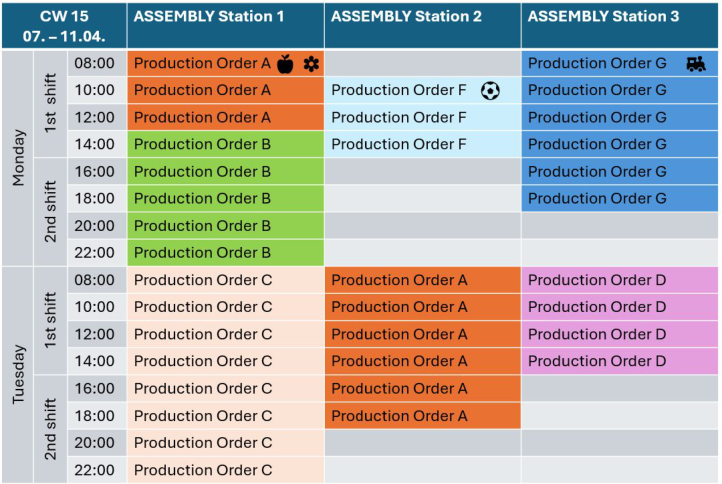
In “self-organized shift planning”, a concept is developed in which the production employees in an assembly department staff the 15 workstations in a self-organized manner. To this end, the implementation of a digital planning board is planned, which will be tested and validated in a pilot project. An analog planning board is currently already in use, which is shown in Figure 1 as an example. The production controller divides each order into sub-orders using specified times, each of which has a processing time of 2 hours. Using a symbol, employees can assign themselves to a workstation at the start of each shift and process the order directly. Several employees can also execute an order at the same time. After successful completion, the order labels are removed to visualize the execution.
In the event of disruptions or problems, corresponding notes can be displayed, as can prioritized orders. Employees resolve any conflicts that arise independently and help each other out in the event of delays.
Figure 1: Exemplary representation of the planning board.
The basic idea behind the agile organizational approach is that self-organized work scheduling can react faster and more reliably to unforeseeable fluctuations in work demand than centralized shift planning. Another aspect is that personal preferences and tastes of employees are taken into account through self-scheduling.
EMPLOYEE QUALIFICATION AS A SUCCESS FACTOR For the realization of this self-organized shift planning, the qualifications of the employees are a crucial success factor, as this ensures the agility of this concept. Only through multiple qualifications do employees acquire the
Operations Management – A Concept for a Self-Organized Task and Workplace Allocation 23
expertise to complete different orders, which leads to fewer staffing conflicts, as employees can choose from different open orders.
Without appropriate qualifications, there is a risk that self-organized shift planning will lead to inefficiencies. Thus, employee qualification is not only a prerequisite, but also a central lever for fully exploiting the advantages of self- organized shift planning and sustainably increasing agility in manufacturing.
In the current, analog planning board, no corresponding comparison takes place. It is up to the manager to assess whether the employees on the respective shift have sufficient expertise to complete the orders at hand. To realize the full potential of self-organized shift planning, the planning board is digitized and linked to the section’s qualification matrix. This makes it possible to automatically check whether employees have the necessary expertise to fill individual jobs.
In addition, the employee’s level of routine can be recorded and, if certain orders are not assembled for a long time, this can be pointed out in order to maintain expertise. By linking the planning board with the ERP system, it is even possible to check whether the existing expertise is sufficient for future production orders and, if necessary, to assign new qualifications to employees in advance.
CONCLUSION
The concept of self-organized shift planning enables employees to enjoy more attractive working conditions and more self-determination, while at the same time relieving supervisors of non-value-adding administrative tasks. The centralized planning and allocation of orders, workplaces and employees is replaced by the self-organized shift planning of employees and supplemented by a flexible planning board. The present work emphasizes the necessity of employee training in order to achieve a higher level of employee flexibility. The next steps include the introduction of a digital planning board, which determines the training needs of employees and manages them in a targeted manner. This will be followed by a pilot project in a team of around 30 employees to test the concept of self-organized shift work, refine the concept and evaluate the results.
ACKNOWLEDGMENT
The “agileASSEMBLY” research and development project is funded by the German Federal Ministry of Education and Research (BMBF) and managed by the Project Management Agency Karlsruhe (PTKA) as part of the “Industry 4.0 – Adaptability of companies in tomorrow’s value creation” (InWandel) project under the “Future of value creation – Research on production, services and work”program. Further information on the ongoing research project can be found at www.agileassembly.de.
REFERENCES
Bauernhansl, Thomas; Hompel, Michael ten; Vogel-Heuser, Birgit (2014): Industrie 4.0 in Produktion, Automatisierung und Logistik. Anwendung, Technologien, Migration. Wiesbaden: Springer Vieweg.
24 Perevalova and Gerlach
Bosse, Christian K.; Zink, Klaus J. (Hg.) (2019): Arbeit 4.0 im Mittelstand. Chancen und Herausforderungen des digitalen Wandels für KMU. Springer-Verlag GmbH. [1. Auflage]. Berlin, Germany: Springer Gabler. Dombrowski, Uwe; Richter, Thomas; Krenkel, Philipp (2017): Interdependencies of
Industrie 4.0 & Lean Production Systems: A Use Cases Analysis. In: 2351–9789 11, S. 1061–1068. doi: 10.1016/j.promfg.2017.07.217. Dregger, Johannes; Niehaus, Jonathan; Ittermann, Peter; Hirsch-Kreinsen, Hartmut; Hompel, Michael ten (2018): Challenges for the future of industrial labor in manufacturing and logistics using the example of order picking systems. In: 2212–8271 67, S. 140–143. doi: 10.1016/j.procir.2017.12.190. Glasl, Friedrich; Lievegoed, Bernard (2016): Dynamische Unternehmensen- twicklung. Grundlagen für nachhaltiges Change Management. 5, erweiterte und aktualisierte Auflage. Bern, Stuttgart: Haupt Verlag; Verlag Freies Geistesleben. Hopp, Wallace J.; Oyen, Mark P.: Agile workforce evaluation: A framework for
cross-training and coordination. IIE Transactions, 2004, 36. Jg., Nr. 10, S. 919–940. Laloux, Frederic (2014): Reinventing Organizations. Ein Leitfaden zur Gestaltung sinnstiftender Formen der Zusammenarbeit. Unter Mitarbeit von Mike Kauschke. 1st ed. München: Franz Vahlen. Oechsler, Walter A. (2011): Personal und Arbeit. Grundlagen des Human Resource
Management und der Arbeitgeber-Arbeitnehmer-Beziehungen. 9., aktualis. u. überarb. Aufl. München: Oldenbourg (Oldenbourgs Lehr- und Handbücher der Wirtschafts- u. Sozialwissenschaften). Parker, Sharon K.: Beyond motivation: Job and work design for development, health, ambidexterity, and more. Annual review of psychology, 2014, 65. Jg., Nr. 1, S. 661–691. Spath, Dieter (Hg); Ganscher, Oliver; Gerlach, Stefan; Hämmerle, Moritz; Krause, Tobias; Schlund, Sebastian: Produktionsarbeit der Zukunft-Industrie 4.0. Stuttgart: Fraunhofer Verlag, 2013. Tolio, Tullio (Hg.) (2009): Design of flexible production systems. Methodologies
and tools. Politecnico di Milano. Berlin, Heidelberg: Springer. Uhl-Bien, Mary; Arena, Michael: Complexity leadership: Enabling people and organizations for adaptability. Organizational dynamics, 2017.
LISTED IN THE AHFE DIGITAL BOOKSTORE CATALOGUE
Explore the complete digital volume
Creativity, Innovation and Entrepreneurship
Read this individual research paper free through the original publisher, or explore the full digital proceedings book.
ISBN 978-1-964867-42-7
Explore this ISBN in the AHFE Bookstore ↗Listed in the July 2026 bookstore catalogue; search by ISBN to confirm current availability · Digital book purchase optional