Abdulah P. Indardaya, Aura C. Matias (2020). Designing an Arm Support Model to Minimize UECTD Risk Among Filipino Electronic Technicians Using QFD, KANO Model, TRIZ and Anthropometry. In: Advances in The Ergonomics in Manufacturing: Managing the Enterprise of the Future. AHFE Open Access, vol. 12. https://doi.org/10.54941/ahfe100441
Department of Industrial Engineering and Operations Research College of Engineering, University of the Philippines Diliman, Quezon City,1101 Philippines ↗
Electronics technicians are prone to develop Upper Extremity Cumulative Trauma Disorder (UECTD) owing to the awkward posture, repetitive motion and static loading associated with the routine tasks of multi-testing, soldering and desoldering. In the Philippines, validation using Rapid Upper-Limb Assessment (RULA) yielded a score of 5.774 requiring intervention as a result of an Action Level 3 classification. A two-phase study approach, Quality Functional Deployment (QFD), KANO model, Theory of Inventive Problem Solving (TRIZ) and Anthropometry results were used as inputs in the design stage. QFD revealed 168 relationships between engineering and customer requirements, and 48 correlations with technical requirements. Six “attractive”, five “one-dimensional” and three “indifferent” engineering attributes were generated from the Kano Model analysis. Meanwhile, the determined contradictions during the designing stage were resolved using TRIZ. The resulting engineering attributes based on QFD, KANO and TRIZ were matched with the 5th to 95th percentile upper extremity anthropometric dimensions to determine the best fit and the ensuing optimal attributes were used to construct the design model. This study demonstrated the effectiveness of combining TRIZ, QFD principles, KANO Model Analysis, and Anthropometry in achieving the target ergonomic and functional design objectives tailored after user requirements to mitigate a real-world occupational hazard.
The Philippines is known as one of the import capital Asian countries of second-hand electrical and electronic equipment (EEE) from developed countries. According to Terazono and Yoshida (2008), Japan has exported 2 million second-hand TVs annually primarily to other Asian countries since 2004. Although the destinations of the said exports vary from year to year, it is estimated that around 400,000 units is exported to the Philippines annually. In terms of general second-hand electronic equipment, Cardenas (2007) estimated that approximately 0.6-1.2 million of these pieces of equipment were imported into the Philippines every year from 2001 to 2005. The growth of second-hand EEE in the Philippines has been characterized with good and bad effects. On the one hand, it opens job opportunities to Filipino electronic technicians. On the other, Terazono and Yoshida (2008) argue that imported TVs are either damaged upon arrival (3%) or malfunctioned (40%). As a result, repair services and technicians are highly needed. Technician and associate professional occupation group are ranked fourth among the jobs with highest workdays lost due to occupational injuries (Bureau of Labor and Employment Statistics (BLES), 2012). The tasks related to multitesting, soldering and desoldering involve repetitive motion, static muscle loading, awkward postures and even vibration. Previous studies have confirmed that repetitive motion, static muscle loading and existence of vibration can lead to UECTD (NIOSH, Armstrong, 1982; Punnet, 1985; Siverstein, 1986). Moreover, during the troubleshooting process, technicians tend to position their arms, shoulder, elbow and wrists in awkward manners. Awkward posture is considered to be the top driver of CTD development (Armstrong, 1982; Putz-Anderson, 1988; Rothflesch, 1978). Arm support is suggested to alleviate the risk of UECTD development. It was found in various studies that arm support helps to reduce the activity of the muscles in the different parts of the upper extremities (Feng et al, 1997; Onyebeke, C. et al, 2013; Stal et al, 2001; Coulson et al, 2010; P.K. Nag et al, 2007; Fernandez, 1998).
Problem Statement The tasks performed by an electronic technician are highly associated with static muscle loading, repetitive motion and awkward postures which increase the risk of UECTD development. An arm support is deemed necessary to minimize the risk, utilizing industrial engineering and ergonomic principles to meet the functional and ergonomic requirements of the end-user.
Objectives of the Study In response to the need of having a mechanism that could potentially minimize the risk of UECTD development among Filipino electronic technicians, this paper aims to achieve the following:
to quantify the UECTD risk level among Filipino electronic technicians while conducting troubleshooting activities such as multitesting, soldering and desoldering;
to gauge the technician requirements and integrate their voice on the design of the arm support model;
to systematically resolve the identified design technical contradictions or problems without sacrificing the engineering and user requirements; and
to develop and design an ergonomic arm support using Theory of Inventive Problem Solving (TRIZ), QFD principles, KANO Model Analysis and anthropometry.
Significance of the Study In repairing service industries and electronic technician professions, upper extremities and various tools are widely used. Designing an ergonomic arm support model that can minimize the risk of developing UECTD and can promote safety and health in the long run. This paper can provide information to the technicians which among the tasks that can influence the risk of UECTD. Also, the findings of this paper can be used as inputs in formulating job and workplace design for electronic technicians and repairing services industries specially when dealing with Cumulative Trauma Disorder issues. Moreover, this provides a new design approach in achieving the target ergonomic and functional design objectives tailored after user requirements to mitigate a real-world occupational hazard.
Conceptual Framework
Figure 1. Research Conceptual Framework
Figure available in the original PDF paper.
The concept of this paper starts with the UECTD risk. The risk of developing Upper Extremities Cumulative Trauma Disorder (UECTD) is caused by three main risk factors namely awkward posture, static muscle loading, and repetitive motion. RULA also suggested that tasks performed by electronic technicians are highly associated with UECTD. Theoretically, arm support reduces the pressure of the neck, trunk and shoulder. To respond to this, an ergonomic arm support model was developed. This study used a two-phase research approach. The first phase focused on the preliminary investigations which included video analysis, interview, RULA analysis and the first survey. During this phase, the concept of arm support was introduced and technicians were asked about the features that an arm support device should have. Also, anthropometric measurements were conducted. The second phase of the study was the designing stage. The second survey was conducted which included technician arm support requirements or features rating and the KANO survey. The customer requirements gathered during the first survey and the feature importance ratings were used as inputs to the Quality Functional Deployment (QFD). Also, QFD were used to measure the relationships among the features. Then, KANO model analysis was employed to gauge the perception of the technicians about the engineering features and their possible effects on satisfaction. These two processes can be described as the product analysis. The results generated from the product analysis suggested various contradictions or problems. Furthermore, the mentioned contradictions were then used as inputs to the Theory of Inventive Problem Solving (TRIZ) methodology. TRIZ analysis, QFD and KANO model results were utilized to come up with the design attributes. These attributes were then matched with the upper extremity anthropometric dimensions to get the best fit. These were then assembled to arrive with the arm support design model. Then, design specifications were generated.
REVIEW OF RELATED LITERATURE Cumulative Trauma Disorder (CTD)
Work-Related Cumulative Trauma Disorder (WRCTD) or Repetitive Strain Injuries (RSI) or Musculoskeletal Disorder is a term used to describe a soft tissue injury due to series of activities. WRCTDs are defined as those diseases and injuries that affect the musculoskeletal, peripheral nervous, and neurovascular systems that are caused or aggravated by occupational exposure to ergonomic hazard (NIOSH). This disorder is associated with the word cumulative which means that it is developed over a period of time due to repeated activities or tasks that can cause stress to a particular portion of the body. Another term that is associated with this health condition is the word trauma. Trauma refers to the injuries in the body due to stress.
The prevalence of CTD varies from industry to industry. Steelcase Inc (2002) reported that seventy percent of CTD cases include people in the manufacturing, assembly, process and service jobs. Twenty-five percent of the said cases include those who are in the managerial, professional and sales professions. In addition, five percent of the CTD cases include those people who are in the administrative professions. The variation in the number of cases is due to the distinction of the risk factors that could aggravate CTD development. One of the classifications of Cumulative Trauma Disorder is Upper-Extremities CTD. This is also known as Upper limb or Thoracic Musculoskeletal Disorder. It is defined as soft tissue injuries in the shoulder, arm, forearm, wrist, or hand. Usually, this disorder is evident in these parts of the body because they are often used in activities. One of the examples of job that often use hands in carrying out activities is electronic technician profession. In this job, a technician usually uses both hands in carrying out repairing procedures. As a result, this may lead to tissue injuries.
In 1987, the Bureau of Labor Statistics conducted a survey to the 25 states in the U.S and reported that 10,600 of the CTD cases involved the upper extremities. In the UK, this type of CTD is ranked as the second disorder experienced by the employees in various work organization. Melhorn (1996) argues that this illness has been identified by the National Institute for Occupational Safety and Health as one of the ten most significant occupational health problems in the United States, accounting for 56% of all occupational injuries that affect 15% to 20% of all Americans.
Factors Affecting Upper-Extremities Cumulative Trauma Disorder There have been a significant number of researches performed in the area of Upper-Extremity Cumulative Trauma Disorders. Most of the objectives of these studies are to determine the risk factors associated to the development of UECTD. Some researchers classified these factors as intrinsic and extrinsic. Kummel and Melhorn (2000) reports that intrinsic contributing factors include age, anatomical abnormalities, and metabolic disorders among others. Extrinsic factors include ergonomic factors, repetition, force, posture, vibration, temperature, contact stresses and unaccustomed activities. Other studies suggested that the existence of Upper Extremity Cumulative Trauma Disorder is due to physical, personal and psychosocial factors.
Physical factors are the primary reasons for the development of UECTD (Armstrong, 1982 and Silverstein, 1986). In the area of Ergonomics and Human Factors, physical factors refer to the physical aspect of the environment which mainly refers to force, repetition, vibration, posture/ergonomics, temperature, color, and noise, among others. Usually these physical factors are actually geared with ergonomic hazard that aggravates UECTD. Researchers (Armstrong, 1982; Arndt, 1987; Blair 1987; Punnet, 1985; Rothflesch, 1978; Siverstein, 1986; Stock, 1991) believe that vibrating tools, forceful motions, and motions in awkward or extreme postures are three other important ergonomic hazards proven to cause these disorders. Another ergonomic physical hazard that is associated with physical factors is the physical activity of a person. Bernard (1997) suggested that the lack of physical activity may increase susceptibility to injury, and after injury, the threshold for further injury is reduced. Basically, physical activity of an employee plays a significant role in the prevalence of CTD.
Aside from the physical factors, several studies have found that individual or personal variables also affect the development of UECTD. Studies Guo et al., 1995; English et al., 1995; Ohlsson et al., 1994; Biering-Sorensen, 1983) concluded that age factor significantly affect the occurrence of CTD. Another studies ( Hales et al., 1994; Johanson, 1994; Chiang et al., 1993; Armstrong et al., 1987) showed that gender is a significant contributing factor. In addition, more researches (Werner et al., 1994; Nathan et al., 1993; Heliovaara, 1987) strongly claimed that anthropometry of a person such as the Body Mass Index (BMI), weight and height are significant factors. Other researchers (Finkelstein, 1995; Kelsey et al., 1990; Hildebrandt, 1987; Owen et al., 1984; Svensson and Andersson, 1983) found that smoking habit of a person is a significant factor. These are just some of the personal factors that could affect CTDs. Other factors may include job experience, wage and marital status.
Arm Support Device Bart Visser et al. (2000) claim that reduction of muscle activation in the neck-shoulder region during standard visual display unit work can be achieved with arm supports. P.K Nag et.al (2009) believe that the forearm support significantly reduced the activity of forearm muscles over the floating posture. The essential role of arm support in some professions has been studied. Bergqvist et al. (1995) claim that various studies have confirmed that lack of arm support is a predictor of CTD development. Other researchers have proven that pressure can be reduced using an arm support. Rose (1991) believes that key activation forces are reduced from 1.1N to 0.7N when arm support is used. Some researchers (Aaras, 1990; Ro, 1997; Anderson, 1980; Jorgensen et al., 1989) and Pheasant (1997) stated that working with unsupported or elevated arms increases the load on the neck, shoulder and back. It has been noted also that static loads are pronounced when sitting rather than standing (Steelcase, 2002). Designing an arm support is difficult since a lot of factors must be considered. There are available arm support devices in the market but these are all intended for typists and other office professions and health related uses.
KANO Model Analysis Determining the ergonomic needs for a certain product or design is difficult. This challenge is driven by the fact that user’s behaviour and physical characteristics vary. Designers and engineers integrate tools that can quantify the customer requirements and perception toward product attributes. One of the techniques which is commonly used is the KANO model. A KANO model analysis was developed by Professor Noriaki Kano of Tokyo Rika University in the 1980s. The main idea of this analysis is to determine and categorize the product or service attributes and their potential influence on customer satisfaction. This divides the attributes into three category modals namely attractive, one-dimensional and must-be. The must-be requirements indicate that dissatisfaction level tend to increase when the product or service is less functional. However, no matter how the product or service becomes functional, the satisfaction level never rises. The attractive requirement states that when the product or attribute is fulfilled, user or customer becomes satisfied. However, dissatisfaction level does not increase if it is not fulfilled. Furthermore, one-dimensional requirement refers to the attribute that states that the more it is fulfilled, the higher the satisfaction level and vice versa. KANO model is integrated in a study to establish the relationship between performance attributes and measure the influence of the features to the satisfaction or dissatisfaction level. Chen, C. and Chuang, M. (2008) used KANO model to better understand the relationship between performance criteria and customer satisfaction, and to resolve trade-off dilemma in multiple-criteria optimization by identifying the key criteria in customer satisfaction. This tool is not just applicable for product or service improvements but also for other essential aspects of the organization. Llinares, C. and Page, A. (2011) used KANO model to analyse the impact of different subjective attributes on consumers’ purchase decisions.
Quality Functional Deployment (QFD) Identifying the technical requirements of a product or service is a crucial aspect in any product development process specially in giving consideration to the customer requirements. In terms of designing, QFD is a tool commonly employed to achieve the engineering attribute values without sacrificing the voice of the customers. Sireli et al. (2007) stated that QFD can help to evaluate the impact values of design requirement characteristics on meeting customer requirement expectations by prioritizing the design requirement based on their important values. Also, this method has been considered as a powerful tool in assessing the customer standards and at the same time providing ergonomic guides for product or service designs. Guedez, V. et. al (2001) used QFD to achieve the ideal container design in a flexible manufacturing system. It has been used as well to gather useful information in the ergonomic design for hand tools. Haapalaine, M. et. al (1999) concluded that QFD is a suitable method for the ergonomic design of hand tools.
Theory of Inventive Problem Solving (TRIZ) Problems during the product development process are inevitable. In most cases, these problems are generated when one aspect of the product or process is changed. These problems are described as contradictions. There are numerous methodologies that are typically employed to address this issue. One of these methodologies is the Theory of Inventive Problem Solving (TRIZ). TRIZ was developed by Genrich Altshuller and his collegues in the year 1946. This was created by examining and codifying over 2 million patents in terms of principles and means of solving the problem. Domb (1997) suggested that the main concept of the theory can be summarized into ideality, contradictions and technical system evolution. Various studies had been conducted already using TRIZ for designing products and services. Butdee, S. and Vignat, F. (2008) successfully applied TRIZ methodology to assist light weight bus body design. The strength of the new designed light weight bus was tested and the result was accepted. Another study was on developing innovative designs for automated manufacturing systems (Li, T. & Huang, H., 2008). The authors applied TRIZ and Fuzzy Analytical Hierarchy Process (AHP) to come up with a design of automated connector assembly line.
Today, TRIZ is commonly employed in product or process development together with the other design and problem solving methodologies. Marsot, Jacques and Claudon, L. (2004) demonstrated how to integrate ergonomics into product design by using Functional Analysis, QFD and TRIZ in designing a boning knife. The study showed how the three methods effectively integrated ergonomic design into the design stage. TRIZ and other methods such as the KANO model and QFD are also applied in the furniture industry. Hashim, A. and Dawal, S. (2012) improve the school workshop’s workstation design for adolescent in terms of ergonomic and users need by combining KANO model and QFD. Also, Raneses, N. et. al (2012) conducted a study on combining QFD, TRIZ and Value Engineering in designing ergonomic classroom desks and chairs. In these studies, researchers were able to determine the requirements of the users and translate them into design parameters. Another interesting application of TRIZ methodology, QFD and KANO model is when it is used to prevent health hazards. Panabang, M. et. al (2011) were able to design working women pump shoes to minimize blister problem by combining melded QFD, TRIZ and Value Engineering. In this paper, the authors determined the voice of the working women and manufacturers and translate them into parameters to design ergonomic pump shoes.
METHODOLOGY
Phase I: Preliminary Investigation The target respondents of this study were the self-employed Filipino electronic technicians. Fourteen right handed Filipino male technicians participated in the experiment. Due to resources constraints, all the respondents were selected within Cagayan de Oro areas. The video and photograph analyses were conducted at the Electronics and Communications Laboratory of Mindanao University of Science and Technology at Lapasan Highway, Cagayan de Oro City. This paper used two surveys to gather data. The first survey was intended for the preliminary investigations which include profiling, video and photograph analyses, job analysis and anthropometric measurements. The videos gathered were also used in conducting the RULA. Also during the first survey technicians were asked as to the desired features of the arm support device. The second survey focused on the importance rating of the desired features gathered during the first survey and KANO model survey. To efficiently gather data, video recording and photograph analyses were used. Filming took place from the right and left laterals of the technician. Two cameras were positioned perpendicular to the plane of movement to be studied (Cook et al., 2003). Each respondent was monitored relative to their tasks. The recording was analyzed and monitored frame-by- frame. Job and task analyses were employed in this study to determine the tasks involved and the amount of time required to complete the task when troubleshooting. This also helped in determining the critical activities that are to be considered when designing the arm support device. In addition, technicians were asked to list down the tasks that they are performing when troubleshooting and asked them to give the estimated percentage time spent to do the tasks.
Phase 2: Designing Stage In the designing stage, results from the preliminary investigation were utilized. During phase 1, features that were listed down were then summarized and used as inputs for the second survey. The summarized customer requirements gathered during Phase 1 were then used during the second survey to determine their importance rating (5-very important, 4-somewhat important, 3-moderately important, 2-somewhat unimportant, 1-very unimportant). The results were then used in the QFD analysis. QFD is a method used to develop a design and at the same time to satisfying the customer requirements without sacrificing the product or technical requirements. Among the pre- identified engineering requirements of the arm support device were following the lower arm in any direction; having adjustable height; base and body metallic materials; pads are made of foam; smooth texture of the pads; mounted on the table; can support both the upper and lower arms; detachable capability; Width of the pads; price; weight; colour; edges regularity; and the size. To get the over-all importance score or the prioritization of “hows” for each engineering characteristic and at the same time considering the weight of the demanded features, sums of the relationship score that were multiplied to the corresponding relative weight (percentage) were calculated. Then, technicians were asked how they are going to feel if a particular engineering feature is fulfilled or not fulfilled. The answers were outlined as “must be that way”, “like it that way”, “neutral”, “can live with it” and “dislike it that way”. There were twenty eight questions that were formulated. After the survey, responses were analyzed using the KANO evaluation table. Opposing questions were analyzed to get the category modal. After determining the modal of each engineering feature, frequencies were then tabulated. The tabulated frequency of all the category modals of each category was then summarized. To determine the highest modal, percentage of each category modal was calculated. The highest percentage was then considered as the modal that represents the feature. Then, satisfaction and dissatisfaction coefficients were calculated using the calculated modal values. The customer satisfaction coefficient states whether satisfaction can be increased by meeting a product requirement, or whether fulfilling this product requirement merely prevents the customer from being dissatisfied (Berger et al., 1993). To calculate the
coefficients, the following formulas were followed:
After QFD and KANO model analyses (product analysis), the results were then tabulated. Using the tabulation of results, assessment about whether a certain engineering feature is to be recommended for the final design was conducted. The tabulation of results was also used as inputs for TRIZ. Various complex problems were identified after the product analysis. These problems were caused by the physical and technical contradictions noted during the QFD process. Problems or contradictions identified after the product analysis were used as the specific problem. The specific problem was then transformed as the 39 parameters. The 39 parameters of contradiction matrix were used to determine the TRIZ general problem. Then, the TRIZ general problem was transformed into the 40 inventive problem solving principles. Applicable principles were chosen based on the suggested 40 inventive problem solving principles. The selected principles pertained to the TRIZ general solution. Then, these principles were converted to a sound and rational specific solution. The recommended engineering features from QFD and KANO model analyses and the derived specific solutions from TRIZ analysis were then utilized to come up with the design of arm support device.
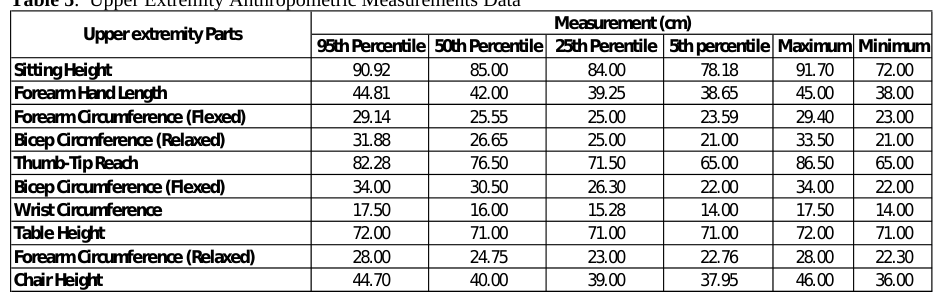
To get the best fit and other dimensions of the design, upper extremity anthropometry measurements among Filipino electronic technicians were utilized. In this paper, there were ten upper extremity anthropometric dimensions that were considered namely setting height, forearm hand length, forearm circumference (flexed), bicep circumference (relaxed), forearm circumference (relaxed), thumb-tip reach, bicep circumference (flexed), wrist circumference, table height and chair height. These measurements were matched with the final resulting design attributes.
RESULTS AND DISCUSSION
In terms of age bracket distribution, 50% of the respondents (n=14) belong to 25-29 age bracket, 22%, 20-24 age bracket and 14%, 30-35 and 36-40 age brackets. Majority of them are single, (57%) and 43% of them are married. 28.57% of the respondents are within the weight bracket of 129-139 kilogram, 21.43% belongs to 140-150 kilogram weight bracket, 14.29% for 120-128 kilogram, 162-172 kilogram and 173-183 kilogram weight brackets while 7.14% of the total respondents are within the weight bracket of 184-194 kilogram. The maximum weight among the respondents is 187 kilogram while 128 kilogram is the minimum weight. In terms of height, majority (42.86%) of the respondents are within the height of 63 and 65 inches, 28.57% are 64 and 66 inches tall, 21.43% of them are 67 inches tall while 7.14% is 62 inches tall, with the shortest at 62 inches and the tallest at 67 inches.
Moreover, among the fourteen electronic technicians who participated, 28.57% have been working as an electronic technician for four years. 21.43% of them have been in a technician profession for five years. Among the respondents, 35.72% of them said that they have been working as technicians for five to six years. Three respondents (21.43%) claim that they have been working as technicians for eight to twelve years. With regard to the working hours, more than half (57%) of the technicians are working eight hours per day, followed by technicians who work six hours a day (22%). 14% is working seven hours per day and only 7% of them said that they spend five hours a day doing troubleshooting activities.
In addition, desoldering, multitesting, soldering and other tasks such as board cleaning, wire cutting and parts adjustments are among the tasks identified. An average of 35.21% of the time during the troubleshooting session is spent to multitesting. 29.64% is the average time spent to soldering task per repairing session, followed by desoldering task (26.64%). An average of 8.50% of the time is accounted to other tasks which included cleaning, wire cutting and alignment and part adjustments. Among the top equipment that the respondents usually repair include TVs or monitors, radio cassettes, DVD players and Amplifiers. Other appliances that are mentioned during the survey are electric fan, speaker and microphone.
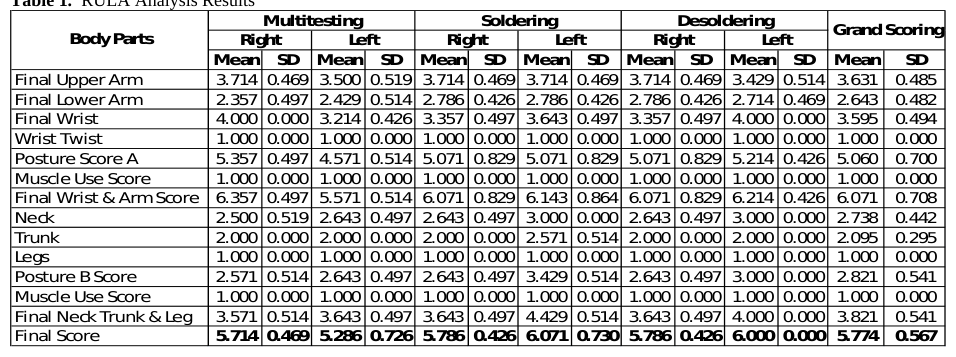
Rapid Upper-Limb Assessment (RULA) Results The top tasks performed by the technicians are multitesting, soldering and desoldering which accounted for 91.50% of the total time when troubleshooting. During the multitesting task, the right view analysis has a total RULA score of 5.714 while the left task receives a score of 5.286. In terms of the soldering task, on the right hand side, the technicians are using soldering iron. With regard to the soldering task, 28.57% of the respondents derive a total score of 7 while using the soldering lead (left view) that resulted to an average of 6.071 RULA score. In contrast, the right hand uses a soldering iron which obtains an average score of 5.786. Lastly, it can be noted that both the desoldering and soldering (right views) have equivalent scores of 5.786. This is because the right hand uses soldering iron in which the analysis is already been performed during the soldering task RULA analysis.
The mean upper arms grand score is 3.631, which indicates an average degree of shoulder flexion more than 90, while the average lower arms score is 2. The average wrist twist score is 1.00, which means that the wrists were placed in an extension position with an angle less than 15. The final average wrist grand score of 3.595 shows that wrist flexion angle is greater than 0 degree but less than or equal to 15 degrees. Most of the wrists of the technicians are bent from the midline. The mean neck score is 2.738 and the mean trunk score is 2.095, which indicates that the neck and trunk of the participants are either in flexion, rotation, side bending or in combination. The final RULA grand score of electronic technicians during the multitesting, desoldering and soldering tasks ranges from a minimum of 5 to a maximum of 7 with an average score of 5.774 approximately equal to 6.0 indicating that the average worker needed an action level 3 which is “further investigation and change soon”. Furthermore, no participants have an acceptable RULA score of 1 or 2.
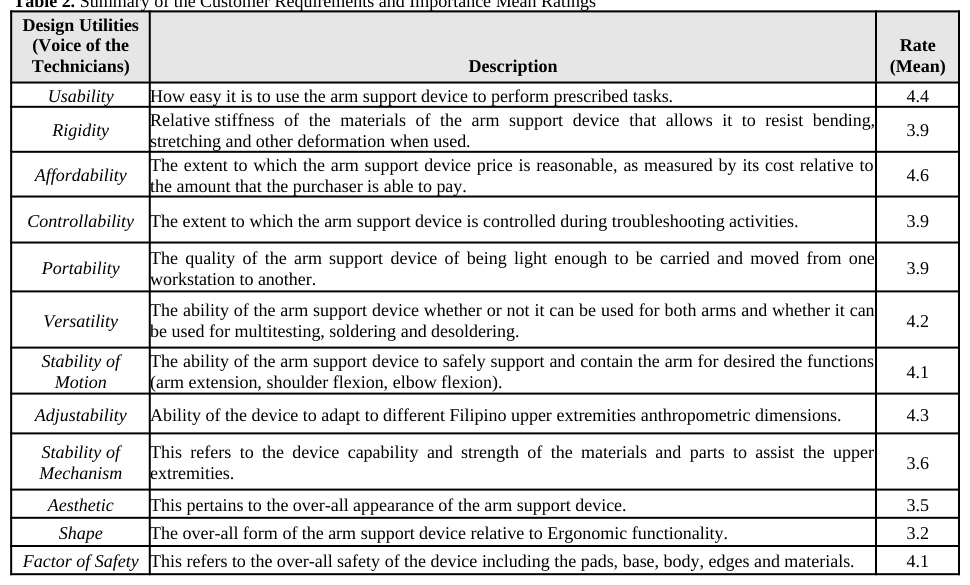
Table 1. RULA Analysis Results Right Left Grand Scoring Desoldering Body Parts Right Left MultitestingTable 2. Summary of the Customer Requirements and Importance Mean Ratings Design Utilities (Voice of the Technicians) Description
Among the technician requirements, affordability has the highest importance score which is 4.6, followed by usability and adjustability. Other requirements which are given higher importance rate of 4.1 to 4.3 are the safety factor, stability of motion and versatility. Other features such as portability, controllability and rigidity are given 3.9 score. Stability of mechanism, aesthetic and shape are among the requirements which received fair importance. In addition, it is noted that none of the mentioned features received a 1 or 2 score.
QFD, KANO Model and TRIZ Analyses Results The above-mentioned feature requirements are then translated into measurable engineering requirements. In this type of design, there are fifteen identified critical specifications. These specifications include following the lower arm in any direction, having adjustable height, base and body are made from metallic materials, pads are made of foam, smooth texture of the pads, mounted on the table, can support the upper and lower arms, detachable capability, width of the pads, price, weight, colour, edges regularity and the size.
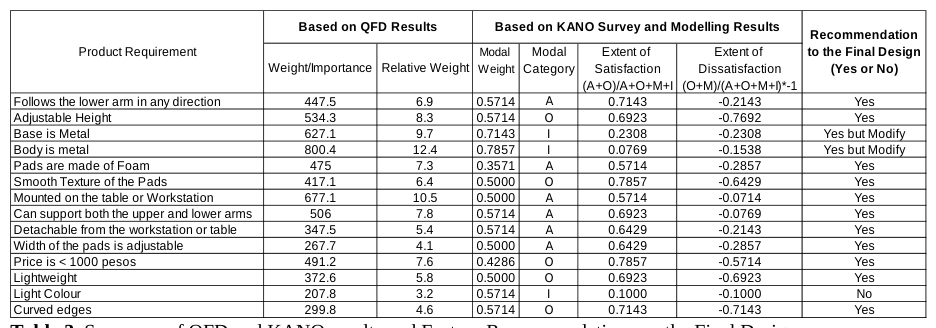
The direction of improvement for each engineering feature was determined. Features such as the cost, weight and size must be minimized. The rest of the requirements are described as target values or characteristics. Forty eight correlations are noted among the requirements. Nineteen are strong positively correlated to each other. Twenty two are positively correlated while seven of them are negatively correlated. From the House of Quality (HOO), there are 168 relationships that are noted. 36.90% or 62 of the relationships belong to the strong relationship category. There are 55 (32.74%) relationships that fall under medium category. 51 or (30.36%) of the total identified relationships belong to the weak relationship.
Table 3. Summary of QFD and KANO results and Feature Recommendations on the Final Design As a result, the feature that states that the body of the arm support device should be metal has the highest weighted importance score (12.6%). This is followed by 9.9% (base is metal feature), 8.9% (size), 8.4% (adjustable height), 8.0% (support both the lower and upper arms), 7.7% (cost), 7.5% (pads made of foam) and 7.0% (follows the lower arm in any direction), 6.6% (texture of the pads) and 5.9% (weight). Among the features that got the lowest weighted importance are colour (3.3%), width of the pads (4.2%), curved edges (4.7%) and detachable from the table (5.5%).
Generally, QFD has shown that many engineering features are associated with each other. These relationships serve as guides in coming up with the final design by taking into account the possible effects of one engineering requirement to another feature. Aside from this, the notion of the technicians toward the design of the arm support device was also considered. It exemplified the features that need to be focused.
Based on Table 3, the features such as following the lower arm in any direction (57.14%), mountable on the table (50.00%), can support both the upper and lower arms (57.14%), and adjustable width of the pads (50.00%) are among the attractive requirements. One-dimensional requirements include adjustable height (57.14%), smooth texture of the pads (50.00%), lightweight (50.00%) and curved edges (50.00%). Metallic base (71.43%), metallic body (78.57%) and light colour (57.14%) are among the indifferent features. It can be noted as well that the feature foam as the main material of the pads (35.71%) was included either in the attractive or indifferent requirements. 28.57% of the respondents claimed that dark colour is better. 7.14% gave a questionable response on the feature that states that the arm support should follow the lower arm in any direction feature. Also, based on the table above, the price, adjustable height, support both lower and upper arms, detachable from the table, adjustable width of the pads, pad texture, curved edges and follows the lower arms in any direction are among the features that greatly affect satisfaction. The requirement pertaining to the following the lower arm in any direction has the lowest dissatisfaction influence. Curved edges, weight, base material, and colour feature have equal weight in terms of satisfaction and dissatisfaction influences. However, colour feature has the least influence. In addition, among the engineering features that have lowest influence on customer satisfaction are body material, colour and base material. The features that slightly affect dissatisfaction include colour, support on both lower and upper arms, mounted on the table and body is metal requirement All the features are recommended in the final design but the light colour feature. This is because it has the least importance rating and at the same time it will slightly affect the satisfaction and dissatisfaction level of the technicians. Two features namely metallic base and body are still recommended for the final design but subject to modifications. These features did not influence the satisfaction or dissatisfaction level of the users but have the highest importance ratings. Also, these features are included in the design process since they are strongly correlated with the other engineering and customer requirements. Another observation from the results is the adjustable width of the pads being recommended to the final design even if it does not greatly affect the dissatisfaction level if it is not included and has the least importance weight. This feature will delight the users if it is included.
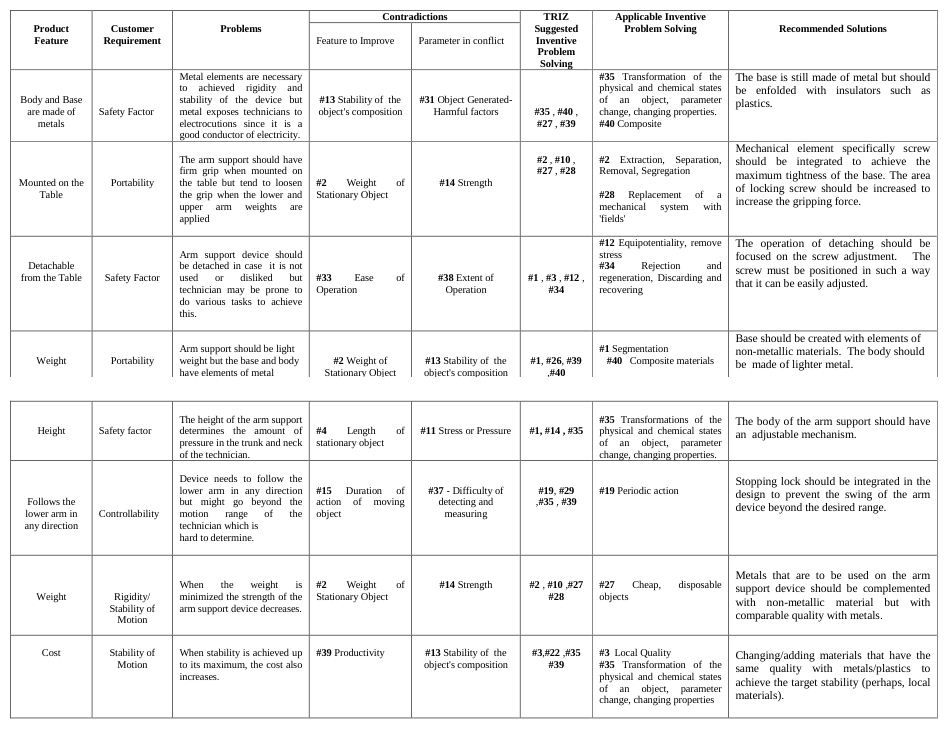
The product analysis included the measurement of the relationships between engineering features and other engineering feature items and between the customer requirements and the engineering features. From the product analysis, various problems are identified specifically the contradictions among features. To resolve this, Theory of Inventive Problem Solving (TRIZ) was employed. The complete TRIZ analysis is summarized in Table 4.
Table 4. TRIZ Analysis Results
Anthropometry
Table 5 summarized the upper-extremity anthropometric measurements of Filipino technicians. The maximum range which is the 5th to 95th percentile is used (ergonomics4schools.com) since this paper aimed for the safe and comfortable posture and good match between the technicians and the arm support device,). For instance, the bicep circumference (relaxed), the measurements considered are from 21 cm (5th percentile) up to 31.88 cm (95th percentile). Maximum and minimum data are not utilized to provide space for errors or outliers. These data are matched with the dimensions of the arm support resulting attributes to get the best.
In general, the relationships and relative importance ratings of the arm support features both the customer and technical requirements resulted from the QFD analysis, the KANO model results which are the perception of the technicians on the technical features of the product and how these features affect the level of satisfaction or dissatisfaction, the TRIZ recommended solutions to the identified contradictions or problems, and the 5 th to 95th percentile of the anthropometric measurements are utilized to arrive to a reasonable and ergonomic arm support design.
SUMMARY, CONCLUSIONS AND RECOMMENDATIONS The tasks performed by the Filipino technicians such as multitesting, desoldering and soldering are indeed highly associated with risks particularly due to awkward postures and static muscle loading that increase the UECTD risk development. Based on the studies, arm support is suggested to reduce the pressure and activity of the muscles in the upper extremities particularly on the shoulders, wrists, upper and lower arms and neck. It is concluded as well that designing an arm support intended for electronic technicians is deemed necessary given the tasks involved in this kind of profession to minimize the risk of UECTD development.
Moreover, this paper have shown that QFD is an effectual tool in assessing the standards of the users and developing a design and at the same time satisfying customer requirements without sacrificing the product or technical requirements. This paper confirms the usefulness of Kano model as a method in gauging the perception of the technicians on the technical features of the product and how these features affect their level of satisfaction or dissatisfaction. This study also shows a clear application of TRIZ as a systematic approach in identifying design contradictions and providing ideal solutions. The application of anthropometry in this study has evidently shown a logical approach in achieving the best fit and broadening the range of befitting users. In general, this research paper demonstrated that the combined applications of QFD, KANO Model, TRIZ and Anthropometry is an effective approach in addressing design problems and achieving the target arm support ergonomic and functional design parameters without sacrificing the user requirements. By combining the four different methods, the authors were able to come up with the following design specifications:
Prototyping and validation of the effects of using the proposed design of the arm support model on work performance and comfort are recommended. Also, further studies as to the other possible factors such as the type of tools and equipment used that potentially influence UECTD risk development among Filipino technicians should be conducted. Replicability of this study to other product and process development particularly on prosthesis and other health related equipment, tools and systems is also recommended.
REFERENCES
Armstrong, T. and et. al. (1982). Investigation of Cumulative Trauma Disorders in a Poultry Processing Plant. American Industrial Hygiene Association Journal. p.103-116. Arndt, R. (1987). Work Pace, Stress, And Cumulative Trauma Disorders. Ib Journal of Hand Surgery, p.866. Banerjee, P. and et. al. A Study on Upper Extremity Cumulative Trauma Disorder in Different Unorganised Sectors of West
Bengal, India. Journal of Occupational Health, Vol. 45 (2003) , No. 6 351-357, Retrieved, December 12, 2011, from http://www.jstage.jst.go.jp/article/joh/45/6/45_351/_article/-char/en. Baron S. and Habes D (1992). Occupational Musculoskeletal Disoreders Among Supermarket Cashiers. Scandinavian Journal of Work, Environment and Health. p. 127-129. Bernard B. and et. al., (1997). Musculoskeletal Disorders and Workplace Factors: A Critical Review of Epidemiologic Evidence
for Work-Related Musculoskeletal Disorders of the Neck, Upper Extremity, and Low Back. National Institute for Occupational Safety and Health Journal, p. 1-6 – p. 1-9. Bernard B. and et. al. (1992). Psychosocial and Work Organization Risk Factors for Cumulative Trauma Disorders in the Hands and Wrists of Newspaper Employees. Scandinavian Journal of Work, Environment and Health . 119-120 Biering-Serensen, F and Bendix, T.,(1983). Posture Of The Trunk When Sitting On Forward Incling Seats. Scandanavian Journal
of Rehabilitation Medicine, J5, 197-203. Blair, S. J., and Bear-Lehman, J. (1987). Editorial comment: Prevention Of Upper Extremity Occupational Disorders. Journal of Hand Surgery, p.821. Blue, C. (1993). Women in Nontraditional Jobs: Is There a Risk for Musculoskeletal Injury? AAOHN Journal, 41, p. 235 – 240. Bureau of Labor and Employment Statistics. Labstat Updates: Safety and Health in Workplace… Cases of Occupational
Injuries. Vol. 15, No. 42, Retrieved, February 02, 2012, from http://www.bles.dole.gov.ph/PUBLICATIONS %20UPDATES/Vol15_42.pdf. Butdee, S. and Vignat F., TRIZ Method for Light Weight Bus Body Structure Design, Vol. 31 (2008), Issue 2, p. 456-457. Caplan, J. and et. Al, 40 Inventive Principles with examples: Human Factors and Ergonomics. Retrieved from, www. innovationtriz.com. Cardenas, M.F., (2007). Importation of Used Electronic Appliances: A Pilippine Inventory. In: Proceedings of the Fourth NIES
Workshop on E-waste. National Institute for Environmental Studies, Tsukuba. Carson, R. (1993).Ergonomically Designed Tools: Selecting The Right Tool For The Job Industrial Engineering 25, p-27-29. Chen, C.C. and Chuang, M.C., (2008). Integrating the Kano Model Into Robust Design Approach to Enhance Customer Satisfaction with Product Design. International Journal of Production Economics, 114 (2), 667-681. Dawal Z. and Hashim, A. (2012). Kano Model and QFD Integration Approach fo Ergonomic Design Improvement. Elsevier
Journal. Domb, Ellen and et. al, The 39 Features of Altshuller’s Contradiction Matrix. The TRIZ Journal Retrieved, http://www.trizjournal.com/archives/1998/11/d/. Garcia, D.T., Fernandez, E., & Agarwal, R.K. (1997). Implementation of Arm Supports as an Aid to Computer Work in the
Office. In B. Das & W. Karwowski (Eds.), Advances in occupational ergonomics and safety II (pp. 429–432). Amsterdam, The Netherlands and Berlin, Germany: IOS Press and Ohmsha. Guedez, V. and et al., Ergonomic Design of Small Containers Using the Quality Function Deployment (QFD),” Proceedings of International Journal of Operations and Production Management, Vol. 15, no. 9, 1995. Hales, T. and et. al, (1992). Management Of Upper Extremity Cumulative Trauma Disorders. AAOHN Journal, p. 118-121. Haartz J., and Sweeney M., (1995). Work-related Musculoskeletal Disorders: Prevention and Intervention Research at NIOSH.
Proceedings of the 6th FIOH-NIOSH Joint Symposium on Occupational Health and Safety, p. 135. Li, T. and Huang, H. (2008). Applying TRIZ and Fuzzy AHP to develop innovative design for automated manufacturing systems. Expert Systems with Applications: An International Journal archive, Vol. 36 Issue 4, May, 2009. Ligh, R. (2002). Ergonomics : Cumulative Trauma Injury -- Carpal Tunnel Syndrome. Journal of the California Dental
Association, p.1. Llinares, C. and Page, A. (2011). Kano’s Model in Kansei Engineering to Evaluate Subjective Real Estate Consumer Preferences.
Elsevier Journal. Lu , Jinky Leilanie del Prado. Prevalence of Carpal Tunnel Syndrome and Cumulative Trauma Disorders among Women Workers in the Export Processing Zones in Manufacturing Industries in the Philippines. Asian Journal of Ergonomics, Retrieved, December 04, 2011, from http://iems.net/aje/v5n1/prado-lu.html. Mangubat, H. and et. al. Prevalence of Cumulative Trauma Disorders of the Upper Extremity and Identification of Risk Factors
among Non-Medical Personnel in the University of the Philippines - Philippine General Hospital. The National Health Science Journal, Retrieved, November 23, 2011, from http://www.actamedicaphilippina.com.ph. Marras,W. (2003).The Case For Cumulative Trauma In Low Back Disorders. The Spine Journal. p.2-3. Panabang, M. and et. Al (2008). Design-for-Comfort and Fashion High Heel Pump Shoes for Working Women using Melded
QFD, TRIZ and Value Enginering. Philippine Engineering Journal, Vol. 29, No. 1:23-50. Melhorn, J. M., The Impact Of Workplace Screening On The Occurrence Of Cumulative Trauma Disorders, Journal of Occupational & Environmental Medicine, Vol.41, No.2, 1999, pp.84-92. Middlesworth, Mark. Rapid Upper Limb Assessment (RULA): A Step-by-Step Guide. Ergonomic Plus Journal, Retrieved,
February 27, 2014 from www.ergo.com. Miller, H. (2001). Cumulative Trauma Disorders: Rising Incidence, Rising Awareness. Retrieved, June 27, 2011. from Available at www.hermanmiller.com.br. National Statistics Office (NSO). 2009 and 2010 Labor Force Survey (LFS). Available at http://www.census.gov.ph/. Accessed
on November 16, 2011. Niu, S. (2010). Ergonomics And Occupational Safety And Health: An Ilo Perspective. Elsvier Journal. p. 744. Pan, C. and et. al. (1996). An Exploratory Study Of The Relationship Between Biomechanical Factors And Right-Arm Musculoskeletal Discomfort And Fatigue In A VDT Data-Entry Task. Ekvier Science, Vol 27. No. 3, p. 195. Putz-Anderson V. (1988). Cumulative Trauma Disorders: A Manual For Musculoskeletal Diseases Of The Upper Limbs.
National Institute for Occupational Safety and Health. Raneses, N and et. al (2012). Design and Manufacture of Ergonomic Classroom Desks and Chairs for Deped* Primary Schools, Utilizing Philippines’ Priority Sustainable Industry of Engineered Bamboo. Retrieved February 31, 2014, from http://www.academia.edu/Documents/in/Melded_QFD_TRIZ_and_VE Sireli, Y., Kauffmann, P., and Ozan, E. (2007). Integration of Kano’s Model into QFD for Multiple Product Design, IEEE
Transactions on Engineering Management Vol.54 No. Sauewein, Elmar and et. al (1996). The Kano Model: How to Delight Your Customers. Volume I of the IX. International Working Seminar on Production Economics, Innsbruck/Igls/Austria, February 19-23 1996, pp. 313 -327 Stanimirova I. and et. al. (2007). Dealing with missing values and outliers in principal component analysis. Volume: 72, Issue:
1, Publisher: Elsevier, Pages: 172-178. Steelcase Inc. (2002). Musculoskeletal Disorders: A Framework for Understanding. Grand Rapids, p. 7. Takala, J., Niu (2003), S. Responses to the equity challenge in safety and health at work: improvement of working conditions in equitable bases. In: 27th International Congress on Occupational Health. Terazono, A. and Yoshida A. (2010). Reuse of Secondhand TVs Exported From Japan to the Philippines: Elsevier Journal.p. 1-2. U.S Department of Health and Human Services (1993). Public Health Service Journal, p. 34-37. Worthy, Tina., The Learning Zone: Anthropometry, retrieved from http://www.ergonomics4schools.com/lzone/anthropometry.html. Yu, Huiling and Fan, Delin., Man-made Boards Technology Trends based on TRIZ Evolution Theory: Elsevier. Physics Procedia
(2012), p. 221-227. ___________________ This paper was supported and funded by the Department of Science and Technology-Science Education Institute through the Engineering Research and Development for Technology (ERDT) Program.
LISTED IN THE AHFE DIGITAL BOOKSTORE CATALOGUE
Explore the complete digital volume
Advances in The Ergonomics in Manufacturing: Managing the Enterprise of the Future
Read this individual research paper free through the original publisher, or explore the full digital proceedings book.
ISBN 978-1-4951-2103-6
Explore this ISBN in the AHFE Bookstore ↗Listed in the July 2026 bookstore catalogue; search by ISBN to confirm current availability · Digital book purchase optional