Shuying He (2025). Cultural-to-Modern Design Translation: A Study on Canal Transportation Map Using SWOT & KANO Models. In: Human Factors in Communication of Design. AHFE Open Access, vol. 177, pp. 32–43. https://doi.org/10.54941/ahfe1006329
Objective To address the issues of scarce Chinese canal - culture CC products, shallow cultural exploration, and lack of emotional expression, we take The Supervision of Grain Transport along the Grand Canal as a case. Using SWOT and KANO models, we construct a design - translation process to guide practice. Methods First, SWOT analyzes the traditional - cultural - element design in CC products within competitive environments. Then, a KANO questionnaire is created and data is collected. Next, the KANO model filters the results, determines user needs, and classifies them. Results The map is presented in a contemporary style. CC - product design meets user needs, expresses traditional culture, and promotes canal - culture inheritance. Conclusion SWOT and KANO models are applicable to traditional - culture CC - product design. They clarify user demands, facilitate canal - culture promotion, and offer new ideas for the inheritance of other regional cultures.
In the digital age, traditional Chinese culture spreads diversely via modern means like CC products. In 2022, policies spurred cultural - heritage work and CC - product growth. With support, regional cultures like canal culture gain more attention, and user demands turn to cultural connotations. Canal - culture CC - product markets have problems: single products, shallow cultural mining, and weak emotions. This paper, using Canal Transportation Map as a case and SWOT - KANO models, constructs a design process for these products. By combining with popular CC - product types, it explores design, offering ideas for canal - culture inheritance, enriching CC - product - design theory and aiding traditional - culture revitalization.
ANALYSIS OF THE BACKGROUND AND CURRENT STATUS OF CANAL TRANSPORTATION MAP The Background of the Creation of “Canal Transportation Map”
Cultural-to-Modern Design Translation: A Study on Canal Transportation Map 33
natural landscapes, and architectures along the Lu River during the Qing Dynasty. It is housed in the National Museum of China, with a history of more than 200 years. The scroll, about 6.8 metres long, depicts many ships, buildings and 820 figures, rich in life atmosphere. It adopts a delicate realistic approach, depicting the scenery on both sides of the river, reflecting the economic, cultural and political conditions of the time. It has high historical, cultural, aesthetic and artistic values.
Figure 1: Contents of Canal Transportation Map.
Figure available in the original PDF paper.
Value Points and Opportunities of Canal Culture In 2017, General Secretary Xi Jinping’s instruction in Tongzhou emphasized excavating Grand Canal - related historical and cultural resources for modern use, guiding canal - culture protection and inheritance. Since 2020, policies like the “Plan for the Integrated Development of the Grand Canal’s Culture and Tourism” have promoted cultural - tourism integration, creating opportunities for canal - culture CC products. After China’s Grand Canal was inscribed, the tourism industry boomed, further fueling this trend.
The Canal Transportation Map, a valuable Qing - Dynasty painting, is an important canal - culture carrier, comparable to famous scrolls. But it’s much less well - known. So, revitalizing it through contemporary design to promote canal - culture popularity, inheritance, and innovation is an urgent need.
The Current Status of Domestic and International Research on Traditional Cultural CC Products Translation Design Traditional culture applied in CC products design mainly includes non- heritage artefacts, traditional paintings and traditional music. Creative bodies represented by museums, monuments and art galleries continue to mine traditional cultural elements. Traditional Chinese cultural elements provide a constant source of inspiration for modern CC products product design. Yufen Li explored how to refine and draw on traditional Chinese cultural elements in the process of CC products product design (Li, 2021); Jingcheng Li et al. explored an innovative way of integrating CC products with digital technology (Jing et al., 2023); Yan Zexue et al. studied the transformation of Jiangsu’s red cultural resources in the CC products product path (Yan et al., 2024). Among them, traditional paintings have become an important creative element in CC products design because of their high visibility and artistic value, and “Thousand Miles of Rivers and Mountains” and “Qingming Shanghe Tu” are frequently applied in CC products design as representatives of them.
34 He
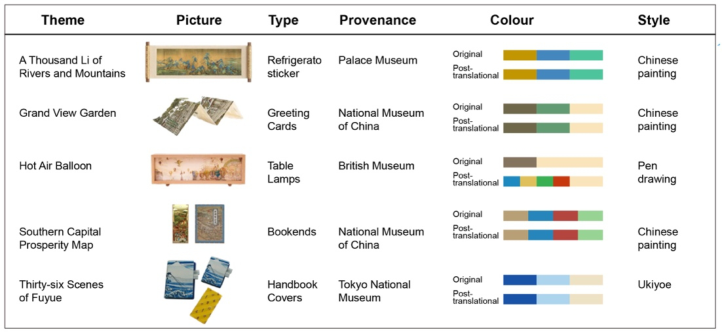
Over time, silk in traditional paintings yellows due to oxidation, losing its original charm. Most current cultural creative designs merely imitate the original style, like on fridge stickers and lamps, without delving into cultural connotations or evoking deep emotional resonance. This not only makes products shallow but also deviates from contemporary aesthetics, hampering the integration of culture and tourism.
Figure 2: Analysis of traditional cultural and creative design works.
The Canal Transportation Map, a precious collection, vividly portrays the bustling canal hubs in the Yuan, Ming, and Qing dynasties, embodying the profound canal culture. However, there are few related cultural creative products, and with limited dissemination and innovation of canal culture, its popularity lags behind the development of canal cultural tourism, creating a research gap.
Therefore, this study uses the Canal Transportation Map as a case to explore the essence of canal culture and construct a way to transform traditional culture into modern creative design. This breaks the limitations of existing designs, deeply explores and expresses canal culture, aiming to boost cultural - tourism integration and revitalize traditional culture in the new era.
SWOT ANALYSIS OF THE CC PRODUCTS DESIGN OF CANAL TRANSPORTATION MAP SWOT analysis, proposed by Michael Porter, covers the four elements of strengths, weaknesses, opportunities, and threats, and this study applies this method to analyse Canal Transportation Map: the internal conditions focus on the strengths such as its regional characteristics and artistic value, and the weaknesses such as the copyright issue and the aesthetic differences, while the external environment focuses on the threats such as the policy support, the opportunities in the tourism market and the competition in the market, and the deviations in the cultural interpretation. The SWOT analysis aims to comprehensively analyse the internal and external environments of
Cultural-to-Modern Design Translation: A Study on Canal Transportation Map 35
traditional cultural creations, and provide a scientific basis for the precise formulation of inheritance and innovation strategies.
THE RESEARCH PROCESS OF TRADITIONAL CULTURAL CULTURAL CREATION TRANSLATION DESIGN BASED ON KANO MODEL The KANO model, proposed by Noriaki Kano, a professor at Tokyo Institute of Technology in 1984, classifies and prioritizes user needs and is widely used in product design and the service industry. It categorizes needs into five types: Must-be Quality, One-dimensional Quality, Attractive Quality, Indifferent Quality, and Reverse Quality by analyzing user demands and expectations for products or services. (Zhang, 2024). Must-be Quality are basic needs. If not met, users are extremely dissatisfied, yet fulfilling them doesn’t offer a competitive edge. One-dimensional Quality has a linear correlation with user satisfaction. The higher the level of such features, the higher the satisfaction, and vice versa. Attractive Quality exceeds user expectations, bringing extra surprises and enhancing product competitiveness. Indifferent Quality is what users don’t care about; providing it doesn’t affect satisfaction. Reverse Quality are unwanted by users, and providing them reduces satisfaction.
Demand Acquisition Based on Canal Culture CC products User demand is an important indicator that responds to the real needs of the target population, and is also the reference basis for designing the KANO questionnaire (Wei et al., 2022). The acquisition of user demand requires an in-depth understanding of the users and a full understanding of their specific needs for traditional culture and canal culture cultural creations. In this study, we went to obtain the requirements through three ways: sample collection, user interviews and desktop research, and selected 30 canal culture CC products and traditional culture CC products with high sales volume in the market, comprehensively analysed the types, sources, elements, themes, and evaluations of the products (including good reviews, moderate reviews and bad reviews), and summarised the research results to obtain 20 user requirements, as shown in Table 1.
Table 1: Canal culture CC products needs categories and secondary classification items.
Table available in the original PDF paper.
Primary
No. Secondary
Requirement
Requirement
Requirement
Explanation Educational needs A1 Learning Learn the history of canal culture A3 Cultural Appreciate canal
cultural relics A3 Popular science Provide tour-guided services
and easy to carry B3 Interactivity Integration with technological elements (such as AR display) Economic needs C1 Cost Reasonable price C2 Quality Good quality C3 Process Types Contain special
processes C4 Material Types Use special materials C5 Packaging Unique packaging Emotional needs D1 Aesthetics Exquisitely
designed D2 Artistry A variety of design styles D3 Thematic Theme series for
festivals or seasons D4 Commemorability Designed with canal attractions or cultural relics D5 Regionality With obvious canal
culture elements D6 Experience Come with some small gifts D7 Customization Provide private
customized service Social needs E1 Gifting Be suitable for giving to friends E2 Aesthetic Reflect one’s
unique aesthetics
Demand Analysis of CC products Based on Canal Culture According to the scores of positive and negative questions to categorise the user needs. KANO questionnaire is set up with 20 test items and 40 questions, and the comparison of KANO model evaluation results is shown in Table 2.
Cultural-to-Modern Design Translation: A Study on Canal Transportation Map 37
Table 2: Comparison of Kano model evaluation results.
Table available in the original PDF paper.
Negative Direction Meters Like Take for Doesn’t
Reluctantly Dislike
Positive direction
granted matter
accept Like Q A A A O Take for
R I I I M granted doesn’t
R I I I M matter reluctantly
R I I I M accept dislike R R R R Q
The questionnaires were sent out through the online form, and 216 valid questionnaires were finally returned, which meets the sample size requirement that the sample size is 5–20 times the number of questions in the KANO model (Li et al., 2024). Among them, 142 are male and 82 are female, and the age group is concentrated in 18–30 years old, which is in line with the age characteristics of the consumer group of CC products. Based on the results of the questionnaire, the attribute division of demand can be initially obtained, and each demand point may have data in different attribute classifications, the number of people choosing the six attribute classifications of the same demand point will be accumulated and the percentage will be calculated, and the attribute with the highest percentage will be the attribute type of the demand point. Collating the data from 216 questionnaires and categorising each of the 20 demand points to arrive at the attribute type of each demand is shown in Table 3.
Table 3: Kano attribute segmentation.
Table available in the original PDF paper.
No. Attribute Attribute Classification M O A I R Q A1 28.57% 12.5% 26.79% 30.36% 0% 1.79% I A2 28.57% 17.86% 23.21% 25% 3.57% 1.79% M A3 25% 14.29% 28.57% 32.14% 0% 0% I B1 25% 41.07% 16.07% 14.29% 3.57% 0% O B2 17.86% 14.29% 35.71% 28.57% 3.57% 0% A B3 17.86% 7.14% 48.21% 21.43% 5.36% 0% A C1 25% 16.07% 33.93% 23.21% 1.79% 0% A C3 26.79% 21.43% 23.21% 25% 3.57% 0% M C4 17.86% 19.64% 33.93% 26.79% 0% 1.79% A C5 16.07% 14.29% 23.21% 42.86% 3.57% 0% I C6 23.21% 10.71% 39.29% 23.21% 3.57% 0% A D1 25% 19.64% 26.79% 23.21% 3.57% 1.79% A D2 17.86% 7.14% 26.79% 39.29% 7.14% 1.79% I D4 23.21% 42.86% 14.29% 16.07% 0% 3.57% O D5 26.79% 44.64% 14.29% 10.71% 3.57% 0% O D6 16.07% 16.07% 39.29% 28.57% 0% 0% A
Continued
38 He
Table 3: Continued No. Attribute Attribute Classification M O A I R Q
Table available in the original PDF paper.
D7 16.07% 10.71% 39.29% 30.36% 0% 3.57% A D8 19.64% 16.07% 42.86% 16.07% 3.57% 1.79% A E1 17.86% 19.64% 35.71% 23.21% 1.79% 1.79% A E2 16.07% 12.5% 42.86% 25% 0% 3.57% A
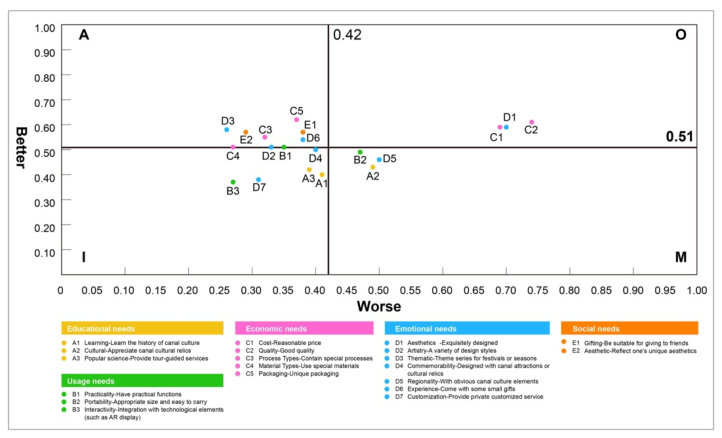
In the traditional KANO model, the type of attribute with the highest percentage determines the attribute division of the need, ignoring the influence of other elements on satisfaction, resulting in the results of the need analysis appearing to be too direct and rigid. To solve the above problem, Berger et al. proposed to correct and optimise the results of the original KANO questionnaire by using the Better-Worse index, by calculating the user satisfaction coefficients of each demand to determine its corresponding quality attributes. The user satisfaction coefficient consists of 2 parts: increasing user satisfaction coefficient Better and decreasing user satisfaction coefficient Worse, which are calculated as follows: Bbetter/SSI = (A + O)/(A + O + M + I) (1)
Wworse/DDSI = −(M + O)/(A + O + M + I) (2) The Better and Worse indices for each demand are calculated by substituting the values of the attributes of each demand into equations (1) and (2), respectively. Taking the Better index as the vertical coordinate and the absolute value of the Worse index as the horizontal coordinate, four quadrants are divided by taking the average of the absolute values of the two indices respectively. The four quadrants represent different demand attributes, with the first quadrant being expectation-based demand (O); the second quadrant being glamour-based demand (A); the third quadrant being indistinguishable demand (I); and the fourth quadrant being must-have demand (M). Comparing Table 5, it can be seen that the original requirement attributes have been changed to form the optimised.
Among them, Must-be Quality needs (M) are: A2 learning, B2 portability, D5 locality, which will cause users’ dissatisfaction when they are not satisfied; the One-dimensional Quality needs (O) are: C1 cost-effectiveness, C2 quality, D1 aesthetics, which will gradually increase the users’ satisfaction when they are satisfied; and the Attractive Quality (A) are: C3 process variety, C5 packaging, D3 thematicity, D6 experientiality, E1 Gift, E2 Aesthetic embodiment, user satisfaction will be significantly increased when these needs are satisfied; indifferent Quality needs (I) for A1 Learning, A3 Science, B1 Practicality, B3 Interactivity, C4 Material type, D2 Artistic, D4 Commemorative, D7 Customisation, these needs will not cause changes in user satisfaction when they are satisfied or not, so they will not be further analysed in the demand analysis. Therefore, they will not be analysed further in the requirement analysis.
Cultural-to-Modern Design Translation: A Study on Canal Transportation Map 39
Figure 3: Requirements matrix.
In order to more accurately match user needs and improve user satisfaction, the user’s demand sensitivity needs to be ranked, through the Better and Worse coefficient formula can be calculated, the larger the S coefficient, it means that the user’s sensitivity to this demand is greater, and the more it should be prioritised in the design, the calculation formula is as follows:
Equation reproduced from the original PDF.
Based on the long-term experience of using the KANO model theory in practice, the attributes of requirements are generally ranked as follows: Must-be Quality (M)> One-dimensional Quality (O)> Attractive Quality (A)> Indifferent Quality (I) (Liang, 2021). Must-be Quality needs should be prioritised in the design, followed by One-dimensional Quality and Attractive Quality needs. Needs with high S-coefficient in the same attribute should be prioritised. Therefore, by combining the requirement sensitivity ranking with the requirement attribute ranking from practical experience, the final user requirement ranking can be obtained.
DESIGN PRACTICE In the study of traditional cultural CC products translation design based on SWOT analysis method and KANO model, the design practice selects Canal Transportation Map as an example, mainly relying on the sorting of user demand sensitivity in the KANO model and the sorting of demand attributes in the practical experience, and taking the demand with high sorting as the key point of the translation design to design a CC products product that meets the users’ needs.
40 He
Must-be Quality transformation Must-be Quality needs (M) are basic needs that must be met by the user, and if these types of needs are not met, they will cause dissatisfaction, but providing them will not enhance user satisfaction. In this study there are three must- have needs, and the order of the second-level needs is: D5 Geographical, B2 Portability, and A2 Cultural. In terms of the first-level needs, they are distributed among emotional needs, usage needs and educational needs, indicating that users have more comprehensive basic needs for canal culture and CC products.
Among them, D5 The sensitivity of the demand of regionality is the highest, indicating that users hope that the CC products of canal culture can have obvious elements or logos of canal culture (e.g. boats, rivers, etc.). Through the preliminary SWOT analysis and literature research, it can be seen that the homogenisation of CC products design elements is serious, and the CC products of canal culture lack in-depth interpretation of cultural connotation and fail to satisfy the users’ deep-seated emotional needs. Based on the above analysis, the core elements such as river boats, character scenes, architectural landscapes and other elements in Canal Transportation Map should be extracted firstly to construct a multi-dimensional design material library with canal characteristics, in order to highlight the regionality of canal culture and provide a basis for the extension of subsequent CC products design.
Secondly, it should satisfy the demand of A2 culturality and increase the popularisation of the canal’s cultural and historical background and heritage sites. By selecting 12 representative buildings in the scroll: the Imperial Dockyard, the Floating Beam Chidu, the Three Water Divisions, the Seven Platforms, the Northeast Corner Tower, the Jade Emperor Pavilion, the Salt Officer’s Hall, the Salt Switching Hall, the Purple Bamboo Grove, the Houjiaxiang, the Tianhou Palace, and the Sanjiao Academy, and combining the names of the buildings with their functions and features for the typeface design, we aim at demonstrating the social landscape of the canal banks, and recreating the canal’s grandeur in the Qing Dynasty period. The combination of the font design and the scroll is applied to carriers such as refrigerator stickers, postcards and keychains, taking into account the portability of the CC products and ensuring that the products are the right size and easy to carry.
One-Dimensional Quality Transformation One-dimensional Quality (O) are directly proportional to user satisfaction, the more expectation-type needs are satisfied in CC products, the higher the user’s goodwill will be, and the user’s satisfaction will not decrease when the expectation-type needs are not satisfied. In this study, there are three aspirational needs, and the sensitivity rankings of the secondary needs are, in order: C1 Cost-performance, D1 Aesthetics, and C2 Quality. The demand of aesthetics is ranked high, indicating that while the market for CC products is booming, users’ requirements for CC products are also increasing. Therefore, providing high-quality and beautifully designed CC products can
Cultural-to-Modern Design Translation: A Study on Canal Transportation Map 41
help to improve user satisfaction and allow more consumers to establish an emotional link with canal culture, thus enhancing the popularity of canal culture, promoting the popularisation of canal culture, and achieving the goal of integrated development of culture and tourism.
Attractive Quality Transformation Attractive Quality (A) is users’ unexpected need, effectively enhancing user satisfaction in product design. Second - level needs are ranked as C5 Packaging, E1 Gift, D6 Experiential, E2 Aesthetic Embodiment, D3 Thematic, and C3 Craft Kind. From first - level demands, the focus is on emotional and social ones, suggesting CC products meeting emotional and social needs are more competitive.
C5 Packaging and E1 Gifting have the highest demand sensitivity, meaning CC products must meet social needs in different scenarios. When designing CC products based on the Canal Transportation Map, we can refer to “Qingming Shanghe Tu” and “Gusu Fanhua Tu”. Using long scrolls and books as carriers, we can develop collectible and exquisitely - packaged products suitable for gifting.
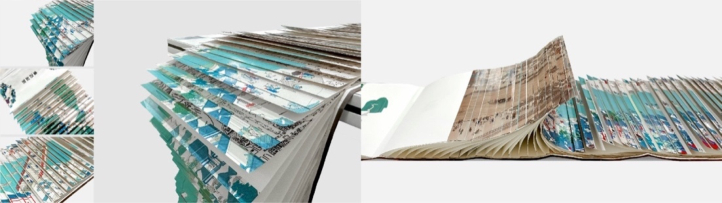
This study uses dragon scale books as the carrier. The Canal Transportation Map Scrolls are divided into 240 parts, cut into “dragon scales”, stapled and stuck on the book’s back, and wrapped with brocade silk outside to resemble scales. The inner page introduces the scroll’s theme, presenting the beauty of traditional custom paintings and having collection and sales value.
Figure 4: Book design of Canal Transportation Map.
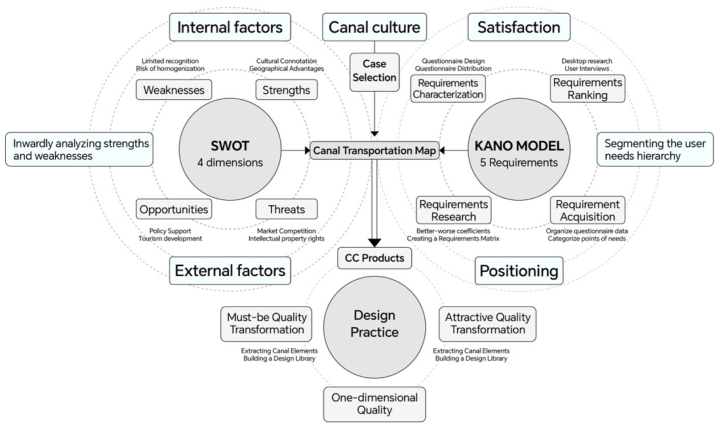
This study aims to accurately respond to the needs of the audience and vividly present the theme of the scroll, cleverly applying SWOT analysis and the KANO model to plan and design more than a dozen CC products with contemporary flavour and wide dissemination potential, and successfully realizing the innovation and transformation of the five categories of needs and the three levels of needs. On this basis, the author has constructed a demand model for CC products design with canal culture as the core, aiming to provide a valuable reference framework and practical example for the creative transformation and wide dissemination of traditional culture in the contemporary context.
42 He
Figure 5: User requirement model for CC products design of canal culture.
CONCLUSION
Canal culture has a long history and rich heritage, inspiring CC product design. After China’s Grand Canal was listed on the World Heritage List, more focused on its inheritance. This study used Canal Transportation Map as a case, analyzed demands with SWOT and KANO models, and designed ten CC products, achieving the map’s modern interpretation and cultural dissemination. The study built a relevant theoretical framework and provided reference for other traditional CC products. Winning Red Dot Awards in 2023–2024 verified its validity. However, the study has shortcomings. It only used one case, and demand analysis might be incomplete. The products may face practical problems. Future research can expand samples, use more methods, and solve practical issues.
REFERENCES
Li, G. Gang, Q. (2024). “The Study of the Design Requirements of Wujia Clay Figurine App Based on KANO Model”, Design, 37(16), pp. 26–30. Li, J. Yang, L and Sun, T. (2023). “Design Thinking Driven Digital Cultural and
Creative Design: Pattern Construction and Practice Examples”. Frontiers in Art Research Volume 5, Issue 11: 9–19 Li, Y. (2021). “Refinement and Drawing Lessons from Traditional Chinese Cultural Elements for Cultural and Creative Product Design”, Proceedings of Business and Economic Studies, 4(4), pp. 89–92 Liang, Q. (2021). “User Demand Analysis and Functional Design of Sports and
Fitness APP Based on KANO Model”, Design, pp. 150–153. Wei, Y. Li, A. Xu, X. (2022). “Usability Optimization Design of Cloud Pet APP Based on Kano-QFD”, Packaging Engineering, 43(2), pp. 378–386.
Cultural-to-Modern Design Translation: A Study on Canal Transportation Map 43
Yan, Z. Yan, J. Yu, Y. Yang, J and Wang, C. (2024). “Application of Jiangsu Red Resources in Cultural and Creative Product Design Based on KANO-AHP”, Packaging Engineering, 45(18), pp. 102–109 Zhang, K. Xu, M and Ding, J. (2024). “Research on Space Design of Cultural
Auditorium in Zhinan Village Based on KANO Model”, Design, 37(7), pp. 151–154.
LISTED IN THE AHFE DIGITAL BOOKSTORE CATALOGUE
Explore the complete digital volume
Human Factors in Communication of Design
Read this individual research paper free through the original publisher, or explore the full digital proceedings book.
ISBN 978-1-964867-53-3
Explore this ISBN in the AHFE Bookstore ↗Listed in the July 2026 bookstore catalogue; search by ISBN to confirm current availability · Digital book purchase optional