Qianqian Tang, Yonghong Liu, Qingxia Chen (2025). Innovative Design of Immersive Running Pod Based on Multi-sensory Theory. In: Usability and User Experience. AHFE Open Access, vol. 194, pp. 27–38. https://doi.org/10.54941/ahfe1006665
As the application of immersive experience in the field of sports becomes more and more extensive, the stimulation of a single sense is difficult to satisfy the user's demand for a sense of immersion. Therefore, how to enhance immersion through multi-sensory co-design has become the key to the development of immersive sports. The study aims to enhance the immersion and user experience of running pods by integrating visual, auditory, tactile, olfactory and other multi-sensory interaction elements. The study first investigates the behavior of users with immersive running experience, and summarizes users' multi-sensory demands for immersive running through user journey maps; then analyzes users' demands through the KANO model, extracts the weight ordering of different demand elements, and clarifies the key demands and product features in order to establish a list of functional demand types. The study translates users' multi-sensory demands into product functional modules, and derives a total of 13 core styling design demands for immersive running pods of must-be, one-dimensional, and attractive quality, and uses them as a guide to formulate a corresponding design strategy and construct a design model for immersive running pods. The above findings provide specific design ideas and practice paths for future product optimization of immersive running pods, which can more accurately grasp user needs, thus improving user immersion experience and user satisfaction.
Current Status and Progress of Multi-Sensory Research in Immersive Sport Experiences The concept of immersion was first introduced in 1975 by the American psychologist Cziksentmihalyi, who argued that when people concentrate on something they are willing to put effort into and receive timely feedback, it produces a great sense of satisfaction and happiness (Cziksentmihalyi, 1975). Ghani believes that immersion experience will occur when a person is fully absorbed in the work or thing being done and can derive the desired pleasure from it (Ghani & Deshpande, 1994). Brown and others concluded through interviews that immersion requires concentration, neglect of time and loss of self (Brown & Cairns, 2004). In summary, the immersive running explored
in this paper is a pleasurable experiential state felt by individuals when they are fully engaged in running, and its core feature lies in a feeling of complete immersion, forgetting other things in reality, and sometimes even losing the state of time and spatial awareness.
The concept of multi-sensory integrates multiple sensory systems of sight, hearing, smell, taste, and touch. In daily life, an individual’s perception is usually the result of the joint action of multiple senses, and different sensory information intertwines with each other to enhance the understanding of the environment and interactive experience.Meir Plotnik found that visual flow had a significant effect on walking speed on a treadmill, and that runners were able to reach a steady state of walking faster and with a greater sense of immersion when the speed of visual flow was matched to the speed of running (Plotnikt et al., 2015). Chen Chongyang and others showed that music can improve running performance through psychological, physiological and emotional mechanisms (Chen et al., 2021). For example, music can reduce the level of perceived effort (RPE) during exercise and increase the sense of pleasure and immersion in exercise. Feng and others experimentally found that haptic factors such as the sense of flowing wind and the vibration of footsteps in immersive virtual environments have a positive impact on the user’s non-fatiguing walking movement, which can enhance the sense of presence and improve the user’s spatial orientation ability in virtual environments on the whole (Feng et al., 2016). Powis found that visually impaired runners were able to recognize routes and derive pleasure from multi-sensory practices during running, and the study participants perceived the auditory, olfactory, and tactile pleasures of the waterfront route as providing sensory immersion beyond vision more than any other environment (Powis & Macbeth, 2024). These studies suggest that multi-sensory applications are becoming a key factor in enhancing exercise experience and immersion, and that more and more research will focus on how to optimize exercise performance and enhance immersion by integrating different sensory designs in the future.
The Importance of Multi-Sensory Design for Building Immersive Environments From a design perspective, multi-sensory design means that the designer breaks through the limitations of a single sensory channel and stimulates the user’s sensory functions at a multi-sensory level from multiple perceptions, such as human vision, hearing, touch, and smell, so that the user can have a specific experience (Kang, 2021). In the field of art, some studies have explored how to enhance the user’s perception and immersion in the virtual environment through the synergy of multi-sensory channels such as vision, hearing, touch and smell by constructing a multi-sensory experience system in virtual reality (Zhang, 2018). In the area of cultural inheritance, Lv & Cui (2023) proposed a multi-sensory design strategy based on emotional resonance, immersive experience and contextual interaction to enhance users’ perception and experience of traditional handicrafts-based non-heritage through virtual reality technology. Shen & Li (2024) found that product
Innovative Design of Immersive Running Pod Based on Multi-Sensory Theory 29
design with multi-sensory experience can bring users a more comprehensive and deeper experience, which can help to promote the inheritance and development of museum culture. In the field of architectural design, Globa et al. (2022) explored the potential of multi-sensory design in immersive environments, emphasizing the integration of visual, auditory and other multi-sensory channels to provide richer immersive experiences for spatial design. Based on these findings, multi-sensory design has significant potential in building immersive environments in a variety of fields such as art, culture, and education. Through the synergistic effect of multi-sensory channels, it can stimulate the user’s perception more comprehensively and create a more real and profound immersive experience with emotional resonance.
Limitations of Multi-Sensory Design in Building Immersive Running Environments Although multi-sensory design has been widely applied to immersive experiences, there are still limitations in existing theories and practices for the construction of immersive running environments. First, the existing theories lack specific knowledge of users’ multi-sensory needs in immersive running contexts. Currently, multi-sensory design is mainly applied in virtual immersive environments with static or low dynamic interaction, such as art exhibitions and cultural communication, and less attention is paid to the multi-sensory needs of users in the dynamic movement space. Running, as a high-intensity activity that relies on body movement, involves complex physiological feedback and spatial interaction, and its sensory needs are individually differentiated and scene-dependent, most of the existing designs fail to accurately recognize and satisfy the specific sensory needs of runners in the immersion process.
Second, existing studies lack a systematic evaluation of the weighting of sensory needs. In immersive running environments, visual, auditory, tactile, olfactory and other sensory feedbacks are not equally important, and the priority of different sensory needs may vary with individual differences and changes in environmental settings. The existing design does not consider the priority and weight distribution between the specific needs of each sense, which may easily affect the overall immersion experience.
Aiming at the limitations of the current multi-sensory design in immersive running environment, this paper proposes to study an immersive running cabin based on multi-sensory theory, extract the specific multi-sensory needs of users in immersive running through the user behavioral journey map, analyze the user’s needs by combining with the KANO model, determine the weighting of the different sensory needs, make clear the key needs and product features, and formulate corresponding design strategies based on the guidance of the KANO model. The user behavioral journey map and product features are used as a guide to formulate corresponding design strategies. The above innovative design approach combines the user behavioral journey map and the KANO model to solve the multi-sensory design challenges in immersive running environments, which provides a practical basis for the application of multi-sensory theory in sports environments.
RESEARCH METHODOLOGY AND DESIGN Multi-Sensory User Demand Element Extraction
In past studies, user behavior journey mapping is often used to systematically analyze user behavior and acquire user needs (Wang et al., 2019). As a visualization tool for analyzing user behavior (Soualhi et al., 2013), user behavior journey mapping is based on the basic characteristics of the user population, dividing the process of using products or services into multiple stages, subdividing the user’s behaviors and actions at each stage, recording the behavior path and analyzing the touchpoints of the user’s various behaviors, and then obtaining the satisfaction level of the corresponding touchpoints through the user interview or the user’s response. According to the level of satisfaction of the touchpoints, they are categorized into pleasure points and pain points, and finally user requirements are deduced based on the pleasure points and pain points (Cui et al., 2015). The user behavioral journey map that introduces multi-sensory requirements is to analyze the multi-sensory touchpoints by sorting out the user’s interaction with the product, and then extract the multi-sensory requirements based on the pleasure points and pain points derived from the sorting.
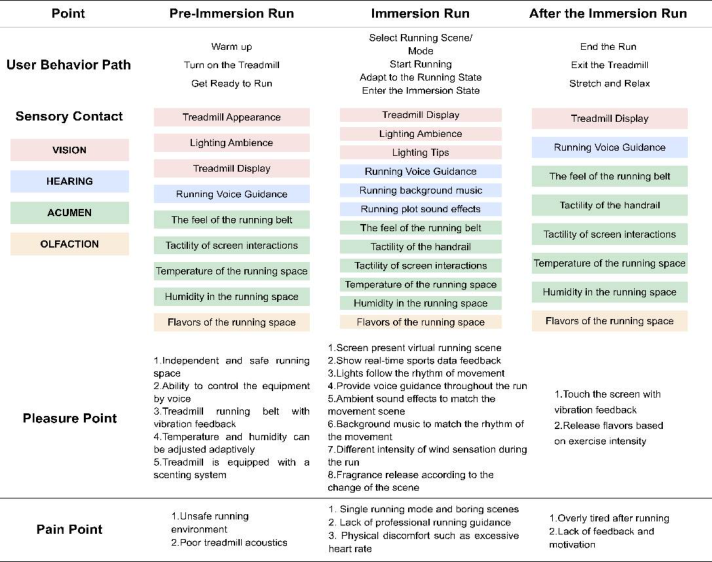
Through user interviews and focus group discussions, this paper divides the user’s immersive running process into three stages, namely: before immersive running, during immersive running, and after immersive running, and lists the corresponding user behavior paths therein. In addition, since the user’s gustatory senses have low relevance in the process of immersive running, the sensory contacts are divided into four categories, namely, visual contacts, tactile contacts, auditory contacts, and olfactory contacts, according to the multi-sensory theory. Based on the feedback information obtained from user behavior and the observation and interview process, we summarize the information and organize the sensory touchpoints at each stage according to the type of senses, extract the user’s pleasure points and pain points, and visualize the information in the form of user behavioral journey map (see Figure 1).
Through the derivation of user behavioral journey map based on multi- sensory needs, combined with the review of literature and user research and other methods, 22 user multi-sensory needs during immersive running were sorted out, and these needs were categorized and organized from four multi- sensory dimensions: visual, auditory, tactile, and olfactory (see Table 1).
Table 1: Multi-sensory user needs.
Table available in the original PDF paper.
Serial Number User Needs Sensory Type A1 Individual space styling Vision A2 Handrails and other safety devices A3 Ambient light A4 Function alert light A5 High-definition large screen A6 Virtual running scene A7 Sports data feedback
Continued
Innovative Design of Immersive Running Pod Based on Multi-Sensory Theory 31
Table 1: Continued Serial Number User Needs Sensory Type
Table available in the original PDF paper.
B1 Voice-controlled devices Hearing B2 Stereo surround sound effects B3 With scene-matching sound effects B4 Synchronized with the rhythm of the music B5 Voice-guided B6 Storyline accompaniment C1 Running belt vibration Acumen C2 Handrail vibration C3 Touch screen vibration C4 Automatic adjustment of temperature and humidity C5 Wind sensation D1 Scenting system Olfaction D2 Matches odor to the environment D3 Odor to the state of motion D4 Automatically adjusts odor concentration
Figure 1: Immersive running user behavior journey map.
Multi-Sensory Needs Analysis Based on KANO Modeling KANO model is an important theoretical model developed by Noriaki Kano, a Japanese quality management guru, in the 1980s (Kano et al., 1984) and is one of the most widely used satisfaction measurement tools (Yin et al., 2022).
According to the KANO model the user’s needs are categorized into 6 types: Must-be Quality (M), One-dimensional Quality (O), Attractive Quality (A), Indifferent Quality (I), Reverse Quality (R) & Questionable Quality (Q) (Madzík et al., 2019). Among them, Questionable Quality do not usually occur and are eliminated in the calculation process. The study was conducted to determine the user’s demand profile for immersive running pods through KANO modeling in order to improve user satisfaction (Neira-Rodado et al., 2020). The questionnaire of this study was set up with 25 questions, and 139 responses were collected, and after screening the users who had experienced immersive running, 110 valid questionnaires were finally obtained, and the validity rate of the recovered questionnaires was 79%.
The analysis of the results of this study introduces the Better-Worse coefficient proposed by Berger (Berger et al., 1993). For further quantitative analysis, which is calculated by the formulae to derive the Worse and Better coefficients of each sensory factor, assisting in defining and prioritizing their KANO attributes (see Table 2).
Table 2: Summary of KANO model analysis results (in %).
Table available in the original PDF paper.
User Needs A O M I R Better Worse
12.73 19.09 20.91 46.36 0.91 32.11 –40.37
A1. Individual space styling 14.55 5.45 3.64 64.55 11.82 22.68 –10.31 A2. Handrails and other safety devices
C1. Running belt vibration 27.27 9.09 4.55 51.82 7.27 39.22 –14.71 C2. Handrail vibration 27.27 3.64 6.36 51.82 10 34.69 –11.22 C3. Touch screen vibration 30 5.45 2.73 56.36 4.55 37.5 –8.65 C4. Automatic adjustment of temperature and humidity
40.91 10 2.73 38.18 7.27 55.45 –13.86
C5. Wind sensation 33.64 11.82 1.82 47.27 5.45 48.08 –14.42 D1. Scenting system 22.73 3.64 6.36 50.91 16.36 31.52 –11.96 D2. Matches odor to the environment Continued
Innovative Design of Immersive Running Pod Based on Multi-Sensory Theory 33
Table 2: Continued User Needs A O M I R Better Worse
Table available in the original PDF paper.
35.45 4.55 3.64 42.73 10.91 46.32 –9.47
D3. Odor to the state of motion
20 3.64 4.55 49.09 20 30.59 –10.59
D4. Automatically adjusts odor concentration
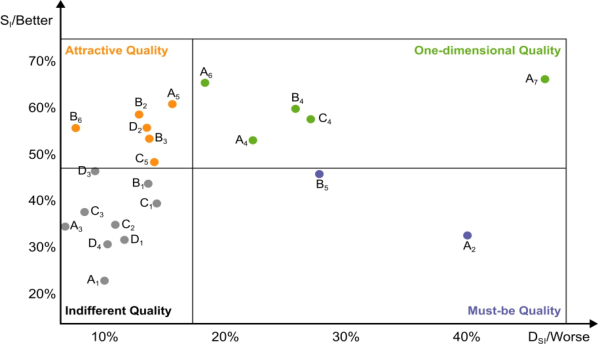
Better Take the average of the absolute values of Better value and Worse of all functions (0.176, 0.469) as the coordinate origin, and plot a scatter plot based on the absolute values of Better coefficient and Worse coefficient of the functions, with the horizontal coordinate as the absolute value of Worse and the vertical coordinate as the value of Better, and plot a quartile plot of the Better-Worse coefficient, which can visually display all the Functional item attribute situation. Among them: the first quadrant is the desired needs, the second quadrant is the charismatic needs, the third quadrant is the undifferentiated needs, and the fourth quadrant is the essential needs (see Figure 2).
Figure 2: Quartile coordinate plot of Better-Worse coefficients.
In summary, we get the core multi-sensory demands that users really pay attention to in the immersive running cabin, and summarize each functional demand according to the type of demand (see Table 3). Usually, the priority of requirement attribute satisfaction is as follows: essential attribute > desired attribute > attractive attribute > non-differentiated result > reverse result. Therefore, on the basis of the priority hierarchy of demand satisfaction, according to the characteristics of each demand hierarchy, the immersive running pod design needs to prioritize the functional experience of A4, A6, A7, B4, C4 on the premise of satisfying the essential demands of A2 and B5, and then finally satisfy the user’s demand for A5, B2, B3, B6, C5 and D2.
Table 3: Immersive running pod multi-sensory demand attribute list.
the rhythm of the music C4. Automatic C5. Wind sensation C2. Handrail vibration adjustment of temperature and humidity
D2. Matches odor to the C3. Touch screen environment
vibration D1. Scenting system D3. Odor to the state of motion D4. Automatically
adjusts odor concentration
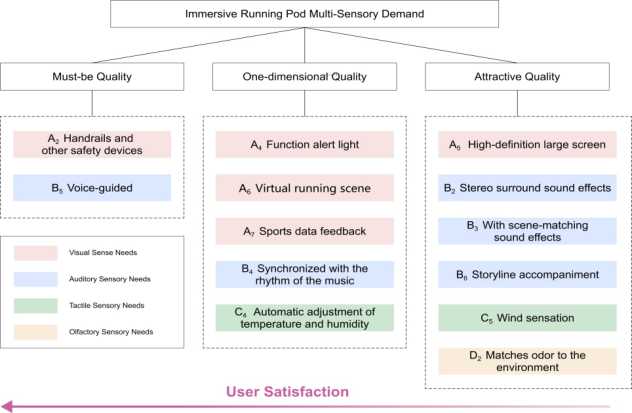
MULTI-SENSORY DESIGN STRATEGY FOR IMMERSIVE RUNNING PODS Based on the results of KANO quality type and weight ranking of multisensory requirements, the immersive running pod design strategy is obtained and output as a design strategy model (see Figure 3).
Figure 3: Modeling multi-sensory design strategies for immersive running pods.
Innovative Design of Immersive Running Pod Based on Multi-Sensory Theory 35
Must-be Multi-Sensory Requirements Design Strategies According to the KANO attribute of multi-sensory needs, users will be extremely dissatisfied when the must-be level of needs are not provided, so this part is the core prerequisite for users to reach the immersive experience. The core of the design strategy is to guarantee the safety performance and guidance function without affecting the smoothness of the immersive experience.
In the design of running pods, safety devices such as handrails should be ergonomically designed to ensure that users can naturally hold or touch the handrails during the running process. Its height and angle also need to be adjusted according to the height, pace and exercise intensity of different users to meet the personalized needs of different users.
Voice guidance belongs to the auditory sensory needs, the function needs to ensure the timeliness and accuracy, to provide real-time, clear guidance for the user in the process of immersive running, to help them better control the rhythm of movement, improve exercise efficiency. At the same time, in order to enhance the immersion experience, it can interact with the elements in the virtual scene.
One-Dimensional Multi-Sensory Requirements Design Strategies As an One-dimensional quality, user satisfaction increases when the demand is provided and decreases when it is not, so the design strategy at this level is a key factor for users to reach immersion.
Functional reminder light is an indispensable design feature of the immersive running pod. The change of the light echoes with the user’s movement state, and through the dynamic light feedback, it can provide users with more intuitive hints to help them better adjust their movement state, for example, when the movement intensity is too high, the hint light can change to red to remind users to pay attention to the safety and avoid over-exercise.
As one of the important visual sensory elements, the virtual running scene can provide various types of exercise environments, and users can choose the appropriate scene according to their personal preferences and exercise goals. Common scenarios are such as forest, beach, city runway, mountain, and so on. Meanwhile, runners can be required to cross virtual obstacles, avoid virtual animals or interact with other avatars in specific scenes.
Motion data feedback can clearly present motion-related information to the user through a visualization interface. Through real-time feedback, users can understand their own running status at any time, so as to make corresponding adjustments and improve the exercise experience.
The music synchronized with the rhythm is an important factor that affects the runner’s mood and exercise rhythm. The realization path is to monitor the user’s pace frequency in real time through the sensor, and match the music in the library with the pace frequency, for example, playing relaxing music when the exercise intensity is low; and switching to more rhythmic music when running at high intensity.
Automatic adjustment of temperature and humidity involves tactile sensory design, which is equipped with high-precision sensors to monitor the
temperature and humidity changes in the cabin in real time and automatically adjust the indoor temperature and humidity according to the user’s exercise intensity and changes in the external environment.
Attractive Multi-Sensory Requirements Design Strategies According given the KANO attribute that user satisfaction is greatly enhanced when attractive requirements are provided, optimization strategies at this level are the highlights of the immersive experience for the user. The design strategy focuses on enhancing immersion and user experience through the synergy of multi-sensory stimulation.
As the carrier of the virtual running scene and sports data feedback, the high-definition large screen can enhance the user’s sense of immersion through clear image presentation and wide field of view.
Stereo surround sound belongs to the auditory sensory elements, and a high-quality surround sound system is used in the immersive running cabin, which allows the user to perceive the sound from all directions through precise sound source localization and enhances the spatial sense of the virtual scene.
Matching sound effects with the environmentThe sound effects are designed to match different virtual running scenes. For example, in the forest scene, you can add birdsong, wind, and the sound of leaves; in the city streets, you can add the sound of people talking, the sound of cars, and so on.
Through the introduction of plot clues, users can follow virtual characters to complete certain tasks or challenges during the exercise process to enhance the sense of participation. For example, after the user completes a certain running distance, the virtual character in the plot will provide the user with new goals or hints, leading the user to the next plot stage.
Wind sensing belongs to tactile sensory design, which can provide dynamic wind feedback for runners. The wind sensing system should dynamically adjust the wind speed according to the user’s exercise speed and intensity. When the user accelerates, the wind speed should increase accordingly to simulate the natural wind sensation during running; when the user decelerates, the wind sensation gradually decreases, so that the user can feel the natural wind force matching the speed during the movement.
The odor that matches the environment is a design element located at the olfactory sensory level. According to different virtual scenes, odors matching the exercise environment are released in the running pod. For example, in the forest scene, the fresh pine fragrance and the earthy smell of grass are added; in the desert scene, the dry sandy smell is added; and in the city street scene, the odor elements such as cafes and traffic can be added.
CONCLUSION
With the fitness industry’s increasing emphasis on user experience, the development of immersive running will show more active vitality in the era of digitalization and intelligence. In this paper, we conduct an in-depth analysis of the user requirements of immersive running pods, and through behavioral research, user journey mapping analysis, and the application of
Innovative Design of Immersive Running Pod Based on Multi-Sensory Theory 37
KANO model, we have successfully transformed the multi-sensory needs of users into 13 core design requirements, and formulated corresponding design strategies based on these requirements. The study reveals the key role of multi-sensory interaction elements in enhancing user immersion, which not only provides a concrete practical path for the product design of immersive running pods, but also provides theoretical support for the application of multi-sensory design in future sports spaces.
ACKNOWLEDGMENT
Project: Key Technology Development and Application of Intelligent Fitness Equipment Based on Industrial Design (2023GZ3).
REFERENCES
Berger, C., Blauth, R. & Boger, D. (1993). Kano’s methods for understanding customer-defined quality. Journal Name. Brown, E. & Cairns, P. (2004). A grounded investigation of game immersion.
In: CHI’04 extended abstracts on Human factors in computing systems, pp. 1297–1300. Chen, Z., Xiang, Y., Xu, A. & Hong, X. (2021). A review on the effects of music intervention on sports performance. Advances in Psychology, 11(8), pp. 1911–1921. Csikszentmihalyi, M. (1975). Beyond boredom and anxiety. Book Reviews, pp. 703–707. Cui, L., Huang, J., Li, Y. (2015). Degradation models with Wiener diffusion processes
under calibrations. IEEE Transactions on Reliability, 65(2), pp. 613–623. Feng, M., Dey, A. & Lindeman, R. W. (2016). The effect of multi-sensory cues on performance and experience during walking in immersive virtual environments. In: 2016 IEEE Virtual Reality (VR), pp. 173–174. IEEE. Ghani, J. A. & Deshpande, S. P. (1994). Task characteristics and the experience
of optimal flow in human—computer interaction. The Journal of Psychology, 128(4), pp. 381–391. Globa, A., Beza, B. B. & Wang, R. (2022). Towards multi-sensory design: Placemaking through immersive environments – Evaluation of the approach. Expert Systems with Applications, 204, p. 117614. Kang, Q. (2021). Research on multi-sensory music therapy product design for
Alzheimer’s disease patients (Master’s thesis). Hunan University, Changsha, China. Kano, N., Seraku, N., Takahashi, F. & et al. (1984). Attractive quality and must-be quality. Journal Name. Lv, P. & Cui, J. (2023). The application of multi-sensory design in virtual
experiences of traditional handicraft intangible cultural heritage. Design, 8(4), pp. 3506–3513. Madzík, P., Budaj, P., Mikuláš, D. & et al. (2019). Application of the Kano model for a better understanding of customer requirements in higher education – A pilot study. Administrative Sciences, 9(1), p. 11. Neira-Rodado, D., Ortíz-Barrios, M., De la Hoz-Escorcia, S. & et al. (2020).
Smart product design process through the implementation of a fuzzy Kano-AHP- DEMATEL-QFD approach. Applied Sciences, 10(5), p. 1792.
Plotnik, M., Azrad, T., Bondi, M. & et al. (2015). Self-selected gait speed-over ground versus self-paced treadmill walking, a solution for a paradox. Journal of Neuroengineering and Rehabilitation, 12, pp. 1–11. Powis, B. & Macbeth, J. L. (2024). Running blind: The sensory practices of visually
impaired runners. Qualitative Research in Sport, Exercise and Health, 16(3), pp. 244–258. Shen, H. & Li, Z. (2024). Design method of museum cultural and creative products based on multi-sensory experience. Advances in Economics and Management Research, 11(1), p. 32. Soualhi, A., Razik, H., Clerc, G. & et al. (2013). Prognosis of bearing failures
using hidden Markov models and the adaptive neuro-fuzzy inference system. IEEE Transactions on Industrial Electronics, 61(6), pp. 2864–2874. Wang, W., Wei, T., Zhang, Y. & et al. (2019). A method of intelligent product design cue construction based on customer touchpoint correlation analysis and positive creativity theory. Advances in Mechanical Engineering, 11(1), pp. 56–90. Yin, S., Cai, X., Wang, Z. & et al. (2022). Impact of gamification elements on user
satisfaction in health and fitness applications: A comprehensive approach based on the Kano model. Computers in Human Behavior, 128, p. 107106. Zhang, Q. (2018). Research on multi-sensory design expression of classical Chinese gardens based on virtual reality: A case study of Ge Garden in Yangzhou (Master’s thesis). Lanzhou Jiaotong University, Lanzhou, China.
LISTED IN THE AHFE DIGITAL BOOKSTORE CATALOGUE
Explore the complete digital volume
Usability and User Experience
Read this individual research paper free through the original publisher, or explore the full digital proceedings book.
ISBN 978-1-964867-70-0
Explore this ISBN in the AHFE Bookstore ↗Listed in the July 2026 bookstore catalogue; search by ISBN to confirm current availability · Digital book purchase optional