Siyue Lin, Yonghong Liu, Qingxia Chen (2024). Exploring Flow Experience Requirements in Intelligent Fitness through the Perspective of Whole-Body Interaction. In: Usability and User Experience. AHFE Open Access, vol. 156, pp. 351–360. https://doi.org/10.54941/ahfe1005446
The rapid development of intelligent fitness products has shifted design focus from solely emphasizing fitness effectiveness to prioritizing a holistic fitness experience. Integrating the concept of flow experience into the design of smart fitness products has proven effective in enhancing user satisfaction from both emotional and overall experiential perspectives. With the advancement of interactive technologies, users now engage in increasingly diverse interaction behaviors during fitness activities, demanding a more comprehensive approach to user research that considers the comprehensive interaction between users and their environment.This research explores the core challenge of exploring flow experience requirements from a whole-body interaction perspective during the user research process. The paper first delves into the elements of flow experience, subsequently conducting an in-depth exploration of methods for collecting and analyzing whole-body interaction data during fitness processes. Building upon this foundation, the paper establishes an insight pathway into flow experience requirements within the framework of whole-body interaction.The study sequentially analyzes the interactive technologies of smart fitness products and the environmental scene factors of fitness spaces to construct a rational user research experimental process and environment. Through user scenario interaction experiments, we collects and analyzes users' physical behaviors and implicit activities, ultimately deriving insightful requirements.In our user research on the home fitness treadmills design, we validated the effectiveness of this insight pathway。 The paper establishes a user research methodology based on the perspective of whole-body interaction and flow experience goals, providing guidance for a novel research approach in this field.
Whole-body interaction (WBI) involves the comprehensive capture and pro- cessing of human signals from physical, physiological, cognitive, and emo- tional sources to generate feedback for interaction in a digital environment (England, 2009). With the evolution of interactive technologies, users’ inter- active behaviors during fitness activities have become increasingly diverse, offering a multidimensional operational experience. Traditional approaches to needs research fall short in addressing the holistic perspective of user- environment interaction. Therefore, adopting a research perspective centered on whole-body interaction experience allows for insight into more user needs, providing a more fitting usage scenario and a more immersive user experience.
In 1975, Csikszentmihalyi introduced the concept of “flow experience,” describing a state where individuals are fully immersed in an activity, expe- riencing a sense of complete absorption, sometimes even losing awareness of time, space, and their surroundings (1975). As a positive emotional experi- ence, the flow contributes significantly to satisfying users’ emotional needs and enhancing the pleasure users derive from using products. Particularly in the field of fitness product design, the flow experience not only significantly improves users’ fitness efficiency but also enhances their willingness to sustain usage. Therefore, a thorough investigation into how to facilitate the occur- rence of the flow experience through whole-body interaction technology in intelligent fitness has become a worthwhile topic for exploration.
Analysis of Elements for Flow Experience in Fitness The swift evolution of intelligent fitness products has transitioned design emphasis from mere fitness effectiveness to prioritizing a positive fitness expe- rience. Integrating the flow experience concept into intelligent fitness product design, inherently featuring clear activity goals, significantly enhances the overall user experience emotionally and holistically. Jackman, PC systemati- cally evaluated the current literature on the flow theory in exercise, suggesting that exergame design features, music, and virtual stimuli can influence certain dimensions of flow (2019). Liao and Shen applied the flow experience per- spective to the transformation and innovative strategies of home smart fitness products, introducing elements such as “freedom in time and space”, “shape conforms to aesthetics”, “continuous supervision and encouragement”, and “contextual attributes” (2022).
Whole-Body Interaction Experience in Intelligent Fitness Equipment WBI has emerged as a novel framework within the realm of human-computer interaction, garnering widespread attention in the field of interaction design. From a design strategy perspective, the general design process of WBI can be roughly divided into three stages: (1)involve incorporating all elements relevant to users into the interaction design; (2) specify the integration of these elements; (3) expand the interaction design of these elements, iterat the design process as more information about users and their usage environment is discovered (England, 2011).
Whole-Body Interaction seamlessly integrates explicit and implicit activity information, flexibly combining knowledge from the external world with that within the user’s mind (Yao, 2018). WBI necessitates a holistic con- sideration of users’ physical, physiological, cognitive, and emotional factors (England et al., 2009). From a data collection and analysis perspective, WBI can describe explicit user interaction through behavioral, physiological, and sensory data. Analyzing hidden internal activities involves emotional and cognitive data. Integrating explicit and implicit activities through contextual analysis can derive explicit and implicit requirements (Tan, Zhang, and Jin, 2023).
Exploring Flow Experience Requirements in Intelligent Fitness 353
CONSTRUCTING THE PATH TO INSIGHTFUL REQUIREMENTS Preparation
Heuristic cards: Both the flow experience and functional aspects.
Based on foundational elements of flow experience and the person– artefact–task (PAT) model (Finneran and Zhang, 2003), and drawing insights from theoretical research on flow in the fitness interaction domain, we iden- tified 21 specific flow experience elements associated with fitness interaction. These elements will be used as heuristic cards during the user experience phase, aiding users in uncovering a multitude of potential requirements that can foster the generation of flow experiences.
Table 1. Flow experience elements associated with fitness interaction.
Table available in the original PDF paper.
Phase of flow No. Flow experience elements Flow antece-dents P 1-1-1 Freedom in time and space (Liao and Shen, 2022) P–A 1-2-1 Clear artefact goals (Finneran and Zhang, 2003; Dai and Liu, 2015) 1-2-2 A sense of potential control (Chen, 2000) 1-2-3 Aesthetic experience (Liao and Shen, 2022) 1-2-4 Software or hardware problems (Dai and Liu, 2015) 1-2-5 Information quality (Dai and Liu, 2015) P-T 1-3-1 Autotelic (Csikszentmihalyi, 1975) 1-3-2 Continuous monitoring and encouragement (Liao and Shen, 2022) 1-3-3 Clear goals (Csikszentmihalyi, 1975) 1-3-4 Balance of challenges and skills (Csikszentmihalyi, 1975) 1-3-5 Immediate feedback (Csikszentmihalyi, 1975) T–A 1-4-1 Artefact -Task fit (Finneran and Zhang, 2003) Flow experience 2-1-1 Merger of action and awareness (Csikszentmihalyi, 1975) 2-1-2 Concentration on the task at hand (Csikszentmihalyi, 1975) 2-1-3 Sense of control (Dai and Liu, 2015; Chen, 2000) 2-1-4 Telepresence (Dai and Liu, 2015; Chen, 2000) 2-1-5 A loss of self-consciousness (Csikszentmihalyi, 1975) 2-1-6 The sense of time distortion (Csikszentmihalyi, 1975) Flow consequences 3-1-1 Enjoyment (Chen, 2000) 3-1-2 Perceived usefulness (Dai and Liu, 2015; Chen, 2000)
Additionally, we examined mainstream treadmill features and interaction methods, conducted a literature review on the latest technological advance- ments, interviewed relevant technical experts, and clarified the primary implementation paths and application methods of interactive technologies. While current interaction methods for home fitness equipment predomi- nantly involve physical buttons, screens, and voice interaction, trends indicate a growing interest in somatosensory interaction, fitness wearables and vir- tual reality technologies (Windasari and Lin, 2021; Liu and Guo, 2022). The acquisition of real-time body data during fitness activities is also a signif- icant trend, with technologies such as real-time heart rate monitoring and gait parameter detection gaining attention (Addolorato et al., 2019; Bhar- gava and Nabi, 2020; Su et al., 2022). We compiled these functional elements into heuristic cards, expanding users’ imagination in the process of require- ment exploration and facilitating the initial correlation of requirements with interaction design.
Mood board: In our pursuit of a comprehensive understanding of sensory aspects in the fitness domain, we meticulously curated a collection of key
literature on sensory engineering. This effort led to the identification and cat- egorization of 182 sensory descriptors, which were further distilled into seven distinct dimensions: cold-warm, static-dynamic, simple-complex, slack-taut, attacking-defending, clear-obscure, and hard-soft. To ensure the accuracy and relevance of these descriptors, we engaged five experienced designers in a voting process. Each designer evaluated and selected the most representative image for each descriptor, aligning with their cognitive perceptions. The out- come of this process yielded a curated set of images, organized into a mood board, serving as a valuable tool to assist users in expressing nuanced sensory requirements that may be challenging to articulate through language alone.
Physical Scene Construction: Combining research on existing smart tread- mills on the market, on-site interview and home fitness environment analy- sis, we derived typical human-machine interaction environment models for fitness. Through in-home interviews with users, we analyzed the physical ele- ments of home treadmill usage scenarios, constructing typical home treadmill physical scene models. In addition, we prepared some interactive elements that can be used for co-creative design expressions, providing a tangible understanding of user requirements.
Experiment Process We recruited six participants who are physically fit and have a certain level of experience using treadmills, each engaging in physical activities for a min- imum of three hours per week. The participant pool is balanced, comprising three males and three females, with ages ranging from 24 to 34 years old.
Table 2. Process of experiment.
Table available in the original PDF paper.
Process Objective Steps Process Construction The purpose of this process is to utilize tools to guide and stimulate users’ imaginative space, creating a preliminary framework for experiencing the home treadmill scenario. This lays the foundation for subsequent insight into user requirements.
Provide basic task card for users to choose the starting step in sequential order. Users simulate corresponding step operations in the scenario and supplement the puzzle. Repeat the process until users complete the entire pro- cess. Restore the puzzle to the canvas and engage in initial discussions. Requirement Elicitation
The purpose of this process is to guide users in expressing direct pain points and opportunities using heuristic cards, uncovering potential pain points and opportunities in the process.
Users read the shuffled flow element cards and associate freely. Users read the functional and interaction element cards, selecting cards of interest and those can meet the require- ments for a flow experience. Conduct interviews to refine pain points and correspond to behavioral puzzles. Co-Creation and Sensory Expression
Explore emotional and sensory needs, through co-creation to discover specific implementation methods for user demand elements.
Express users’ sensory needs using the emotional board in the primary scenario. Users place interaction component cards at touchpoints based on their requirements in the main scenario. Document the outcomes of the co-creation. Clustering and Interviews
Users categorize the identified requirement cards. Conduct in-depth interviews based on the selected cards.
Filter and prioritize requirements for in-depth interviews, uncovering the underlying motivations behind user behaviors.
Exploring Flow Experience Requirements in Intelligent Fitness 355
Figure 1: Experiment record.
Figure available in the original PDF paper.
Exploring User Experience Journey and Physical Interactions on Treadmills
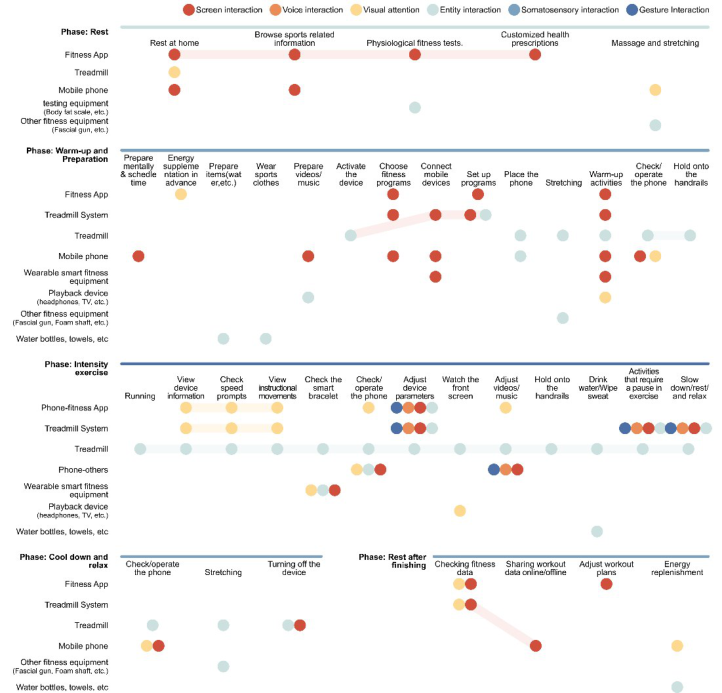
Figure 2: Mapping user behavior from a whole-body interaction perspective.
In the realm of user experience analysis, constructing a user journey serves as a method to describe macro-level behaviors. This journey delineates differ- ent interaction stages based on a segment of the complete lifecycle. This paper employs the user experience journey associated with the usage of a tread- mill as a reference, meticulously observing and documenting the physical behaviors and corresponding interaction elements during the treadmill usage process.User interactions with the treadmill system encompass macro-level behaviors occurring throughout a usage cycle, such as running and adjusting
device parameters. It also involves micro-level behaviors, including interac- tions with specific touchpoints, like voice input, gesture control, and visual attention.
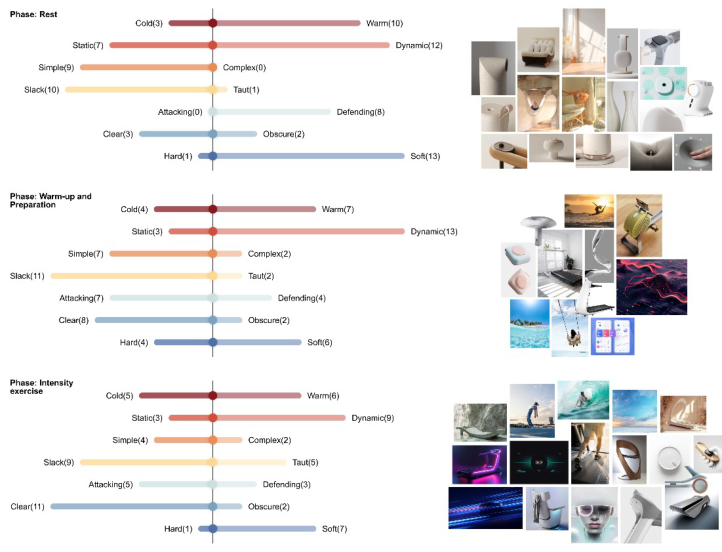
Analysis of Implicit User Activities: Unveiling Sensory Preferences In this analysis, users’ preferences are explored based on the images selected in different phases, corresponding to their represented vocabulary and emo- tional dimensions. The results are depicted in frequency charts for each phase. The high-frequency image selections are then compiled to form a mood board, aiding designers in intuitively grasping users’ sensory requirements.
In the rest phase, the most frequently chosen words include natural (6), warm (4), soft (3), gentle (3), curved (3), ordinary (3). Dominant preference dimensions are simple (simple-complex), defending (attacking-defending), and soft (hard-soft). These features reflect users’ overall preference for a sim- ple, conservative, and gentle home environment, emphasizing these qualities in their expectations for the treadmill usage experience during rest.
In the warm-up and preparation phase, high-frequency words include vig- orous (4), leisurely (3), rhythmic (3). Prominent preference dimensions are dynamic (static- dynamic), slack (slack-taut), and clear (clear-obscure). These features signify users’ inclination towards a dynamic, relaxed, and spacious, as well as bright treadmill usage experience during warm-up.
Figure 3: Main stage perceptual dimension analysis and mood board.
Exploring Flow Experience Requirements in Intelligent Fitness 357
In the Intensity exercise phase, top choices include curved (5), sunny (4), technological (4), rhythmic (3), dynamic (3), open (3), natural (3). Predomi- nant preference dimensions are soft (hard-soft), dynamic (static- dynamic), and clear (clear-obscure). These features indicate users’ preference for a dynamic, gentle, and natural, as well as bright and powerful treadmill usage experience during continuous exercise. Compared to the first two phases, users exhibit a more neutral preference in the looseness-tightness and cold- warm dimensions during continuous exercise. This can be explained by users’ willing-ness to be in a relatively tense and effortful state during continuous exercise, influencing their sensory expression. Additionally, users’ preference for technological aspects (cold) during exercise impacts their preference in the cold-warm dimension.
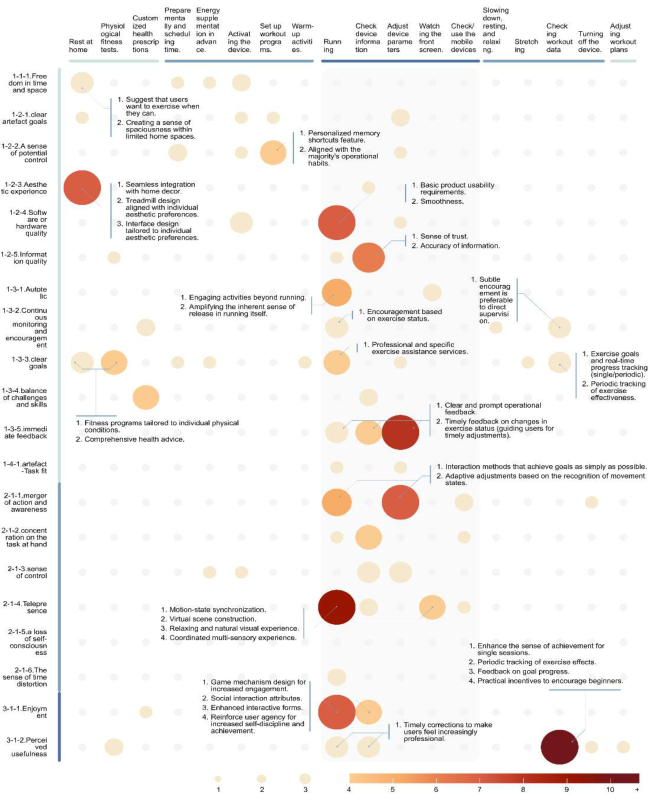
Combining user interview transcripts with the analysis of each demand category, we identified pain points and design opportunities. The refinement and quantitative analysis of prioritized demand cards yielded the following conclusions.
Rest Personal Temporal Freedom: Users desire optimization of time notification mechanisms, enhancing their perception of spatial experience and providing a sense of increased temporal freedom through design.
Overall Aesthetic Experience: Users prioritize the aesthetic appeal of the treadmill’s overall design in the home environment, focusing on its aesthetic integration with home decor during rest and emphasizing interface style during running.
Clear Objectives: Users seek professional, personalized fitness plans, com- prehensive health advice, periodic physiological tests, and assistance in establishing clear fitness goals, enhancing their sense of purpose.
Preparation and Warm-Up Implicit Control: Personalized memory shortcuts during device activation or program setting enhance users’ sense of implicit control, contributing to a positive flow experience.
Service Quality: Emphasis on the overall smoothness of the system is cru- cial for users, highlighting that system fluidity has high priority throughout the design and development process.
Intensity Exercise-Running Innate Motivation and Enjoyment: Users find pure running monotonous, necessitating additional engaging activities alongside running, such as gami- fication, social elements, or richer interaction forms.
Creation of Immersive Ambiance: Designing interactive elements that synchronize with the running state, like breathing rhythm lights or music matching the running pace, fosters an immersive connection with the present environment.
Intensity Exercise-View Device Information Information Quality: Ensuring the accuracy of information and building trust in it is essential. Strategies such as increased information update frequency
and prompt feedback on real-time heart rate or running posture contribute to the user’s immersive experience.
Timely Interaction Feedback: Swift feedback on changes in exercise status, real-time heart rate, or posture during device parameter adjustments is crucial for maintaining user engagement.
Intensity Exercise-Adjusting Device Parameters Action and Consciousness Integration: Designing intuitive interactions that align with the user’s flow state avoids complexity, ensuring the user’s attention is consolidated on minimal points during this intense interaction.
Adaptive Adjustments: Systems that can adaptively adjust based on the user’s movement state minimize necessary operations, focusing the user’s attention on a few crucial points, merging thought and action seamlessly.
Figure 4: Flow experience as a target demand clustering map.
Exploring Flow Experience Requirements in Intelligent Fitness 359
Cool Down and Relax & Rest After Finishing Perceived Usefulness: During this phase, enhancing the sense of achievement through data visualization or motivating mechanisms positively reinforces each exercise completion, contributing to sustained user interest.
Notably, there were no user reports on experiences or needs related to self-awareness loss. Considering user interviews, this suggests a natural lack of consideration for others’ opinions during the exercise process in the home setting, indicating a relative absence of resonance and associated requirements.
CONCLUSION
In conclusion, this study focuses on treadmill usage, employing user scenario interaction experiments to collect and analyze users’ physical behaviors and implicit activities, revealing valuable insights into user behaviors and prefer- ences across different scenarios. Distinct patterns of user preferences emerge during various fitness stages, with a preference for simplicity, conservatism, and gentleness during rest, dynamism, relaxation, and spaciousness during warm-up, and a desire for dynamic, gentle, and natural experiences during continuous exercise. The integration of user interview records and demand category analysis unveils pain points and design opportunities, resulting in refined and quantitatively analyzed demand cards. The study emphasizes the importance of factors such as temporal freedom, aesthetic appeal, clear objectives, implicit control, service quality, intrinsic motivation, immersive ambiance, information quality, timely feedback, action and consciousness integration, adaptive adjustments, and perceived usefulness across different stages of the exercise journey. The strength of this research lies in its compre- hensive approach, rigorously examining users’ physical behaviors, emotional dimensions, and preferences from a holistic perspective. This methodologi- cal rigor ensures a comprehensive understanding of user flow experiences in fitness scenarios, providing actionable insights for the design and evaluation of intelligent fitness products.
FUNDING This work was supported by Quanzhou Municipal Science and Technology Major Project “Key Technology Development and Application of Intelligent Fitness Equipment Based on Industrial Design” (2023GZ3).
REFERENCES
Addolorato, S. et al. (2019) ‘Bibliometric Analysis of Fitness Equipment: How Scientific Focuses Affect Life-Cycle Approaches and Sustainable Ways of Development’, Sustainability, 11(20), p. 5728. Available at: https://doi.org/10/ggkc8c. Bhargava, Y. and Nabi, J. (2020) ‘The opportunities, challenges and obligations
of Fitness Data Analytics’, Procedia Computer Science, 167, pp. 1354–1362. Available at: https://doi.org/10/gtgjch.
Chen, H., Wigand, R. T. and Nilan, M. (2000) ‘Exploring Web users’ optimal flow experiences’, Information Technology & People, 13(4), pp. 263–281. Available at: https://doi.org/10/fmwmnt. Dai, B. and Liu, Z. (2022) ‘Review on Flow Experience on the Internet: Concept,
Antecedents and Consequences’, China Journal of Information Systems. 2015(01), pp. 84–98. Csikszentmihalyi, M. (2000) Beyond boredom and anxiety. 25th anniversary ed. San Francisco: Jossey-Bass Publishers. England, D. et al. (2009) ‘Towards an Advanced Framework for Whole Body Interac-
tion’, in R. Shumaker (ed.) Virtual and Mixed Reality. Berlin, Heidelberg: Springer Berlin Heidelberg (Lecture Notes in Computer Science), pp. 32–40. Available at: https://doi.org/10.1007/978-3-642-02771-0_4. England, D. (ed.) (2011) Whole Body Interaction. London: Springer London (Human-Computer Interaction Series). Available at: https://doi.org/10.1007/978- 0-85729-433-3. Finneran, C. M. and Zhang, P. (2003) ‘A person–artefact–task (PAT) model of
flow antecedents in computer-mediated environments’, International Journal of Human-Computer Studies, 59(4), pp. 475–496. Available at: https://doi.org/10/ c58tvk. Jackman, P. C. et al. (2019) ‘Flow states in exercise: A systematic review’, Psychology of Sport and Exercise, 45, p. 101546. Available at: https://doi.org/10/ggsfnt. Liao S. and Shen J. (2022) ‘Analysis of the Elements of Flow Experience in Smart
Fitness at Home Based on Flow Theory’, Packaging Engineering. 2022(14), pp. 139–145. Liu, Y. and Guo, Y. (2022) ‘Case Study of Intelligent Fitness Product Interaction Design Based on Service System’, in M. Kurosu (ed.) Human-Computer Inter- action. User Experience and Behavior. Cham: Springer International Publishing (Lecture Notes in Computer Science), pp. 389–399. Available at: https://doi.org/ 10.1007/978-3-031-05412-9_27. Novak, T. P., Hoffman, D. L. and Yung, Y.-F. (2000) ‘Measuring the Customer Expe-
rience in Online Environments: A Structural Modeling Approach’, Marketing Science, 19(1), pp. 22–42. Available at: https://doi.org/10/b8n. Schaper, M.-M. et al. (2019) ‘FUBImethod: Strategies to engage children in the co-design of Full-Body interactive experiences’, International Journal of Human- Computer Studies, 132, pp. 52–69. Available at: https://doi.org/10/gtgh7n. Su B. et al. (2022) ‘Scientific athletics training: flexible sensors and wearable devices
forkineses monitoring applications’, Scientia Sinica Informationis, 52(1), p. 54. Available at: https://doi.org/10/gqtswz. Tan, Z., Zhang, R. and Jin, Y. (2023) ‘The Requirements Insight of Experience in Intelligent Cockpit from a Whole Body Interaction Perspective’, Zhuangshi. 2022(14), pp. 18–24. Windasari, N. A. and Lin, F. (2021) ‘Why Do People Continue Using Fitness
Wearables? The Effect of Interactivity and Gamification’, SAGE Open, 11(4), p. 215824402110566. Available at: https://doi.org/10/gtgh8x. Yao Z. et al. (2018) ‘Comparison of Embodied Interaction and Whole Body Interaction’, Journal of Computer-Aided Design & Computer Graphics, 30(12), p. 2366. Available at: https://doi.org/10/gtgh23.
LISTED IN THE AHFE DIGITAL BOOKSTORE CATALOGUE
Explore the complete digital volume
Usability and User Experience
Read this individual research paper free through the original publisher, or explore the full digital proceedings book.
ISBN 978-1-964867-32-8
Explore this ISBN in the AHFE Bookstore ↗Listed in the July 2026 bookstore catalogue; search by ISBN to confirm current availability · Digital book purchase optional