Wei Ding, Yuting Liao (2023). Applying the Kano Model to Optimize the Furniture in Rental Scenarios - An application to China case study. In: Usability and User Experience. AHFE Open Access, vol. 110, pp. 376–385. https://doi.org/10.54941/ahfe1003211
With the price of commercial housing rising year by year and the increasing floating population, more and more people choose to rent housing to solve their housing problems in the transitional stage. In order to reduce rental costs, many furniture in rental houses has problems such as poor quality of supporting facilities, incomplete functions, and difficulty in carrying, often ignoring the functional and emotional needs of tenants for the use of furniture, so it is necessary to find new furniture forms to meet the material and spiritual needs of contemporary renters.In this paper, the strategic analysis tool stemming from the PEST(political, economic, social, and technological) has been adopted to explore the necessity of studying furniture for rental scenes. Among the relevant research and practical cases, the research on rental furniture mainly focuses on space-saving, multi-functional, and modular design, and puts a lot of practice into the structural design of furniture, and conducts in-depth research on the difficulty of furniture disassembly and assembly, the portability of furniture, etc. However, relevant studies have ignored the functional and emotional needs of tenants in the process of using furniture, so some products do not fit well with the actual rental group.In response to this problem, we carried out user research using user interviews and Kano models. The research process is divided into three parts: experimental design, experimental development, and experimental results. We want to obtain basic user information through user interviews, and then use the Kano model to analyze and classify user needs and prioritize demand. Combined with the two-factor theory, we analyze the relative satisfaction (SI) and relative dissatisfaction (DSI) of each demand for users, so as to finally evaluate the functional demand of users for rental furniture design, and show the data results of this study in the experimental results.Based on the above research, this paper summarizes the requirements of furniture in the rental scenario and proposes the optimization strategy for this type of furniture design from four dimensions: user targeting, furniture appearance, furniture structure, furniture function, and furniture experience.
With the development of urbanization, people’s living needs and living concepts have undergone profound changes, the survey shows that China’s housing rental rate is increasing year by year, and more and more young peo- ple will choose to rent to solve the housing problem in the transitional stage of
Applying the Kano Model to Optimize the Furniture in Rental Scenarios 377
life. To pursue a higher quality of life, many people will choose to buy furni- ture to improve comfort and convenience in the process of renting. Therefore, furniture design for housing rental scenarios brings market opportunities and production power to enterprises, and can effectively meet the living needs of people and improve the housing experience.
RELEVANT STUDIES Furniture User Experience
Person-centered design conception and ergonomics have been widely used in the field of design. Many researchers used ergonomics to evaluate and improve furniture products (Jeong, Park, 1990). Others conducted research on human scale (Panagiotopoulou, Christoulas, Papanckolaou et al., 2004) Suitable furniture size is conducive to improving learning and work efficiency (Žunji´c A, Papi´c G, Bojovi´c B, et al., 2015).
In recent years, user research on furniture products has combined pre- vious research points and added aspects such as the industry development impact of furniture products. The physiological and psychological dynamic development of the crowd. H’ominous Furniture is a furniture design fea- sibility research project. The researchers in this project conducted question interviews with potential target markets and based on the interview result qualitatively summarized the key points that the respondents paid attention to when purchasing furniture, including the material preference for solid wood, attention to furniture quality, durability, and price. (Lachica, Con- deno, Cruz, et al., 2019). Some researchers pointed out in the process of the innovative design of furniture for school scenes that in addition to user- centered design principles, researching on furniture and learning experience, user perception, and environmental interaction is also conducive to finding opportunities for furniture design (Imms, Morris, Grunseit, 2020).
Earlier researches show that ergonomics has a guiding role in furniture design, and we must pay full attention to the research on ergonomics to ensure that the furniture is in line with the needs of physical scale and function. However, these studies generally adopted the method which com- bined questionnaire survey and interview, and most of the data processing work is analyzed from a qualitative perspective, which makes the results less scientific.
PEST Analysis PEST is an acronym for four sources of change: political, economic, social, and technological. In the previous study, PEST analysis is widely used to understand strategic risk (Sammut-Bonnici, 2014). Later research shows that it can be used to propose strategies for the development of an industry, which is helpful for researchers to identify the changes and the effects of the macro environment on industrial development.
378 Ding and Liao
Kano Model The Kano model is an analytical model used to reflect the relationship between service quality and satisfaction. Its division of demand attributes is mainly divided into five items. Attractive requirements (A) have the greatest influence on improving satisfaction, if they are not fulfilled, however, it will not lead to satisfaction reduction. One-dimensional requirements (O) corre- spond to the desired user demand. The more these requirements are valued the higher user satisfaction. Must-be requirements (M) represent the neces- sary function, if they are not fulfilled, satisfaction with this product will drop significantly. Indifferent requirements (I) mean that it does not matter whe- ther the function is there or not, which is a function that the user does not care about. Reverse requirements (R) represent that the existence of the function will reduce user satisfaction (Kano, 1984). Based on the Kano model, Charles Berger proposed the Better-Worse coefficient calculation method for auxili- ary identification, also called satisfaction sensitivity calculation, which can help identify the importance of a function to affect user satisfaction on the basis of dividing demand categories (Berger, 1993). The calculation formula is as follows.
Equation reproduced from the original PDF.
PEST ANALYSIS TO EXPLORE THE TARGET USER Political
In recent years, China’s Ministry of Housing and Urban-Rural Development and other departments announced housing policies such as “the people who rent or buy houses can have equal rights.” constantly changing the Chinese concept of house purchase. On the one hand, governments in various parts of China will strengthen the management of the leasing market and conti- nuously regulate the order of the leasing market to protect the interests of the renters. On the other hand, various provinces of China have successively issued affordable rental housing development plans. Many provinces have actively developed affordable rental housing, gathering a large number of new housing for China’s housing rental market (Anjuke Institute, 2022). Stri- cter market supervision measures and government-led construction of new affordable housing can generate more rental demand and increase rental hou- sing. Both of these will open a new supply and demand gap for the furniture market and bring greater design opportunities for furniture development in the rental scenario.
Economic On the one hand, affected by China’s housing prices, most people in the tran- sition stage can hardly afford the high purchase expenses, while they have to choose to rent a house in other places, so the demand for rental hou- sing has always existed. Relevant data show that China’s rental market has developed steadily, rents are generally stable, and fluctuations have not exce- eded the normal range. On the other hand, China’s economy will gradually
Applying the Kano Model to Optimize the Furniture in Rental Scenarios 379
resume orderly development after the COVID-19 pandemic, and the impact on economic operations will be reduced. Therefore, the macroeconomic situ- ation and the real estate market will make the rental market develop better than the purchase market in the future.
Social Types of research show that the government in major cities will provide talent apartments in graduation season to attract highly educated young people to work locally. As a result, the main demand groups are the floating population and college graduates. Changes in the social environment and changes in the main population of housing rental mean that the demand for rental housing will be different, so carrying out user research on youth housing rental groups can help solve the problem of changes in the life needs of young people in the rental scenario.
Technological Since the rise of composite materials, furniture design had more development opportunities in material selection, structural innovation, and cost control. Many means of modern technology such as machine technology, CNC tech- nology, and information processing transmission technology have been used to disrupt traditional furniture production. China’s self-owned brands have skilled technology in furniture production and whole-house customization. They provide a more intelligent and comfortable furniture experience for users, which means the furniture design driven by technology development needs more scientific solutions.
RESEARCH DESIGNS BASED ON THE KANO MODEL Combined with the previous research background investigation, the relevant studies in furniture user experience, and the characteristics of research meth- ods, the target user is identified as young people with rental experience. This study is intended to be carried out in three phases. Firstly, according to user interviews, and questionnaire, the current requirements of users for furniture in the rental scenario is collected, and a preliminary description and classi- fication are carried out. Secondly, the Kano model questionnaire is designed according to the above demand points, and then the recovered data is analy- zed, and the priority of user requirements is obtained through demand model classification and satisfaction sensitivity analysis. Finally, according to the experimental results, the author will propose a furniture design improvement strategy for rental users according to the high demand of important levels.
EXPERIMENTAL DEVELOPMENT AND THE RESULTS User Interview
10 young people aged 18–35 participated in the user interviews, and all of them have normal language communication skills and have rental experience in China.
380 Ding and Liao
The interviews were structured and include personal information, rental situation, and interaction with furniture during the renting. Personal informa- tion of the user includes the user’s age, education, occupation, and monthly income. The questions about the rental situation include the current renting situation, room area, the type of furniture, and other specific conditions. In terms of the interaction with furniture, the interviewee describes one-day life in a rental house in chronological order. Through the description, the fur- niture that the user participates in daily activities and the problems when interacting with the furniture can be refined. After summarizing and sorting out the information and original needs of the above ten respondents, the kinds of furniture design elements are initially classified and each user requirement has been coded, as shown in Table 1.
User Experience Research in Kano Model Kano questionnaire design and distribution. Based on the information colle- cted in the user interviews, the Kano questionnaire has been designed with specific needs as a reference, and each user requirement is a function point. Each point has a functional question and a dysfunctional question. Questi- onnaire options are set to five items: Dislike, Live with, Indifferent, Must Be, and Like. Then we carried out the second round of user research. young people with rental experience are selected as the study object. For enlarging the sample size, this research was conducted online.
100 questionnaires were distributed and 79 were valid After processing the data in the valid questionnaire according to the Kano evaluation (Table 2), the customer survey responses are divided according to the five attributes of the Kano model. Then we obtain the result by taking the maximum value of the individual demand attribute (Table 3).
Satisfactory Sensitivity Calculation Demand classification is not enough to accurately illustrate the improvement order of these requirements, so the result of the customer survey also needs to be calculated by satisfaction sensitivity. The value of satisfaction (Better/SI) and the value of dissatisfaction (Worse/DSI) are calculated respectively. The obtained data is ranked in absolute value to finally evaluate the user’s functi- onal question for rental furniture design. The results are summarized with the function classification results which are shown in Table 3. The dissatisfaction has been taken as an absolute value.
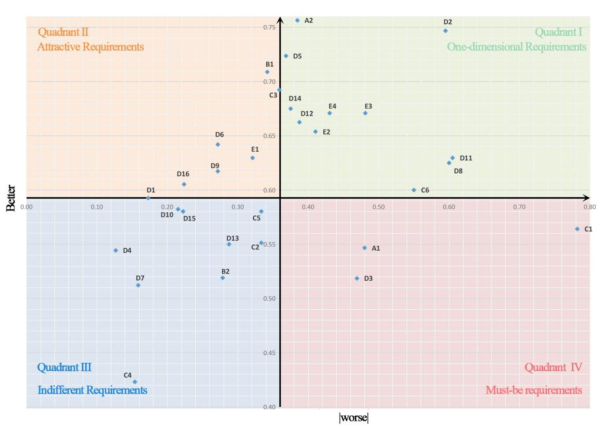
A scatter plot is drawn. Satisfaction is the horizontal axis, and the absolute value of dissatisfaction is the vertical axis. A new coordinate axis is establi- shed by the average of the two values. The satisfaction portfolio shows the importance of young people’s requirements for rental furniture (Figure 1).
DISCUSSION
According to the quadrant characteristics of the satisfaction portfolio, the requirement points of the first quadrant are one-dimensional requirements, the second quadrant is the attractive requirement, the third quadrant is the
Applying the Kano Model to Optimize the Furniture in Rental Scenarios 381
Table 1. Preliminary classification and the code of user requirements.
Table available in the original PDF paper.
Elements Code User Requirements Appearance A1 The appearance of furniture can match the interior style. A2 The appearance of furniture can make you feel warm. Material B1 The furniture material has a good texture. B2 The materials of the furniture are environmentally friendly and recyclable. Structure C1 The structure of the furniture is stable and makes you feel safe. C2 There is a clear division of labor between furniture and furniture. C3 The combination relationship between furniture can be adju- sted according to your needs. C4 It can be folded. C5 It can be easily disassembled and assembled. C6 Less furniture disassembly and assembly loss Function D1 It enables pets and owners to have fun together. D2 The furniture for lying is comfortable. D3 There is a space in front of the bed that can be used to store items. D4 The bedroom is furnished so you can sit on the floor. D5 It can help the owner and pet rest independently. D6 The use area can be adjusted to adapt to the needs of users. D7 Audio-visual entertainment equipment can be placed around the dining table. D8 The tables and chairs are comfortable for work and study. D9 The height of the table and chairs can be adjusted. D10 Furniture gives you a dedicated space for greenery. D11 You have enough space for storage. D12 Well-planned storage supports you sort your items according to their type. D13 Well-planned storage supports you sort your items according to how often they are used. D14 It can help you distinguish worn or unworn clothing. D15 The furniture for storage can have lighting functions. D16 The furniture for storage can have disinfection functions. Experience E1 You can clean it easily and quickly. E2 The furniture is easy to maintain. E3 The furniture is small in size, and it is easy to handle. E4 The furniture is light, and it is easy to move.
indifference requirement, and the fourth quadrant is the must-be require- ments. The demand points in the fourth quadrant are greater than the first quadrant and greater than the second quadrant. According to the sensitivity calculation results of this study, the furniture design for Chinese renters must meet the functional points A1, C1, and D3, that is, the shape of the furniture does not match the style of the interior space, the furniture structure remains safe and stable, and the space for placing items is set at the bedside.
The function points A2, C6, D2, D5, D8, D11, D12, D14, E2, E3, and E4 have the characteristics of one-dimensional requirements, mainly reflecting
382 Ding and Liao
Table 2. Kano evaluation (Sauerwein, 1996).
Table available in the original PDF paper.
Customer Survey Responses Dysfunctional Question Answer Like
the user’s requirements for furniture comfort, such as making people feel warm, helping the owner and pet rest independently and so on. At the same time, it also reflects the user’s demand for storage space. Physically, it is neces- sary to provide sufficient storage space and help users classify items, such as sorting items according to the frequency of use and distinguishing worn or unworn clothing. The results also show the user’s experience requirements for furniture, such as the furniture can be easily maintained, the furniture is stored in a small volume, and the weight is light so that it can be handled. The above requirements need to be met as much as possible, and if they are not met, user satisfaction will be greatly reduced.
The function points B1, C3, E1, D6, D9, D16 are satisfied. The above requirements have the attribute of attractive requirements. Therefore, desi- gners should appropriately take the above functions into design considera- tion, which can become the functional highlights of furniture products. The
Applying the Kano Model to Optimize the Furniture in Rental Scenarios 383
Table 3. Functional attribute classification and satisfaction sensitivity calculation results.
Table available in the original PDF paper.
Code A O M I R Category Better |Worse| A1 0.22 0.28 0.16 0.26 0.07 O 0.55 0.48 A2 0.38 0.34 0.02 0.21 0.02 A 0.76 0.38 B1 0.43 0.26 0.07 0.21 0.04 A 0.71 0.34 B2 0.37 0.13 0.13 0.33 0.01 A 0.52 0.28 C1 0.09 0.45 0.29 0.12 0.01 O 0.56 0.78 C2 0.34 0.18 0.13 0.29 0.02 A 0.55 0.33 C3 0.38 0.28 0.06 0.23 0.02 A 0.69 0.36 C4 0.29 0.11 0.04 0.39 0.04 I 0.42 0.15 C5 0.34 0.23 0.10 0.17 0.01 A 0.58 0.33 C6 0.20 0.39 0.15 0.30 0.01 O 0.60 0.55 D1 0.43 0.16 0.01 0.40 0.01 A 0.59 0.17 D2 0.22 0.50 0.07 0.18 0.02 O 0.75 0.59 D3 0.22 0.29 0.17 0.32 0.01 I 0.52 0.47 D4 0.44 0.09 0.04 0.46 0.02 A 0.54 0.13 D5 0.40 0.27 0.07 0.18 0.04 A 0.72 0.37 D6 0.40 0.23 0.04 0.29 0.00 A 0.64 0.27 D7 0.38 0.13 0.02 0.33 0.00 I 0.51 0.16 D8 0.21 0.40 0.18 0.20 0.02 O 0.63 0.60 D9 0.43 0.18 0.09 0.28 0.01 A 0.62 0.27 D10 0.44 0.13 0.09 0.32 0.00 A 0.58 0.22 D11 0.20 0.43 0.17 0.21 0.01 O 0.63 0.60 D12 0.32 0.33 0.05 0.35 0.01 O 0.66 0.39 D13 0.38 0.16 0.12 0.32 0.02 A 0.55 0.29 D14 0.40 0.26 0.11 0.30 0.02 A 0.68 0.38 D15 0.40 0.16 0.05 0.28 0.01 A 0.58 0.22 D16 0.40 0.16 0.05 0.51 0.07 A 0.61 0.22 E1 0.37 0.26 0.06 0.32 0.00 A 0.63 0.32 E2 0.28 0.34 0.05 0.24 0.05 O 0.65 0.41 E3 0.28 0.37 0.10 0.22 0.04 O 0.67 0.48 E4 0.33 0.32 0.10 0.22 0.04 A 0.67 0.43
result mainly reflects the user’s requirements for furniture autonomy, such as “the use area and the combination relationship between furniture can be adjusted adapting to the needs of users”, “the height of tables and chairs can be adjusted” and so on. In terms of furniture cleaning, disinfection function, and simple furniture cleaning method can be used as extras for furniture design.
Function point D1 is judged as an attractive requirement with a small gap in the classification of requirements, which falls on the coordinate axis in the satisfaction sensitivity calculation. We believe that further research is nee- ded, so we will not classify it as a functional attribute in this study. As for the function points B2, C4, C5, C2, D10, D13, D15, D4, and D7, the characteri- stics of indifferent attributes are presented in the research results, which can appropriately reduce the input of energy and cost.
384 Ding and Liao
FURNITURE DESIGN IMPROVEMENT STRATEGIES Combining background research, user interviews, and the results of the Kano model on user requirements, five strategies can be proposed for furniture design which is designed for young renters in China.
User Targeting Strategy: Focus on Youth Characteristics The furniture design is in line with the basic characteristics of the youth group. According to this study, the main population of housing rental in China is young people, so the furniture design in the rental scenario should start from the physiological and psychological characteristics and consum- ption habits of the youth, and continuously improve the cost performance of furniture while meeting the basic human engineering.
Appearance Strategy: The Appearance of Furniture Should Avoid Visual Conflicts With the Interior Design In this study, the people interviewed said they would like to buy furniture which is in harmony and unity avoiding conflict and confrontation in the interior design. Based on controlling costs, improving the gloss, touch, or furniture materials can become one of the highlights of furniture design. At the same time, the furniture design should be combined with the interior design so that the two can achieve visual harmony. Besides, the style of furni- ture should be simple and fashionable, and the color can be considered warm gray tones, which can meet most decoration styles.
Structural Strategy: The Furniture Structure Should Be Safe and Easy The stability of furniture structure is a must-be requirement in furniture design, and designers must ensure the structural stability of the furniture. In order to meet the moving demands, it is necessary to select the connection components that can be easily disassembled and assembled, and focus on reducing the loss caused by the disassembly and assembly of furniture in the design process.
Functional Strategy: Satisfying Ergonomics Is the First Priority In the relevant studies, the application of ergonomics in furniture design is always the first priority. We found that the furniture for sitting or lying needs to continuously improve comfort. Secondly, how to increase storage space is worth studying. The furniture for storage should conform to the usage habit as much as possible, which can help users classify scientifically classify daily necessities.
Experience Strategy: Furniture Is Easy to Store, Move and Maintain Renters sometimes have to move, which is a special need in the housing ren- tal situation. Therefore, the furniture for the rental scene should have the function of convenient storage, and designers should try their best to control the weight of the furniture and volume of the furniture to make the furniture
Applying the Kano Model to Optimize the Furniture in Rental Scenarios 385
move conveniently. Besides, the surface of the furniture should adopt wear dirt-resistant materials, which is convenient for users to clean and maintain.
CONCLUSION
The target user of housing rental in China is young people between the ages of 18 and 35, and designing furniture in the rental scene for them is worth studying. Specifically, the design of furniture appearance can not be separated from the style of the interior design, and the structure of furniture must be stable. The human-machine interaction of furniture, the configuration and function of storage space, and the requirements of furniture volume and wei- ght have a high degree of influence on user satisfaction, and designers should meet this demand in related design activities.
Furthermore, further research is needed to investigate the relationship between pet-feeding behavior and furniture use. It is expected to study whe- ther users feed pets, the types of pets to feed, and their interaction with pets. This enlightens us that in addition to the factors of people themselves, user research on furniture design should also fully understand the physiological and psychological effects of the environment and things around people on behavioral activities.
REFERENCES
Anjuke Institude. (October 15, 2022) Real Estate National Rental Market Report; Website: https://ai.anjuke.com Berger, C. (1993). Kano’s Methods for Understanding Customer-defined Quality.
Center for Quality Management Journal, 2(4), pp. 3–36. Imms, W., Morris, J., & Grunseit, D. (2020). Innovative Furniture and Student Engagement. Encyclopedia of Educational Innovation. Springer. Industry Council for China Rental Apartment. (December 30, 2021) China Housing
Rental Market Blue Book in 2021. Website: http://www.iccra.cn Jeong, B. Y., & Park, K. S. (1990). Sex Differences in Anthropometry for School Furniture Design. Ergonomics, 33(12), pp. 1511–1521. Kano, N. (1984). Attractive Quality and Must-be Quality. Journal of the Japanese
Society for Quality Control, 31(4), pp. 147–156. Lachica, B. C. R., Condeno, G., Cruz, N. S. D., Emnacin, R., Amoncio, R. M. S., & Labor, W. L. (2019). A Feasibility Study on the Establishment of H’ominous Furniture in Christopher Plaza, Lagro, Quezon City. Ascendens Asia Singapore– Bestlink College of the Philippines Journal of Multidisciplinary Research, 1(1). Panagiotopoulou, G., Christoulas, K., Papanckolaou, A., & Mandroukas, K. (2004).
Classroom Furniture Dimensions and Anthropometric Measures in Primary Sch- ool. Applied Ergonomics, 35(2), pp. 121–128. Sammut-Bonnici, T., & Galea, D. (2014). PEST analysis. Sauerwein, E., Bailom, F., Matzler, K., & Hinterhuber, H. H. (1996). The Kano Model: How to Delight Your Customers. In International working seminar on production economics Volume 1 No. 4. Žunji´c, A., Papi´c, G., Bojovi´c, B., Matija, L., Slavkovi´c, G., & Luki´c, P. (2015).
The Role of Ergonomics in the Improvement of Quality of Education. FME Transactions, 43(1), pp. 82–87.
LISTED IN THE AHFE DIGITAL BOOKSTORE CATALOGUE
Explore the complete digital volume
Usability and User Experience
Read this individual research paper free through the original publisher, or explore the full digital proceedings book.
ISBN 978-1-958651-86-5
Explore this ISBN in the AHFE Bookstore ↗Listed in the July 2026 bookstore catalogue; search by ISBN to confirm current availability · Digital book purchase optional