Yisha Wang, Wei Ding (2023). Artistic Features and Expression Contents of Portrait Bricks in Cultural Ecology —— Taking Portrait Bricks Unearthed in Zhejiang, China as an Example. In: Human Factors in Communication of Design. AHFE Open Access, vol. 90, pp. 61–71. https://doi.org/10.54941/ahfe1003696
The mapping from biological to cultural ecological niches is a guide to finding the most suitable ecological niches in a system of individuals or populations. Portrait bricks are a central reflection of Chinese people's livelihood, thought, literature and religion, and have been an important decorative tool in houses and tombs for many generations. This paper analyzes and summarizes the artistic features and expressions of Han Dynasty portrait bricks in Zhejiang Province, China, and constructs an analysis model of Han portrait bricks under ecological evolution.
HISTORICAL ANALYSIS IN THE CULTURAL ECOLOGICAL SITUATION Ecological niche is a general term for the environment in which an organism is located and for its own survival habits. As early as 1917, Joseph Grinnell, a French ecologist, already clearly proposed the concept of special environ- ment, believing that in a large natural environment, each individual organism has a special ecological niche that can be distinguished from other organisms.
The study of cultural ecology theory focuses on the protection of the entire traditional cultural ecological space. Therefore, under the guidance of the ecological niche theory, this paper will study the artistic characteristics and expressions of the Han Dynasty portrait bricks in Zhejiang Province, China, from the perspective of the cultural ecosystem.
THE ORIGIN OF PORTRAIT BRICKS IN ZHEJIANG During the Han Dynasty, the bricks were often used as inkstones and became antiques because of their high fire quality and hardness, and those with pain- tings on them were collectively called portrait bricks. Portrait brick is a class of building parts with decorative role, usually believed to have appeared in the late Warring States period, flourished in the Han Dynasty, and widely progressed in the Wei, Jin and North and South Dynasties.
The flow of portrait bricks through the ages has been quite extensive. Zhejiang portrait bricks have greater historical significance and aesthetic value because of their thematic content and expression with Jiangnan cha- racteristics, and are important physical materials for the study of scale art and artistic activities in China throughout the ages.They have been unearthed in large numbers throughout the province, and are widely distributed, being found in dozens of cities and counties such as Hangzhou, Ningbo, Wenzhou, Shaoxing, Jiaxing, Taizhou, Jinhua, Huzhou, Quzhou and Zhoushan. The brick sintered block from the Zhejiang Hemudu Museum, with its five-leaf clover image, can be considered the earliest portrait brick.
Mr. Lu Xun, who grew up in this fertile soil in Shaoxing, used to go to antique stores to buy portrait bricks and inscribed bricks during his teach- ing days in the two teacher training colleges in Zhejiang and the Shaoxing Provincial Middle School, and later compiled them into the Catalogue of Han Portraits.Some of the main sources for the study of ancient pictorial bricks in Zhejiang province include Li Guoxin and Yang Shufei’s Zhejiang Pictorial Bricks, Zhang Heng and Chen Xilin’s Ancient Image Bricks of the Han and Six Dynasties, Huijibi Grain, compiled by the Huijibi Society, and Wang Yuxiang and Luo Yonghua’s Nianjiyinghui: A Collection of Jinshui Topiaries from the Sipijing She. In general, the research on portrait bricks in Zhejiang is a bit inadequate, and only Shaoxing and Taizhou have better overall and complete portrait brick data.
THE ARTISTIC STYLE OF ZHEJIANG PORTRAIT BRICKS The mapping of the artistic study of the Zhejiang portrait tiles to modern aesthetic concepts reveals the strong correlation between the nature of artistic creation by humans of different dynasties in the cultural ecological niche. The simple composition, smooth lines, geometry, and decomposition of the tiles are full of the designer’s wisdom in the expression of the tiles’ symbolic thinking, which reflects the eternal aesthetic value that transcends history.
Perspective or Exaggerated Realism Style There are two types of realism in Zhejiang portrait bricks: one is the desire to represent the image of an object at a particular moment and from a particular angle, or what is known in modern times as perspective, and the other is the omission of details and the capture of the basic shape, or the enlargement of characteristic parts of the object, or the exaggeration of quantity or volume, in order to emphasize what the designer had in mind as the most important thing, reflecting some general view of the people of various dynasties under the cultural ecological position.
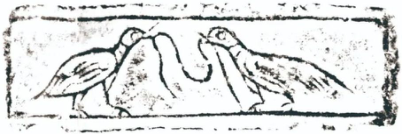
In the Six Dynasties bird portrait tile from Taizhou (Fig. 1), two birds with full bodies stand looking at each other, holding a bug together. The left bird’s front wings are larger than the back claws, in line with the realistic perspective of large front and small back, and the feathers are closer to the side of the body, presenting a taut forward state of the body, while the right bird has the same front wings more than the back claws, in line with the realistic perspective of large front and small back, and the wings are slightly more
Artistic Features and Expression Contents of Portrait Bricks in Cultural Ecology 63
Figure 1: The six dynasties bird portrait tile from Taizhou.
open than the feathers, presenting a backward dynamic, the two birds move in and out of the picture with changes, robust and energetic, and vivid.
The Decorative Style of Symmetry and Balance Zhejiang portrait tiles exist in the decorative nature of all formal relationships-contrast, rhythm, balance, spacing, overlap, and other varia- tions. Many of these animal motifs exist in symmetrical structural forms, the balance and symmetry of which were discovered by human ancestors in their production practices and tool production practices, with the vast majority evenly distributed on the left and right ends of the vertical axis.
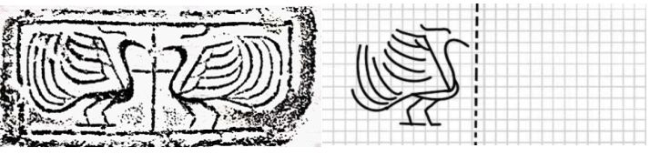
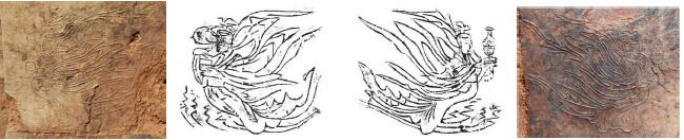
The Xijin bird-print tile from Shaoxing (Fig. 2) is representative of the sym- metry between the left and right sides of the vertical axis. The two phoenix birds stand opposite each other, their tails open at the same time, and their wings are spread high, connected by a “ten” pattern in the middle. The sym- metrical structure of the same animal is more common in portrait bricks, and occurs most frequently in bird, fish, and dragon bricks.
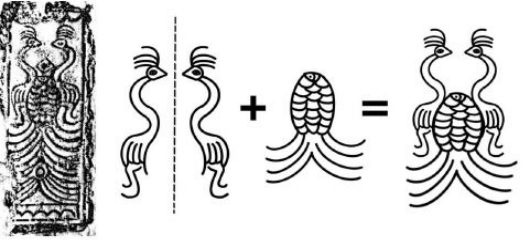
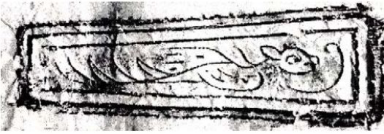
Shengzhou Three Kingdoms Eastern Wu brick (Fig. 3), in the form of an inlaid inner jacket. The general features of the picture are the symmetry of the front and back, the fish and birds in the same composition, the sparse top and the dense bottom, and the dense middle and sparse sides. The cleverness of this image lies in the fact that the two phoenixes on the left and right face each other, leaving a fish part between the central part, and the fish tail and the phoenix tail can also be combined into one, and the fish pattern is implied in the bird pattern, while the bird pattern can also set off the fish pattern. There are very few cases of equidistant homogeneous nesting in Zhejiang’s portrait bricks.
Segmentation and Juxtaposition of Planar Modeling Methods In terms of content, Zhejiang image tiles are often a variety of figures on the same subject without any connection to each other, and even the patterns
Figure 2: The Xijin bird-print tile from Shaoxing.
64 Yisha and Wei
Figure 3: Shengzhou three kingdoms eastern Wu brick.
composed are often arranged one by one. A portrait tile can be divided into several sections side by side, commonly into 3–5 sections, each carved into a different animal shape. These compositional methods are able to balance the size of the figures in each section, making the whole picture harmonious and rich.
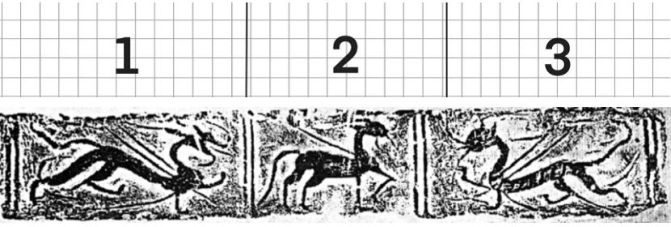
The dragon, tiger, and deer tiles from the Western Jin Dynasty in Taizhou (Fig. 4) are composed of three panels, with a dragon on the left, a deer in the middle, and a tiger on the right. The left dragon opens its mouth wide and spits out its tongue, and its front left paw is raised high in the air, showing a rebuke from a Mercedes-Benz. The right tiger is leaning forward with its big head and high tentacles, and its front right paw is raised high, showing a running and grasping shape. The middle deer has a slightly retracted front left paw and an upright head and neck, showing a frightened state. Although the three animals are divided into three sections, the three together present a whole picture of the dragon and tiger catching the deer.
Figure 4: The dragon, tiger, and deer tiles from the western Jin dynasty in Taizhou.
THE CONTENT OF ZHEJIANG PORTRAIT TILES EMBODIES From the perspective of the cultural ecological niche, people, society, and nature are linked through various types of design. On this level, the picto- rial information of Zhejiang’s portrait bricks can be roughly divided into the following three categories. The first category is the image system of figures;
Artistic Features and Expression Contents of Portrait Bricks in Cultural Ecology 65
the second category is the image system of natural flora and fauna; the third category is the image system projected in the social system. The third cate- gory can be classified as a system of images projected in the social system, covering the social life of different dynasties, social thought and imaginary life based on social thought. In addition to the first three categories, there are also artistic images that have no special meaning, and they are classified as the fourth category of texture patterns. It is worth noting that the above four types of motifs are also crossed and blended with each other.
Characters and Mythological Themes Social themes such as laborers, officials, and religious rituals, and mytholo- gical themes such as Fuxi, Nuwa, the Queen Mother of the West, the four gods, and the flying fairies. In the Six Dynasties period, there were tiles with social and artistic themes such as laborers and religious figures, and in the Southern Dynasties period, there were also tiles with Buddhist themes such as the Flying Heavenly Beings and the Kagura Heavenly Beings. In terms of distribution, they are found in Shaoxing, Ningbo, Shengzhou, Taizhou, and Yuhang.
The figures in the bricks not only reflect the current society, but also serve as a kind of trust for a better life. The change in subject matter from “gods and goddesses” to “feathered men” or “immortals” was due to the spread of Buddhism in Zhejiang, which transformed the Buddhist god of incense and music into a folk belief in Zhejiang, expressing people’s desire to become immortal and live forever. The subject of life is shown in the bricks of the Six Dynasties in Gaoqiao Street, Huangyan District, Taizhou; the subject of gods and goddesses is shown in the bricks of the Jin gods and goddesses in Jiufeng Mountain, Huangyan District, Taizhou; and the subject of flying immortals is shown in the bricks of the Southern Dynasties in Xiaoheng Mountain, Yuhang (Fig. 5).
Image Subjects of Natural Flora and Fauna Animal-painted brick such as dragon, phoenix, deer, horse, eagle, crane, cow, pig, fish, turtle, etc. Plant pattern portrait bricks such as plum, willow, bamboo, grass, pine, etc. In terms of geographical division, there are many Shaoxing, such as the brick with dragon and tiger patterns in Yuankang for three years in the Western Jin Dynasty, the brick with gluttonous patterns, and the brick with double dragon patterns in Yonghe for six years. In addi- tion, Shangyu, Ningbo, Yuyao, Shengzhou, Huzhou, Anji and Deqing are all distributed.
Figure 5: The southern dynasties in Xiaoheng mountain, Yuhang.
66 Yisha and Wei
The animal image in the portrait brick not only becomes the object of people’s sustenance, but also reflects the social production and life process. Zhejiang, as the southeast coast, has a traditional agricultural manage- ment mode called bird field, which judges the farming time according to the migration of birds. Among the portrait bricks unearthed in Zhejiang, the combination of livestock and bird images is common, such as the bird pattern brick of the Western Jin Dynasty found in Shihuang Township, Sheng- zhou, the combination of deer and birds, and the bird pattern brick of the Western Jin Dynasty found in Changle Town, Shengzhou (Figure 6), and the combination of rabbits and birds.
Figure 6: The bird pattern brick of the western Jin dynasty found in Changle Town, Shengzhou.
Projecting the Image Subject of Social System The portrait tiles that project the social system are records of social events. There are two types of images, one with themes containing the idea of gods and immortals, such as bird-riding, seeking immortality, and worship, and the other with themes of daily life, such as fishing, riding the Zhou, and pla- ying games. In terms of distribution, they are found in Shaoxing, Hangzhou, Shengzhou, Taizhou, Huzhou, etc.
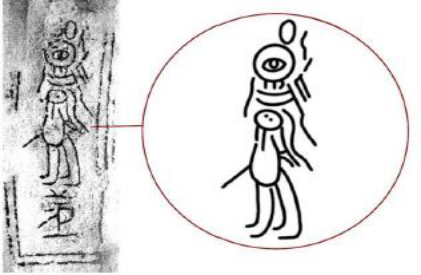
The concept of the immortal was particularly prevalent from the Qin and Han dynasties to the Sixth Dynasty, and was used to express the aspirations of the ancients for an eternal and free life. For example, in the Western Jin Dynasty’s Yongning 2 year old bird-riding brick in Heping County, Zhejiang Province (Figure 7), a man rides on a flying bird, expressing his desire to ride the bird to the sky.
Figure 7: The western Jin dynasty’s Yongning 2 year old bird-riding brick in.
Artistic Features and Expression Contents of Portrait Bricks in Cultural Ecology 67
Texture Pattern Subject Matter The motifs are mainly artistic expressions without specific meanings, inclu- ding cloud hooks, cloud thunder patterns, straight stripes, horizontal stripes, wave patterns, copper coin patterns and other geometric patterns, as well as patterns combining animal and plant forms and geometric figures, such as animal face patterns, double dragon rhombus patterns, fish and lotus pat- terns, etc. In terms of distribution, they are found in Shaoxing, Hangzhou, Ningbo, Shengzhou, Taizhou, Wenzhou, and other places.
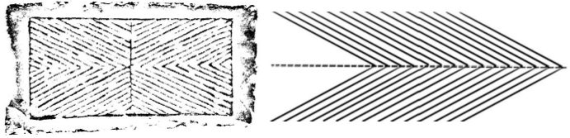
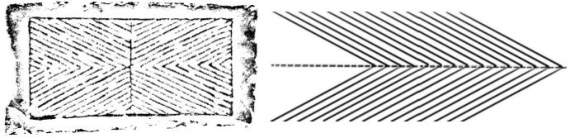
Geometric patterns are mostly formed by geometric images and used as ornaments to increase aesthetics and order, such as the geometric portrait tiles from Jiufeng Mountain in Huangyan District, Taizhou (Fig. 8). The combi- nation of plants and animals with geometric patterns has a special meaning, such as the fish and lotus pattern in the Eastern Jin Dynasty of Zhejiang Province (Fig. 9).
Figure 8: The geometric portrait tiles from Jiufeng mountain in Huangyan district, Taizhou.Figure 9: The fish and lotus pattern in the eastern Jin dynasty of Zhejiang province.
ANALYSIS OF THE HOMOGENEITY OF PORTRAIT BRICKS BETWEEN CITIES AND COUNTIES Similarities and Differences in Artistic Style
From a structural point of view, the lines of the portrait and animal tiles in Zhejiang are thin and flowing, but their curves are constantly changing in thickness, density, and weight, reaching a simple, smooth, beautiful, and majestic state of art. These works boldly use a highly refined and generali- zed technique, highlighting contours, key parts, and representative elements, and attempting to emphasize the intersection of lines in the overall image, highlighting the postures and movements of people and animals.
Differences in Expressions The differences in the content of the bricks between the counties and cities of Zhejiang Province reflect, to a large extent, the differences in the materials used in each region. The local animal tiles in Shengzhou are mostly birds,
68 Yisha and Wei
while those in the upper Shaoxing area are mainly dragons, as well as the theme of seeking immortality. This difference in subject matter not only refle- cts the focus of each region’s artistic creation, but also reflects the survival and development of each region’s people on a larger scale.
Techniques and Differences Line engraving, concave and convex processing techniques, due to the lines of the molded image, the shape of the block according to the different means of concave and convex processing and according to the structure of its pat- tern form type, generally can be divided into: Yin line engraving and Yang line engraving. The lines on these bricks are concave and convex, with sim- ple and smooth lines, reasonable black and white arrangements, and vivid figures.
Shallow relief carving,the combination of lines and surfaces in this type of tile, with small curves on the larger face of the object, enhances the expres- siveness and dynamics of the subject. High relief carving,As the images of these bricks have a strong sense of three-dimensionality and a specific sense of space. Therefore, the trend of relief images in the lower reaches of the Yangtze River gradually evolved from shallow relief to high relie.
TRACEABILITY UNDER ECOLOGICAL EVOLUTION As a cultural management under ecological evolution, the ecotone composi- tion of Zhejiang portrait tiles can be understood as the design system formed under certain historical conditions. In the ecosystem of art and design, the width of the ecological niche refers to the adaptability and compatibility of the artistic style and function of Han Dynasty portrait bricks with their surroundings.
According to the doctrine of ecological niche and potential, all ecologi- cal units in the natural environment have the basic attributes of “state” and “potential”. “State”refers to the basic state of the biological unit itself, which is the result of the development and accumulation of the unit under the action of the external environment. “Potential” is the influence and domi- nance of the ecological unit on the surrounding environment. In the case of portrait bricks, the word “state” refers to the natural resource endow- ment, local ethnic characteristics and unique human content of Zhejiang portrait bricks, reflecting the current living conditions of society. The word “potential” mainly refers to the reflection of Zhejiang’s portrait bricks to the external environment, as well as their effect on local economic and social development.
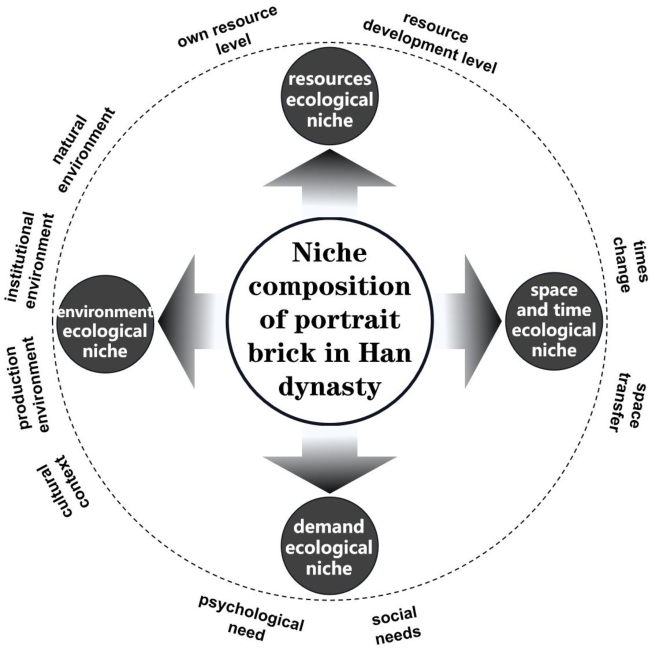
Based on the analysis of the connotation of cultural ecological niche, the ecological niche of Zhejiang portrait bricks should contain four dimensions, namely resource ecological niche, environmental ecological niche, demand ecological niche and spatio-temporal ecological niche (Figure 10). Its com- ponents basically cover the ontological conditions and external relations of the study of portrait bricks, and are important factors that determine their survival and development in the cultural ecosystem.
Artistic Features and Expression Contents of Portrait Bricks in Cultural Ecology 69
Figure 10: Pictorial brick ecological position model diagram.
THE ECOLOGICAL TRACEABILITY OF ZHEJIANG PORTRAIT BRICKS Environmental Ecology
Social environment - The establishment of the Western Han Dynasty put an end to the situation of war and strife at that time, thus establishing a unified political pattern. The Six Dynasties were a time of war and poli- tical chaos, when the lower classes suffered great exploitation.The natural environment - wars, earthquakes, grasshoppers, paddy fields and drylands, plagues, and finally the whole society was in a state of extreme turmoil.
Resource Ecological Position Productivity level-The emperors Gao, Hui, Wen and Jing all adopted the policy of “rest and recuperation” in politics, restoring production and emph- asizing agriculture to develop social economy. History and Cultural Heritage - The rise of the culture of generous burial was an important ideological basis for the formation of Han dynasty portrait brick culture. The rulers practiced filial piety, and thick burials were considered filial.
70 Yisha and Wei
Temporal and Spatial Ecological Position Although the Sui and Tang dynasties were a glorious era in ancient China in terms of political, economic and cultural construction, the rulers of the Sui and Tang dynasties, who were devoted to the funeral customs of the north, did not learn from and continue the burial forms of the southern dynasties, but took the construction of tombs of the northern dynasties to the extreme. This led to the phenomenon of Sui and Tang tombs and wall-painted tombs, a pattern that did not change until Song and Yuan. Without the support and promotion of social rulers, the art of portrait brick was bound to decline irrevocably and finally perish on the stage of history.
Ecological Position of Demand Ideology - The Han dynasty’s prevalence of Huanglao’s idea of gods and immortals, as well as the ancient Chinese art of witchcraft, were also impor- tant ideological factors that influenced portrait tiles. The rulers, in order to protect their own rights and interests, attempted to relieve such a huge social crisis and to achieve eternal life and prosperity.
CONCLUSION
This paper introduces the theory of cultural ecological position into the study of artistic characteristics and expression content of portrait bricks, aiming to explore how to trace the current situation of Zhejiang portrait bricks with cultural ecological position. By constructing an ecological position model of the portrait bricks from four dimensions: resources, environment, demand, and space-time, the paper provides a model example for the study of regional portrait bricks, taking Zhejiang Province, China, as an example.
ACKNOWLEDGMENT
The authors would like to acknowledge.
REFERENCES
Joseph Grinnell “The niche - relationship of the California Thrasher”, American Ornithologists’ Union, 1917, No. 4. Li Ruiping. A study on the status of research on Han Dynasty portrait bricks [J].
Journal of Chongqing Institute of Science and Technology (Social Science Edition), 2006(1): 69–73. doi: 10.3969/j.issn.1673–1999.2006.01.019. Liu Weipeng, Zhang Shujuan. The characteristics of Southern Dynasty portrait bricks in the lower reaches of Yangtze River[J]. Journal of Nanjing Xiaozhuang College, 2019, 35(03):14-24+29. Sun Chuanming, Liu Mengjie. Research on the sustainable development of intangi-
ble cultural heritage from the perspective of ecological niche theory[J]. Cultural Heritage, 2018(04): 31–37. Sun Chuanming, Liu Mengjie. Research on the sustainable development of intangible cultural heritage from the perspective of ecological position theory[J]. Cultural Heritage, 2018(04): 31–37.
Artistic Features and Expression Contents of Portrait Bricks in Cultural Ecology 71
Wang Anxia, Wei Mengying. Study on the artistic characteristics and connotations of animal-printed bricks in Jiangnan area during the Six Dynasties[J]. Creativity and design, 2017(03): 20–28. Wang Huaiping. The material resources of pictorial style in Han portraits - taking
architecture, clothing and farming as examples[J]. Journal of Anhui Agricultural University (Social Science Edition), 2019, 28(6): 119–122. Yu Shixiao, “Measuring the width of multidimensional ecological niches of species”, Journal of Ecology, 1994, no. 1. Yu, Hang. The process of making Han Dynasty portrait bricks[J]. Coopera-
tive Economy and Technology, 2012(14): 118–119. doi: 10.3969/j.issn.1672– 190X.2012.14.068. Yuan Shouyun, Wang Jingtao. The categories and distribution of the subject matter of portrait bricks in the Wei-Jin and Six Dynasties period in Zhejiang [J]. Fine Arts, 2016(05): 121–123. DOI: 10.13864/j.cnki.cn11-1311/j.001540. Zhang Ying, “Research on tourism development strategies in northern Guangdong
based on ecological niche theory”, Journal of Southwest Normal University (Natural Science Edition), No. 12, 2015.
LISTED IN THE AHFE DIGITAL BOOKSTORE CATALOGUE
Explore the complete digital volume
Human Factors in Communication of Design
Read this individual research paper free through the original publisher, or explore the full digital proceedings book.
ISBN 978-1-958651-66-7
Explore this ISBN in the AHFE Bookstore ↗Listed in the July 2026 bookstore catalogue; search by ISBN to confirm current availability · Digital book purchase optional